
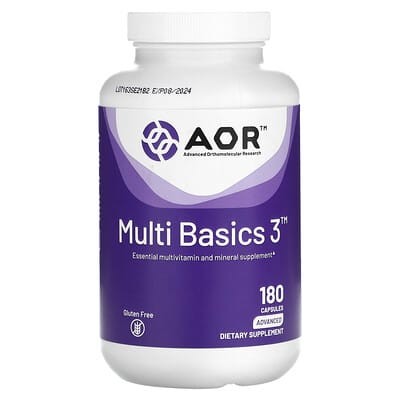
Multi Basics 3

Goals
$48.37 $0.80 per serving


Product analysis
Multi Basics 3 offers broad vitamin and mineral coverage, with zinc that may support hair and nail health when intake is low. An undisclosed blend and incomplete component breakdowns make the full formula difficult to compare.
AI assessment of the formula, label and price. How scoring works
Nutrient Quality38
Most nutrient forms are named, but their absorption and quality cannot be established confidently. The silicon preparation is not equivalent to the form linked to hair and nail findings.
Ingredient Transparency75
Amounts and most forms are listed, which helps with checking the main nutrients. The blend contents and several component breakdowns are missing, so the full composition remains unclear.
Value For Money40
The limited price comparisons suggest middling value for silicon and vanadium. They do not establish the value of the complete multivitamin.
Customer Satisfaction72
Customer ratings are very favorable, but come from a relatively small group of reviewers. The feedback is encouraging without establishing effects on hair or nails.
Product Focus10
The clearest hair and nail role is supporting zinc intake when it is inadequate. The broad formula and undisclosed blend make it harder to connect the complete serving with a specific benefit.
- Format
Capsule - Container
- 180 Capsule(s)
- Per serving
- $0.80
- Customer rating
- 4.8 · 50 ratings
Goals

Impact
Moderate effect
Silicon · 5 mgBiotin · 300 mcg
Magnesium Not classified
No linked studies yet.

Impact
Moderate effect
Biotin · 300 mcgVitamin D · 1000 IUZinc · 11 mgVitamin C · 120 mg
Ingredients
| Ingredient | Amount per serving | Score |
|---|---|---|
Vitamin A Complex | 1010 mcg RAE | |
Vitamin C (Magnesium Ascorbate) | 120 mg | |
Vitamin D3 (Cholecalciferol) | 1000 IU | |
Vitamin E (Alpha-Tocopherol) | 7.1 mg | |
Vitamin K2 (Menaquinone-4, Menaquinone-7) | 120 mcg | |
Thiamine | 9 mg | |
Riboflavin | 2.5 mg | |
Niacin (Inositol Hexanicotinate) | 115 mg | |
Vitamin B6 (Pyridoxine) | 25 mg | |
Folate (Calcium L-5-Methyltetrahydrofolate) | 1335 mcg DFE | |
Vitamin B12 (Cyanocobalamin) | 647 mcg | |
Biotin | 300 mcg | |
Pantothenic Acid (Calcium D-Pantothenate) | 100 mg | |
Choline (Choline Bitartrate) | 100 mg | |
Calcium (Calcium Citrate Malate, Calcium D-Pantothenate) | 70 mg | |
Iodine (Potassium Iodide) | 150 mcg | |
Magnesium (Magnesium Ascorbate, Magnesium Citrate) | 60 mg | |
Zinc (Zinc Citrate) | 11 mg | |
Selenium (Selenomethionine) | 55 mcg | |
Copper (Copper Citrate) | 1.5 mg | |
Manganese (Manganese Bisglycinate) | 2.3 mg | |
Chromium (Chromium Picolinate) | 100 mcg | |
Molybdenum (Sodium Molybdate) | 45 mcg | |
Potassium (Potassium Iodide) | 50 mg | |
Mixed Tocopherols | 100 mg | |
Inositol (Inositol Hexanicotinate) | 83 mg | |
Quercetin | 65 mg | |
Mixed Citrus Bioflavonoids | 25 mg | |
Mixed Tocotrienols | 10 mg | |
Lutein Ester | 6 mg | |
Silica (Silicon Hydrolyzed Vegetable Protein Chelate) | 5 mg | |
Boron (Boron Citrate) | 700 mcg | |
Vanadium (Vanadium Citrate) | 18 mcg |
Vanadium (Vanadium Citrate) · 18 mcg OverallScore58
A serving provides 18 mcg of vanadium at a somewhat high cost per serving. The amount is a small amount. The source is Vanadium Citrate.
How this ingredient is rated
Active Ingredient Quality & Bioavailability63
The source is Vanadium Citrate. The product claims GMP manufacturing; specific third-party purity testing is not established.
Vanadium Form Quality
The source is Vanadium Citrate.
Manufacturing & Purity Signals
The product claims GMP manufacturing; specific third-party purity testing is not established.
Dose, Safety & Label Transparency58
The label states 18 mcg of elemental vanadium per serving, a small amount.
Dose Efficacy & Safety Balance
The 18 mcg serving is a small amount.
Elemental Weight Transparency
The label states 18 mcg of elemental vanadium per serving.
Value50
The cost per serving is somewhat high.
Price Per Serving Efficiency
The cost per serving is somewhat high.
The serving lists 5 mg of silica, but the elemental silicon amount is unknown. The cost per serving is fairly high. The silicon form is Silicon Protein Chelate.
How this ingredient is rated
Active Ingredient Quality & Bioavailability40
The silicon form is Silicon Protein Chelate. No silica standardization percentage or extract ratio is available.
Silicon Chemical Form & Absorption
The silicon form is Silicon Protein Chelate.
Botanical Standardization & Extract Quality
No silica standardization percentage or extract ratio is available.
Trademark and Source Transparency
The silicon form is Silicon Protein Chelate.
Dose, Safety & Label Transparency30
The serving lists 5 mg of silica, but the elemental silicon amount is unknown.
Elemental Silicon Dosage Adequacy
The serving lists 5 mg of silica, but the elemental silicon amount is unknown.
Label Transparency: Source vs. Active Yield
The silica amount is stated as 5 mg per serving.
Value50
The cost per serving is fairly high.
Price per Serving Relative to Median
The cost per serving is fairly high.
Alternative products
Report alternatives
Sources
Published studies used for the product analysis and the top-ranked studies for each ingredient and goal.
- The Role of Sesbania grandiflora-Derived Biotin and Bambusa arundinacea-Derived Silica Extracts in Promoting Hair, Skin, and Nail Health: A Randomized, Double-Blind, Placebo-Controlled Clinical Study.
- Low serum biotinidase activity in children with valproic acid monotherapy.
- Vitamins A, B, C, and D: A Short Review for the Dermatologist.
- The Infatuation With Biotin Supplementation: Is There Truth Behind Its Rising Popularity? A Comparative Analysis of Clinical Efficacy versus Social Popularity.
- Menkes disease and response to copper histidine: An Indian case series.
- Trace element levels in alopecia areata.
- UV damage to hair and the effect of antioxidants and metal chelators.
- Preserving fibre health: reducing oxidative stress throughout the life of the hair fibre.
- Hair Loss After Metabolic and Bariatric Surgery: a Systematic Review and Meta-analysis.
- Quantitative Analysis of Selected Circulating Hematological Biomarkers, Essential Minerals, Vitamins, and Thyroid Hormones in Females Affected by Hair Loss.
- Twelve weeks of protracted venous infusion of fluorouracil (5-FU) is as effective as 6 months of bolus 5-FU and folinic acid as adjuvant treatment in colorectal cancer.
- Role of oxaliplatin combined with 5-fluorouracil and folinic acid in the first- and second-line treatment of advanced colorectal cancer.
- Phase I-II study of vinorelbine in combination with 5-fluorouracil and folinic acid as first-line chemotherapy in metastatic breast cancer: a regimen with a low subjective toxic burden.
- [Evaluation of the role of dietary intake in the occurrence of alopecia].
- A pilot study evaluating the efficacy of topically applied niacin derivatives for treatment of female pattern alopecia.
- Topical adenosine increases thick hair ratio in Japanese men with androgenetic alopecia.
- Beyond Efficacy: 0.6% Selenium Disulfide Shampoo Matches 2% Ketoconazole for Seborrheic Dermatitis with Superior Cosmesis.
- Selenium Disulfide-based shampoo applied for 4 weeks significantly improves dandruff and seborrheic dermatitis.
- A Comparative Randomized Clinical Study Assessing the Efficacy of a 1% Selenium Disulfide-Based Shampoo versus 2% Ketoconazole Shampoo in Subjects with Moderate to Severe Scalp Seborrheic Dermatitis.
- Changes of serum trace elements level in patients with alopecia areata: A meta-analysis.