



Magnesium Supportive
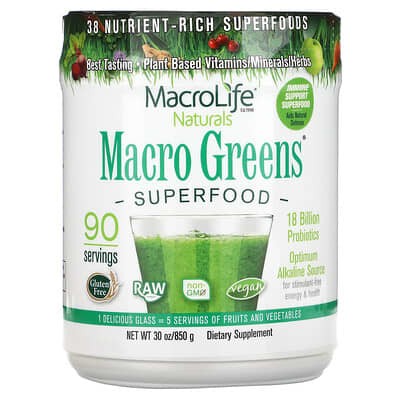
$103.46 $1.14 per serving
Product analysis
MacroLife Naturals Macro Greens is a greens powder intended to complement everyday nutrition with plant ingredients and vitamins. Each 9.4 g serving provides 475 mg of vitamin C and 100 IU of natural vitamin E, but only small amounts of calcium and magnesium, while many plant ingredients are grouped into blends without individual quantities.
AI assessment of the formula, label and price. How scoring works
Nutrient Quality43
The powder uses favorable forms of vitamin E, calcium and magnesium, though the mineral amounts are small. Many additional nutrient forms and the quantities within its plant blends remain unclear.
Ingredient Transparency51
The label gives most nutrient amounts and names several vitamin and mineral forms. The quantities in the various plant and enzyme blends are not fully broken down.
Value For Money23
The vitamin E, vitamin C and several minerals are expensive when compared as individual nutrients, particularly the small calcium and magnesium amounts. The serving price also pays for plant blends, for which no established price comparison is available.
Customer Satisfaction81
Customers give it an average of 4.45 out of 5. The 2,886 ratings provide a substantial base of generally positive customer feedback.
Product Focus26
The formula mixes many different plant ingredients, vitamins and minerals for general nutritional support. Vitamin C offers a clearer contribution than the many individual blend ingredients, whose quantities are not stated.
- Format
Powder - Container
- 30 Ounce(s)
- Per serving
- $1.14
- Also available
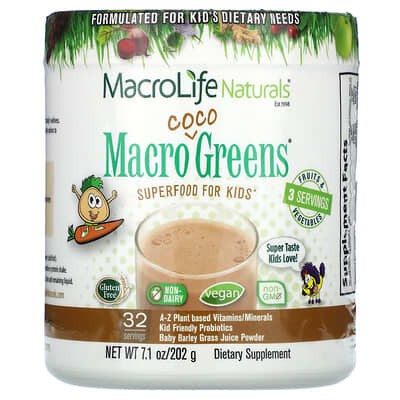 Macro Coco Greens$24.85
- Customer rating
- 4.5 · 2,827 ratings
Goals
Impact
Moderate effect
Magnesium · 3 mgVitamin B12 · 3 mcgVitamin E · 100 IUVitamin C · 475 mg
Macro Greens has a limited fit for routine cardiovascular support, centered on antioxidant nutrients. Vitamin C at 475 mg supplies the clearest antioxidant contribution. Vitamin E is declared at 100 IU, but its usable amount for comparison remains unresolved, limiting how much it adds to the choice.
Vitamin C Supportive
Vitamin E Mixed
Vitamin B12 No effect

Ingredients
| Ingredient | Amount per serving | Score |
|---|---|---|
Calories | 40 Calorie(s) | |
Total Fat | 1.5 Gram(s) | |
Cholesterol | 0 mg | |
Total Carbohydrates | 6 Gram(s) | |
Protein | 1 Gram(s) | |
Vitamin E (D-Alpha-Tocopherol Succinate) | 100 IU | |
Vitamin C | 475 mg | |
Vitamin B12 (Methylcobalamin) | 3 mcg | |
Calcium (Calcium Citrate) | 17 mg | |
Magnesium (Magnesium Glycinate) | 3 mg | |
Sodium | 40 mg | |
Iron | 1.4 mg | |
Vitamin A | 450 IU | |
Nutrient Rich Super Food Blend | 1735 mg | |
Non-Dairy Probiotic Cultures | 0 NP | |
Antioxidant Proprietary Blend | 1490 mg | |
Adaptogenic & Metabolic Herbs Proprietary Blend | 2808 mg | |
Natural Fibers Proprietary Blend | 1225 mg | |
Harmonizing & Support Herbs Proprietary Blend | 1480 mg | |
Natural Plant Enzymes Proprietary Blend | 200 mg |
Vitamin E (D-Alpha-Tocopherol Succinate) · 100 IU OverallScore58
MacroLife Naturals Macro Greens is a reasonable choice with natural vitamin E. The labeled serving provides 100 IU of vitamin E. D-alpha-tocopheryl succinate is a natural form of vitamin E. The cost is high at $0.48 per 30 IU of vitamin E. A serving costs $1.58 and pays for the full formula.
Vitamin A · 450 IU OverallScore13
MacroLife Naturals Macro Greens is a limited vitamin A choice because its form is unknown. A labeled serving supplies 450 IU of vitamin A. That is a relatively small amount. The vitamin A form is unknown, so its preparation cannot be assessed. The price is $17.60 per 5,000 IU of vitamin A, a high price. A labeled serving costs $1.58 for the full formula.
Alternative products
Report alternatives
Sources
Published studies used for the product analysis and the top-ranked studies for each ingredient and goal.
- Circulating and dietary magnesium and risk of cardiovascular disease: a systematic review and meta-analysis of prospective studies.
- Magnesium and the risk of cardiovascular events: a meta-analysis of prospective cohort studies.
- Quantitative Association Between Serum/Dietary Magnesium and Cardiovascular Disease/Coronary Heart Disease Risk: A Dose-Response Meta-analysis of Prospective Cohort Studies.
- Comparative Efficacy of Nutraceuticals on Endothelial Function: A Systematic Review and Network Meta-Analysis.
- Serum magnesium, mortality, and cardiovascular disease in chronic kidney disease and end-stage renal disease patients: a systematic review and meta-analysis.
- Vitamin B12 Status and Cardiovascular Risk: Novel Insights from NMR-Based Lipoprotein Profiling in 20,665 Adults.
- Pregnancy Metal Mixtures and Blood Pressure and Hypertension in Mid-Life: A Prospective U.S. Cohort Study.
- Vitamin B12 Deficiency, Hyperhomocysteinemia, and Diabetes as Metabolic Determinants of Cardiovascular Risk in Mexican Women.
- Impact of serum vitamin (Vitamin D, Vitamin B12) and trace element (Fe, Zn, Cu) levels on major adverse cardiovascular events and poor prognosis in STEMI patients undergoing primary PCI.
- Vasoplegic syndrome after cardiovascular surgery: A review of pathophysiology and outcome-oriented therapeutic management.
- Vitamin C may reduce troponin and CKMB levels after PCI and CABG: a meta-analysis.
- Vitamin C improves endothelium-dependent vasodilation by restoring nitric oxide activity in essential hypertension.
- Vitamin C supplementation improves blood pressure and oxidative stress after acute exercise in patients with poorly controlled type 2 diabetes mellitus: A randomized, placebo-controlled, cross-over study.
- Vascular benefits of vitamin C supplementation against fine particulate air pollution in healthy adults: A double-blind randomised crossover trial.
- Ascorbic acid reduces blood pressure and arterial stiffness in type 2 diabetes.
- Supplementation with vitamin E alone is associated with reduced myocardial infarction: a meta-analysis.
- Vitamin E ameliorates blood cholesterol level and alters gut microbiota composition: A randomized controlled trial.
- Effects of long-term vitamin E supplementation on cardiovascular events and cancer: a randomized controlled trial.
- Independent and combined associations of dietary antioxidant exposure with all-cause and cause-specific mortality in the general population.
- Tocotrienol rich fraction supplementation improved lipid profile and oxidative status in healthy older adults: A randomized controlled study.