
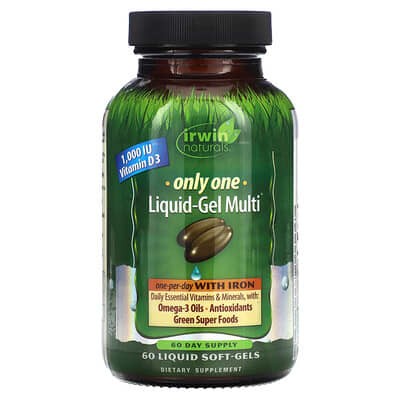

$21.99 $0.36 per serving


Product analysis
Only One Liquid-Gel Multi brings together nutrients that support normal functions such as collagen formation, particularly when dietary intake is low. Its two undisclosed blends make it harder to judge the complete formula.
AI assessment of the formula, label and price. How scoring works
Nutrient Quality37
Natural-form vitamin E is a clear strength among the identified forms. Several other forms are unspecified or lack enough information for a confident comparison, so quality across the complete formula remains uncertain.
Ingredient Transparency72
Ingredient amounts and most forms are stated, making much of the label straightforward to compare. The two blends and several unspecified forms leave meaningful gaps in the formula description.
Value For Money42
Vitamin A and natural-form vitamin E offer favorable value for their stated content. Value across most of the remaining formula is uncertain, so those strengths do not establish that the complete mix is a bargain.
Customer Satisfaction63
Customer feedback leans positive, but the review pool is small. The limited number of ratings makes the satisfaction picture less settled.
Product Focus12
Several nutrients support skin-related nutrition, especially when intake is low. The large mixture and unidentified blends make the formula less targeted, while everyday vision and cardiovascular benefits remain uncertain.
- Format
Softgel - Container
- 60 Softgel(s)
- Per serving
- $0.36
- Customer rating
- 4.3 · 39 ratings
Goals

Impact
High effect
Zinc · 15 mgVitamin C · 250 mgCopper · 2 mgSelenium · 70 mcgVitamin E · 30 IU
Vitamin C supports collagen formation and helps restore wound healing when intake is deficient. Extra vitamin C has no established skin benefit when intake is adequate, and larger serving amounts do not demonstrate greater improvement. Zinc also supports skin repair when intake is low. Biotin and riboflavin mainly matter when low intake contributes to dermatitis.
How this product is rated for Skin Health
Ingredient fit63
The relevant connection is mainly nutritional support or limited surrogate evidence, rather than established cosmetic improvement.
Goal fit
The relevant connection is mainly nutritional support or limited surrogate evidence, rather than established cosmetic improvement.
Dose adequacy
The declared amounts support the saved exposure comparison; larger nutrient amounts do not establish extra benefit when intake is adequate.
Pathways56
The represented skin route has limited support from the supplied ingredients and amounts.
Depth
The represented skin route has limited support from the supplied ingredients and amounts.
Breadth
Coverage is limited to the skin routes represented by the supplied ingredients; it does not imply broad improvement.
Evidence100
Deficiency-related skin roles are clearer than added benefits in adequately nourished adults.
Evidence strength
Deficiency-related skin roles are clearer than added benefits in adequately nourished adults.
Studied preparation
The supplied preparation finding does not establish superiority of a nutrient form or equivalence to a different studied blend.
Formulation logic94
The supplied findings identify no required missing partner or specified conflict. Amount comparisons do not establish combination benefits.
Partner coverage
No missing required partner limits the eligible ingredients; no automatic combination benefit follows.
Conflicts
No specified ingredient conflict was identified in the supplied findings.
Effective doses
The included ingredients meet the supplied minimum exposure comparison; this is not a proven clinical benefit threshold.

Impact
High effect
Magnesium · 10 mgVitamin D · 1000 IUFish Oil · 500 mgSelenium · 70 mcgVitamin B12 · 50 mcgVitamin B6 · 20 mgVitamin E · 30 IUFolate · 400 mcgNiacin · 20 mgVitamin C · 250 mg
Folate, B6 and B12 help process homocysteine, but lowering this marker has not consistently reduced cardiovascular events. Thiamin helps prevent deficiency-related heart disease; extra thiamin has no established cardiovascular benefit when intake is adequate. Selenium's heart relevance concerns severe deficiency. The fish-oil declaration does not establish a separately eligible combined EPA+DHA active amount, and general antioxidant or vitamin functions do not prove event prevention.
How this product is rated for Cardiovascular Support
Ingredient fit59
Vitamin B9 (Folate), Vitamin B6, Vitamin B12 provide the principal recognized connection. Amount or disclosure limitations reduce the combined finding.
Goal fit
Relevant ingredients sit within a broader formula with several actives not established for this goal.
Dose adequacy
The declared amounts receive partial combined recognition; lower or unresolved amounts limit comparison with the supplied reference exposures.
Pathways60
The strongest recognized area is homocysteine clearance. Coverage remains concentrated in one area.
Depth
Homocysteine clearance is the strongest recognized area; this is a marker connection, not a prediction of clinical-event prevention.
Breadth
One area meets the supplied coverage requirement, leaving limited breadth across other cardiovascular outcomes.
Evidence72
Vitamin C leads the saved evidence finding. The supplied preparation, population and outcome limitations constrain the practical claim.
Evidence strength
Vitamin C has the strongest recognized evidence among counted ingredients; marker changes and essential functions do not automatically establish fewer cardiovascular events.
Studied preparation
The saved findings recognize the eligible preparations; this does not establish identical exposure, population or outcomes to the cited interventions.
Formulation logic97
No required partner is missing and no assessed conflict is recorded. Unresolved or lower amounts limit the final amount finding.
Partner coverage
The counted ingredients work without an additional missing partner; no extra combination benefit is established.
Conflicts
No assessed conflict is recorded; this does not establish comprehensive interaction testing.
Effective doses
Vitamin E does not meet the saved minimum amount criterion; the other counted ingredients do.

Impact
High effect
Zinc · 15 mgVitamin E · 30 IUVitamin C · 250 mgCopper · 2 mgVitamin A · 5000 IU
The counted nutrients have connections to vision-related nutrition, but their supplied findings largely concern specific combinations or disease populations. Those findings do not establish improved everyday vision from this formula. Ingredient amounts and normal antioxidant functions cannot by themselves show a visual-performance benefit.
How this product is rated for Eye Health
Ingredient fit59
Copper receives the main saved credit, but the relevant findings do not establish a standalone routine vision benefit. The useful interpretation depends on the population and outcome studied.
Goal fit
Copper receives the main saved credit, but the relevant findings do not establish a standalone routine vision benefit.
Dose adequacy
Unresolved amounts for Vitamin A, Vitamin E limit the contribution of those nutrients; the known amounts provide varying contributions.
Pathways60
The saved findings concentrate on antioxidant-related connections in the retina and lens; those roles do not establish improved vision. Coverage remains concentrated in this area.
Depth
The saved findings concentrate on antioxidant-related connections in the retina and lens; those roles do not establish improved vision.
Breadth
The saved findings concentrate in one area, with limited coverage of the other examined aspects of vision.
Evidence88
Copper leads the saved findings, but its supplied scientific context does not establish an independent everyday vision benefit. Combination findings cannot establish the same benefit for this product.
Evidence strength
Copper leads the saved findings, but its supplied scientific context does not establish an independent everyday vision benefit.
Studied preparation
The counted ingredients meet the saved preparation criteria; this does not transfer a complete clinical regimen’s benefit to this product.
Formulation logic94
The counted ingredients have their required partners and no evaluated conflict was identified. Unresolved amounts limit some contributions.
Partner coverage
No counted ingredient lacks a required partner in this comparison; this does not establish that a clinical combination regimen has been reproduced.
Conflicts
No evaluated ingredient conflict was identified in the supplied facts.
Effective doses
Vitamin A, Vitamin E have unresolved amounts below the comparison threshold; the other counted ingredients meet it.
Ingredients
| Ingredient | Amount per serving | Score |
|---|---|---|
Vitamin A (Beta-Carotene) | 5000 IU | |
Vitamin C (Ascorbic Acid) | 250 mg | |
Vitamin D (Vitamin D3) | 1000 IU | |
Vitamin E (D-Alpha-Tocopherol) | 30 IU | |
Thiamine (Thiamine Hydrochloride) | 20 mg | |
Riboflavin | 20 mg | |
Niacin (Niacinamide) | 20 mg | |
Vitamin B6 (Pyridoxine Hydrochloride) | 20 mg | |
Folic Acid | 400 mcg | |
Vitamin B12 (Methylcobalamin) | 50 mcg | |
Biotin | 500 mcg | |
Pantothenic Acid (D-Calcium Pantothenate) | 20 mg | |
Iron (Iron Amino Acid Chelate) | 18 mg | |
Magnesium (Magnesium Oxide) | 10 mg | |
Zinc (Zinc Oxide) | 15 mg | |
Selenium (L-Selenomethionine) | 70 mcg | |
Copper (Copper Citrate) | 2 mg | |
Manganese (Manganese Citrate) | 2 mg | |
Chromium (Chromium Picolinate) | 120 mcg | |
Molybdenum (Molybdenum Citrate) | 75 mcg | |
Fish Oil | 500 mg | |
Green Super Food Blend | 25 mg | |
BioPerine Complex | 6 mg |
Vitamin A (Beta-Carotene) · 5000 IU OverallScore69
Each serving provides 5,000 IU of vitamin A from beta-carotene, a precursor the body can convert to vitamin A. The amount falls within the range favored in the evaluation.
How this ingredient is rated
Active Ingredient Quality & Bioavailability50
Beta-carotene is a vitamin A precursor; its natural or synthetic origin is not established by the saved facts.
Vitamin A Chemical Form & Source
Beta-carotene is a vitamin A precursor; its natural or synthetic origin is not established by the saved facts.
Dose, Safety & Label Transparency82
The serving provides 5,000 IU of vitamin A, within the range favored in the evaluation. The named source is identified, but its complete percentage is not established.
Dosage Efficacy & Safety Thresholds
The serving provides 5,000 IU of vitamin A, within the range favored in the evaluation.
Label Transparency of Specific Forms
Beta-carotene is named, but a complete source percentage is not established in the saved facts.
Value80
The whole-product price is about $0.37 per 5,000 IU of vitamin A.
Price per 5,000 IU Dose
The whole-product price is about $0.37 per 5,000 IU of vitamin A.
Vitamin E (D-Alpha-Tocopherol) · 30 IU OverallScore65
Fish Oil · 500 mg OverallScore10
Alternative products
Report alternatives
Sources
Published studies used for the product analysis and the top-ranked studies for each ingredient and goal.
- Marine Omega-3 Supplementation and Cardiovascular Disease: An Updated Meta-Analysis of 13 Randomized Controlled Trials Involving 127 477 Participants.
- Impact of omega-3 fatty acids on hypertriglyceridemia, lipidomics, and gut microbiome in patients with type 2 diabetes.
- A systematic review of fish-oil supplements for the prevention and treatment of hypertension.
- Effects of fish oil-derived fatty acids on suboptimal cardiovascular health: A multicenter, randomized, double-blind, placebo-controlled trial.
- Effect of High-Dose Marine Omega-3 Fatty Acids on Atherosclerosis: A Systematic Review and Meta-Analysis of Randomized Clinical Trials.
- Associations of dietary folate, vitamin B6 and B12 intake with cardiovascular outcomes in 115664 participants: a large UK population-based cohort.
- Folate, Homocysteine, and Adverse Outcomes After Ischemic Stroke.
- Effect of folic acid on endothelial function following acute myocardial infarction.
- Folic acid enhances endothelial function and reduces blood pressure in smokers: a randomized controlled trial.
- 5-methyltetrahydrofolate, the active form of folic acid, restores endothelial function in familial hypercholesterolemia.
- Circulating and dietary magnesium and risk of cardiovascular disease: a systematic review and meta-analysis of prospective studies.
- Magnesium and the risk of cardiovascular events: a meta-analysis of prospective cohort studies.
- Quantitative Association Between Serum/Dietary Magnesium and Cardiovascular Disease/Coronary Heart Disease Risk: A Dose-Response Meta-analysis of Prospective Cohort Studies.
- Comparative Efficacy of Nutraceuticals on Endothelial Function: A Systematic Review and Network Meta-Analysis.
- Serum magnesium, mortality, and cardiovascular disease in chronic kidney disease and end-stage renal disease patients: a systematic review and meta-analysis.
- The current state of niacin in cardiovascular disease prevention: a systematic review and meta-regression.
- Effects of niacin on apo A1 and B levels: a systematic review and meta-analysis of randomised controlled trials.
- Effect of lipid-lowering therapies on lipoprotein(a) levels: a comprehensive meta-analysis of randomized controlled trials.
- Extended-release niacin vs gemfibrozil for the treatment of low levels of high-density lipoprotein cholesterol. Niaspan-Gemfibrozil Study Group.
- Equivalent efficacy of a time-release form of niacin (Niaspan) given once-a-night versus plain niacin in the management of hyperlipidemia.