
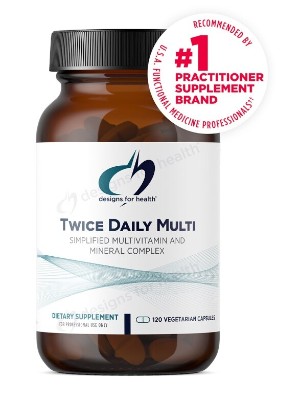

$62.49 $1.04 per serving

Product analysis
Twice Daily Multi brings together nutrients that support normal skin and eye function, particularly when dietary intake is low. Undisclosed proportions in its vitamin blends make the exact mix harder to compare.
AI assessment of the formula, label and price. How scoring works
Nutrient Quality42
The natural vitamin E forms and the boron form are favorable features. Quality across the other nutrients remains uncertain, so these strengths do not establish the quality of the entire mix.
Ingredient Transparency79
Amounts and nearly all forms are stated, which helps with checking the label. The proportions within the vitamin A and vitamin E mixtures are not disclosed.
Value For Money39
The vitamin A and boron contributions are relatively costly, while the vitamin E offers limited value. Value for most of the other nutrients cannot be judged reliably.
Customer Satisfaction69
The available ratings are highly positive. The small number of responses leaves a less settled picture of customer satisfaction.
Product Focus48
The clearest nutritional fit is support for normal skin and eye function. The broad formula does not establish extra cosmetic benefits or improved vision in someone whose intake is already adequate.
- Format
Capsule - Container
- 120 Capsule(s)
- Per serving
- $1.04
- Customer rating
- 4.7 · 41 ratings
Goals

Impact
High effect
Zinc · 15 mgVitamin C · 500 mgSelenium · 200 mcgVitamin E · 158 mg

Impact
High effect
Zinc · 15 mgVitamin E · 158 mgVitamin C · 500 mgVitamin A · 3200 IU
Ingredients
| Ingredient | Amount per serving | Score |
|---|---|---|
Vitamin A (Mixed Carotenoids, Vitamin A Palmitate) | 3200 IU | |
Vitamin C (Ascorbic Acid) | 500 mg | |
Vitamin D (Cholecalciferol) | 500 IU | |
Vitamin E (D-Alpha-Tocopherol) | 24 IU | |
Thiamine (Thiamine Hydrochloride) | 50 mg | |
Riboflavin | 30 mg | |
Niacin (Niacinamide) | 30 mg | |
Vitamin B6 (Pyridoxine Hydrochloride) | 50 mg | |
NatureFolate Blend | 400 mcg | |
Vitamin B12 (Methylcobalamin) | 500 mcg | |
Biotin (D-Biotin) | 300 mcg | |
Pantothenic Acid (D-Calcium Pantothenate) | 50 mg | |
Iodine (Potassium Iodide) | 75 mcg | |
Zinc (TRAACS Zinc Glycinate Chelate) | 15 mg | |
Selenium (Selenium Glycinate) | 200 mcg | |
Manganese (TRAACS Manganese Glycinate Chelate) | 3 mg | |
Chromium (TRAACS Chromium Nicotinate Glycinate Chelate) | 400 mcg | |
Molybdenum (TRAACS Molybdenum Glycinate Chelate) | 100 mcg | |
Mixed Tocopherols (D-Alpha-Tocopherol, D-Beta-Tocopherol, D-Delta-Tocopherol, D-Gamma-Tocopherol) | 158 mg | |
Alpha Lipoic Acid | 20 mg | |
Boron (Bororganic Glycine) | 2 mg |
Vitamin E (D-Alpha-Tocopherol) · 24 IU OverallScore58
Each serving provides 24 IU of vitamin E. That is a relatively small amount. The cost per serving is high. The blend includes several tocopherols, but their amounts are unknown.
How this ingredient is rated
Active Ingredient Quality & Bioavailability77
The blend includes natural d-alpha, d-beta, d-gamma and d-delta tocopherols; their proportions are unknown. No tocotrienols are listed.
Natural (d-alpha) vs. Synthetic (dl-alpha)
The blend includes natural d-alpha, d-beta, d-gamma and d-delta tocopherols; their proportions are unknown.
Mixed Tocopherol Isomer Diversity
The blend includes alpha, beta, gamma and delta tocopherols.
Tocotrienol Complex Inclusion
No tocotrienols are listed.
Dose, Safety & Label Transparency48
Each serving provides 24 IU of vitamin E. That is a relatively small amount. Individual tocopherol amounts are not specified.
Therapeutic Dosage Range
Each serving provides 24 IU of vitamin E. That is a relatively small amount.
Label Transparency and Isomer Specificity
Individual tocopherol amounts are not specified.
Value40
The cost per serving is high.
Cost per Natural-Form Therapeutic Serving
The cost per serving is high.
Boron (Bororganic Glycine) · 2 mg OverallScore74
A serving provides 2 mg of boron, with a high cost for the amount supplied. The amount is in a maintenance range, below amounts commonly used for bone health. It uses Bororganic Glycine.
How this ingredient is rated
Active Ingredient Quality & Bioavailability100
It uses Bororganic Glycine. Bororganic Glycine is a named branded source.
Boron Form & Bioavailability
It uses Bororganic Glycine.
Trademarked & High-Purity Sources
Bororganic Glycine is a named branded source.
Dose, Safety & Label Transparency80
The label lists 2 mg of boron per serving. The amount is in a maintenance range, below amounts commonly used for bone health.
Elemental Dose Transparency
The elemental boron amount is stated.
Dosage Efficacy & Safety Margin
The amount is in a maintenance range, below amounts commonly used for bone health.
Value10
The cost is high for a 3 mg equivalent of boron.
Price per 3mg Elemental Boron
The cost is high for a 3 mg equivalent of boron.
Vitamin A (Mixed Carotenoids, Vitamin A Palmitate) · 3200 IU OverallScore63
A serving provides 3,200 IU of vitamin A at a high cost for the vitamin A amount. The sources are mixed carotenoids and retinyl palmitate. Their proportions are unknown.
How this ingredient is rated
Active Ingredient Quality & Bioavailability65
The sources are mixed carotenoids and retinyl palmitate. Their proportions are unknown.
Vitamin A Chemical Form & Source
The sources are mixed carotenoids and retinyl palmitate. Their proportions are unknown.
Dose, Safety & Label Transparency82
A serving provides 3,200 IU of vitamin A. The sources are mixed carotenoids and retinyl palmitate. Their proportions are unknown.
Dosage Efficacy & Safety Thresholds
A serving provides 3,200 IU of vitamin A.
Label Transparency of Specific Forms
The sources are mixed carotenoids and retinyl palmitate. Their proportions are unknown.
Value20
The cost for the vitamin A amount is high.
Price per 5,000 IU Dose
The cost for the vitamin A amount is high.
Alternative products
Report alternatives
Sources
Published studies used for the product analysis and the top-ranked studies for each ingredient and goal.
- U.S. Multicenter Clinical Trial of Corneal Collagen Crosslinking for Treatment of Corneal Ectasia after Refractive Surgery.
- United States Multicenter Clinical Trial of Corneal Collagen Crosslinking for Keratoconus Treatment.
- EpiSmart Crosslinking for Keratoconus: A Phase 2 Study.
- Prospective Randomized Trial of Corneal Cross-linking Riboflavin Dosing Frequencies for Treatment of Keratoconus and Corneal Ectasia.
- Corneal collagen cross-linking for keratoconus: results of 3-year follow-up in Pakistani population.
- Efficacy and safety of AZR-MD-001 selenium sulfide ophthalmic ointment in adults with meibomian gland dysfunction: A vehicle-controlled, randomized clinical trial.
- The efficacy and safety of selenium supplementation versus placebo in the treatment of Graves' orbitopathy: A systematic review and meta-analysis of randomised controlled trials.
- Efficacy and safety of AZR-MD-001 selenium sulfide ophthalmic ointment in adults with meibomian gland dysfunction over six months of treatment: A Phase 2, vehicle-controlled, randomized extension trial.
- AZR-MD-001 0.5% selenium sulfide ophthalmic ointment for the treatment of contact lens discomfort: A vehicle-controlled, randomized, clinical trial.
- The effect of a biweekly novel selenium sulfide-containing topical treatment in symptomatic contact lens wearers: An exploratory study.
- A randomized trial of vitamin A and vitamin E supplementation for retinitis pigmentosa.
- Efficacy and safety of retinol palmitate ophthalmic solution in the treatment of dry eye: a Japanese Phase II clinical trial.
- Vitamin A supplementation for preventing morbidity and mortality in children from six months to five years of age.
- Vitamin A supplementation improves retinal function in infants at risk of retinopathy of prematurity.
- Effect of short-term, high-dose retinol on dark adaptation in aging and early age-related maculopathy.
- Role of Oral Vitamin 'C' on Astigmatic Errors in Phacoemulsification.
- Ascorbic acid metabolites are involved in intraocular pressure control in the general population.
- Nutritional modulation of cataract.
- Dietary n-3 Fatty Acid, α-Tocopherol, Zinc, vitamin D, vitamin C, and β-carotene are Associated with Age-Related Macular Degeneration in Japan.
- Adherence to a Mediterranean diet, lifestyle and age-related macular degeneration: the Coimbra Eye Study - report 3.