
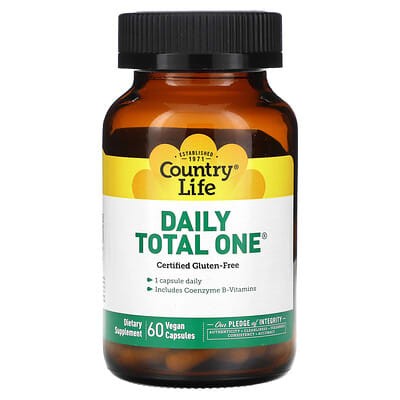

$13.19 $0.21 per serving


Product analysis
Daily Total One combines vitamins and minerals that support normal functions such as vision, skin nutrition and nutrient metabolism. The broad blend may appeal if you want several nutrients together, although the proportions of mixed forms are not disclosed.
AI assessment of the formula, label and price. How scoring works
Nutrient Quality39
Natural vitamin E is a quality strength, while silica has limited absorption potential. Quality comparisons remain uncertain for most other nutrients despite many forms being named.
Ingredient Transparency77
Amounts and most ingredient forms are listed, which helps you check what is included. The proportions of mixed forms are omitted, so you cannot tell how much each form contributes.
Value For Money43
Vitamin A, natural vitamin E and silicon have favorable cost comparisons. Value remains uncertain for most of the other nutrients, so those examples do not establish value for the entire blend.
Customer Satisfaction66
Customer feedback is positive, but the number of ratings is small. A broader set of reviews would give a firmer picture of satisfaction.
Product Focus26
The blend supports several normal nutrient functions, with its clearest connections involving vitamin A and the B vitamins. Its many ingredients span different aims, so one broad formula may be less targeted than a supplement chosen for a particular need.
- Format
Capsule - Container
- 60 Capsule(s)
- Per serving
- $0.21
- Customer rating
- 4.5 · 33 ratings
Goals

Impact
Moderate effect
Vitamin C · 60 mgCopper · 1 mgSelenium · 200 mcgSilicon · 5 mgVitamin E · 120 IU
Copper supports the cross-linking of collagen and elastin, while selenium participates in antioxidant enzymes. Riboflavin and vitamin B6 support normal skin nutrition, and pantothenic acid contributes to lipid metabolism; the silica declaration does not establish equivalence to the studied silicon preparation.
How this product is rated for Skin Health
Ingredient fit47
The saved assessment identifies 8 skin-relevant ingredients alongside ingredients serving other goals. Amounts provide partial support in the saved assessment; low or unresolved quantities limit the contribution.
Goal fit
The saved assessment identifies 8 skin-relevant ingredients alongside ingredients serving other goals.
Dose adequacy
Amounts provide partial support in the saved assessment; low or unresolved quantities limit the contribution.
Pathways43
The strongest saved connection is antioxidant responses to UV exposure, with a partial contribution. The saved findings identify one main skin mechanism, with limited support across the remaining areas.
Depth
The strongest saved connection is antioxidant responses to UV exposure, with a partial contribution.
Breadth
The saved findings identify one main skin mechanism, with limited support across the remaining areas.
Evidence89
Copper provides the strongest evidence connection in the saved assessment; normal nutrient roles and specific trial outcomes remain distinct. The saved assessment recognizes 5 ingredients with amounts and preparations matching its comparison criteria.
Evidence strength
Copper provides the strongest evidence connection in the saved assessment; normal nutrient roles and specific trial outcomes remain distinct.
Studied preparation
The saved assessment recognizes 5 ingredients with amounts and preparations matching its comparison criteria.
Formulation logic91
The assessed ingredients can contribute independently or have their required partner present. No ingredient conflict was identified in the saved assessment. 5 of 8 credited ingredients meet the saved minimum amount criterion; below it: Silicon, Vitamin A, Vitamin E.
Partner coverage
The assessed ingredients can contribute independently or have their required partner present.
Conflicts
No ingredient conflict was identified in the saved assessment.
Effective doses
5 of 8 credited ingredients meet the saved minimum amount criterion; below it: Silicon, Vitamin A, Vitamin E.

Impact
Moderate effect
Vitamin K · 25 mcgPotassium · 10 mgMagnesium · 15 mgVitamin D · 200 IUSelenium · 200 mcgVitamin B12 · 120 mcgVitamin B6 · 20 mgVitamin E · 120 IUFolate · 400 mcgNiacin · 40 mgVitamin C · 60 mg
Daily Total One combines folate, B6 and B12 with magnesium, potassium and many other nutrients. Its clearest connection is homocysteine clearance, giving it one strong pathway and little breadth. Many active ingredients serve unrelated goals; vitamin E's amount is unclear, and the listed vitamin K form has no goal-specific role here.
How this product is rated for Cardiovascular Support
Ingredient fit53
Several ingredients relate to cardiovascular pathways, but 17 other listed actives target unrelated goals and dilute the product's focus.
Goal fit
Folate, B6 and B12 fit this goal, while numerous other active ingredients are linked to unrelated goals.
Dose adequacy
Several amounts are clear, but vitamin E's is not; thiamin is 10 mg per serving, above its research reference, and suitability at that exposure is unassessed.
Pathways60
Folate, B6 and B12 relate most closely to homocysteine clearance; the other cardiovascular pathways receive little coverage.
Depth
The strongest pathway connection is homocysteine clearance, through folate, B6 and B12.
Breadth
Homocysteine clearance is the only pathway with substantial coverage; the other cardiovascular pathways are largely uncovered.
Evidence70
Vitamin B6 has the strongest ingredient-level evidence in the formula, below the goal's highest evidence level.
Evidence strength
Vitamin B6 has the strongest research support among this product's ingredients at relevant amounts.
Studied preparation
Research has examined five ingredients in forms and amounts similar to those listed, but not the whole blend as a combination.
Formulation logic96
Credited ingredients work alone or have their partners, and no conflict is matched; vitamin E's amount is unclear.
Partner coverage
Every credited ingredient works alone or has its partner in this product.
Conflicts
No ingredient conflict is matched.
Effective doses
Five of six relevant ingredients reach amounts used in research; vitamin E does not, and its label amount is unclear.

Impact
Lower effect
Silicon · 5 mgBiotin · 100 mcg
Magnesium Not classified
No linked studies yet.

Impact
Moderate effect
Vitamin E · 120 IUVitamin C · 60 mgCopper · 1 mgVitamin A · 5000 IU
Vitamin A is needed for the visual cycle, which lets your eyes respond to light. Getting enough matters when low vitamin A impairs seeing in the dark. Riboflavin deficiency can also cause eye problems, but taking extra riboflavin hasn't been shown to improve vision when you already get enough.
How this product is rated for Eye Health
Ingredient fit45
Vitamin A and riboflavin relate to eye problems caused by deficiency; extra intake is not a general vision improvement.
Goal fit
Vitamin A and riboflavin relate to eye problems caused by deficiency; extra intake is not a general vision improvement.
Dose adequacy
Declared serving amounts include Selenium 200 mcg; Vitamin B2 (Riboflavin) 10 mg; Vitamin D 5 mcg; other nutrients have different amounts or unresolved active-unit equivalents.
Pathways60
The main connection is to nutrients associated with retinal and lens protection; this alone does not imply improved vision.
Depth
The main connection is to nutrients associated with retinal and lens protection; this alone does not imply improved vision.
Breadth
The main connection is to nutrients associated with retinal and lens protection; this alone does not imply improved vision.
Evidence88
Correcting vitamin A or riboflavin deficiency differs from improving vision in an adequately nourished adult.
Evidence strength
Correcting vitamin A or riboflavin deficiency differs from improving vision in an adequately nourished adult.
Studied preparation
The declared ingredient forms do not, by themselves, imply a vision benefit.
Formulation logic90
The declared ingredients have no particular identified conflict. A matching amount or form alone cannot show that everyday vision will improve.
Partner coverage
No missing ingredient partner is identified; this does not turn individual ingredients into a proven beneficial combination.
Conflicts
No particular ingredient conflict is identified for this serving.
Effective doses
Declared serving amounts include Selenium 200 mcg; Vitamin B2 (Riboflavin) 10 mg; Vitamin D 5 mcg; other nutrients have different amounts or unresolved active-unit equivalents.

Impact
Lower effect
Vitamin D · 200 IUVitamin E · 120 IUVitamin C · 60 mg

Impact
Moderate effect
Biotin · 100 mcgVitamin D · 200 IUIron · 4 mgVitamin C · 60 mg
Vitamin C contributes to normal collagen formation and iron absorption, while copper has roles in pigmentation and connective tissue. Those normal functions don't make routine hair regrowth a reliable expectation. Silicon is supplied as silica, which differs from the specific silicon preparation associated with changes in fine-hair strength and thickness.
How this product is rated for Hair Health
Ingredient fit52
The nutrient mix has a connection to hair, but its practical value depends on the ingredient and whether a shortage is present.
Goal fit
The ingredients mix hair-related nutrients with other nutritional functions; their presence alone does not promise hair growth.
Dose adequacy
Biotin: 100 mcg; Selenium: 200 mcg; Iron: 4 mg; Vitamin C: 60 mg; Copper: 1 mg. These are serving amounts, not a recommendation or a guarantee of hair benefit.
Pathways55
The ingredients relate most directly to antioxidant functions around hair follicles, which does not guarantee visible growth.
Depth
The ingredients relate most directly to antioxidant functions around hair follicles, which does not guarantee visible growth.
Breadth
The nutrient roles are concentrated rather than showing a clear range of independent hair benefits.
Evidence78
Vitamin B12 is the main ingredient connection here. Its presence does not make the full combination a reliable hair-regrowth treatment.
Evidence strength
Vitamin B12 provides the main connection, but normal nutrient roles and hair regrowth are different outcomes.
Studied preparation
The declared nutrient forms provide a relevant comparison, without implying that the complete combination reliably improves hair growth.
Formulation logic93
No particular conflict or missing required partner is identified. Amount limitations involving Vitamin A, Vitamin D remain relevant.
Partner coverage
No missing required ingredient partner is identified for the relevant nutrients.
Conflicts
No particular ingredient conflict is identified.
Effective doses
The amount information for Vitamin A, Vitamin D limits the dose comparison; this does not prove an absence of benefit.
Ingredients
| Ingredient | Amount per serving | Score |
|---|---|---|
Vitamin A (Beta-Carotene, Retinyl Palmitate) | 5000 IU | |
Vitamin C (Ascorbyl Palmitate, Calcium Ascorbate) | 60 mg | |
Vitamin D (Ergocalciferol) | 200 IU | |
Vitamin E (D-Alpha-Tocopheryl Acid Succinate) | 120 IU | |
Vitamin K (Phytonadione) | 25 mcg | |
Thiamin (Thiamine Cocarboxylase Chloride, Thiamine Hydrochloride) | 10 mg | |
Riboflavin (Riboflavin 5-Phosphate) | 10 mg | |
Niacin (Inositol Hexanicotinate, Niacinamide) | 40 mg | |
Vitamin B6 (Pyridoxal 5-Phosphate, Pyridoxine Hydrochloride) | 20 mg | |
Folic Acid | 400 mcg | |
Vitamin B12 (Methylcobalamin) | 120 mcg | |
Biotin (D-Biotin) | 100 mcg | |
Pantothenic Acid (Calcium D-Pantothenate, Pantethine) | 40 mg | |
Calcium (Calcium Ascorbate, Calcium Citrate, Calcium D-Pantothenate, Calcium Hydroxyapatite, Dicalcium Phosphate) | 20 mg | |
Iron (Ferrous Gluconate) | 4 mg | |
Phosphorus (Calcium Hydroxyapatite, Dicalcium Phosphate, Pyridoxal 5-Phosphate, Riboflavin 5-Phosphate) | 5 mg | |
Magnesium (Magnesium Citrate, Magnesium Rice Chelate) | 15 mg | |
Olive leaf extract (Oleuropein) | 15 mg | |
Selenium (L-Selenomethionine, Selenium Rice Chelate) | 200 mcg | |
Copper (Copper Citrate) | 1 mg | |
Manganese (Manganese Citrate) | 2 mg | |
Chromium (Chromium Picolinate) | 120 mcg | |
Molybdenum (Molybdenum Amino Acid Chelate) | 20 mcg | |
Potassium (Potassium Citrate) | 10 mg | |
Inositol (Inositol Hexanicotinate) | 20 mg | |
Choline | 12 mg | |
Silica (Horsetail extract) | 5 mg | |
Betaine | 3.8 mg | |
Boron (Boron Citrate) | 500 mcg |
Vitamin E (D-Alpha-Tocopheryl Acid Succinate) · 120 IU OverallScore72
A serving provides 120 IU of vitamin E as d-alpha-tocopheryl succinate, a natural form. The whole product costs about $0.22 per serving.
How this ingredient is rated
Active Ingredient Quality & Bioavailability46
The vitamin E is identified as d-alpha-tocopheryl succinate, a natural form. The saved facts do not establish mixed tocopherols or tocotrienols.
Natural (d-alpha) vs. Synthetic (dl-alpha)
D-Alpha-Tocopheryl Succinate is a natural form of vitamin E.
Mixed Tocopherol Isomer Diversity
The saved facts do not establish a mixed-tocopherol complex.
Tocotrienol Complex Inclusion
The saved facts do not establish the presence of tocotrienols.
Dose, Safety & Label Transparency85
A serving provides 120 IU of vitamin E. The amount and d-alpha-tocopheryl succinate form are named; individual isomer milligram amounts are not established.
Therapeutic Dosage Range
A serving provides 120 IU of vitamin E.
Label Transparency and Isomer Specificity
The amount and d-alpha-tocopheryl succinate form are named; individual isomer milligram amounts are not established.
Value100
A whole-product serving costs about $0.22; the identified forms are d-prefixed.
Cost per Natural-Form Therapeutic Serving
A whole-product serving costs about $0.22; the identified forms are d-prefixed.
Vitamin A (Beta-Carotene, Retinyl Palmitate) · 5000 IU OverallScore65
Each serving supplies 5,000 IU of vitamin A from beta-carotene and preformed retinyl palmitate. The proportions are not disclosed, so the amount from each form is unclear.
How this ingredient is rated
Active Ingredient Quality & Bioavailability40
The vitamin A combines beta-carotene with preformed retinyl palmitate; their relative amounts are not disclosed.
Vitamin A Chemical Form & Source
Beta-carotene and retinyl palmitate are listed, but their shares are unknown.
Dose, Safety & Label Transparency82
The serving supplies 5,000 IU, but the split between the two forms is not disclosed.
Dosage Efficacy & Safety Thresholds
The serving provides 5,000 IU of vitamin A.
Label Transparency of Specific Forms
Both forms are named, but their proportions are not disclosed.
Value80
The whole-product serving price works out to about $0.22 per 5,000 IU of vitamin A.
Price per 5,000 IU Dose
About $0.22 per 5,000 IU of vitamin A, based on the whole-product serving price.
Silicon (Horsetail extract, Silica) · 5 mg OverallScore48
A serving lists 5 mg of silica, but the saved facts do not establish how much elemental silicon it provides. The whole-product serving costs about $0.22.
How this ingredient is rated
Active Ingredient Quality & Bioavailability40
Silica is identified, although its elemental silicon yield is not established by the source amount.
Silicon Chemical Form & Absorption
Silica is the identified form; the evaluation favors other forms.
Botanical Standardization & Extract Quality
The saved facts do not report a silica standardization percentage or an extract ratio.
Trademark and Source Transparency
Silica is identified as a source; no trademarked source is recorded in the saved facts.
Dose, Safety & Label Transparency30
The 5 mg per serving refers to silica; the amount of elemental silicon remains unknown.
Elemental Silicon Dosage Adequacy
The elemental silicon amount is unknown, so its dose cannot be assessed from the saved facts.
Label Transparency: Source vs. Active Yield
The saved facts list 5 mg of silica per serving, but do not give its elemental silicon yield.
Value100
The whole-product serving costs about $0.22.
Price per Serving Relative to Median
The price is about $0.22 per whole-product serving.
Alternative products
Report alternatives
Sources
Published studies used for the product analysis and the top-ranked studies for each ingredient and goal.
- Associations of dietary folate, vitamin B6 and B12 intake with cardiovascular outcomes in 115664 participants: a large UK population-based cohort.
- Folate, Homocysteine, and Adverse Outcomes After Ischemic Stroke.
- Effect of folic acid on endothelial function following acute myocardial infarction.
- Folic acid enhances endothelial function and reduces blood pressure in smokers: a randomized controlled trial.
- 5-methyltetrahydrofolate, the active form of folic acid, restores endothelial function in familial hypercholesterolemia.
- Circulating and dietary magnesium and risk of cardiovascular disease: a systematic review and meta-analysis of prospective studies.
- Magnesium and the risk of cardiovascular events: a meta-analysis of prospective cohort studies.
- Quantitative Association Between Serum/Dietary Magnesium and Cardiovascular Disease/Coronary Heart Disease Risk: A Dose-Response Meta-analysis of Prospective Cohort Studies.
- Comparative Efficacy of Nutraceuticals on Endothelial Function: A Systematic Review and Network Meta-Analysis.
- Serum magnesium, mortality, and cardiovascular disease in chronic kidney disease and end-stage renal disease patients: a systematic review and meta-analysis.
- The current state of niacin in cardiovascular disease prevention: a systematic review and meta-regression.
- Effects of niacin on apo A1 and B levels: a systematic review and meta-analysis of randomised controlled trials.
- Effect of lipid-lowering therapies on lipoprotein(a) levels: a comprehensive meta-analysis of randomized controlled trials.
- Extended-release niacin vs gemfibrozil for the treatment of low levels of high-density lipoprotein cholesterol. Niaspan-Gemfibrozil Study Group.
- Equivalent efficacy of a time-release form of niacin (Niaspan) given once-a-night versus plain niacin in the management of hyperlipidemia.
- Sex-specific associations between sodium and potassium intake and overall and cause-specific mortality: a large prospective U.S. cohort study, systematic review, and updated meta-analysis of cohort studies.
- Potassium intake, stroke, and cardiovascular disease a meta-analysis of prospective studies.
- Blood pressure response to changes in sodium and potassium intake: a metaregression analysis of randomised trials.
- Twenty-Four-Hour Urinary Sodium and Potassium Excretion and Their Associations With Blood Pressure Among Adults in China: Baseline Survey of Action on Salt China.
- Dietary Sodium and Potassium Intake and Risk of Non-Fatal Cardiovascular Diseases: The Million Veteran Program.