
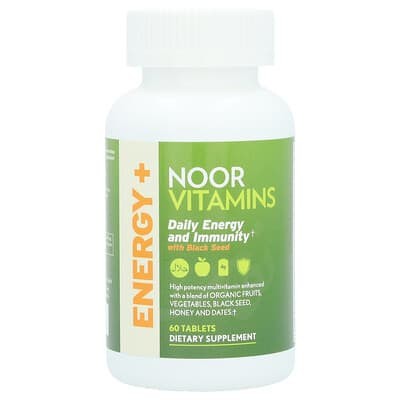

$28.74 $0.47 per serving

Product analysis
Energy + supplies vitamins and minerals that may help skin when low nutrient intake affects repair or normal skin function. An unnamed proprietary blend makes part of the formula difficult to assess.
AI assessment of the formula, label and price. How scoring works
Nutrient Quality33
The synthetic vitamin E form is less favored than the natural form in the available comparison. Quality advantages for most other ingredients remain uncertain, and several forms are not identified.
Ingredient Transparency71
Active amounts are listed, but several forms are missing, making like-for-like comparisons harder. The vitamin A mixture proportions and proprietary blend contents are also undisclosed.
Value For Money40
Vitamin A offers moderate value, while the synthetic vitamin E contributes poorly to the available form-based comparison. Reliable value information is missing for most other ingredients, limiting a firm judgment on the combined serving.
Customer Satisfaction72
Customer feedback is strongly positive. The small review base leaves satisfaction less certain.
Product Focus10
The supported purpose is to help fill nutrient gaps that can affect skin repair and skin health. The broad mixture extends beyond that specific benefit, and extra skin improvements are not established when intake is adequate.
- Format
Tablet - Container
- 60 Tablet(s)
- Per serving
- $0.47
- Customer rating
- 4.8 · 29 ratings
Goals

Impact
High effect
Zinc · 15 mgVitamin C · 90 mgCopper · 2 mgSelenium · 70 mcgLycopene · 200 mcgVitamin E · 30 IU
Vitamin C supports collagen formation and can restore impaired wound healing when intake is deficient. Zinc helps skin repair when intake is low enough to cause deficiency. B6 and riboflavin can also address deficiency-related dermatitis, while extra skin benefit is not established when nutrient intake is adequate. Copper is needed for connective-tissue enzymes, but that requirement does not show added copper improves adequately nourished skin.
How this product is rated for Skin Health
Ingredient fit55
Vitamin C and relevant nutrients supplies the main recognized connection. Vitamin C and relevant nutrients offers partial amount coverage, with small or unresolved declarations limiting the comparison.
Goal fit
Vitamin C and relevant nutrients supplies the main recognized connection. Other actives make the formula less focused on this role.
Dose adequacy
Vitamin C and relevant nutrients offers partial amount coverage, with small or unresolved declarations limiting the comparison.
Pathways56
The breadth finding is limited to connective-tissue function.
Depth
The main assigned connection is connective-tissue function. The underlying nutrient roles do not prove added skin benefit when intake is adequate.
Breadth
The breadth finding is limited to connective-tissue function.
Evidence89
Copper is required by connective-tissue enzymes, but necessity does not establish that added copper improves skin when intake is adequate.
Evidence strength
Copper is required by connective-tissue enzymes, but necessity does not establish that added copper improves skin when intake is adequate.
Studied preparation
The counted declarations meet the preparation check; that does not establish product-specific trial results.
Formulation logic89
No missing required partner or configured conflict was identified. Unresolved amounts for Vitamin A, Vitamin E, Zinc limit the minimum-exposure finding.
Partner coverage
No missing required partner was identified among the counted ingredients; no extra combination benefit follows from this.
Conflicts
No configured ingredient conflict was identified in the supplied facts.
Effective doses
Unresolved amounts for Vitamin A, Vitamin E, Zinc limit the minimum-exposure finding.
Ingredients
| Ingredient | Amount per serving | Score |
|---|---|---|
Vitamin A (Beta-Carotene, Vitamin A Acetate) | 3500 IU | |
Vitamin C (Calcium Ascorbate) | 90 mg | |
Vitamin D3 (Cholecalciferol) | 600 IU | |
Vitamin E (DL-Alpha-Tocopheryl Acetate) | 30 IU | |
Vitamin K1 | 25 mcg | |
Vitamin B1 (Thiamine Mononitrate) | 4.5 mg | |
Vitamin B2 (Riboflavin) | 5.1 mg | |
Niacin (Niacinamide) | 40 mg | |
Vitamin B6 (Pyridoxine Hydrochloride) | 6 mg | |
Folic Acid | 400 mcg | |
Vitamin B12 (Cyanocobalamin) | 18 mcg | |
Biotin | 300 mcg | |
Pantothenic Acid | 10 mg | |
Calcium (Calcium Carbonate) | 200 mg | |
Iodine (Potassium Iodide) | 150 mcg | |
Magnesium (Magnesium Oxide) | 80 mg | |
Zinc Oxide | 15 mg | |
Selenium (L-Selenomethionine) | 70 mcg | |
Copper (Copper Sulfate Pentahydrate) | 2 mg | |
Manganese (Manganese Sulfate) | 2 mg | |
Chromium (Chromium Picolinate) | 120 mcg | |
Molybdenum (Sodium Molybdate) | 75 mcg | |
Potassium (Potassium Chloride) | 80 mg | |
Lycopene | 200 mcg | |
Lutein | 200 mcg | |
Boron (Boron Citrate) | 150 mcg | |
NOORTRITION organic and Natural Herbal Blend | 100 mg |
Vitamin A (Beta-Carotene, Vitamin A Acetate) · 3500 IU OverallScore59
Each serving contains 3,500 IU of vitamin A from beta-carotene and retinyl acetate. The proportion from each source is not disclosed, so the preformed share is uncertain.
How this ingredient is rated
Active Ingredient Quality & Bioavailability40
Vitamin A comes from beta-carotene and preformed retinyl acetate; their relative amounts are not disclosed.
Vitamin A Chemical Form & Source
Vitamin A comes from beta-carotene and preformed retinyl acetate; their relative amounts are not disclosed.
Dose, Safety & Label Transparency82
The serving contains 3,500 IU of vitamin A. Both forms are named, but their proportions are not disclosed.
Dosage Efficacy & Safety Thresholds
The serving contains 3,500 IU of vitamin A.
Label Transparency of Specific Forms
Both forms are named, but their proportions are not disclosed.
Value50
At the whole-product price, 5,000 IU of vitamin A works out to about $0.68.
Price per 5,000 IU Dose
At the whole-product price, 5,000 IU of vitamin A works out to about $0.68.
Vitamin E (DL-Alpha-Tocopheryl Acetate) · 30 IU OverallScore27
Vitamin E provides 30 IU per serving as synthetic dl-alpha-tocopheryl acetate. It has less biological activity than natural d-alpha vitamin E, and a whole-product serving costs about $0.48.
How this ingredient is rated
Active Ingredient Quality & Bioavailability0
Vitamin E uses synthetic dl-alpha-tocopheryl acetate. The saved facts do not identify a mixed-tocopherol complex or tocotrienols.
Natural (d-alpha) vs. Synthetic (dl-alpha)
dl-alpha-tocopheryl acetate is synthetic and has less biological activity than the natural d-alpha form.
Mixed Tocopherol Isomer Diversity
The saved facts do not identify a mixed-tocopherol complex.
Tocotrienol Complex Inclusion
The saved facts do not identify tocotrienols.
Dose, Safety & Label Transparency66
A serving provides 30 IU of vitamin E. Separate isomer amounts are not available in the saved facts.
Therapeutic Dosage Range
A serving provides 30 IU of vitamin E.
Label Transparency and Isomer Specificity
The form and total amount are identified, but separate isomer amounts are not provided in the saved facts.
Value0
A whole-product serving costs about $0.48. The vitamin E is synthetic, with lower biological activity than natural d-alpha.
Cost per Natural-Form Therapeutic Serving
A whole-product serving costs about $0.48. The vitamin E is synthetic, with lower biological activity than natural d-alpha.
Alternative products
Report alternatives
Sources
Published studies used for the product analysis and the top-ranked studies for each ingredient and goal.
- Low serum biotinidase activity in children with valproic acid monotherapy.
- Evaluation of biophysical skin parameters and hair changes in patients with acne vulgaris treated with isotretinoin, and the effect of biotin use on these parameters.
- The Role of Sesbania grandiflora-Derived Biotin and Bambusa arundinacea-Derived Silica Extracts in Promoting Hair, Skin, and Nail Health: A Randomized, Double-Blind, Placebo-Controlled Clinical Study.
- Generalized seborrhoeic dermatitis. Clinical and therapeutic data of 25 patients.
- Holocarboxylase synthetase deficiency: novel clinical and molecular findings.
- Noninferiority of Copper Dressings Than Negative Pressure Wound Therapy in Healing Diabetic Wounds: A Randomized Clinical Trial.
- Improvement of facial skin characteristics using copper oxide containing pillowcases: a double-blind, placebo-controlled, parallel, randomized study.
- Radially Electrospun Fibrous Membrane Incorporated with Copper Peroxide Nanodots Capable of Self-Catalyzed Chemodynamic Therapy for Angiogenesis and Healing Acceleration of Diabetic Wounds.
- Engineering copper nanoparticle/polysaccharide-immobilized cotton gauze for accelerated healing of Staphylococcus aureus-infected dermal wounds.
- Stimulation of Healing of Non-Infected Stagnated Diabetic Wounds by Copper Oxide-Impregnated Wound Dressings.
- Systemic and skin-targeting beneficial effects of lycopene-enriched ice cream: A pilot study.
- Topical lycopene emulgel significantly improves biophysical parameters of human skin.
- Supplementation with tomato-based products increases lycopene, phytofluene, and phytoene levels in human serum and protects against UV-light-induced erythema.
- Association of Vitamin A Intake With Cutaneous Squamous Cell Carcinoma Risk in the United States.
- β-Carotene and other carotenoids in protection from sunlight.
- The effect of niacinamide on reducing cutaneous pigmentation and suppression of melanosome transfer.
- Niacinamide: A B vitamin that improves aging facial skin appearance.
- The clinical anti-aging effects of topical kinetin and niacinamide in Asians: a randomized, double-blind, placebo-controlled, split-face comparative trial.
- A Phase 3 Randomized Trial of Nicotinamide for Skin-Cancer Chemoprevention.
- Nicotinamide for Skin Cancer Chemoprevention.