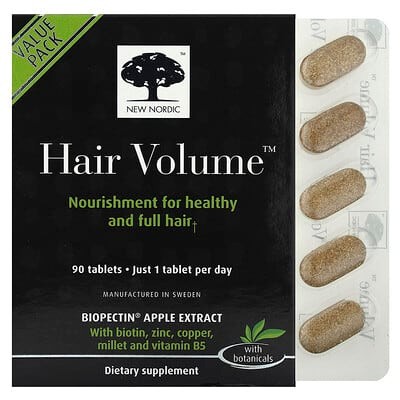
Hair Volume

Hair Volume

New Nordic4.4 (8,335 ratings)
Format:Tablet Quantity: 90 Tablet(s) · 90 servings
Goals
$51.30 $0.57 per serving

About this product

Hair and nail nutrition is the clearest fit, especially when low nutrient intake contributes to problems. The 3,000 mcg biotin serving has a limited connection to brittle-nail support, while 15 mg zinc contributes to normal hair maintenance when intake is low. More biotin or zinc does not establish extra growth when nutritional needs are already met.

The mineral choices weaken an otherwise clearly measured formula. Zinc oxide and copper sulfate are less favorable forms for uptake, while vitamin B5 uses the named calcium D-pantothenate form. Every ingredient amount is disclosed, but several forms remain unspecified.

The botanical and amino-acid additions do not establish a separate hair benefit. Horsetail extract lacks a declared silica yield, so its 200 mg amount cannot show how much silicon it supplies. The broader blend also costs more than its small cysteine contribution justifies, making it less appealing for someone seeking only zinc or an amino acid.

Who is it for
  • Adults seeking combined hair-and-nail nutrition when intake may be low
  • People comfortable with limited evidence for the added botanicals
Best for
  • Combined biotin and zinc intake for nutritional gaps
  • Brittle-nail support with modest expectations

Pros

  • Biotin and zinc address relevant nutritional needs in one serving
  • Copper is included alongside zinc
  • All active amounts are individually disclosed

Cons

  • Zinc oxide and copper sulfate are less favorable forms for uptake
  • Horsetail silica yield is not disclosed
  • Added amino acids do not establish an extra hair benefit
  • Several ingredient forms are unspecified

Product analysis

55 out of 100

Hair Volume may help when low zinc or biotin contributes to shedding, with limited support for brittle nails. The mineral forms and unclear plant preparations limit the appeal of its broader mixture.

AI assessment of the formula, label and price. How scoring works

Nutrient Quality28

The vitamin B5 form is favorable, while zinc oxide and copper sulfate are less favorable for absorption. Several plant and amino-acid preparations are unspecified, making their quality harder to compare.

Ingredient Transparency79

All ingredient amounts are disclosed, making serving comparisons easier. Several forms are missing, leaving important preparation details unclear.

Value For Money42

Value varies across the mixture, with reasonable biotin and methionine comparisons but higher costs for vitamin B5, zinc and cysteine. The horsetail contribution cannot be judged confidently on cost.

Customer Satisfaction83

Customer feedback is favorable across a large review pool. The volume gives a broad picture of satisfaction without establishing hair growth.

Product Focus67

The formula combines hair-related nutrition with plant ingredients and amino acids. Additional ingredients do not establish more hair growth once nutritional needs are met.

Format
Tablet
Container
90 Tablet(s)
Per serving
$0.57
Customer rating
4.4 · 8,335 ratings
Report analysis

Goals

Impact
High effect
B- Ingredient FitF PathwaysA EvidenceA+ Formulation Logic
Biotin · 3000 mcgZinc · 15 mgMethionine · 50 mg

Zinc and biotin can help when inadequate intake or deficiency contributes to shedding, without establishing extra growth when intake is adequate. Horsetail does not establish elemental silicon exposure or equivalence to the preparation studied for hair strength. Copper supports pigmentation and connective tissue biology, but routine oral regrowth is unproven; accompanying amino acids do not establish a separate benefit.

How this product is rated for Hair Health

Ingredient fit72

Zinc is a relevant nutrient for low-intake shedding. The amounts provide mixed coverage of the saved comparison anchors.
Goal fit
The product includes recognized hair-related nutrients alongside other actives, making its focus broader than hair health.
Dose adequacy
Most recognized amounts make substantial contributions, with some below the saved comparison anchors.

Pathways10

The saved findings show limited hair-fibre coverage from horsetail, with no pathway reaching the breadth criterion.
Depth
Horsetail accounts for limited hair-fibre coverage, without establishing exposure to the silicon preparation studied for hair strength.
Breadth
No pathway reaches the saved breadth criterion.

Evidence94

Zinc’s relevance is strongest when intake is low. Preparation matching does not establish routine regrowth from the formula.
Evidence strength
Zinc provides the strongest recognized support, specifically for shedding associated with low intake.
Studied preparation
The nutrient preparations are recognized, but horsetail is not equivalent to the silicon preparation studied for hair strength.

Formulation logic100

No unmet partner requirement or configured conflict was identified. The included ingredients meet the minimum amount criterion.
Partner coverage
The recognized ingredients do not have an unmet partner requirement in the supplied findings.
Conflicts
No configured ingredient conflict was identified; this is not a general safety assessment.
Effective doses
All ingredients included in this finding meet its minimum amount criterion, which is not a clinically proven hair-growth threshold.
Study evidence
Biotin Supportive 4 studies
Copper Adverse 4 studies
Horsetail Not classified

No linked studies yet.

Zinc Supportive 22 studies
Nail Health
Impact
Highest effect
B- Ingredient FitB- PathwaysA+ EvidenceA+ Formulation Logic
Biotin · 3000 mcgHorsetail · 200 mgMethionine · 50 mg

Biotin has a limited connection to brittle-nail improvement from small, mostly uncontrolled studies using 2500 mcg daily over months. Amounts above that exposure do not establish greater nail benefit. Zinc is relevant when low zinc status causes nail abnormalities.

How this product is rated for Nail Health

Ingredient fit71

Biotin supplies the main relevant connection. The counted ingredients contribute unevenly, with smaller amounts or preparation differences limiting the overall match.
Goal fit
The nail-related ingredients share the formula with ingredients serving broader nutritional goals.
Dose adequacy
The counted ingredients contribute unevenly, with smaller amounts or preparation differences limiting the overall match.

Pathways70

The strongest saved connection is keratinization cofactors. One pathway reaches the configured coverage threshold.
Depth
The strongest saved connection is keratinization cofactors.
Breadth
One pathway reaches the configured coverage threshold.

Evidence96

Vitamin B7 (Biotin) leads the saved evidence finding. Biotin findings come mainly from small uncontrolled nail studies.
Evidence strength
Vitamin B7 (Biotin) leads the saved evidence finding; the supplied nail-specific evidence remains limited.
Studied preparation
Some counted material is not fully matched to the reviewed preparation, limiting preparation-specific confidence.

Formulation logic100

The counted ingredients have no unmet partner requirement, and no configured conflict was found. Passing the amount threshold does not prove clinical effectiveness.
Partner coverage
The counted ingredients work alone or have the partner required by the supplied configuration.
Conflicts
No configured ingredient conflict was found.
Effective doses
All counted ingredients pass the configured inclusion threshold; it is not a proven effective nail dose.
Study evidence
Biotin Supportive 8 studies
Horsetail Not classified

No linked studies yet.

Zinc No effect 1 study
Everyday Health
Impact
Moderate effect
C- Ingredient FitD- PathwaysB- EvidenceA+ Formulation Logic
Zinc · 15 mg

Vitamin B5 contributes to normal energy metabolism, while zinc supports normal antioxidant and immune functions. The serving includes 20 mg B5 and 15 mg zinc alongside biotin and copper; extra intake does not imply extra benefit when nutritional needs are met.

How this product is rated for Everyday Health

Ingredient fit57

2 relevant ingredients underpin the saved finding, alongside other actives less directly related to everyday health. Most of the saved dose comparisons are met, although some contributions are smaller.
Goal fit
2 relevant ingredients underpin the saved finding, alongside other actives less directly related to everyday health.
Dose adequacy
Most of the saved dose comparisons are met, although some contributions are smaller.

Pathways41

The strongest supported area is energy metabolism cofactors. 1 area reaches the saved coverage benchmark, so support is concentrated in one aspect of everyday health.
Depth
The strongest supported area is energy metabolism cofactors.
Breadth
1 area reaches the saved coverage benchmark, so support is concentrated in one aspect of everyday health.

Evidence72

Zinc provides the strongest support in the saved finding. Evidence remains specific to its nutritional or studied role. The relevant ingredients meeting the saved dose benchmark use preparations accepted by the supplied assessment.
Evidence strength
Zinc provides the strongest support in the saved finding. Evidence remains specific to its nutritional or studied role.
Studied preparation
The relevant ingredients meeting the saved dose benchmark use preparations accepted by the supplied assessment.

Formulation logic100

The relevant ingredients can contribute on their own or have their needed nutritional partners present. No ingredient conflict was flagged by the supplied checks. All ingredients included in the saved dose finding reach its minimum amount benchmark.
Partner coverage
The relevant ingredients can contribute on their own or have their needed nutritional partners present.
Conflicts
No ingredient conflict was flagged by the supplied checks.
Effective doses
All ingredients included in the saved dose finding reach its minimum amount benchmark.
Study evidence
Zinc Supportive 60 studies
Immunity
Impact
High effect
D+ Ingredient FitD- PathwaysA+ EvidenceA+ Formulation Logic
Zinc · 15 mg

Zinc and copper contribute to normal immune-cell function when intake is low. Copper is present alongside zinc, satisfying the evaluated partner and conflict conditions. The small L-cysteine amount did not contribute, and findings for N-acetylcysteine cannot be transferred to L-cysteine.

How this product is rated for Immunity

Ingredient fit50

Zinc is a principal relevant ingredient. Relevant amounts provide partial contributions, with some smaller or unresolved quantities.
Goal fit
Relevant ingredients share the formula with other actives, making its focus on this goal less concentrated.
Dose adequacy
The relevant amounts make partial contributions; small or unresolved quantities limit the overall amount comparison.

Pathways40

The strongest represented area is lymphocyte function and immune regulation, with partial coverage. One area reaches substantial coverage, leaving the contribution concentrated in a few aspects.
Depth
The strongest represented area is lymphocyte function and immune regulation, with partial coverage.
Breadth
One area reaches substantial coverage, leaving the contribution concentrated in a few aspects.

Evidence100

Zinc anchors the saved evidence findings. The clinical expectation remains limited to supported nutrient functions or bounded regular-use findings.
Evidence strength
Zinc provides the strongest contribution in the saved findings; this does not establish infection prevention or benefits above adequate nutritional intake.
Studied preparation
The relevant ingredients meet the supplied preparation criteria, without establishing superiority of individual forms.

Formulation logic100

The relevant ingredients have no unmet partner requirement or triggered conflict. Their amounts meet the supplied minimum comparison level.
Partner coverage
The relevant ingredients can contribute independently or have their required partner present; no added combination benefit is established.
Conflicts
None of the evaluated ingredient conflicts was triggered.
Effective doses
The relevant amounts meet the supplied minimum comparison level; this is not a guaranteed clinical response threshold.
Study evidence
Zinc Supportive 73 studies
Skin Health
Impact
High effect
C+ Ingredient FitC- PathwaysA- EvidenceA+ Formulation Logic
Zinc · 15 mgCopper · 2 mg

Zinc and biotin have skin-related nutritional roles when intake is deficient: zinc deficiency can impair wound healing and cause lesions, while biotin deficiency can cause dermatitis. More biotin does not establish extra benefit when intake is adequate. Copper participates in connective-tissue enzymes, but added copper has no established cosmetic benefit in replete adults. The botanical silica source does not establish an elemental silicon contribution.

How this product is rated for Skin Health

Ingredient fit68

Copper supplies the leading saved contribution. The amount comparison remains partial across the counted ingredients.
Goal fit
Copper supplies a main skin-related connection within a formula also directed toward other goals.
Dose adequacy
The counted amounts receive partial overall recognition in the saved comparison, without establishing the same effects as a study regimen.

Pathways56

The saved findings are strongest in dermal collagen matrix. Only this category reaches the breadth threshold.
Depth
The strongest saved contribution is assigned to dermal collagen matrix; this category does not itself demonstrate a clinical skin improvement.
Breadth
Only dermal collagen matrix reaches the saved breadth threshold, leaving the findings concentrated in one category.

Evidence89

Copper leads the saved evidence comparison, but its connective-tissue function does not establish added skin benefit in replete adults.
Evidence strength
Copper leads the saved evidence comparison, but its connective-tissue function does not establish added skin benefit in replete adults.
Studied preparation
The saved findings recognize the counted preparations; that does not establish product-specific trials or cosmetic benefit in replete adults.

Formulation logic100

Partner requirements are met, no configured conflict is matched and the counted amounts meet the saved minimum comparison.
Partner coverage
No unmet partner requirement is recorded for the counted ingredients; this does not establish extra benefit from combining them.
Conflicts
No configured ingredient conflict is matched in the supplied facts.
Effective doses
All counted ingredients meet the saved minimum amount comparison; this does not establish a clinically effective skin dose.
Study evidence
Biotin Supportive 10 studies
Copper Supportive 16 studies
Zinc Supportive 66 studies

Ingredients

IngredientAmount per servingScore
Biotin
3000 mcg 78
Pantothenic Acid (D-Calcium Pantothenate)
20 mg 61
Zinc (Zinc Oxide)
15 mg 48
Copper (Copper Sulfate)
2 mg 59
Apple extract (Procyanidin-B2)
300 mg
Millet extract
250 mg
Horsetail extract
200 mg 29
L-Cysteine
60 mg 39
L-Methionine
50 mg 61
Men 18–50 Dairy Free Women
Report overview
Biotin · 3000 mcg OverallScore78
B+ Active Ingredient Quality & BioavailabilityB+ Dose, Safety & Label TransparencyC Value
Each serving lists 3,000 mcg of biotin, a higher amount in the evaluation. A whole-product serving costs about $0.57.
How this ingredient is rated

Active Ingredient Quality & Bioavailability82

Biotin is identified without a specific isomer being resolved. The evaluation flags no artificial colors or sweeteners.
Biologically Active d-Biotin Isomer
The saved information identifies biotin but does not resolve a specific isomer.
Excipient Purity
No artificial colors or sweeteners were flagged in the available ingredient evidence.

Dose, Safety & Label Transparency84

The listed serving provides 3,000 mcg of biotin, a higher amount in the evaluation; its amount is individually disclosed.
Biotin Potency for Health Goals
The listed 3,000 mcg per serving is in a higher category in the evaluation.
Label Transparency & Exact Disclosure
Biotin is individually listed at 3,000 mcg per serving.

Value60

A whole-product serving costs about $0.57 and provides 3,000 mcg of biotin; other nutrients are also considered in the value evaluation.
Price per 5,000 mcg Biotin
The whole-product price works out to about $0.95 per 5,000 mcg of biotin; the evaluation also considers other nutrients.
Methionine · 50 mg OverallScore61
C Active Ingredient Quality & BioavailabilityC- Dose, Safety & Label TransparencyB- Value
Each serving lists 50 mg of L-methionine, a lower amount in this comparison. The whole-product serving costs about $0.57, a mid-range price in this comparison.
How this ingredient is rated

Active Ingredient Quality & Bioavailability60

The form is L-methionine; the available facts do not record a purity grade or testing claim.
Methionine Isomer Form
L-methionine is a biologically active form.
Purity and Source Standards
The available facts do not record a purity grade or specific purity-testing claim, so those qualities remain unverified.

Dose, Safety & Label Transparency58

Each serving lists 50 mg of methionine, a lower amount in this comparison. The ingredient amount is individually stated.
Methionine Dosage Potency
Each serving lists 50 mg of methionine, a lower amount in this comparison.
Transparency of Disclosure
The methionine amount is individually stated as 50 mg per serving.

Value70

A whole-product serving costs about $0.57, a mid-range price in this comparison.
Price per Methionine Serving
A whole-product serving costs about $0.57, a mid-range price in this comparison.
F Active Ingredient Quality & BioavailabilityA- Dose, Safety & Label TransparencyD+ Value
The serving provides 2 mg of copper as copper sulfate, an inorganic form. The evaluation favors named organic forms for absorption.
How this ingredient is rated

Active Ingredient Quality & Bioavailability37

Copper sulfate is an inorganic salt; the evaluation favors named organic forms for absorption. The serving's copper amount is stated separately.
Copper Form Bioavailability
Copper sulfate is an inorganic salt; the evaluation favors named organic forms for absorption.
Elemental Copper Labeling Clarity
The saved facts identify 2 mg of copper per serving and name copper sulfate as its source.

Dose, Safety & Label Transparency85

The serving's zinc-to-copper ratio is lower than the balance favored in the evaluation.
Copper Dosage Safety & Efficacy
The 2 mg of copper per serving matches the amount favored in the evaluation.
Zinc-to-Copper Balance
The serving has 15 mg of zinc and 2 mg of copper; their ratio is lower than the balance favored in the evaluation.

Value50

A whole-product serving costs about $0.57 and provides 2 mg of copper.
Price Per Serving Efficiency
A whole-product serving costs about $0.57 and provides 2 mg of copper.
Report alternatives

Sources

Published studies used for the product analysis and the top-ranked studies for each ingredient and goal.

  1. Effectiveness of sodium bicarbonate and zinc chloride mouthwashes in the treatment of oral mucositis and quality of life in patients with cancer under chemotherapy.
    Mohammadi F; Oshvandi K; Kamallan SR; Khazaei S; Ranjbar H; Ahmadi-Motamayel F; Gillespie M; Jenabi E; Vafaei SY · Nursing open · 2022
    Randomized trial144 participantsEveryday Health forZinc
  2. Zinc supplementation in young children with acute diarrhea in India.
    Sazawal S; Black RE; Bhan MK; Bhandari N; Sinha A; Jalla S · The New England journal of medicine · 1995
    Randomized trial937 participantsEveryday Health forZinc
  3. Associations of mortality with ocular disorders and an intervention of high-dose antioxidants and zinc in the Age-Related Eye Disease Study: AREDS Report No. 13.
    Clemons TE; Kurinij N; Sperduto RD; AREDS Research Group · Archives of ophthalmology (Chicago, Ill. : 1960) · 2004
    Randomized trial4,753 participantsEveryday Health forZinc
  4. Effects of zinc and probiotic co-supplementation on inflammation, gastrointestinal symptoms, quality of life, and mood in irritable bowel syndrome patients.
    Rezazadegan M; Soheilipour M; Amani R · Scientific reports · 2026
    Randomized trial84 participantsEveryday Health forZinc
  5. Effect of zinc sulfate supplementation on premenstrual syndrome and health-related quality of life: Clinical randomized controlled trial.
    Siahbazi S; Behboudi-Gandevani S; Moghaddam-Banaem L; Montazeri A · The journal of obstetrics and gynaecology research · 2018
    Randomized trial142 participantsEveryday Health forZinc
  6. The Role of Sesbania grandiflora-Derived Biotin and Bambusa arundinacea-Derived Silica Extracts in Promoting Hair, Skin, and Nail Health: A Randomized, Double-Blind, Placebo-Controlled Clinical Study.
    Patel MN; Maheshvari J; Patel N · Cureus · 2025
    Randomized trial105 participantsHair Health Nail Health Skin Health forBiotin
  7. Low serum biotinidase activity in children with valproic acid monotherapy.
    Schulpis KH; Karikas GA; Tjamouranis J; Regoutas S; Tsakiris S · Epilepsia · 2001
    Clinical trial125 participantsHair Health Skin Health forBiotin
  8. Vitamins A, B, C, and D: A Short Review for the Dermatologist.
    Coerdt KM; Goggins CA; Khachemoune A · Alternative therapies in health and medicine · 2021
    Narrative reviewHair Health forBiotin
  9. The Infatuation With Biotin Supplementation: Is There Truth Behind Its Rising Popularity? A Comparative Analysis of Clinical Efficacy versus Social Popularity.
    Soleymani T; Lo Sicco K; Shapiro J · Journal of drugs in dermatology : JDD · 2018
    Narrative reviewHair Health forBiotin
  10. Menkes disease and response to copper histidine: An Indian case series.
    Yoganathan S; Sudhakar SV; Arunachal G; Thomas M; Subramanian A; George R; Danda S · Annals of Indian Academy of Neurology · 2022
    Case series4 participantsHair Health forCopper
  11. Trace element levels in alopecia areata.
    Bhat YJ; Manzoor S; Khan AR; Qayoom S · Indian journal of dermatology, venereology and leprology · 2009
    Case-control study100 participantsHair Health forCopper
  12. UV damage to hair and the effect of antioxidants and metal chelators.
    Millington KR; Marsh JM · International journal of cosmetic science · 2021
    In vitro / ex vivo studyHair Health forCopper
  13. Preserving fibre health: reducing oxidative stress throughout the life of the hair fibre.
    Marsh JM; Davis MG; Lucas RL; Reilman R; Styczynski PB; Li C; Mamak M; McComb DW; Williams RE; Godfrey S; Navqi KR; Chechik V · International journal of cosmetic science · 2016
    In vitro / ex vivo studyHair Health forCopper
  14. The effects of minoxidil, 1% pyrithione zinc and a combination of both on hair density: a randomized controlled trial.
    Berger RS; Fu JL; Smiles KA; Turner CB; Schnell BM; Werchowski KM; Lammers KM · The British journal of dermatology · 2003
    Randomized trial200 participantsHair Health forZinc
  15. Incubatory environment of the scalp impacts pre-emergent hair to affect post-emergent hair cuticle integrity.
    Schwartz JR; Henry JP; Kerr KM; Flagler MJ; Page SH; Redman-Furey N · Journal of cosmetic dermatology · 2018
    Randomized trialHair Health forZinc
  16. A comparison of hair quality and cosmetic acceptance following the use of two anti-dandruff shampoos.
    Draelos ZD; Kenneally DC; Hodges LT; Billhimer W; Copas M; Margraf C · The journal of investigative dermatology. Symposium proceedings · 2006
    Randomized trial40 participantsHair Health forZinc
  17. BMI and levels of zinc, copper in hair, serum and urine of Turkish male patients with androgenetic alopecia.
    Ozturk P; Kurutas E; Ataseven A; Dokur N; Gumusalan Y; Gorur A; Tamer L; Inaloz S · Journal of trace elements in medicine and biology : organ of the Society for Minerals and Trace Elements (GMS) · 2015
    Case-control study216 participantsHair Health forZinc
  18. Analysis of serum zinc and copper concentrations in hair loss.
    Kil MS; Kim CW; Kim SS · Annals of dermatology · 2013
    Case-control study342 participantsHair Health forZinc
  19. Nutrient supplementation for prevention of viral respiratory tract infections in healthy subjects: A systematic review and meta-analysis.
    Vlieg-Boerstra B; de Jong N; Meyer R; Agostoni C; De Cosmi V; Grimshaw K; Milani GP; Muraro A; Oude Elberink H; Pali-Schöll I; Roduit C; Sasaki M; Skypala I; Sokolowska M; van Splunter M; Untersmayr E; Venter C; O'Mahony L; Nwaru BI · Allergy · 2022
    Meta-analysis199,055 participants115 studies pooledImmunity forZinc
  20. Zinc supplementation reduces the incidence of acute lower respiratory infections in infants and preschool children: a double-blind, controlled trial.
    Sazawal S; Black RE; Jalla S; Mazumdar S; Sinha A; Bhan MK · Pediatrics · 1998
    Randomized trial609 participantsImmunity forZinc