
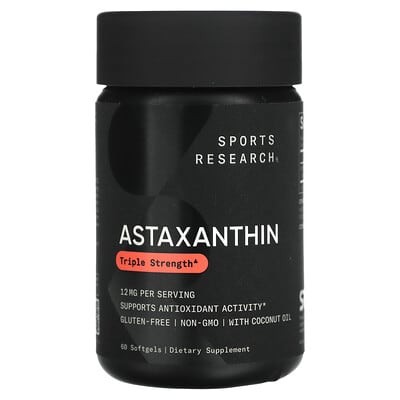

$26.95 $0.44 per serving


Product analysis
Astaxanthin 12 mg offers good value for an ingredient with limited evidence for maintaining selected aspects of skin appearance. Small, sometimes sponsored trials leave uncertainty about how noticeable or consistent the benefit will be.
AI assessment of the formula, label and price. How scoring works
Nutrient Quality40
Astaxanthin is identified, but preparation quality is not established. The ingredient name alone does not show an absorption advantage.
Ingredient Transparency100
The ingredient amount and form are disclosed. That supports a straightforward label comparison without resolving preparation quality.
Value For Money100
The cost for the amount of astaxanthin compares favorably. That affordability does not establish stronger skin, eye or cognitive effects.
Customer Satisfaction90
Customer ratings are favorable across a very large review base. The volume provides a broad picture of customer opinion without proving health benefits.
Product Focus63
A single ingredient keeps the formula simple. Limited skin-related findings are more relevant than broad promises about cognition, heart health or whole-body aging.
- Format
Softgel - Container
- 60 Softgel(s)
- Per serving
- $0.44
- Customer rating
- 4.7 · 13,645 ratings
Goals

Impact
Highest effect
Astaxanthin · 12 mg

Impact
Highest effect
Astaxanthin · 12 mg

Impact
Situational effect
Astaxanthin · 12 mg

Impact
High effect
Astaxanthin · 12 mg

Impact
Situational effect
Astaxanthin · 12 mg

Impact
High effect
Astaxanthin · 12 mg
Ingredients
| Ingredient | Amount per serving | Score |
|---|---|---|
Icelandic Astalif (Astaxanthin) | 12 mg |
Astaxanthin · 12 mg OverallScore68
Each serving provides 12 mg of astaxanthin at a low cost per milligram. The source is unclear. Packaging protection from light and heat is also uncertain.
How this ingredient is rated
Active Ingredient Quality & Bioavailability36
The astaxanthin source is not specified. A branded ingredient is indicated.
Biological Source Quality
The astaxanthin source is not specified.
Formulation Technology
No liposomal or water-dispersible formulation claim is indicated.
Branded Ingredient Standard
A branded astaxanthin ingredient is indicated, but its name is unclear.
Dose, Safety & Label Transparency84
12 mg per serving falls within the range used in most human studies. Protection from light and heat is unclear because the packaging opacity is not established.
Clinical Potency per Serving
12 mg per serving falls within the range used in most human studies.
Active Astaxanthin Yield Transparency
The active astaxanthin amount is stated as 12 mg per serving.
Ingredient Stability & Packaging
Protection from light and heat is unclear because the packaging opacity is not established.
Value100
The cost per milligram of astaxanthin is low, based on the price of the full serving.
Price per Milligram of Active Astaxanthin
The cost per milligram of astaxanthin is low, based on the price of the full serving.
Alternative products
Report alternatives
Sources
Published studies used for the product analysis and the top-ranked studies for each ingredient and goal.
- Astaxanthin, a natural antioxidant, lowers cholesterol and markers of cardiovascular risk in individuals with prediabetes and dyslipidaemia.
- Antioxidant Lipid Supplement on Cardiovascular Risk Factors: A Systematic Review and Meta-Analysis.
- Administration of natural astaxanthin increases serum HDL-cholesterol and adiponectin in subjects with mild hyperlipidemia.
- Effects of Astaxanthin Supplementation on Glycemic Control and Lipid Profile in Patients With Prediabetes and Type 2 Diabetes: A Meta-Analysis of Randomized Controlled Trials.
- Astaxanthin Supplemented with High-Intensity Functional Training Decreases Adipokines Levels and Cardiovascular Risk Factors in Men with Obesity.
- Effects of astaxanthin-rich Haematococcus pluvialis extract on cognitive function: a randomised, double-blind, placebo-controlled study.
- Effect of astaxanthin-rich extract derived from Paracoccus carotinifaciens on cognitive function in middle-aged and older individuals.
- The Effects of Astaxanthin on Cognitive Function and Neurodegeneration in Humans: A Critical Review.
- Effects of Astaxanthin Supplementation on Fatigue, Motor Function and Cognition: A Meta-Analysis of Randomized Controlled Trials.
- Astaxanthin and improvement of dementia: A systematic review of current clinical trials.
- Benefits and Safety of Astaxanthin in the Treatment of Mild-To-Moderate Dry Eye Disease.
- Astaxanthin (AstaReal®) Improved Acute and Chronic Digital Eye Strain in Children: A Randomized Double-Blind Placebo-Controlled Trial.
- Effects of diet containing astaxanthin on visual function in healthy individuals: a randomized, double-blind, placebo-controlled, parallel study.
- Astaxanthin, cell membrane nutrient with diverse clinical benefits and anti-aging potential.
- Nutritional Supplementation for Myopia Prevention and Control: A Systematic Review of Randomized Controlled Trials.
- The anti-inflammatory and antioxidant effects of astaxanthin as an adjunctive therapy in community-acquired pneumonia: a randomized controlled trial.
- The Role of Astaxanthin as an Antioxidant and Anti-Inflammatory Agent in Human Health: A Systematic Review.
- Astaxanthin ameliorates inflammation, oxidative stress, and reproductive outcomes in endometriosis patients undergoing assisted reproduction: A randomized, triple-blind placebo-controlled clinical trial.
- Astaxanthin Modulates Inflammation in Type 2 Diabetes via Regulation of microRNAs, Lysophosphatidylcholine, and α-Hydroxybutyrate.
- Redox-sensitive miRNAs and Humanin could mediate effects of exercise and astaxanthin on oxidative stress and inflammation in type 2 diabetes.