
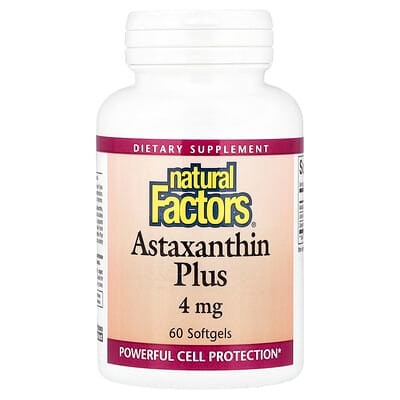

$16.77 $0.27 per serving


Product analysis
Astaxanthin Plus 4 mg may offer modest support for skin and some aspects of vision during screen use, though the benefits remain uncertain. Clear ingredient amounts and sources make the blend easier to compare.
AI assessment of the formula, label and price. How scoring works
Nutrient Quality40
The ingredient sources are identified, but their preparation quality remains uncertain. Named algae and flower sources alone do not establish absorption or finished-product quality.
Ingredient Transparency100
The amounts and sources of all three active ingredients are stated. That makes it easier to compare the blend with other carotenoid supplements.
Value For Money70
The astaxanthin offers very good value for the amount provided. Value for the added lutein and zeaxanthin remains uncertain.
Customer Satisfaction80
Customer ratings are very positive. More than a thousand ratings give the feedback a broad base.
Product Focus61
The clearest possible benefits concern selected skin and vision measures. The serving is below amounts linked to some favorable findings, so broad benefits for the heart, memory or ageing remain uncertain.
- Format
Softgel - Container
- 60 Softgel(s)
- Per serving
- $0.27
- Customer rating
- 4.6 · 1,065 ratings
Goals

Impact
High effect
Astaxanthin · 4 mg
Astaxanthin has limited findings for maintaining selected skin measures during seasonal deterioration in women. The 4 mg serving is below the 6 mg exposure supporting the narrow skin findings, so partial saved amount credit does not establish the same benefit. Lutein is present at a small amount below the reviewed skin-study exposure and receives no saved contribution. These findings do not establish whole-body rejuvenation or longer life.
How this product is rated for Longevity
Ingredient fit72
Astaxanthin is the sole credited ingredient and receives partial amount coverage.
Goal fit
Astaxanthin provides the saved skin-related focus, alongside links to other goals.
Dose adequacy
Astaxanthin receives partial saved amount coverage; 4 mg per serving is below the supplied 6 mg skin-study anchor.
Pathways40
Astaxanthin provides the saved antioxidant-defence coverage.
Depth
Antioxidant defence receives partial saved coverage through astaxanthin.
Breadth
Only antioxidant defence meets the saved coverage threshold.
Evidence82
Astaxanthin leads the saved evidence finding, with small, bounded skin outcomes rather than general aging benefits.
Evidence strength
Astaxanthin supplies the saved evidence contribution, with modest skin findings and uncertainty about between-group effects.
Studied preparation
The counted astaxanthin receives full saved preparation recognition.
Formulation logic100
Astaxanthin needs no missing partner and no configured conflict was found.
Partner coverage
Astaxanthin satisfies the saved partner requirement.
Conflicts
No configured ingredient conflict was matched.
Effective doses
Astaxanthin passes the saved minimum amount threshold; lutein is excluded for its low amount.

Impact
High effect
Astaxanthin · 4 mg
Astaxanthin has limited oral evidence for maintaining selected skin measures and reducing responses to controlled UV exposure. The small studies do not establish universal reversal of skin ageing or sunscreen-equivalent protection. Its declared active amount supports comparison with those studies, but one serving does not establish their repeated daily use. The small carotenoid amount does not establish the lutein exposure studied for skin outcomes.
How this product is rated for Skin Health
Ingredient fit72
Astaxanthin supplies the main recognized connection. Astaxanthin offers partial amount coverage, with small or unresolved declarations limiting the comparison.
Goal fit
Astaxanthin supplies the main recognized connection.
Dose adequacy
Astaxanthin offers partial amount coverage, with small or unresolved declarations limiting the comparison.
Pathways19
No evaluated function reaches the breadth criterion; this does not establish absence of normal nutrient functions.
Depth
The main assigned connection is UV-related skin responses.
Breadth
No evaluated function reaches the breadth criterion; this does not establish absence of normal nutrient functions.
Evidence87
Astaxanthin has limited evidence from small studies of selected UV or cosmetic skin measures.
Evidence strength
Astaxanthin has limited evidence from small studies of selected UV or cosmetic skin measures.
Studied preparation
The counted declarations meet the preparation check; that does not establish product-specific trial results.
Formulation logic100
No missing required partner or configured conflict was identified. All ingredients counted for this check meet its minimum amount criterion, which does not establish a clinically effective regimen.
Partner coverage
No missing required partner was identified among the counted ingredients; no extra combination benefit follows from this.
Conflicts
No configured ingredient conflict was identified in the supplied facts.
Effective doses
All ingredients counted for this check meet its minimum amount criterion, which does not establish a clinically effective regimen.

Impact
Moderate effect
Astaxanthin · 4 mg
Astaxanthin may help some aspects of vision during screen use, but the possible benefit is limited and uncertain. Favorable effects apply most clearly to adults aged 40 and over, rather than everyone who uses a screen. The 4 mg serving is below the 9 mg daily amount associated with that finding, and shouldn't be treated as a proven effective dose.
How this product is rated for Eye Health
Ingredient fit72
Astaxanthin may help some aspects of vision associated with screen use, although the benefit remains uncertain.
Goal fit
Astaxanthin may help some aspects of vision associated with screen use, although the benefit remains uncertain.
Dose adequacy
The serving supplies 4 mg of astaxanthin; that amount alone doesn't predict improved vision.
Pathways17
Astaxanthin has a limited possible connection with visual function during screen use.
Depth
Astaxanthin has a limited possible connection with visual function during screen use.
Breadth
The mixture does not demonstrate broad improvements across several aspects of everyday vision.
Evidence70
Astaxanthin may help some aspects of vision associated with screen use, although the benefit remains uncertain. The result depends on the ingredient and the circumstances of use.
Evidence strength
Astaxanthin may help some aspects of vision associated with screen use, although the benefit remains uncertain.
Studied preparation
The declared nutrient form identifies the ingredient, without guaranteeing the benefits of a complete disease-specific combination.
Formulation logic100
The individual ingredients have no identified missing partner or particular conflict.
Partner coverage
No required ingredient partner is missing for the individual contribution described here.
Conflicts
No particular ingredient conflict is identified here.
Effective doses
The serving supplies 4 mg of astaxanthin; that amount alone doesn't predict improved vision.
carotenoids Not classified
No linked studies yet.

Impact
Moderate effect
Astaxanthin · 4 mg
Astaxanthin has an uncertain connection to reducing inflammation. A limited signal concerns CRP, a blood marker linked to inflammation, rather than clear relief of symptoms. Higher amounts haven't consistently produced a stronger anti-inflammatory effect, so the serving size shouldn't be read as a promise of greater benefit.
How this product is rated for Inflammation
Ingredient fit51
Astaxanthin has a limited inflammatory-marker signal; higher quantities do not imply greater benefit.
Goal fit
Astaxanthin has a limited inflammatory-marker signal; higher quantities do not imply greater benefit.
Dose adequacy
Astaxanthin 4 mg per serving; these declared amounts alone do not demonstrate symptom relief.
Pathways16
The relevant ingredient functions do not imply broad relief across different inflammatory conditions.
Depth
Astaxanthin has a limited inflammatory-marker signal; higher quantities do not imply greater benefit.
Breadth
Several distinct anti-inflammatory effects are not demonstrated by ingredient presence alone.
Evidence82
Astaxanthin has a limited inflammatory-marker signal; higher quantities do not imply greater benefit.
Evidence strength
Astaxanthin has a limited inflammatory-marker signal; higher quantities do not imply greater benefit.
Studied preparation
Preparation-specific benefits cannot be assumed to apply to every form or use of this ingredient.
Formulation logic100
No particular ingredient conflict or missing required partner is identified.
Partner coverage
No missing required ingredient partner is identified.
Conflicts
No particular ingredient conflict is identified.
Effective doses
Astaxanthin 4 mg per serving; a numerical dose comparison is not a guarantee of anti-inflammatory benefit.

Impact
Moderate effect
Astaxanthin · 4 mg
Astaxanthin Plus lists 4 mg astaxanthin from Haematococcus pluvialis per serving, with lutein and zeaxanthin also present. The supplied study found triglyceride and HDL changes at 6 mg per day or more in people with mild hyperlipidemia, but no LDL improvement. This serving is lower, and daily use is unspecified.
How this product is rated for Cardiovascular Support
Ingredient fit51
Astaxanthin is tied to the goal, alongside lutein and zeaxanthin, which do not add another cardiovascular pathway here.
Goal fit
Astaxanthin is the relevant active; lutein and zeaxanthin are also present but add no supplied pathway.
Dose adequacy
The label lists 4 mg astaxanthin per serving; the supplied study used at least 6 mg daily, and frequency is unknown.
Pathways19
Astaxanthin relates to triglyceride metabolism, but the supplied facts show only partial coverage.
Depth
Triglyceride metabolism is the strongest route, but its coverage remains partial.
Breadth
No target pathway reaches the supplied coverage level; triglyceride metabolism is closest.
Evidence79
The supplied human evidence is a small study in mild hyperlipidemia, with lipid-marker changes but no LDL improvement.
Evidence strength
A 12-week study reported triglyceride and HDL changes at 6 mg daily or more, but no LDL improvement.
Studied preparation
The label identifies astaxanthin from Haematococcus pluvialis; the supplied evidence concerns astaxanthin, not broader cardiovascular outcomes.
Formulation logic100
Astaxanthin works alone here, with no listed conflict trigger.
Partner coverage
Astaxanthin's supplied role doesn't require another active ingredient.
Conflicts
No supplied caffeine, stimulant or high-sodium concern applies.
Effective doses
The 4 mg serving is below the 6 mg/day amount used in the trial; product frequency isn't specified.

Impact
Moderate effect
Astaxanthin · 4 mg
Astaxanthin at 4 mg contributes through antioxidant and inflammation-related protection in the saved findings. Cognitive findings are mixed, and the reviewed trial did not show a clear advantage over placebo, so a reliable improvement in memory or attention remains uncertain.
How this product is rated for Cognitive Support
Ingredient fit51
The saved ingredient and dose findings describe how closely the relevant actives support cognitive needs.
Goal fit
Relevant cognitive ingredients sit within a broader formula containing several actives for other purposes.
Dose adequacy
The assessed amounts provide partial coverage of the saved dose comparison; this is an exposure comparison, not proof of benefit.
Pathways19
The contribution centers on a limited set of cognitive processes rather than broad coverage.
Depth
The strongest represented process is oxidative and inflammatory protection, with limited coverage in the saved findings.
Breadth
No assessed cognitive process reaches the saved coverage threshold.
Evidence79
The saved evidence findings distinguish ingredient relevance from a match to the reviewed preparation.
Evidence strength
Astaxanthin supplies the strongest evidence contribution at the assessed amount. The supplied evidence retains its limitations and does not imply uniform cognitive improvement.
Studied preparation
The ingredients meeting the saved dose threshold are recorded in preparations accepted by the saved evidence assessment.
Formulation logic100
The saved formulation checks consider companion ingredients, opposing effects and minimum amounts.
Partner coverage
The assessed ingredients can contribute independently or have their required companion present.
Conflicts
No ingredient conflict was identified by the saved checks.
Effective doses
All ingredients included in the saved dose check reach its minimum threshold.

Impact
Moderate effect
Astaxanthin · 4 mg
Astaxanthin at 4 mg has a limited connection to triglyceride metabolism. The supplied trial used higher amounts in people with mildly raised triglycerides and found selective lipid changes, so broad cholesterol improvement or prevention of cardiac events should not be assumed.
How this product is rated for Heart Health
Ingredient fit51
Relevant ingredients sit within a broader formula with several other purposes, limiting its focus on heart health. The assessed amounts provide partial coverage of the saved reference levels, with undisclosed quantities limiting the assessment.
Goal fit
Relevant ingredients sit within a broader formula with several other purposes, limiting its focus on heart health.
Dose adequacy
The assessed amounts provide partial coverage of the saved reference levels, with undisclosed quantities limiting the assessment.
Pathways15
The strongest saved connection is triglyceride metabolism, with limited coverage. No pathway reaches the saved coverage threshold.
Depth
The strongest saved connection is triglyceride metabolism, with limited coverage.
Breadth
No pathway reaches the saved coverage threshold.
Evidence83
Astaxanthin supplies the strongest saved evidence finding at the assessed amount; the scope of its actual cognitive evidence still matters. The effective entries are classified as studied preparations in the saved findings.
Evidence strength
Astaxanthin supplies the strongest saved evidence finding at the assessed amount; the scope of its actual cognitive evidence still matters.
Studied preparation
The effective entries are classified as studied preparations in the saved findings.
Formulation logic100
The assessed ingredients can work alone or have their required partner. No configured ingredient conflict was found in the supplied assessment. All assessed ingredients reach the saved minimum amount threshold.
Partner coverage
The assessed ingredients can work alone or have their required partner.
Conflicts
No configured ingredient conflict was found in the supplied assessment.
Effective doses
All assessed ingredients reach the saved minimum amount threshold.
Ingredients
| Ingredient | Amount per serving | Score |
|---|---|---|
Astaxanthin (Haematococcus pluvialis) | 4 mg | |
Lutein (Marigold) | 1 mg | |
Zeaxanthin (Marigold) | 170 mcg |
Astaxanthin (Haematococcus pluvialis) · 4 mg OverallScore78
A serving provides 4 mg of astaxanthin from Haematococcus pluvialis algae. At the whole-product price, that works out to about $0.07 per mg of listed astaxanthin.
How this ingredient is rated
Active Ingredient Quality & Bioavailability60
Haematococcus pluvialis algae is the recorded source; the label claim is not independently verified.
Biological Source Quality
Haematococcus pluvialis algae is recorded as the source of the astaxanthin.
Formulation Technology
The saved facts do not record a liposomal or water-dispersible formulation claim.
Branded Ingredient Standard
Haematococcus pluvialis is the named algal source; no branded astaxanthin ingredient is identified in the saved facts.
Dose, Safety & Label Transparency84
The active astaxanthin amount is stated as 4 mg per serving; packaging protection is not established by the saved facts.
Clinical Potency per Serving
The label declares 4 mg of astaxanthin per serving.
Active Astaxanthin Yield Transparency
The astaxanthin amount itself is declared as 4 mg per serving.
Ingredient Stability & Packaging
The saved facts do not establish whether the packaging protects the ingredient from light.
Value100
At the whole-product price, the cost is about $0.07 per mg of listed astaxanthin.
Price per Milligram of Active Astaxanthin
The evaluated whole-product price corresponds to about $0.07 per mg of astaxanthin.
Alternative products
Report alternatives
Sources
Published studies used for the product analysis and the top-ranked studies for each ingredient and goal.
- Astaxanthin, a natural antioxidant, lowers cholesterol and markers of cardiovascular risk in individuals with prediabetes and dyslipidaemia.
- Antioxidant Lipid Supplement on Cardiovascular Risk Factors: A Systematic Review and Meta-Analysis.
- Administration of natural astaxanthin increases serum HDL-cholesterol and adiponectin in subjects with mild hyperlipidemia.
- Effects of Astaxanthin Supplementation on Glycemic Control and Lipid Profile in Patients With Prediabetes and Type 2 Diabetes: A Meta-Analysis of Randomized Controlled Trials.
- Astaxanthin Supplemented with High-Intensity Functional Training Decreases Adipokines Levels and Cardiovascular Risk Factors in Men with Obesity.
- Effects of astaxanthin-rich Haematococcus pluvialis extract on cognitive function: a randomised, double-blind, placebo-controlled study.
- Effect of astaxanthin-rich extract derived from Paracoccus carotinifaciens on cognitive function in middle-aged and older individuals.
- The Effects of Astaxanthin on Cognitive Function and Neurodegeneration in Humans: A Critical Review.
- Effects of Astaxanthin Supplementation on Fatigue, Motor Function and Cognition: A Meta-Analysis of Randomized Controlled Trials.
- Astaxanthin and improvement of dementia: A systematic review of current clinical trials.
- Benefits and Safety of Astaxanthin in the Treatment of Mild-To-Moderate Dry Eye Disease.
- Astaxanthin (AstaReal®) Improved Acute and Chronic Digital Eye Strain in Children: A Randomized Double-Blind Placebo-Controlled Trial.
- Effects of diet containing astaxanthin on visual function in healthy individuals: a randomized, double-blind, placebo-controlled, parallel study.
- Astaxanthin, cell membrane nutrient with diverse clinical benefits and anti-aging potential.
- Nutritional Supplementation for Myopia Prevention and Control: A Systematic Review of Randomized Controlled Trials.
- Impact of astaxanthin on oxidative markers, uric acid, and clinical symptoms in heart failure: a randomized clinical trial.
- Astaxanthin Influence on Health Outcomes of Adults at Risk of Metabolic Syndrome: A Systematic Review and Meta-Analysis.
- The anti-inflammatory and antioxidant effects of astaxanthin as an adjunctive therapy in community-acquired pneumonia: a randomized controlled trial.
- The Role of Astaxanthin as an Antioxidant and Anti-Inflammatory Agent in Human Health: A Systematic Review.
- Astaxanthin ameliorates inflammation, oxidative stress, and reproductive outcomes in endometriosis patients undergoing assisted reproduction: A randomized, triple-blind placebo-controlled clinical trial.