
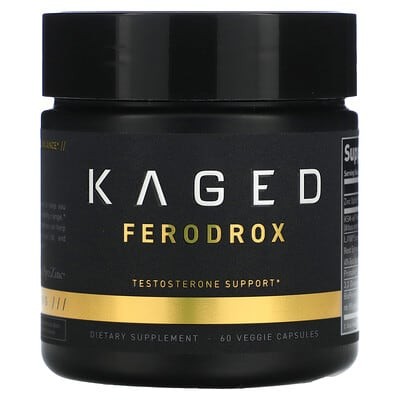

$49.99 $1.66 per serving


Product analysis
Ferodrox may help reduce perceived stress through ashwagandha, with effects depending on the extract and individual circumstances.
AI assessment of the formula, label and price. How scoring works
Nutrient Quality57
The zinc form has favorable absorption characteristics, while quality remains uncertain for most of the other ingredients. Several preparations are named, but the descriptions do not settle their quality.
Ingredient Transparency75
All amounts and most forms are disclosed. The missing DIM form and tongkat ali mixture proportions make a detailed comparison less straightforward.
Value For Money37
The zinc is relatively expensive at the full product price. Value for the other ingredients remains uncertain, leaving the cost of the whole combination difficult to judge.
Customer Satisfaction74
Customer ratings are generally positive across several hundred buyers. That provides a useful satisfaction picture without establishing specific health benefits.
Product Focus52
Stress-related support is the clearest purpose, while many wider uses depend on low nutrient intake or particular extracts. The wide range of proposed uses makes the combination less focused on one need.
- Format
Capsule - Container
- 60 Capsule(s)
- Per serving
- $1.66
- Customer rating
- 4.5 · 756 ratings
Goals

Impact
High effect
Zinc · 30 mgAshwagandha · 600 mg
KSM-66 ashwagandha has limited preparation-specific human hormone findings, with 300 mg per serving receiving only a partial amount contribution. Zinc can help when low intake impairs normal testosterone. PrimaVie shilajit is identified, but its 100 mg per serving falls below the included amount threshold. LJ100 tongkat ali cannot borrow the Physta trial findings, and DIM does not establish a controlled testosterone effect.
How this product is rated for Testosterone Support
Ingredient fit62
Ashwagandha anchors the fit, with smaller or unresolved amounts limiting some contributions. The wider formula also affects how concentrated it is on testosterone-related roles.
Goal fit
The declared actives are concentrated on ingredients considered for hormone-related roles.
Dose adequacy
Smaller or undisclosed amounts limit how much can be attributed to the relevant ingredients.
Pathways50
Stress-hormone regulation is the leading represented route. Coverage across the other specified routes is limited.
Depth
Stress-hormone regulation is the leading represented route; the ingredient-specific evidence limits still apply.
Breadth
One specified route reaches the required coverage, leaving the represented action narrow.
Evidence100
Defined ashwagandha preparations provide the strongest included human hormone findings, with limited transfer across populations and usage conditions.
Evidence strength
Ashwagandha anchors the evidence finding through defined extract studies in selected populations.
Studied preparation
The included preparations satisfy the supplied comparison; ingredient-specific trial limitations still constrain expected hormone effects.
Formulation logic100
The included ingredients meet the amount and partner checks, with no specified conflict triggered.
Partner coverage
No required supporting partner is missing for the included ingredients.
Conflicts
None of the specified ingredient conflict checks was triggered.
Effective doses
The included ingredients meet the minimum amount comparison, which is not a proven testosterone-enhancing dose.

Impact
Moderate effect
KSM-66 ashwagandha at 300 mg provides cautious adjunct support for training adaptation. Zinc supports normal nutritional needs relevant to muscle, particularly when intake is inadequate; neither ingredient establishes additional hypertrophy or a testosterone increase in an adequately nourished adult.
How this product is rated for Muscle Gain
Ingredient fit53
The saved assessment identifies 2 relevant ingredients and 3 other active ingredients; the formula serves 16 goals. The saved amount assessment is limited overall, with unknown amounts contributing no support.
Goal fit
The saved assessment identifies 2 relevant ingredients and 3 other active ingredients; the formula serves 16 goals.
Dose adequacy
The saved amount assessment is limited overall, with unknown amounts contributing no support.
Pathways40
Anabolic and stress-hormone balance is the strongest represented mechanism, with meaningful coverage in the saved findings. 1 of the three mechanism targets meets the saved coverage threshold.
Depth
Anabolic and stress-hormone balance is the strongest represented mechanism, with meaningful coverage in the saved findings.
Breadth
1 of the three mechanism targets meets the saved coverage threshold.
Evidence60
Zinc leads the saved evidence comparison among ingredients meeting the amount threshold. This comparison does not imply uniform muscle growth. The qualifying ingredients match the preparations recognized by the saved assessment.
Evidence strength
Zinc leads the saved evidence comparison among ingredients meeting the amount threshold. This comparison does not imply uniform muscle growth.
Studied preparation
The qualifying ingredients match the preparations recognized by the saved assessment.
Formulation logic100
The assessed ingredients work alone or have their required partner. No configured conflict was identified. 2 of 2 assessed ingredients meet the saved minimum amount threshold.
Partner coverage
The assessed ingredients work alone or have their required partner.
Conflicts
No configured conflict was identified.
Effective doses
2 of 2 assessed ingredients meet the saved minimum amount threshold.

Impact
Moderate effect
Zinc · 30 mg
Zinc supports normal nutritional function, while ashwagandha has limited, preparation-specific cognitive findings. The 300 mg ashwagandha amount cannot be treated as a reliable improvement in everyday work output, and zinc offers no established productivity boost when nutritional needs are met.
How this product is rated for Productivity Boost
Ingredient fit51
2 assessed ingredients relate to productivity, alongside 3 other active ingredients aimed at broader needs. The assessed amounts provide a partial match to the reviewed exposure ranges.
Goal fit
2 assessed ingredients relate to productivity, alongside 3 other active ingredients aimed at broader needs.
Dose adequacy
The assessed amounts provide a partial match to the reviewed exposure ranges.
Pathways18
Synaptic plasticity and neuroprotection is the main area of support identified in the saved assessment. Support remains narrow, with no assessed mechanism reaching the saved coverage threshold.
Depth
Synaptic plasticity and neuroprotection is the main area of support identified in the saved assessment.
Breadth
Support remains narrow, with no assessed mechanism reaching the saved coverage threshold.
Evidence91
Zinc provides the strongest evidence contribution at an assessed meaningful amount; the clinical context still matters. The ingredients assessed at meaningful amounts match preparations recognized in the saved evidence review.
Evidence strength
Zinc provides the strongest evidence contribution at an assessed meaningful amount; the clinical context still matters.
Studied preparation
The ingredients assessed at meaningful amounts match preparations recognized in the saved evidence review.
Formulation logic100
The assessed ingredients can contribute alone or have their required partner present. No ingredient conflicts were identified in the saved assessment. 2 of 2 assessed ingredients meet the saved amount threshold.
Partner coverage
The assessed ingredients can contribute alone or have their required partner present.
Conflicts
No ingredient conflicts were identified in the saved assessment.
Effective doses
2 of 2 assessed ingredients meet the saved amount threshold.

Impact
Moderate effect
Ashwagandha · 600 mg
KSM-66 ashwagandha is matched to the preparation recognized in the supplied resistance-training evidence. Its 300 mg serving provides partial exposure support, while zinc contributes normal nutritional functions without an assumed anabolic benefit.
How this product is rated for Fitness
Ingredient fit51
Fitness-related ingredients share the formula with ingredients aimed at other needs. The counted amounts provide partial exposure support.
Goal fit
Fitness-related ingredients share the formula with ingredients aimed at other needs.
Dose adequacy
The counted amounts provide partial exposure support.
Pathways16
The strongest supported mechanism is muscle protein synthesis, with limited coverage. No performance mechanism reaches the saved coverage target.
Depth
The strongest supported mechanism is muscle protein synthesis, with limited coverage.
Breadth
No performance mechanism reaches the saved coverage target.
Evidence86
Ashwagandha provides the strongest evidence contribution among ingredients counted at a sufficient amount, within the specific supplied outcomes. The counted ingredients at sufficient amounts match the preparations recognized by the saved assessment.
Evidence strength
Ashwagandha provides the strongest evidence contribution among ingredients counted at a sufficient amount, within the specific supplied outcomes.
Studied preparation
The counted ingredients at sufficient amounts match the preparations recognized by the saved assessment.
Formulation logic100
The counted ingredients can contribute independently or have their required partner. No configured ingredient conflict was identified in the supplied findings. 2 of 2 counted ingredients meet the saved minimum exposure threshold.
Partner coverage
The counted ingredients can contribute independently or have their required partner.
Conflicts
No configured ingredient conflict was identified in the supplied findings.
Effective doses
2 of 2 counted ingredients meet the saved minimum exposure threshold.

Impact
High effect
Ashwagandha · 600 mg
Ashwagandha root extract may help reduce perceived psychological stress, with the strongest direct connection among this product’s relevant ingredients. Results vary across extracts, outcomes and duration. Zinc adds conditional anxiety-related nutritional support, but does not establish broad everyday stress relief or an extra benefit from combining the ingredients.
How this product is rated for Stress Relief
Ingredient fit64
Relevant stress-related ingredients form part of a broader formula with many other purposes. The serving amounts meet part of the supplied comparison, leaving some ingredient contributions limited.
Goal fit
Relevant stress-related ingredients form part of a broader formula with many other purposes.
Dose adequacy
The serving amounts meet part of the supplied comparison, leaving some ingredient contributions limited.
Pathways77
The strongest represented area is stress-hormone regulation, based on the supplied ingredients and amounts.
Depth
The strongest represented area is stress-hormone regulation, based on the supplied ingredients and amounts.
Breadth
The more substantially represented areas are stress-hormone regulation, sleep recovery.
Evidence95
Ashwagandha provides the strongest direct perceived-stress findings here, with results dependent on preparation and study conditions.
Evidence strength
Ashwagandha provides the strongest direct perceived-stress findings here, with results dependent on preparation and study conditions.
Studied preparation
The saved comparison recognizes the counted preparations; this does not prove the whole formula relieves stress.
Formulation logic100
The counted ingredients either stand alone in the supplied comparison or have their supporting partners present. No ingredient conflict was identified by the supplied checks.
Partner coverage
The counted ingredients either stand alone in the supplied comparison or have their supporting partners present.
Conflicts
No ingredient conflict was identified by the supplied checks.
Effective doses
All counted ingredients meet the supplied minimum amount comparison, which is not a proven clinical effectiveness threshold.

Impact
High effect
Ashwagandha · 600 mgZinc · 30 mg
Zinc supplies a nutrient involved in normal immune and antioxidant functions. Ashwagandha has stress- and insomnia-specific evidence, which does not establish routine broad health benefits in healthy, unstressed adults. Extract-specific findings do not apply to every preparation.
How this product is rated for Everyday Health
Ingredient fit51
Ashwagandha and the other relevant nutrients provide the main connection to general health. Additional actives make the formula less focused on this goal.
Goal fit
Relevant nutrients contribute to general health, alongside other actives with less direct support for this goal.
Dose adequacy
The relevant amounts provide partial nutritional contributions relative to the saved comparison amounts.
Pathways40
The strongest area is stress resilience and sleep. Contributions also reach the saved coverage level across stress resilience and sleep.
Depth
The strongest supported area is stress resilience and sleep, through the relevant nutrient contributions.
Breadth
The supported areas reaching the saved coverage level are stress resilience and sleep.
Evidence96
Ashwagandha leads the saved findings, but the supplied studies concern specific populations and preparations. They do not establish routine broad-health benefits in unstressed adults.
Evidence strength
Ashwagandha leads the saved findings, but population- and preparation-specific studies do not establish routine broad-health benefit.
Studied preparation
The relevant preparations match those recognized by the saved findings; this does not establish superiority of a form or delivery method.
Formulation logic100
The relevant ingredients can contribute independently, and no configured conflict was found. Their presence together does not establish an added combination benefit.
Partner coverage
The relevant ingredients can contribute independently or have their required partners present; no extra combination benefit is established.
Conflicts
No configured ingredient conflict was identified in the supplied findings.
Effective doses
All ingredients retained for contribution meet the saved amount threshold; that threshold does not prove a clinical benefit.
Ingredients
| Ingredient | Amount per serving | Score |
|---|---|---|
OptiZinc | 30 mg | |
KSM-66 (Ashwagandha Root Extract) | 600 mg | |
LJ100 Eurycoma longifolia root extract (Eurypeptides, Glycosaponins) | 200 mg | |
PrimaVie (Shilajit Fulvic Acid Complex) | 200 mg | |
3,3 Diindolylmethane | 120 mg | |
BioPerine (Piper nigrum) | 10 mg |
Ashwagandha (Ashwagandha Root Extract) · 600 mg OverallScore85
Zinc · 30 mg OverallScore73
The serving supplies a clearly stated 30 mg of zinc as methionine, a favorable form for absorption. About $1.67 per whole-product serving is relatively costly, and the unknown copper amount prevents checking mineral balance.
How this ingredient is rated
Active Ingredient Quality & Bioavailability100
Zinc methionine is a favorable feature for absorption, with the source clearly identified.
Zinc Form Bioavailability
Methionine is a favorable zinc form for absorption.
Dose, Safety & Label Transparency67
The clearly stated amount makes the zinc contribution straightforward to compare. The unknown copper amount leaves mineral balance unverified.
Elemental Dose Transparency
The 30 mg amount is declared as elemental zinc, so no estimate of zinc yield from the source compound is needed.
Zinc Dosage Safety & Effectiveness
The 30 mg elemental zinc amount provides a substantial contribution per serving.
Zinc-to-Copper Mineral Balance
The copper amount is unknown, so zinc-to-copper balance cannot be assessed; unknown copper does not mean no copper.
Value30
The whole-product serving is relatively costly for a zinc-focused comparison; the price covers the full formula.
Price Per Serving Efficiency
About $1.67 buys one whole-product serving, rather than zinc alone.
Alternative products
Report alternatives
Sources
Published studies used for the product analysis and the top-ranked studies for each ingredient and goal.
- Acute and Repeated Ashwagandha Supplementation Improves Markers of Cognitive Function and Mood.
- Effect of ashwagandha (Withania somnifera) extract with Sominone (Somin-On™) to improve memory in adults with mild cognitive impairment: A randomized, double-blind, placebo-controlled study.
- Efficacy of Withania somnifera supplementation on adult's cognition and mood.
- A clinical assessment of the therapeutic effects of Ashwagandha root extract on cognitive performance, sleep, and fatigue in children aged 6-12 years.
- Efficacy and Safety of Ashwagandha Root Extract on Cognitive Functions in Healthy, Stressed Adults: A Randomized, Double-Blind, Placebo-Controlled Study.
- Efficacy of Zinc Supplement in Minimal hepatic Encephalopathy: A prospective, Randomized Controlled Study (Zinc-MHE Trial).
- A preliminary report: effects of zinc and micronutrient repletion on growth and neuropsychological function of urban Chinese children.
- Association between zinc deficiency and cognitive decline in community-dwelling older adults.
- Zinc status, psychological and nutritional assessment in old people recruited in five European countries: Zincage study.
- Zinc alleviates stroke development through autophagy-mediated modulation of immune microenvironment.
- A standardized Ashwagandha root extract alleviates stress, anxiety, and improves quality of life in healthy adults by modulating stress hormones: Results from a randomized, double-blind, placebo-controlled study.
- Efficacy and safety of ashwagandha root extract in children and adolescents with mild attention-deficit/hyperactivity disorder: a randomized, double-blind, placebo-controlled trial.
- Effects of zinc supplementation on parent and teacher behaviour rating scores in low socioeconomic level Turkish primary school children.
- L-shaped association between dietary zinc intake and cognitive decline in Chinese older people.
- The efficacy of zinc augmentation in children with attention deficit hyperactivity disorder under treatment with methylphenidate: A randomized controlled trial.
- Effects of multi-herb and ashwagandha root formulas on stress modulation: a randomized, double-blind, placebo-controlled clinical study.
- Efficacy and Safety of Low-Dose Ashwagandha Supplementation on Exercise Endurance: A Randomized, Placebo-Controlled, Double-Blind, Clinical Trial.
- Enhancing healthspan with Ashwagandha (Withania somnifera): a comprehensive review of its multifaceted geroprotective benefits.
- Safety and Efficacy of Ashwagandha Root Extract on Cognition, Energy and Mood Problems in Adults: Prospective, Randomized, Placebo-Controlled Study.
- A randomized, double blind, placebo controlled study to evaluate the effects of ashwagandha (Withania somnifera) extract on sleep quality in healthy adults.