
Immune Pak

Immune Pak

Animal4.8 (114 ratings)
Format:Powder Quantity: 30 Pack(s) · 30 servings
Goals
$0.00 $0.00 per serving

About this product

The clearest immune-related contribution comes from 1000 mg vitamin C, 125 mcg vitamin D and 30 mg zinc. These nutrients support normal function, particularly when intake is low, but their high amounts do not establish greater immune protection. The vitamin D serving deserves particular attention when considering other vitamin D supplements.

The herbal and antioxidant complexes provide total weights without individual ingredient amounts. Several proposed botanical components remain unconfirmed, so their names or blend weights cannot establish an additional benefit. The 5 mg black pepper extract also does not establish improved absorption of the whole combination.

Mineral disclosure and value leave further questions. The zinc amount is clear and its supporting ingredient details identify oxide, but copper is not quantified; the 220 mg calcium and 170 mg phosphorus provide partial nutritional contributions. The serving is relatively costly for its core nutrients, and the high vitamin C amount is a relevant drawback for buyers focused on training adaptation.

Who is it for
  • Adults deliberately seeking substantial immune-related nutrient amounts
  • People willing to verify their total vitamin D and zinc intake before choosing a concentrated combination
Best for
  • Combining clearly stated vitamin C, vitamin D and zinc amounts
  • Targeted nutrient intake where a genuine dietary shortfall exists

Pros

  • The three core immune-related nutrient amounts are disclosed
  • Calcium and phosphorus amounts are separately stated
  • Black pepper extract has its own declared amount

Cons

  • Individual contents and doses within the main blends are missing
  • Zinc oxide is a less favorable source form
  • Copper content is unknown alongside the substantial zinc serving
  • Black pepper does not establish better absorption of the full formula
  • Limited value for the core vitamin C and mineral contribution

Warnings

  • The 125 mcg vitamin D serving is substantial; review the intended ongoing dose and vitamin D from other supplements before combining products.
  • The 30 mg zinc serving adds materially to total zinc intake, while its copper balance remains unknown.
  • The high vitamin C amount raises a concern about training adaptation, making it a less clear fit for athletes seeking exercise gains.


Product analysis

52 out of 100

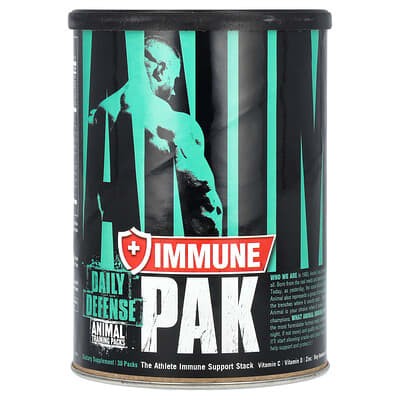
Animal Immune Pak combines immune-support nutrients and herbal ingredients in a convenient pack for athletes. Each pack provides 1,000 mg of vitamin C, 30 mg of zinc and 125 mcg of vitamin D3 to support normal immune function. The high vitamin doses do not necessarily offer extra benefits, and the vitamin D content warrants checking total intake from other supplements.

AI assessment of the formula, label and price. How scoring works

Nutrient Quality42

The pack uses vitamin D3, a well-established form. Mineral quality is less consistent, with less readily absorbed zinc oxide and unclear sources of calcium and phosphorus.

Ingredient Transparency51

The pack lists amounts for the main nutrients and two complexes, leaving the absorption blend without a stated total. Several mineral forms and the full breakdown of the complexes are unclear.

Value For Money62

The pack is good value for its vitamin C and D3, which are central to its immune-support formula. The minerals offer less consistent value, with phosphorus comparing most favorably on price.

Customer Satisfaction74

The pack has a high average rating of 4.8 out of 5. That average draws on 114 ratings, giving it a wider base of customer feedback.

Product Focus37

Immune support is the clearest use, and some of the nutrients also play roles in bone and everyday health. The complexes broaden the formula, with less clarity about what the full mix adds.

Format
Powder
Container
30 Pack(s)
Customer rating
4.8 · 114 ratings
Report analysis

Goals

Immunity
Impact
Highest effect
B Ingredient FitA+ PathwaysA+ EvidenceA+ Formulation Logic
Vitamin C · 1000 mgZinc · 30 mgVitamin D · 125 mcg

Immune Pak combines nutrients relevant to normal immune function, led by 1,000 mg vitamin C, which may modestly shorten colds with regular use. Zinc at 30 mg supports normal immune-cell function. Vitamin D3 at 125 mcg adds nutritional immune support, with no assumed extra benefit from the larger amount.

Study evidence
Zinc Supportive
Everyday Health
Impact
Highest effect
A Ingredient FitB+ PathwaysB+ EvidenceA+ Formulation Logic
Vitamin D · 125 mcgZinc · 30 mgVitamin C · 1000 mg

Immune Pak offers nutritional support for immune function when intake falls short. Vitamin D at 125 mcg supports bone and mineral metabolism as well as immune function. Vitamin C at 1000 mg and zinc at 30 mg complement its immune role, with vitamin C also supporting antioxidant defence.

Study evidence
Zinc Supportive
Testosterone Support
Impact
Moderate effect
C+ Ingredient FitF PathwaysA EvidenceA+ Formulation Logic
Zinc · 30 mgVitamin D · 125 mcg

Immune Pak offers a nutrient-gap approach to testosterone support. Zinc at 30 mg can help restore normal testosterone when zinc deficiency is present. Vitamin D3 at 125 mcg addresses vitamin D intake, but the supplied facts leave suitability at this exposure unassessed and support is mainly relevant to low vitamin D status.

Study evidence
Zinc Disputed
Impact
Highest effect
B Ingredient FitB PathwaysA EvidenceA+ Formulation Logic
Vitamin D · 125 mcgVitamin C · 1000 mg

Immune Pak offers conditional nutritional support for inflammation rather than a dependable direct benefit. Vitamin C at 1000 mg has an inflammatory-marker signal mainly in people with elevated baseline inflammation. Zinc at 30 mg is most relevant when correcting inadequate intake, while 125 mcg vitamin D has mixed and sometimes temporary inflammatory-marker findings.

Study evidence
Zinc Supportive
Impact
Highest effect
B Ingredient FitC PathwaysA+ EvidenceA+ Formulation Logic
Vitamin D · 125 mcgZinc · 30 mgVitamin C · 1000 mg

Immune Pak fits hair health mainly through 30 mg of zinc when deficiency contributes to shedding. Vitamin C at 1000 mg supports normal collagen synthesis, while 125 mcg of vitamin D3 adds a nutritional contribution relevant to follicle biology.

Study evidence
Zinc Supportive
Skin Health
Impact
High effect
B- Ingredient FitF PathwaysA+ EvidenceA+ Formulation Logic
Zinc · 30 mgVitamin C · 1000 mg

Immune Pak mainly supports skin through nutrition when intake is inadequate. Its 1,000 mg vitamin C supplies a nutrient needed for normal collagen formation and wound healing, while 30 mg zinc supports repair functions that can be impaired by deficiency. Those complementary nutritional roles explain the skin connection more clearly than a promise of cosmetic improvement.

Study evidence
Zinc Supportive

Ingredients

IngredientAmount per servingScore
Vitamin C (Ascorbic Acid)
1000 mg 64
Vitamin D (Cholecalciferol)
125 mcg
Calcium
220 mg 51
Phosphorus
170 mg 66
Zinc
30 mg 44
Immune Herbal Support Complex
2000 mg
Immune Antioxidant Complex
1250 mg
Absorption Nutrient
0 NP
Black Pepper extract
5 mg
Adults 18–50
Report overview
F Active Ingredient Quality & BioavailabilityA Dose, Safety & Label TransparencyB+ Value
Animal Immune Pak provides 1000 mg vitamin C per serving; its source is ascorbic acid. The price is low at $1.02 per serving of 1,000 mg vitamin C. Ascorbic acid is an unbuffered acid form. The Other Ingredients panel includes standard processing aids.
Phosphorus · 170 mg OverallScore66
F Active Ingredient Quality & BioavailabilityA+ Dose, Safety & Label TransparencyB+ Value
Animal Immune Pak leaves the source of its phosphorus uncertain, with 170 mg per serving. Dicalcium Phosphate appears in Other Ingredients, but the source of the listed phosphorus is not established. 170 mg is within a targeted supplemental range for bone health. At $0.45 per 75 mg of phosphorus, the price offers good value. The full formula costs $1.02 per serving.
Calcium · 220 mg OverallScore51
F Active Ingredient Quality & BioavailabilityC+ Dose, Safety & Label TransparencyD+ Value
Animal Immune Pak provides calcium. The serving supplies 220 mg calcium. This is a moderate supplemental amount. The calcium form in the nutrient entry is unspecified. Dicalcium phosphate appears in Other Ingredients, but its contribution to the calcium total is unclear. The calcium price is moderate at $0.47 per 100 mg; the full formula costs $1.02 per serving. A flow agent is listed; the available details do not name it.
Report alternatives

Sources

Published studies used for the product analysis and the top-ranked studies for each ingredient and goal.

  1. Dietary intake and blood concentrations of antioxidants and the risk of cardiovascular disease, total cancer, and all-cause mortality: a systematic review and dose-response meta-analysis of prospective studies.
    Aune D; Keum N; Giovannucci E; Fadnes LT; Boffetta P; Greenwood DC; Tonstad S; Vatten LJ; Riboli E; Norat T · The American journal of clinical nutrition · 2019
    Meta-analysis69 studies pooledEveryday Health forVitamin C
  2. Scientific Opinion on the substantiation of a health claim related to vitamin C and increasing non haem iron absorption pursuant to Article 14 of Regulation (EC) No 1924/2006.
    EFSA Panel on Dietetic Products, Nutrition and Allergies (NDA) · EFSA journal. European Food Safety Authority · 2026
    Guideline / consensusEveryday Health forVitamin C
  3. Vitamin C Depletion and All-Cause Mortality in Renal Transplant Recipients.
    Sotomayor CG; Eisenga MF; Gomes Neto AW; Ozyilmaz A; Gans ROB; Jong WHA; Zelle DM; Berger SP; Gaillard CAJM; Navis GJ; Bakker SJ · Nutrients · 2018
    Cohort study598 participantsEveryday Health forVitamin C
  4. Associations of Serum Biomarkers of Fruit and Vegetable Intake With the Risk of Cause-Specific Mortality and All-Cause Mortality: A National Prospective Cohort Study.
    Pu L; Zhang R; Wang X; Zhao T; Sun H; Han L · Frontiers in nutrition · 2022
    Cohort study12,530 participantsEveryday Health forVitamin C
  5. Relation between plasma ascorbic acid and mortality in men and women in EPIC-Norfolk prospective study: a prospective population study. European Prospective Investigation into Cancer and Nutrition.
    Khaw KT; Bingham S; Welch A; Luben R; Wareham N; Oakes S; Day N · Lancet (London, England) · 2001
    Cohort study19,496 participantsEveryday Health forVitamin C
  6. Vitamin D supplementation for prevention of mortality in adults.
    Bjelakovic G; Gluud LL; Nikolova D; Whitfield K; Wetterslev J; Simonetti RG; Bjelakovic M; Gluud C · The Cochrane database of systematic reviews · 2014
    Meta-analysis95,286 participants159 studies pooledEveryday Health forVitamin D
  7. Effect of vitamin D on gastrointestinal symptoms and health-related quality of life in irritable bowel syndrome patients: a randomized double-blind clinical trial.
    Abbasnezhad A; Amani R; Hajiani E; Alavinejad P; Cheraghian B; Ghadiri A · Neurogastroenterology and motility · 2018
    Randomized trial90 participantsEveryday Health forVitamin D
  8. The impact of vitamin D administration on mortality in COVID-19 patients: a systematic review and meta-analysis of randomized controlled trials.
    Kow CS; Ramachandram DS; Hasan SS; Wong Z; Thiruchelvam K · Inflammopharmacology · 2024
    Meta-analysis2,495 participants19 studies pooledEveryday Health forVitamin D
  9. Vitamin D Status and Mortality: A Systematic Review of Observational Studies.
    Heath AK; Kim IY; Hodge AM; English DR; Muller DC · International journal of environmental research and public health · 2019
    Systematic review84 studies pooledEveryday Health forVitamin D
  10. Meta-analysis of long-term vitamin D supplementation on overall mortality.
    Zheng Y; Zhu J; Zhou M; Cui L; Yao W; Liu Y · PloS one · 2014
    Meta-analysis42 studies pooledEveryday Health forVitamin D
  11. Effectiveness of sodium bicarbonate and zinc chloride mouthwashes in the treatment of oral mucositis and quality of life in patients with cancer under chemotherapy.
    Mohammadi F; Oshvandi K; Kamallan SR; Khazaei S; Ranjbar H; Ahmadi-Motamayel F; Gillespie M; Jenabi E; Vafaei SY · Nursing open · 2022
    Randomized trial144 participantsEveryday Health forZinc
  12. Zinc supplementation in young children with acute diarrhea in India.
    Sazawal S; Black RE; Bhan MK; Bhandari N; Sinha A; Jalla S · The New England journal of medicine · 1995
    Randomized trial937 participantsEveryday Health forZinc
  13. Associations of mortality with ocular disorders and an intervention of high-dose antioxidants and zinc in the Age-Related Eye Disease Study: AREDS Report No. 13.
    Clemons TE; Kurinij N; Sperduto RD; AREDS Research Group · Archives of ophthalmology (Chicago, Ill. : 1960) · 2004
    Randomized trial4,753 participantsEveryday Health forZinc
  14. Effects of zinc and probiotic co-supplementation on inflammation, gastrointestinal symptoms, quality of life, and mood in irritable bowel syndrome patients.
    Rezazadegan M; Soheilipour M; Amani R · Scientific reports · 2026
    Randomized trial84 participantsEveryday Health forZinc
  15. Effect of zinc sulfate supplementation on premenstrual syndrome and health-related quality of life: Clinical randomized controlled trial.
    Siahbazi S; Behboudi-Gandevani S; Moghaddam-Banaem L; Montazeri A · The journal of obstetrics and gynaecology research · 2018
    Randomized trial142 participantsEveryday Health forZinc
  16. Management of hair loss associated with endocrine therapy in patients with breast cancer: an overview.
    Karatas F; Sahin S; Sever AR; Altundag K · SpringerPlus · 2016
    Narrative reviewHair Health forVitamin C
  17. Elucidating causal relationships of diet-derived circulating antioxidants and the risk of non-scarring alopecia: A Mendelian randomization study.
    Ba Y; Shen L; Peng X; Zhang Y; Wang J · Medicine · 2024
    Methods validation study201,019 participantsHair Health forVitamin C
  18. Alterations of plasma antioxidants and mitochondrial DNA mutation in hair follicles of smokers.
    Liu CS; Chen HW; Lii CK; Tsai CS; Kuo CL; Wei YH · Environmental and molecular mutagenesis · 2002
    Observational studyHair Health forVitamin C
  19. Removal of synthetic hair dye using formamidine sulfinic acid and other sulfinate precursors.
    Hawkes JA; Lewis DM; Mama J; Murray J · International journal of cosmetic science · 2026
    Methods validation studyHair Health forVitamin C
  20. A Zinc Sulphate-Resistant Acrodermatitis Enteropathica Patient with a Novel Mutation in SLC39A4 Gene.
    Kilic M; Taskesen M; Coskun T; Gürakan F; Tokatli A; Sivri HS; Dursun A; Schmitt S; Küry S · JIMD reports · 2013
    Case reportHair Health forVitamin C