
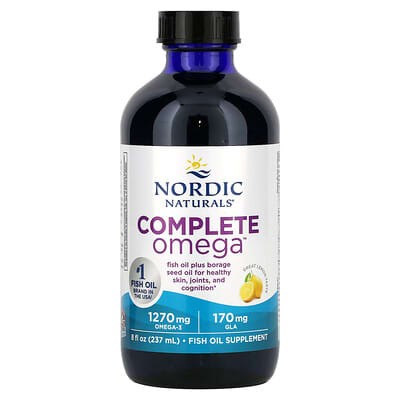

$28.86 $0.60 per serving


Product analysis
Complete Omega Lemon may modestly support joint comfort through its omega-3 content, though findings are mixed.
AI assessment of the formula, label and price. How scoring works
Nutrient Quality20
The oil forms are not clearly declared, leaving absorption difficult to compare. The range of omega fats does not itself establish a quality advantage.
Ingredient Transparency63
The listed amounts are disclosed, helping you compare servings. The oil forms are unspecified, leaving the source details incomplete.
Value For Money90
The omega-3 and omega-9 contributions offer favorable value for the amounts provided. Omega-6 offers more moderate value, so the price advantage is strongest for the other fats.
Customer Satisfaction80
Customer feedback is very favorable across several hundred ratings. Those ratings describe satisfaction without establishing joint or skin benefits.
Product Focus70
Omega-3 provides a possible, modest link to joint comfort after repeated intake. The skin evidence concerns a specific preparation, so it transfers less clearly to the mixed oil.
- Format
Liquid - Container
- 8 Fluid Ounce(s)
- Per serving
- $0.60
- Also available
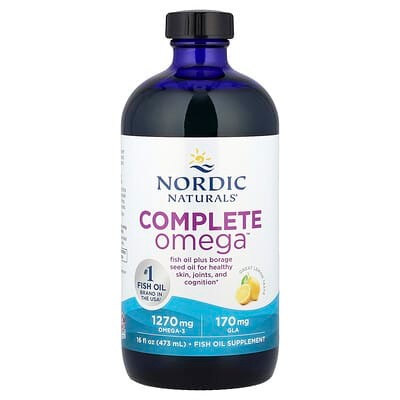 Complete Omega Lemon$50.11
- Customer rating
- 4.8 · 588 ratings
Goals

Impact
High effect
Omega-3 · 1270 mg
Omega-3 is counted toward skin-barrier lipids in the saved findings. The supplied human evidence concerns a specific purified EPA preparation and UV-response measures, rather than a general skin benefit from mixed omega-3. The declared amount contributes to the saved comparison, but unresolved composition and preparation limit transfer of those results. Gamma-linolenic acid remains unresolved rather than confirmed absent.
How this product is rated for Skin Health
Ingredient fit96
Omega-3 is the focused counted ingredient, with a declared amount.
Goal fit
Omega-3 supplies the counted contribution without unrelated actives diluting it.
Dose adequacy
The counted amount reaches the full saved comparison, without establishing an optimal dose or extra benefit from larger amounts.
Pathways50
The saved contribution is concentrated in epidermal barrier lipids.
Depth
Epidermal barrier lipids is the strongest tracked area.
Breadth
Only epidermal barrier lipids reaches the breadth comparison.
Evidence78
The supplied EPA evidence uses a specific preparation and UV-response measures, limiting transfer to generic omega-3.
Evidence strength
The supplied EPA evidence uses a specific preparation and UV-response measures, limiting transfer to generic omega-3.
Studied preparation
The saved findings accept the preparation, but the generic declaration does not establish equivalence to the specific purified EPA intervention.
Formulation logic100
The counted ingredients need no additional partner for their saved contributions. No configured ingredient conflict was matched.
Partner coverage
The counted ingredients work alone or have the required partner in the saved findings.
Conflicts
No configured ingredient conflict was matched.
Effective doses
All counted ingredients reach the saved minimum amount comparison.
Omega-9 Not classified
No linked studies yet.

Impact
Moderate effect
Omega-3 · 1270 mg
EPA at 610 mg and DHA at 405 mg relate to joint comfort through inflammatory processes, with modest and mixed findings after repeated intake. GLA remains unresolved in the supplied ingredient inventory, so no additional contribution is assigned to it.
How this product is rated for Joint Health
Ingredient fit67
Joint-related ingredients share the formula with ingredients aimed at other health needs. The included amounts provide partial support against the saved dose benchmarks.
Goal fit
Joint-related ingredients share the formula with ingredients aimed at other health needs.
Dose adequacy
The included amounts provide partial support against the saved dose benchmarks.
Pathways20
The strongest saved finding concerns inflammation-related support. None of the three target mechanisms reaches the saved coverage threshold.
Depth
The strongest saved finding concerns inflammation-related support.
Breadth
None of the three target mechanisms reaches the saved coverage threshold.
Evidence69
Omega-3 provides the strongest saved evidence rating, with modest benefits in some trials and null findings in others. The saved assessment recognizes the preparations of all ingredients included at qualifying amounts.
Evidence strength
Omega-3 provides the strongest saved evidence rating, with modest benefits in some trials and null findings in others.
Studied preparation
The saved assessment recognizes the preparations of all ingredients included at qualifying amounts.
Formulation logic100
No required ingredient partner is missing in the saved findings. No configured ingredient conflict was found in the saved assessment. All ingredients included in this finding reach the saved minimum dose threshold.
Partner coverage
No required ingredient partner is missing in the saved findings.
Conflicts
No configured ingredient conflict was found in the saved assessment.
Effective doses
All ingredients included in this finding reach the saved minimum dose threshold.
Ingredients
| Ingredient | Amount per serving | Score |
|---|---|---|
Calories | 45 Calorie(s) | |
Total Fat | 5 Gram(s) | |
Total Omega-3 Fatty Acids | 1270 mg | |
Omega-6 Fatty Acids | 500 mg | |
Omega-9 Fatty Acids | 500 mg |
Omega-9 · 500 mg OverallScore88
Omega-6 · 500 mg OverallScore78
Omega-6 provides 500 mg per liquid serving, including a clearly stated 170 mg of GLA. The liquid offers a substantial declared amount with a useful GLA breakdown, although the saved facts do not record its extraction method.
How this ingredient is rated
Active Ingredient Quality & Bioavailability64
A stated GLA amount supports a clear comparison of the identified source; the extraction method is not recorded.
Omega-6 Source & GLA Content
A GLA-containing oil source is identified, with 170 mg of GLA stated per serving.
Extraction Method & Purity
No extraction method is recorded in the saved facts, so processing cannot be assessed.
Dose, Safety & Label Transparency100
The total and GLA amounts are separately stated, making the GLA contribution directly comparable even though the other fatty acids remain unidentified.
Omega-6 Potency vs. Median
500 mg of omega-6 is stated per liquid serving.
Fatty Acid Profile Transparency
GLA is separately stated at 170 mg within 500 mg of total omega-6; the remaining fatty acids are unidentified in the saved facts.
Value60
The whole-product serving has a moderate cost, covering the full formula alongside its omega-6 contribution.
Price Per Serving Efficiency
About $0.61 per whole-product serving, including all ingredients.
Omega-3 · 1270 mg OverallScore84
Alternative products
Report alternatives
Sources
Published studies used for the product analysis and the top-ranked studies for each ingredient and goal.
- Supplementation of fish oil and olive oil in patients with rheumatoid arthritis.
- Krill oil improved osteoarthritic knee pain in adults with mild to moderate knee osteoarthritis: a 6-month multicenter, randomized, double-blind, placebo-controlled trial.
- Effects of omega-3 supplementation on lipid metabolism, inflammation, and disease activity in rheumatoid arthritis: a meta-analysis of randomized controlled trials.
- Impact of type and dose of oral polyunsaturated fatty acid supplementation on disease activity in inflammatory rheumatic diseases: a systematic literature review and meta-analysis.
- A meta-analysis of the analgesic effects of omega-3 polyunsaturated fatty acid supplementation for inflammatory joint pain.
- Dietetic intervention in psoriatic arthritis: the DIETA trial.
- Omega-3 fatty acid supplement skin cancer prophylaxis in lung transplant recipients: A randomized, controlled pilot trial.
- Clinical and metabolic response to flaxseed oil omega-3 fatty acids supplementation in patients with diabetic foot ulcer: A randomized, double-blind, placebo-controlled trial.
- Treatment of hard-to-heal wounds in ischaemic lower extremities with a novel fish skin-derived matrix.
- Effect of eicosapentaenoic acid, an omega-3 polyunsaturated fatty acid, on UVR-related cancer risk in humans. An assessment of early genotoxic markers.
- Psychosocial Burden in People with Atopic Dermatitis: Effects of a Substance-Free Basic Skincare in a Randomized Health Care Study.
- Abnormalities in epidermal lipid metabolism in patients with atopic dermatitis.
- Maternal plasma phosphatidylcholine fatty acids and atopy and wheeze in the offspring at age of 6 years.
- Plasma omega-3 and omega-6 concentrations and risk of cutaneous basal and squamous cell carcinomas in Australian adults.
- Maternal PUFA status and offspring allergic diseases up to the age of 18 months.