
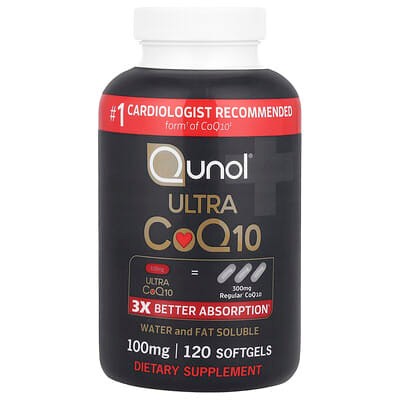

$29.97 $0.24 per serving


Product analysis
Ultra CoQ10 100 mg offers CoQ10 with tentative support for some measures of heart and blood-vessel function. The preparation is unspecified, so effects from particular CoQ10 preparations cannot be assumed.
AI assessment of the formula, label and price. How scoring works
Nutrient Quality28
The unspecified CoQ10 form limits a confident quality judgment. Vitamin E is named more clearly, but its presence does not resolve how the CoQ10 is prepared.
Ingredient Transparency75
The listed amounts are stated, making the basic quantities clear. CoQ10 lacks form details, which limits comparison with specific preparations.
Value For Money52
The CoQ10 serving offers moderate value in the available price comparison. Vitamin E lacks a usable comparison, leaving the value of that contribution uncertain.
Customer Satisfaction95
Customer ratings are very positive across a very large review pool. The volume gives a well-established picture of satisfaction without proving cardiovascular benefits.
Product Focus69
The clearest purpose is support for selected heart and blood-vessel measures, with limited and preparation-dependent evidence. Normal cellular-energy roles do not establish faster calorie burning, and the serving does not match every amount linked to those findings.
- Format
Softgel - Container
- 120 Softgel(s)
- Per serving
- $0.24
- Also available
 Ultra CoQ10 100 mg$18.48
- Customer rating
- 4.8 · 55,545 ratings
Goals

Impact
High effect
Coenzyme Q-10 · 100 mg
CoQ10 participates in cellular energy and antioxidant systems, but its visible-skin findings concern the specific Q10Vital preparation, which this declaration does not establish.
How this product is rated for Longevity
Ingredient fit85
The saved findings count a range of ingredients and compare their amounts with reference amounts. Ingredient presence and amount alone do not establish anti-aging effects.
Goal fit
The counted ingredients form a focused mixture, although the product is linked to several health purposes.
Dose adequacy
The counted amounts provide partial coverage of the saved references; that comparison does not establish a clinically effective anti-aging dose.
Pathways56
The strongest saved coverage is antioxidant defence. Mechanistic coverage does not demonstrate lifespan extension.
Depth
The strongest saved coverage concerns antioxidant defence, a mechanistic finding rather than evidence of slower human aging.
Breadth
Only antioxidant defence reaches the saved coverage threshold; other routes remain limited.
Evidence60
Vitamin E leads the saved finding, but antioxidant activity does not establish routine anti-aging benefit.
Evidence strength
Vitamin E leads the saved finding, but antioxidant activity does not establish routine anti-aging benefit.
Studied preparation
The saved preparation check remains incomplete for Coenzyme Q-10. Clinical preparation equivalence cannot be assumed.
Formulation logic100
The saved findings show partner coverage and no matched ingredient conflicts. Some amount or preparation limits may still restrict practical relevance.
Partner coverage
The counted ingredients have their required partners or work independently under the saved findings; this does not demonstrate added benefit from combining them.
Conflicts
No ingredient conflict was matched in the supplied findings.
Effective doses
All counted ingredients pass the saved minimum amount threshold, which does not establish a proven anti-aging dose.

Impact
High effect
Coenzyme Q-10 · 100 mg
CoQ10 has limited support for vascular function and some blood-pressure or lipid measures in selected populations. The declared conventional CoQ10 amount receives partial exposure recognition in the saved findings. Its identity does not establish a particular oxidation state, superior delivery or equivalence to a branded preparation. These surrogate findings do not establish routine cardiovascular-event prevention.
How this product is rated for Heart Health
Ingredient fit72
Coenzyme Q-10 provide the main relevant connections. Serving amounts and the breadth of the formula limit the connection to this goal.
Goal fit
Relevant ingredients sit within a broader formula, so only part of the ingredient mix connects to this goal.
Dose adequacy
The recognized serving amounts largely approach the saved exposure references, without establishing a clinical benefit threshold.
Pathways53
The strongest recorded connection is blood-vessel function. The formula has a narrow mechanism profile for this goal.
Depth
The strongest recorded connection is blood-vessel function; this describes a mechanism or marker rather than a proven clinical outcome.
Breadth
Meaningful recorded coverage is concentrated in blood-vessel function, leaving the broader goal only partly addressed.
Evidence98
Coenzyme Q-10 leads the recognized evidence. The supporting findings concern selected populations and vascular measures.
Evidence strength
Coenzyme Q-10 leads the recognized evidence. Its supplied limitations still apply; recognition does not establish cardiovascular-event prevention.
Studied preparation
The saved findings recognize the eligible preparations, without establishing that the finished product reproduces trial effects.
Formulation logic100
No required partner is missing and no configured conflict was found. Recognized ingredients meet the saved exposure threshold without establishing extra benefit from combining them.
Partner coverage
The recognized ingredients can contribute without an additional required partner; this does not establish synergy.
Conflicts
No configured ingredient conflict was identified in the supplied facts; this is a limited interaction check.
Effective doses
All ingredients included in this finding meet the saved minimum exposure threshold; that threshold is not proof of clinical effectiveness.

Impact
Lower effect
Coenzyme Q-10 · 100 mg

Impact
High effect
Coenzyme Q-10 · 100 mgVitamin E · 68 mg
Coenzyme Q10 has limited support for changes in blood pressure, lipids or blood-vessel lining function in selected adults with dyslipidemia. The 100 mg per serving receives substantial but partial amount recognition in the saved findings. Its preparation is not explicitly identified in the supplied product facts, limiting transfer of preparation-specific trial results. These marker findings do not establish prevention of heart attack or stroke.
How this product is rated for Cardiovascular Support
Ingredient fit82
A focused formula with substantial but partial amount recognition.
Goal fit
The included ingredients are focused on the goal, although the product is linked to several goals.
Dose adequacy
CoQ10 receives substantial partial recognition; the included vitamin E amount receives less.
Pathways53
Blood-vessel lining function is the strongest saved pathway finding. These assignments describe ingredient roles rather than proven clinical outcomes.
Depth
Blood-vessel lining function has the deepest coverage in the saved findings.
Breadth
Only blood-vessel lining function meets the coverage threshold; oxidative protection remains below it.
Evidence88
Coenzyme Q10 leads the saved evidence finding, with support limited to specific markers and populations.
Evidence strength
Coenzyme Q10 provides the highest saved evidence category among the included ingredients; this is not a probability of clinical benefit.
Studied preparation
Both included preparations pass the saved check, although the product facts do not explicitly identify the CoQ10 preparation.
Formulation logic100
The saved checks find no missing required partner and no listed ingredient conflict. Amount thresholds do not establish extra benefit from combining ingredients.
Partner coverage
Every included ingredient works alone or has its required partner in the saved check.
Conflicts
No listed ingredient conflict was found in the supplied facts.
Effective doses
Both included ingredients clear the saved amount threshold.

Impact
Moderate effect
Coenzyme Q-10 · 100 mg
Coenzyme Q-10 plays a part in cellular energy transfer, but whether taking it increases whole-body calorie burning is unclear. Changes in metabolic markers also do not necessarily mean a faster metabolism or lasting fat loss.
How this product is rated for Metabolism Support
Ingredient fit59
Coenzyme Q-10 plays a part in cellular energy transfer, but whether taking it increases whole-body calorie burning is unclear.
Goal fit
Coenzyme Q-10 plays a part in cellular energy transfer, but whether taking it increases whole-body calorie burning is unclear.
Dose adequacy
One serving supplies 100 mg of Coenzyme Q-10; comparison amounts do not guarantee increased calorie burning.
Pathways17
The connection centers on cellular energy and fat oxidation, which are different from increasing whole-body calorie burning.
Depth
The connection centers on cellular energy and fat oxidation, which are different from increasing whole-body calorie burning.
Breadth
The described metabolic roles do not imply several distinct ways to raise whole-body calorie burning.
Evidence75
Coenzyme Q-10’s cellular energy role does not demonstrate a routine increase in whole-body energy expenditure.
Evidence strength
Coenzyme Q-10’s cellular energy role does not demonstrate a routine increase in whole-body energy expenditure.
Studied preparation
The relevant preparations permit comparison for their described roles; this does not guarantee increased calorie burning.
Formulation logic100
No additional partner is required for the described ingredient roles, and no particular ingredient conflict is identified.
Partner coverage
No additional partner is required for the ingredient roles described here.
Conflicts
No particular ingredient conflict is identified.
Effective doses
The declared amounts meet lower ingredient comparisons; those comparisons are not minimum effective doses for calorie burning.

Impact
High effect
Coenzyme Q-10 · 100 mgVitamin E · 68 mg
Coenzyme Q-10 has limited biomarker relevance from statin-treated coronary disease, where some findings improved and others were null. Its 100 mg serving is below the 300 mg daily regimen studied. Vitamin E adds an antioxidant role, but that function does not establish extra clinical anti-inflammatory benefit.
How this product is rated for Inflammation
Ingredient fit70
The declared active ingredients are relatively focused on relevant roles, though their other uses also affect the finding. Amounts provide a limited match to the saved comparison ranges; unresolved quantities cannot establish a contribution.
Goal fit
The declared active ingredients are relatively focused on relevant roles, though their other uses also affect the finding.
Dose adequacy
Amounts provide a limited match to the saved comparison ranges; unresolved quantities cannot establish a contribution.
Pathways47
The strongest saved finding concerns oxidative stress, which does not itself establish clinical inflammation relief. Only oxidative stress reaches the saved coverage threshold.
Depth
The strongest saved finding concerns oxidative stress, which does not itself establish clinical inflammation relief.
Breadth
Only oxidative stress reaches the saved coverage threshold.
Evidence96
Vitamin E leads the saved evidence finding, but the scientific context limits claims of routine clinical benefit. Recognized preparation matching does not remove those limitations.
Evidence strength
Vitamin E leads the saved evidence finding, but the scientific context limits claims of routine clinical benefit.
Studied preparation
The counted preparations match those recognized in the saved findings; the supplied population and outcome limitations still apply.
Formulation logic100
Counted ingredients meet the saved amount threshold and partner requirements, with no configured conflict identified. These findings do not establish synergy or comprehensive safety.
Partner coverage
The counted ingredients work independently or have their required partner in the saved findings.
Conflicts
No configured ingredient conflict was identified; this does not assess every possible interaction.
Effective doses
All counted ingredients clear the saved amount threshold, a comparison rule rather than a proven effective dose.
Ingredients
| Ingredient | Amount per serving | Score |
|---|---|---|
Calories | 7 Calorie(s) | |
Vitamin E (DL-Alpha-Tocopheryl Acetate) | 68 mg | |
Coenzyme Q10 | 100 mg |
Coenzyme Q-10 · 100 mg OverallScore46
Each serving provides 100 mg of CoQ10. The available information does not establish which form of CoQ10 is present.
How this ingredient is rated
Active Ingredient Quality & Bioavailability12
The available information does not establish which form of CoQ10 is present.
Molecular Form: Ubiquinol vs. Ubiquinone
The available information does not establish whether the CoQ10 is ubiquinone or ubiquinol.
Formulation & Absorption Enhancers
A specialized delivery system or black pepper extract is not established in the available information.
Dose, Safety & Label Transparency72
The serving states 100 mg of CoQ10.
Clinical Dosage Alignment
The serving provides 100 mg of CoQ10.
Label Transparency & Fillers
The 100 mg amount is stated per serving, and the evaluation did not flag the specified additives or common fillers.
Value60
A whole-product serving costs about $0.25.
Price Per Effective Serving
A whole-product serving costs about $0.25.
Alternative products
Report alternatives
Sources
Published studies used for the product analysis and the top-ranked studies for each ingredient and goal.
- Effects of Coenzyme Q10 Supplementation on Lipid Profiles in Adults: A Meta-analysis of Randomized Controlled Trials.
- Six-month supplementation with high dose coenzyme Q10 improves liver steatosis, endothelial, vascular and myocardial function in patients with metabolic-dysfunction associated steatotic liver disease: a randomized double-blind, placebo-controlled trial.
- The effect of coenzyme Q10 on morbidity and mortality in chronic heart failure: results from Q-SYMBIO: a randomized double-blind trial.
- [Coenzyme Q-10 in the treatment of patients with chronic heart failure and reduced left ventricular ejection fraction: systematic review and meta-analysis].
- Effect of coenzyme Q10 in Europeans with chronic heart failure: A sub-group analysis of the Q-SYMBIO randomized double-blind trial.
- Supplementation with vitamin E alone is associated with reduced myocardial infarction: a meta-analysis.
- Vitamin E ameliorates blood cholesterol level and alters gut microbiota composition: A randomized controlled trial.
- Effects of long-term vitamin E supplementation on cardiovascular events and cancer: a randomized controlled trial.
- Independent and combined associations of dietary antioxidant exposure with all-cause and cause-specific mortality in the general population.
- Tocotrienol rich fraction supplementation improved lipid profile and oxidative status in healthy older adults: A randomized controlled study.
- Effects of Coenzyme Q10 on Statin-Induced Myopathy: An Updated Meta-Analysis of Randomized Controlled Trials.
- Coenzyme Q10 Supplementation in Athletes: A Systematic Review.
- Effectiveness of Coenzyme Q10 Supplementation for Reducing Fatigue: A Systematic Review and Meta-Analysis of Randomized Controlled Trials.
- Antifatigue effects of coenzyme Q10 during physical fatigue.
- Effect of coenzyme Q10 supplementation on fatigue: A systematic review of interventional studies.
- Ubiquinol Ameliorates Endothelial Dysfunction in Subjects with Mild-to-Moderate Dyslipidemia: A Randomized Clinical Trial.
- Dose-Response Effect of Coenzyme Q10 Supplementation on Blood Pressure among Patients with Cardiometabolic Disorders: A Grading of Recommendations Assessment, Development, and Evaluation (GRADE)-Assessed Systematic Review and Meta-Analysis of Randomized Controlled Trials.
- Effects of Coenzyme Q10 on Lipid, Glycemic, and Inflammatory Markers in Metabolic Disorders: A Systematic Review and Meta-Analysis.
- Treatment of coenzyme Q10 for 24 weeks improves lipid and glycemic profile in dyslipidemic individuals.
- The effect of coenzyme Q10 supplementation on inflammatory and endothelial dysfunction markers in overweight/obese polycystic ovary syndrome patients.