

$44.00 $0.73 per serving


Product analysis
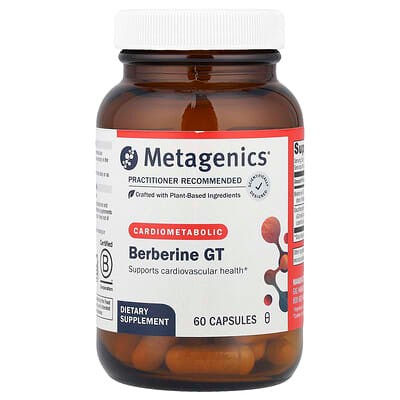
Berberine GT combines berberine with green tea compounds connected to antioxidant processes. Unclear proportions of the green tea components make it harder to compare the extract with more precisely described alternatives.
AI assessment of the formula, label and price. How scoring works
Nutrient Quality40
Both ingredients have named sources or components, but their form quality remains uncertain. Naming an extract or its compounds alone does not establish how well it performs.
Ingredient Transparency80
Both ingredient amounts and their sources or components are named. The proportions of the green tea compounds remain undisclosed.
Value For Money25
The cost is less favorable when compared on the green tea component. That comparison does not establish the value of the berberine portion.
Customer Satisfaction75
Customer ratings are very favorable. The relatively small review base makes that pattern less established.
Product Focus69
The green tea compounds have a connection to antioxidant processes. That connection does not establish longer life or preserved function from this concentrated extract.
- Format
Capsule - Container
- 60 Capsule(s)
- Per serving
- $0.73
- Customer rating
- 4.8 · 176 ratings
Goals

Impact
High effect
Green Tea · 200 mg
Green tea supplies compounds connected to antioxidant processes. Associations with drinking tea and mechanisms involving EGCG do not establish preserved function or longer life from this concentrated extract. The 200 mg serving is recognized in the saved findings, but total extract, beverage exposure and active EGCG amounts are not interchangeable.
How this product is rated for Longevity
Ingredient fit66
The formula's focus and amounts produce a partial fit with the saved ingredient references. The overall roles remain bounded by the specific evidence for this product.
Goal fit
The formula includes ingredients for other uses, so its focus on aging-related outcomes is mixed.
Dose adequacy
The recognized amounts only partly match the saved references; this does not define a proven effective anti-aging dose.
Pathways40
The saved findings are strongest for antioxidant defence, with limited breadth across the other aging-related processes.
Depth
The strongest saved finding concerns antioxidant defence; this describes ingredient roles rather than a demonstrated slowing of aging.
Breadth
Only one pathway reaches the saved coverage threshold, leaving the formula's recognized reach narrow.
Evidence82
Green Tea drives the leading saved evidence finding. The ingredient-specific limitations above still restrict which practical benefits can be expected.
Evidence strength
Green Tea supplies the leading saved evidence finding, but its specific population and outcome limitations still apply.
Studied preparation
The saved findings recognize preparation matches for the qualifying ingredients; this does not extend their evidence to broader aging outcomes.
Formulation logic100
The saved formulation findings identify no matched conflicts and no missing required partners. Amount limitations are retained in the individual findings.
Partner coverage
The recognized ingredients either work independently or have their required partner; no extra combination benefit is established.
Conflicts
No matched ingredient conflict was recorded in the supplied calculation.
Effective doses
All recognized ingredients meet the saved amount threshold, which is a calculation reference rather than proof of anti-aging efficacy.
Ingredients
| Ingredient | Amount per serving | Score |
|---|---|---|
Berberine HCl (Phellodendron amurense bark extract) | 500 mg | |
decaffeinated Green Tea (Camellia sinensis) leaf extract (Catechins, Epigallocatechin Gallate, Caffeine) | 200 mg |
A serving contains 200 mg of green tea leaf extract with 80 mg of EGCG. The extract is described as decaffeinated, but the whole-product caffeine total is not established.
How this ingredient is rated
Composition and Label Disclosure70
The 200 mg green tea extract is listed as 40% EGCG.
Declared Green Tea Marker Concentration
The 200 mg green tea extract is listed as 40% EGCG, with 80 mg of EGCG per serving. It also lists 60% catechins.
Composition and Label Disclosure40
A decaffeinated claim is recorded for green tea, but the whole-product caffeine total is not established.
Whole-Product Caffeine Disclosure
A decaffeinated claim is recorded for green tea, but the whole-product caffeine total is not established.
Commercial Price and Usability25
The whole-product price works out to about $1.83 per 200 mg of EGCG.
Cost per 200 mg Declared EGCG
The whole-product price works out to about $1.83 per 200 mg of EGCG.
Alternative products
Report alternatives
Sources
Published studies used for the product analysis and the top-ranked studies for each ingredient and goal.
- Green tea and coffee intake and risk of cognitive decline in older adults: the National Institute for Longevity Sciences, Longitudinal Study of Aging.
- Associations of green tea, coffee, and soft drink consumption with longitudinal changes in leukocyte telomere length.
- Can teatime increase one's lifetime?
- Influences of tea consumption on self-rated health and life satisfaction among older adults: Evidence from the CLHLS.
- Double-blinded, placebo-controlled trial of green tea extracts in the clinical and histologic appearance of photoaging skin.