
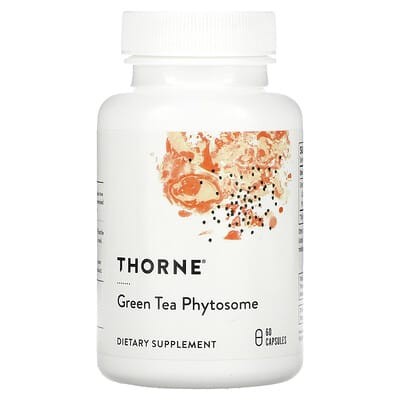

$34.00 $0.56 per serving


Product analysis
Green Tea Phytosome offers a green tea extract, but unclear amounts of its key plant compounds make the likely benefits difficult to judge.
AI assessment of the formula, label and price. How scoring works
Nutrient Quality40
The green tea extract and its phospholipid preparation are identified. That description alone does not establish better absorption or stronger health effects.
Ingredient Transparency80
The extract amount and preparation are stated, making the serving easy to identify. Its component proportions are omitted, so the amount of key tea compounds remains unclear.
Value For Money40
Value cannot be judged confidently without knowing the amount of the key tea compounds. The total extract weight does not resolve that comparison.
Customer Satisfaction80
Customer ratings are strongly positive across several hundred reviews. They describe satisfaction without establishing health effects.
Product Focus71
A single green tea ingredient keeps the formula simple. Its links to several proposed uses remain limited by mixed results and differences from the preparations studied.
- Format
Capsule - Container
- 60 Capsule(s)
- Per serving
- $0.56
- Customer rating
- 4.7 · 829 ratings
Goals

Impact
High effect
Green Tea · 250 mg

Impact
High effect
Green Tea · 250 mg

Impact
High effect
Green Tea · 250 mg

Impact
High effect
Green Tea · 250 mg

Impact
High effect
Green Tea · 250 mg
Ingredients
| Ingredient | Amount per serving | Score |
|---|---|---|
Green Tea Phytosome (Camellia sinensis extract, Phospholipid complex) | 250 mg |
The selected serving provides 250 mg of green tea phytosome. The green tea phytosome has no available numeric EGCG, catechin or polyphenol concentration. The cost per 200 mg of EGCG is unavailable because its amount is unknown. The whole-product caffeine amount is not available.
How this ingredient is rated
Composition and Label Disclosure20
The green tea phytosome has no available numeric EGCG, catechin or polyphenol concentration.
Declared Green Tea Marker Concentration
The green tea phytosome has no available numeric EGCG, catechin or polyphenol concentration.
Composition and Label Disclosure0
The whole-product caffeine amount is not available.
Whole-Product Caffeine Disclosure
The whole-product caffeine amount is not available.
Commercial Price and Usability0
The cost per 200 mg of EGCG is unavailable because its amount is unknown.
Cost per 200 mg Declared EGCG
The cost per 200 mg of EGCG is unavailable because its amount is unknown.
Alternative products
Report alternatives
Sources
Published studies used for the product analysis and the top-ranked studies for each ingredient and goal.
- Safety and efficacy of cognitive training plus epigallocatechin-3-gallate in young adults with Down's syndrome (TESDAD): a double-blind, randomised, placebo-controlled, phase 2 trial.
- Association between tea consumption and risk of cognitive disorders: A dose-response meta-analysis of observational studies.
- Investigating the Impact of Tea Consumption on Cognitive Function and Exploring Tea-Genetic Interactions in Older Adults Aged 65-105 Years: Findings from the 2002-2018 CLHLS Data.
- Consumption of green tea, but not black tea or coffee, is associated with reduced risk of cognitive decline.
- Green Tea Consumption and the Risk of Incident Dementia in Elderly Japanese: The Ohsaki Cohort 2006 Study.
- Green tea catechins and blood pressure: a systematic review and meta-analysis of randomised controlled trials.
- Effect of Green Tea on Blood Pressure in Healthy Individuals: A Meta-Analysis.
- Green tea extract reduces blood pressure, inflammatory biomarkers, and oxidative stress and improves parameters associated with insulin resistance in obese, hypertensive patients.
- Green tea intake lowers fasting serum total and LDL cholesterol in adults: a meta-analysis of 14 randomized controlled trials.
- Effects of green tea on lipid profile in overweight and obese women.
- The effects of green tea on acne vulgaris: A systematic review and meta-analysis of randomized clinical trials.
- Green Tea Catechin Association with Ultraviolet Radiation-Induced Erythema: A Systematic Review and Meta-Analysis.
- Efficacy of (-)-epigallocatechin gallate delivered by a new-type scaler tip during scaling and root planing on chronic periodontitis: a split-mouth, randomized clinical trial.
- Camellia Sinensis Mouthwashes in Oral Care: a Systematic Review.
- Skin photoprotection by green tea: antioxidant and immunomodulatory effects.
- Green tea and coffee intake and risk of cognitive decline in older adults: the National Institute for Longevity Sciences, Longitudinal Study of Aging.
- Associations of green tea, coffee, and soft drink consumption with longitudinal changes in leukocyte telomere length.
- Can teatime increase one's lifetime?
- Influences of tea consumption on self-rated health and life satisfaction among older adults: Evidence from the CLHLS.
- Double-blinded, placebo-controlled trial of green tea extracts in the clinical and histologic appearance of photoaging skin.