Product Image

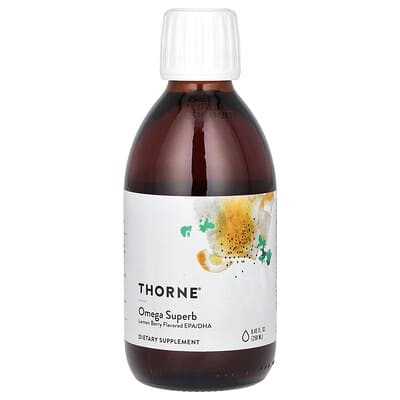
Omega Superb Lemon Berry Flavored

Thorne
4.8
★ ★ ★ ★ ★
(196 ratings)
DHA 440 mg
EPA (Eicosapentaenoic Acid) 700 mg
Product Image
Score77
A potent, pleasant-format omega-three liquid whose premium cost and conflicting quality details need consideration.
How scoring works
Quantity:8 Fluid Ounce(s) • (50 servings)
Goals:
Heart Health
Mental Focus

Score 77

A potent, pleasant-format omega-three liquid whose premium cost and conflicting quality details need consideration.
How scoring works
$50.00($1.00 per serving)
Pure Formulas
$ 50.00
iHerb
$ 50.00
Vitacost
$ 53.25
Report prices

Analysis

The liquid provides 700 mg EPA and 440 mg DHA per serving. That EPA-forward balance offers meaningful depth for cardiovascular and inflammatory support.

The supplied analyses conflict on whether triglyceride form, mixed tocopherols, and IFOS verification are established. Those inconsistencies should be clarified from the current label before treating them as quality strengths.

Lemon-berry flavor may help people who dislike plain oil or softgels. The serving cost is high, and the formula supports long-term nutritional focus rather than immediate alertness.

Who is it for
  • Adults seeking flavored liquid fish oil
  • People wanting meaningful EPA and DHA
  • Users who avoid large softgels
Best for
  • Heart-support routines
  • Long-term brain nutrition
  • EPA-forward liquid supplementation

Pros

  • Meaningful EPA and DHA amounts
  • EPA-forward balance
  • Flavored liquid delivery

Cons

  • High serving cost
  • Conflicting molecular-form information
  • Purity and antioxidant details are inconsistent

Warnings

  • Verify the current label when molecular form or testing matters
  • Fish oil may increase bleeding tendency with anticoagulants
  • Avoid with a fish allergy

Nutrient quality

91 Highest impact

The useful EPA and DHA amounts fit the intended use and avoid obvious overdosing. Related evidence supports a favorable triglyceride form, although the supplied label text does not confirm that detail.

.

Ingredient transparency

79 High impact

EPA and DHA amounts are clear and no proprietary blend is present. Molecular form, antioxidant, verification, flavor, and other inactive details are absent from the supplied product text.

.

Customer satisfaction

67 High impact

The aggregate rating is strong and review volume is moderate. No review text is supplied to assess flavor, repeated complaints, or purpose-specific experience.

.

Value for money

67 High impact

Meaningful EPA and DHA delivery gives the liquid real functional value. A high serving cost and incomplete label-level quality detail reduce its competitiveness.

.

Report analysis

Goals

Heart Health
Impact
Highest effect
A+ Goal FitA- Strength of SupportB- CoverageA+ Formula Quality
EPA (Eicosapentaenoic Acid) · 700 mg

EPA and DHA directly support triglyceride management and other cardiovascular functions. The disclosed balance provides meaningful omega-3 depth for general heart support.

The serving lists 700 mg EPA and 440 mg DHA separately, which makes the active amount easy to assess. Molecular form, oxidation control, and independent contaminant testing are not disclosed.

Study evidence
Mental Focus
Impact
High effect
D+ Goal FitB- Strength of SupportD+ CoverageA Formula Quality

EPA and DHA may support the nutritional foundation for mood and concentration, but they are not acute focus ingredients. The EPA amount is meaningful and exceeds DHA by a useful margin.

The oil weight is not fully characterized, and neither molecular form nor purity testing is disclosed. No antioxidant protection is listed, leaving oxidation control uncertain.

Study evidence

Ingredients

IngredientAmount per serving
Calories
45 Calorie(s)
Total Fat
4.5 Gram(s)
Saturated Fat
1.5 Gram(s)
Eicosapentaenoic Acid
700 mg
Docosahexaenoic Acid
440 mg
All Children
Report overview
DHA · 440 mg OverallScore70
B Active Ingredient Quality & BioavailabilityB+ Dose, Safety & Label TransparencyF Value

Triglyceride fish oil and mixed tocopherols support absorption and oxidation stability. The 440 mg DHA dose is useful, although the oil is dilute relative to total fat. IFOS verification provides strong purity assurance, but cost per gram remains high.

F Active Ingredient Quality & BioavailabilityB- Dose, Safety & Label TransparencyD+ Value

The serving provides 700 mg EPA, and epa exceeds dha by the preferred margin. EPA forms a small share of the disclosed oil weight, but the molecular form and contaminant-testing status are not disclosed. EPA cost efficiency is moderate, while no oil-protection antioxidant is listed.

Loading alternative details
Report alternatives

Sources

Published studies used for the product analysis and the top-ranked studies for each ingredient and goal.

  1. Effects of eicosapentaenoic acid on major coronary events in hypercholesterolaemic patients (JELIS): a randomised open-label, blinded endpoint analysis.
    Yokoyama M; Origasa H; Matsuzaki M; Matsuzawa Y; Saito Y; Ishikawa Y; Oikawa S; Sasaki J; Hishida H; Itakura H; Kita T; Kitabatake A; Nakaya N; Sakata T; Shimada K; Shirato K; Japan EPA lipid intervention study (JELIS) Investigators · Lancet (London, England) · 2007
    Randomized trial18,645 participantsHeart Health forEPA (Eicosapentaenoic Acid)
  2. Effects of omega-3 fatty acids on coronary revascularization and cardiovascular events: a meta-analysis.
    Dinu M; Sofi F; Lotti S; Colombini B; Mattioli AV; Catapano AL; Casula M; Baragetti A; Wong ND; Steg PG; Ambrosio G · European journal of preventive cardiology · 2024
    Meta-analysis134,144 participants18 studies pooledHeart Health forEPA (Eicosapentaenoic Acid)
  3. Meta-analysis Comparing Combined Use of Eicosapentaenoic Acid and Statin to Statin Alone.
    Doshi R; Kumar A; Thakkar S; Shariff M; Adalja D; Doshi A; Taha M; Gupta R; Desai R; Shah J; Gullapalli N · The American journal of cardiology · 2020
    Meta-analysis27,415 participants5 studies pooledHeart Health forEPA (Eicosapentaenoic Acid)
  4. Effects of EPA on coronary artery disease in hypercholesterolemic patients with multiple risk factors: sub-analysis of primary prevention cases from the Japan EPA Lipid Intervention Study (JELIS).
    Saito Y; Yokoyama M; Origasa H; Matsuzaki M; Matsuzawa Y; Ishikawa Y; Oikawa S; Sasaki J; Hishida H; Itakura H; Kita T; Kitabatake A; Nakaya N; Sakata T; Shimada K; Shirato K; JELIS Investigators, Japan · Atherosclerosis · 2008
    Randomized trial14,981 participantsHeart Health forEPA (Eicosapentaenoic Acid)
  5. Eicosapentaenoic Acid combined with optimal statin therapy improves endothelial dysfunction in patients with coronary artery disease.
    Toyama K; Nishioka T; Isshiki A; Ando T; Inoue Y; Kirimura M; Kamiyama T; Sasaki O; Ito H; Maruyama Y; Yoshimoto N · Cardiovascular drugs and therapy · 2014
    Randomized trial80 participantsHeart Health forEPA (Eicosapentaenoic Acid)
  6. Highly purified eicosapentaenoic acid reduces cardio-ankle vascular index in association with decreased serum amyloid A-LDL in metabolic syndrome.
    Satoh N; Shimatsu A; Kotani K; Himeno A; Majima T; Yamada K; Suganami T; Ogawa Y · Hypertension research : official journal of the Japanese Society of Hypertension · 2010
    Randomized trial92 participantsHeart Health forEPA (Eicosapentaenoic Acid)
  7. The Differential Effects of Eicosapentaenoic Acid and Docosahexaenoic Acid on Cardiometabolic Risk Factors: A Systematic Review.
    Innes JK; Calder PC · International journal of molecular sciences · 2018
    Systematic review527 participants6 studies pooledHeart Health forEPA (Eicosapentaenoic Acid)
  8. Highly purified eicosapentaenoic acid and docosahexaenoic acid in humans have similar triacylglycerol-lowering effects but divergent effects on serum fatty acids.
    Grimsgaard S; Bonaa KH; Hansen JB; Nordøy A · The American journal of clinical nutrition · 1997
    Randomized trial234 participantsHeart Health forEPA (Eicosapentaenoic Acid)
  9. Effect of omega-3 long-chain polyunsaturated fatty acid supplementation on heart rate: a meta-analysis of randomized controlled trials.
    Hidayat K; Yang J; Zhang Z; Chen GC; Qin LQ; Eggersdorfer M; Zhang W · European journal of clinical nutrition · 2019
    Meta-analysis3,000 participants51 studies pooledHeart Health forEPA (Eicosapentaenoic Acid)
  10. Long-Chain Polyunsaturated Fatty Acids Are Associated with Blood Pressure and Hypertension over 10-Years in Black South African Adults Undergoing Nutritional Transition.
    Zec MM; Schutte AE; Ricci C; Baumgartner J; Kruger IM; Smuts CM · Foods (Basel, Switzerland) · 2020
    Cohort study300 participantsHeart Health forEPA (Eicosapentaenoic Acid)
  11. Incremental effects of eicosapentaenoic acid on cardiovascular events in statin-treated patients with coronary artery disease.
    Matsuzaki M; Yokoyama M; Saito Y; Origasa H; Ishikawa Y; Oikawa S; Sasaki J; Hishida H; Itakura H; Kita T; Kitabatake A; Nakaya N; Sakata T; Shimada K; Shirato K; Matsuzawa Y; JELIS Investigators · Circulation journal : official journal of the Japanese Circulation Society · 2009
    Randomized trialHeart Health forEPA (Eicosapentaenoic Acid)
  12. Omega-3 Fatty Acids for the Management of Hypertriglyceridemia: A Science Advisory From the American Heart Association.
    Skulas-Ray AC; Wilson PWF; Harris WS; Brinton EA; Kris-Etherton PM; Richter CK; Jacobson TA; Engler MB; Miller M; Robinson JG; Blum CB; Rodriguez-Leyva D; de Ferranti SD; Welty FK; American Heart Association Council on Arteriosclerosis, Thrombosis and Vascular Biology; Council on Lifestyle and Cardiometabolic Health; Council on Cardiovascular Disease in the Young; Council on Cardiovascular and Stroke Nursing; and Council on Clinical Cardiology · Circulation · 2020
    OtherHeart Health forEPA (Eicosapentaenoic Acid)
  13. The influence of n-3 polyunsaturated fatty acids on cognitive function in individuals without dementia: a systematic review and dose-response meta-analysis.
    Suh SW; Lim E; Burm SY; Lee H; Bae JB; Han JW; Kim KW · BMC medicine · 2024
    Meta-analysis9,660 participants24 studies pooledMental Focus forEPA (Eicosapentaenoic Acid)
  14. EPA supplementation improves teacher-rated behaviour and oppositional symptoms in children with ADHD.
    Gustafsson PA; Birberg-Thornberg U; Duchén K; Landgren M; Malmberg K; Pelling H; Strandvik B; Karlsson T · Acta paediatrica (Oslo, Norway : 1992) · 2011
    Randomized trial92 participantsMental Focus forEPA (Eicosapentaenoic Acid)
  15. Docosahexaenoic Acid (DHA) and Eicosapentaenoic Acid (EPA)-Should They Be Mandatory Supplements in Pregnancy?
    Amza M; Haj Hamoud B; Sima RM; Dinu MD; Gorecki GP; Popescu M; Gică N; Poenaru MO; Pleș L · Biomedicines · 2024
    Narrative reviewMental Focus forEPA (Eicosapentaenoic Acid)
  16. Supplementation with oil rich in eicosapentaenoic acid, but not in docosahexaenoic acid, improves global cognitive function in healthy, young adults: results from randomized controlled trials.
    Patan MJ; Kennedy DO; Husberg C; Hustvedt SO; Calder PC; Khan J; Forster J; Jackson PA · The American journal of clinical nutrition · 2021
    Randomized trial310 participantsMental Focus forEPA (Eicosapentaenoic Acid)