Nutrient quality
The serving amount is useful, but the delivery form offers only modest quality advantages. A heavy carbohydrate load weakens the otherwise relevant active profile.
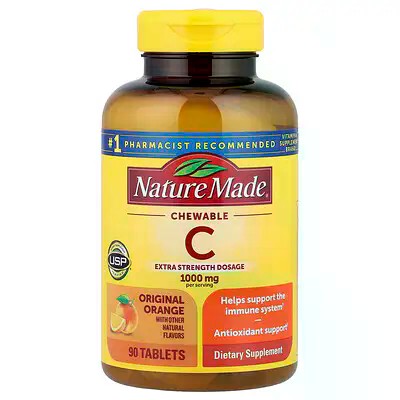
.
 iHerb iHerb | $ 9.89 | |
 Vitacost Vitacost | $ 11.89 |
The chewable supplies a substantial vitamin C amount through ascorbic acid and sodium ascorbate. Partial buffering may improve comfort, although the label presentation makes the exact split between those forms unclear.
Four grams of carbohydrate add considerable delivery overhead to a focused vitamin C product. The 100 mg sodium contribution is clearly shown, but no complementary antioxidant nutrients or useful electrolyte blend broadens the formula.
Chewable delivery can suit people who dislike capsules or powders and the serving value is reasonable. Simpler buffered capsules or powders offer cleaner formulations for users who do not need a chewable.
The serving amount is useful, but the delivery form offers only modest quality advantages. A heavy carbohydrate load weakens the otherwise relevant active profile.
.Conflicting or repeated amount presentation makes the active breakdown difficult to assess. A complete inactive-ingredient list and full use directions are not included in the supplied facts.
.The aggregate rating is very strong with a moderate review base. No specific feedback is supplied to confirm recurring complaints or purpose-related experiences.
.The formula provides moderate value for its quality and format. Carbohydrate-heavy delivery or other format overhead reduces core ingredient efficiency.
.
A full vitamin C amount directly supports antioxidant defenses and normal immune-cell function. Partial buffering with sodium ascorbate may improve tolerance compared with ascorbic acid alone.
The chewable base contains four grams of carbohydrate and duplicates vitamin C across two listed forms. Clear sodium disclosure helps, but the design remains less streamlined than a simple buffered capsule.

Vitamin C at 1,000 mg provides a full target-range amount for antioxidant and collagen support. Sodium ascorbate adds partial buffering to the chewable ascorbic-acid base.
The active amount and sodium contribution are clear, but the serving includes a notable carbohydrate base. People with a medically prescribed sodium restriction should account for the 100 mg sodium contribution.

A large vitamin C serving strongly supports collagen synthesis and antioxidant defense. Partial buffering with sodium ascorbate may improve tolerance compared with ascorbic acid alone.
Repeated quantity entries make the exact split between forms unclear. Chewable carbohydrates and sodium add delivery overhead to an otherwise focused formula.
A substantial vitamin C amount supports antioxidant defenses that may indirectly influence inflammatory stress. Partial buffering with sodium ascorbate may improve stomach comfort.
Vitamin C does not directly address the strongest inflammatory pathways in the selected goal. The carbohydrate-heavy chewable format adds bulk without broadening the formula.
A high vitamin C serving supports antioxidant defense but does not directly target the macula, retina, or lens. Vitamin C contributes to established eye-health combinations, yet it is not a complete vision formula by itself.
Partial buffering and clear sodium disclosure improve usability, while the chewable carbohydrate base adds little value. No carotenoids, zinc, copper, vitamin E, or omega-3 lipids broaden the contribution.
| Ingredient | Amount per serving |
|---|---|
Calories | 20 Calorie(s) |
Total Carbohydrate | 4 Gram(s) |
Vitamin C (Ascorbic Acid, Sodium Ascorbate) | 1000 mg |
Sodium | 100 mg |
The 1,000 mg serving is well targeted and partly buffered with sodium ascorbate. Chewable delivery and a carbohydrate-heavy base reduce formula cleanliness despite the clear sodium disclosure. The cost per gram is moderate.
The sodium amount is incidental to a high-dose vitamin C chewable and is too low for exercise hydration. Sodium ascorbate appears in the vitamin forms, but the sodium line does not clearly identify its full source and no supporting electrolytes are included. The low cost suits vitamin C use rather than athletic replenishment.
Published studies used for the product analysis and the top-ranked studies for each ingredient and goal.