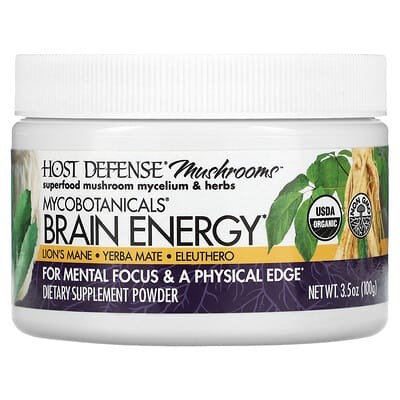
Brain Energy

Brain Energy

Host Defense MycoBotanicals4.5 (64 ratings)
Format:Powder Quantity: 3 Ounce(s) · 33 servings
Goals
$24.26 $0.73 per serving

About this product

Lion’s mane leads at 1.5 g, while yerba mate and eleuthero each provide 750 mg. The three ingredients form a clear mental-energy combination without unnecessary extras.

Yerba mate may add acute alertness, while eleuthero supports fatigue resistance and lion’s mane targets longer-term cognitive support. The label does not identify mushroom part, beta-glucans, eleuthero plant part, or active standardization.

A powder format suits people who prefer mixing a daily drink. Caffeine is not quantified, so stimulant-sensitive users cannot judge timing or likely intensity.

Who is it for
  • Adults seeking a powdered mental-energy blend
  • People who tolerate caffeine from yerba mate
Best for
  • Mental energy and focus
  • Productivity during demanding periods

Pros

  • Substantial lion’s mane amount
  • Useful eleuthero amount
  • Compact three-ingredient design
  • No proprietary blend

Cons

  • Caffeine content is not disclosed
  • Lion’s mane source and extraction are unclear
  • Eleuthero plant part is not identified
  • No active-marker standardization

Warnings

  • Undisclosed caffeine from yerba mate may cause jitters, anxiety, rapid heartbeat, or sleep disruption.
  • Eleuthero may add to the stimulating effect of yerba mate in sensitive users.
  • Avoid taking the blend late in the day when caffeine or eleuthero interferes with sleep.

Product analysis

72 out of 100
A compact three-ingredient blend covers alertness and mental stamina well, but unknown caffeine and weak source detail limit predictability.

AI assessment of the formula, label and price. How scoring works

Nutrient quality80

A substantial eleuthero amount fits whole-herb use, though plant-part and active-marker details are missing. Lion’s mane, yerba mate, and eleuthero coherently target daytime mental energy.

Ingredient transparency74

Listed active weights are mostly clear, and no proprietary blend hides a combined amount. Complete use directions and inactive ingredients are not supplied, while the eleuthero name is understandable, but species, plant part, extract ratio, or marker details are incomplete.

Customer satisfaction60

The average rating is moderate, and the review count is limited. No review text is supplied to assess recurring complaints or purpose-specific experience.

Value for money69

Useful ingredients partly justify the cost, but quality or dose gaps limit value. Serving value is fair rather than exceptional.

Format
Powder
Container
3 Ounce(s)
Per serving
$0.73
Customer rating
4.5 · 64 ratings
Report analysis

Goals

Energy
Impact
Moderate effect
B Ingredient FitD PathwaysC- EvidenceA+ Formulation Logic
Study evidence
Eleuthero Disputed 3 studies
Cognitive Support
Impact
Highest effect
A Ingredient FitC- PathwaysB+ EvidenceA+ Formulation Logic
Hericium mushroom · 1.5 Gram(s)

Lion's mane has a tentative connection to selected thinking tasks, but a generic mushroom ingredient can't be assumed to reproduce effects from a particular mushroom preparation. That leaves everyday memory and attention benefits uncertain. Yerba mate's plant amount also doesn't tell you how much caffeine it supplies, so an alertness effect can't be predicted from that quantity.

How this product is rated for Cognitive Support

Ingredient fit94

The botanical ingredients have preparation-specific or isolated task findings, leaving broad everyday cognitive benefits uncertain.
Goal fit
The botanical ingredients have preparation-specific or isolated task findings, leaving broad everyday cognitive benefits uncertain.
Dose adequacy
Lion’s mane provides 1,500 mg and eleuthero 750 mg per serving; yerba mate mass does not establish caffeine exposure.

Pathways59

Lion’s mane relates to nerve-cell structure and plasticity, but those mechanisms do not demonstrate everyday memory improvement.
Depth
Lion’s mane relates to nerve-cell structure and plasticity, but those mechanisms do not demonstrate everyday memory improvement.
Breadth
The connections are limited to selected mechanisms and should not be read as broad cognitive improvement.

Evidence82

Eleuthero has no preparation-specific cognitive exposure, and generic lion’s mane cannot inherit effects from a particular mushroom complex.
Evidence strength
The botanical ingredients have preparation-specific or isolated task findings, leaving broad everyday cognitive benefits uncertain.
Studied preparation
Eleuthero has no preparation-specific cognitive exposure, and generic lion’s mane cannot inherit effects from a particular mushroom complex.

Formulation logic100

No particular ingredient conflict or missing required partner is identified. Individual ingredient roles do not demonstrate an added benefit from the combination.
Partner coverage
The relevant ingredients can have individual roles without an additional required partner.
Conflicts
No particular ingredient conflict is identified.
Effective doses
Lion’s mane provides 1,500 mg and eleuthero 750 mg per serving; yerba mate mass does not establish caffeine exposure.
Study evidence
Eleuthero No effect 1 study
Mental Focus
Impact
Moderate effect
A Ingredient FitD- PathwaysD+ EvidenceA+ Formulation Logic
Study evidence
Eleuthero Disputed 3 studies
Productivity Boost
Impact
Lower effect
A Ingredient FitF PathwaysF EvidenceA+ Formulation Logic
Eleuthero · 750 mgEleuthero · 750 mg
Study evidence
Eleuthero No effect 1 study
Eleuthero Not classified

No linked studies yet.

Stress Relief
Impact
Moderate effect
A- Ingredient FitD- PathwaysC- EvidenceA+ Formulation Logic
Eleuthero · 750 mg

Whether Hericium mushroom meaningfully reduces perceived stress remains uncertain. Its possible effect is preliminary, and the 1,500 mg serving doesn’t settle that uncertainty. Eleuthero adds a traditional stress-related ingredient, but it has not provided additional benefit beyond stress-management training, so combining the two doesn’t make a larger benefit predictable.

How this product is rated for Stress Relief

Ingredient fit85

Eleuthero, Hericium mushroom provide the main stress-related connection, with amounts that have different practical relevance.
Goal fit
Several ingredients relate to stress, with differing roles and applicability.
Dose adequacy
Eleuthero: 750 mg; Hericium mushroom: 1500 mg per selected serving.

Pathways44

The main connection concerns resilience; that does not show how much emotional stress relief you will feel.
Depth
The main connection concerns resilience; that does not show how much emotional stress relief you will feel.
Breadth
The main connection concerns resilience; that does not show how much emotional stress relief you will feel.

Evidence59

Hericium has a preliminary possible effect on perceived stress, with substantial uncertainty.
Evidence strength
Hericium has a preliminary possible effect on perceived stress, with substantial uncertainty.
Studied preparation
Preparation-specific benefits cannot be fully transferred to every declared extract here.

Formulation logic100

No particular ingredient conflict is identified.
Partner coverage
No required complementary ingredient is missing for the relevant ingredients.
Conflicts
No particular ingredient conflict is identified.
Effective doses
Eleuthero: 750 mg; Hericium mushroom: 1500 mg per selected serving.
Study evidence
Eleuthero No effect 1 study

Ingredients

IngredientAmount per servingScore
Calories
5 Calorie(s)
Total Carbohydrates
1 Gram(s)
Lion's Mane
1.5 Gram(s)
Yerba Mate
750 mg
Eleuthero
750 mg 50
Gluten Free Adults 18–50 Organic Vegetarian
Report overview
Eleuthero · 750 mg OverallScore50
F Composition And Label DisclosureA+ Composition And Label DisclosureD+ Commercial Price And Usability
Brain Energy lists 750 mg of eleuthero per serving, with the amount and ingredient source stated. The label does not specify a plant part, and the available information gives no eleutheroside percentage or extract ratio. Its cost per serving is moderate.
How this ingredient is rated

Composition and Label Disclosure0

The label names eleuthero but does not specify a plant part, marker percentage, or extract ratio.
Eleutheroside Marker Disclosure
No eleutheroside percentage or extract ratio is stated for eleuthero.
Target Plant-Part Identification
The label does not specify which plant part is used.

Composition and Label Disclosure100

The ingredient source and its amount are stated for the serving.
Eleuthero Amount Disclosure
The label lists 750 mg of eleuthero per serving.

Commercial Price and Usability50

The cost per serving is moderate.
Selected-Serving Price Comparison
The cost per serving is moderate.
Loading alternative details
Report alternatives

Sources

Published studies used for the product analysis and the top-ranked studies for each ingredient and goal.

  1. Randomized controlled trial of Siberian ginseng for chronic fatigue.
    Hartz AJ; Bentler S; Noyes R; Hoehns J; Logemann C; Sinift S; Butani Y; Wang W; Brake K; Ernst M; Kautzman H · Psychological medicine · 2004
    Randomized trial96 participantsEnergy forEleuthero
  2. Evidence-based efficacy of adaptogens in fatigue, and molecular mechanisms related to their stress-protective activity.
    Panossian A; Wikman G · Current clinical pharmacology · 2009
    Narrative reviewEnergy Mental Focus forEleuthero
  3. No benefit adding eleutherococcus senticosus to stress management training in stress-related fatigue/weakness, impaired work or concentration, a randomized controlled study.
    Schaffler K; Wolf OT; Burkart M · Pharmacopsychiatry · 2014
    Randomized trial144 participantsMental Focus Cognitive Support Productivity Boost Stress Relief forEleuthero
  4. Stimulating effect of adaptogens: an overview with particular reference to their efficacy following single dose administration.
    Panossian A; Wagner H · Phytotherapy research : PTR · 2005
    Narrative reviewMental Focus forEleuthero
  5. The effect of eight weeks of supplementation with Eleutherococcus senticosus on endurance capacity and metabolism in human
    J Kuo, K W Chen, I S Cheng, P H Tsai, Y J Lu, N Y Lee · Chinese Journal of Physiology · 2010
    Randomized trial9 participantsEnergy forEleuthero