Product Image

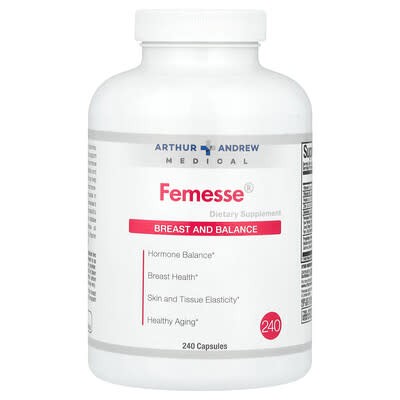
Femesse

Arthur Andrew Medical
4.3
★ ★ ★ ★ ★
(837 ratings)
Selenium 120 mcg
Vitamin E 40 IU
Vitamin B6 40 mg
Folate 100 mcg
Product Image
Score40
Useful vitamin E and selenium cannot compensate for two opaque blends and high B6. Transparency is too weak for confident use.
How scoring works
Quantity:240 Capsule(s) • (60 servings)
Goals:
Immunity
General Health

Score 40

Useful vitamin E and selenium cannot compensate for two opaque blends and high B6. Transparency is too weak for confident use.
How scoring works
$34.99($0.58 per serving)
iHerb
$ 34.99
Pure Formulas
$ 34.99
Amazon
$ 34.99
Vitacost
$ 37.49
Report prices

Analysis

Natural vitamin E and selenomethionine are favorable forms, while zinc and folate provide some basic coverage. Vitamin B6 is supplied at a substantial 40 mg amount.

More than two grams of ingredients sit inside proprietary blends with no visible components or individual doses in the supplied data. That prevents meaningful assessment of effects, interactions, allergens, and whether the product fits its intended users.

Four capsules per serving add burden without resolving the transparency gap. A formula with fully disclosed actives would be safer to compare and easier to integrate into a routine.

Who is it for
  • Only adults who can obtain the full proprietary-blend disclosure
  • Users specifically directed to the formula by a qualified professional
  • People avoiding other high-B6 products
Best for
  • No clear best use without full blend disclosure
  • Natural vitamin E and selenium coverage
  • Users with professional ingredient review

Pros

  • Uses natural vitamin E
  • Provides selenomethionine
  • Discloses zinc, folate, and B6 amounts

Cons

  • Two proprietary blends hide most actives
  • Four-capsule serving is inconvenient
  • Purpose-specific evidence cannot be judged

Warnings

  • The 40 mg vitamin B6 amount may cause nerve symptoms with prolonged use, especially when stacked with other B-complex products.
  • Unknown proprietary-blend ingredients prevent reliable medication, allergy, pregnancy, and sensitivity screening.
  • Do not use during pregnancy or breastfeeding until the complete blend composition has been reviewed by a qualified clinician.

Nutrient quality

43 Lower impact

A few visible nutrients use useful forms, but most ingredients and doses are hidden. Assertive vitamin B6 and low folate further weaken the visible formula.
Ingredient transparency

32 Situational impact

Only a few nutrient amounts are visible, while the two main blends hide their individual actives. Daily directions and a complete excipient list are not supplied.

Customer satisfaction

66 High impact

The supplied aggregate satisfaction metric is supported by the available feedback volume. No feedback excerpts or complaint themes are supplied, so specific experience patterns cannot be verified.

Value for money

21 Situational impact

Serving value is weak relative to the meaningful active content. Numerous small or hidden additions weaken price efficiency.

Report analysis

Goals

Immunity
Impact
High effect
C Goal FitC+ Strength of SupportC- CoverageB- Formula Quality
Zinc · 8 mgSelenium · 120 mcg

The main active ingredients offer some plausible support for daily physiology, but alignment with broad general health is limited. The formula covers a limited set of general-health pathways.

The disclosed amounts provide some usable support, though complete dose adequacy is uncertain. The label provides basic ingredient information but leaves some source or delivery details unclear.

General Health
Impact
Moderate effect
C Goal FitD+ Strength of SupportC CoverageD Formula Quality
Folate · 100 mcgSelenium · 120 mcgZinc · 8 mg

The formula supplies vitamin E, vitamin B6, zinc, and well-absorbed selenomethionine, giving it some legitimate foundational value. Folate is present only as a low amount of basic folic acid, while two proprietary blends hide most of the active detail.

The broad design appears aimed at a more specific women’s wellness use rather than comprehensive daily health. Prolonged use of the relatively high vitamin B6 amount may increase neuropathy risk, especially when combined with other B6-containing products.

Study evidence
Folate Supportive 80 studies
Selenium Supportive 70 studies
Zinc Supportive 60 studies

Ingredients

IngredientAmount per serving
Vitamin E (D-Alpha-Tocopherol Succinate)
40 IU
Vitamin B6 (Pyridoxine Hydrochloride)
40 mg
Folate (Folic Acid)
100 mcg
Zinc (Zinc Sulfate)
8 mg
Selenium (Selenomethionine)
120 mcg
Femesse Proprietary Blend
1940 mg
Proprietary Blend
260 mg
Gluten Free Vegan Dairy Free Women Women 18–50 Vegetarian
Report overview
A- Active Ingredient Quality & BioavailabilityA- Dose, Safety & Label TransparencyF Value

The organic selenomethionine form may support good absorption, although the label does not identify the specific isomer or a branded source. The daily amount fits a practical maintenance range and leaves a useful margin below the upper intake limit. Value is weak when the cost is adjusted to the collection's reference amount, especially because selenium is only one part of a broader blend.

D Active Ingredient Quality & BioavailabilityB- Dose, Safety & Label TransparencyB- Value

The natural d-alpha form offers better biological activity than synthetic vitamin E. The amount fits a practical maintenance dose, but the formula lacks mixed tocopherols and tocotrienols that would broaden vitamin E activity. Clear form naming and moderate serving cost support reasonable use, though isomer-level amounts are not disclosed.

D+ Active Ingredient Quality & BioavailabilityA Dose, Safety & Label TransparencyF Value

The 40 mg dose fits the targeted range, but pyridoxine hydrochloride requires conversion before the body can use it as active B6. Four capsules are needed for one serving, which may make regular use less convenient. No concerning additives are listed in the provided formula data, though the serving cost is high for an inactive B6 form.

Loading alternative details
Report alternatives

Sources

Published studies used for the product analysis and the top-ranked studies for each ingredient and goal.

  1. Intakes of Folate, Vitamin B6, and Vitamin B12 in Relation to All-Cause and Cause-Specific Mortality: A National Population-Based Cohort.
    Bo Y; Xu H; Zhang H; Zhang J; Wan Z; Zhao X; Yu Z · Nutrients · 2022
    Cohort study55,569 participantsGeneral Health forFolate
  2. The responsiveness of plasma homocysteine to small increases in dietary folic acid: a primary care study.
    Schorah CJ; Devitt H; Lucock M; Dowell AC · European journal of clinical nutrition · 1998
    Randomized trial119 participantsGeneral Health forFolate
  3. Associations of Serum Folate and Homocysteine Concentrations with All-Cause, Cardiovascular Disease, and Cancer Mortality in Men and Women in Korea: the Cardiovascular Disease Association Study.
    Song S; Song BM; Park HY · The Journal of nutrition · 2023
    Cohort study21,260 participantsGeneral Health forFolate
  4. The concept of folic acid supplementation and its role in prevention of neural tube defect among pregnant women: PRISMA.
    Seyoum Tola F · Medicine · 2024
    Systematic reviewGeneral Health forFolate
  5. Systematic review of adverse health outcomes associated with high serum or red blood cell folate concentrations.
    Colapinto CK; O'Connor DL; Sampson M; Williams B; Tremblay MS · Journal of public health (Oxford, England) · 2017
    Systematic review71,847 participants46 studies pooledGeneral Health forFolate
  6. Associations of selenium status with all-cause and cause-specific mortality: a systematic review and meta-analysis of cohort studies.
    Cui Z; Xie R; Lu X; Schomburg L; Brenner H; Schöttker B · Redox biology · 2025
    Meta-analysis95 participants20 studies pooledGeneral Health forSelenium
  7. Dietary Antioxidants, Circulating Antioxidant Concentrations, Total Antioxidant Capacity, and Risk of All-Cause Mortality: A Systematic Review and Dose-Response Meta-Analysis of Prospective Observational Studies.
    Jayedi A; Rashidy-Pour A; Parohan M; Zargar MS; Shab-Bidar S · Advances in nutrition (Bethesda, Md.) · 2019
    Meta-analysis507,251 participants41 studies pooledGeneral Health forSelenium
  8. The efficacy and safety of selenium supplementation versus placebo in the treatment of Graves' orbitopathy: A systematic review and meta-analysis of randomised controlled trials.
    Sharabati I; Qafesha RM; Hindawi MD; Amro S; Ayesh BM · Clinical endocrinology · 2024
    Meta-analysis4 studies pooledGeneral Health forSelenium
  9. Associations of plasma metal concentrations with the risks of all-cause and cardiovascular disease mortality in Chinese adults.
    Shi L; Yuan Y; Xiao Y; Long P; Li W; Yu Y; Liu Y; Liu K; Wang H; Zhou L; Yang H; Li X; He M; Wu T · Environment international · 2021
    Cohort study6,155 participantsGeneral Health forSelenium
  10. Updates on clinical studies of selenium supplementation in radiotherapy.
    Puspitasari IM; Abdulah R; Yamazaki C; Kameo S; Nakano T; Koyama H · Radiation oncology (London, England) · 2015
    Systematic review16 studies pooledGeneral Health forSelenium
  11. Effectiveness of sodium bicarbonate and zinc chloride mouthwashes in the treatment of oral mucositis and quality of life in patients with cancer under chemotherapy.
    Mohammadi F; Oshvandi K; Kamallan SR; Khazaei S; Ranjbar H; Ahmadi-Motamayel F; Gillespie M; Jenabi E; Vafaei SY · Nursing open · 2022
    Randomized trial144 participantsGeneral Health forZinc
  12. Zinc supplementation in young children with acute diarrhea in India.
    Sazawal S; Black RE; Bhan MK; Bhandari N; Sinha A; Jalla S · The New England journal of medicine · 1995
    Randomized trial937 participantsGeneral Health forZinc
  13. Associations of mortality with ocular disorders and an intervention of high-dose antioxidants and zinc in the Age-Related Eye Disease Study: AREDS Report No. 13.
    Clemons TE; Kurinij N; Sperduto RD; AREDS Research Group · Archives of ophthalmology (Chicago, Ill. : 1960) · 2004
    Randomized trial4,753 participantsGeneral Health forZinc
  14. Effects of zinc and probiotic co-supplementation on inflammation, gastrointestinal symptoms, quality of life, and mood in irritable bowel syndrome patients.
    Rezazadegan M; Soheilipour M; Amani R · Scientific reports · 2026
    Randomized trial84 participantsGeneral Health forZinc
  15. Effect of zinc sulfate supplementation on premenstrual syndrome and health-related quality of life: Clinical randomized controlled trial.
    Siahbazi S; Behboudi-Gandevani S; Moghaddam-Banaem L; Montazeri A · The journal of obstetrics and gynaecology research · 2018
    Randomized trial142 participantsGeneral Health forZinc