
Nutrient quality
Substantial resveratrol exposure and complementary botanical sources provide good formula depth. Unclear source contributions, missing purity details, and basic delivery reduce confidence.
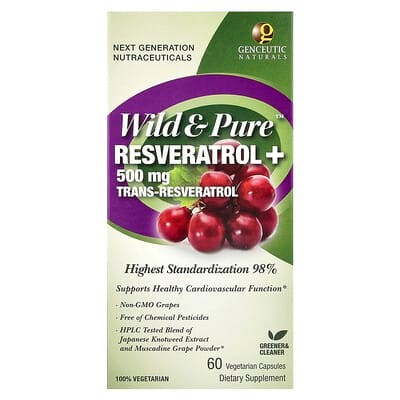
Two resveratrol sources offer substantial polyphenol exposure, but the actual active yield and knotweed purity are unclear.
Two resveratrol sources offer substantial polyphenol exposure, but the actual active yield and knotweed purity are unclear.
 iHerb iHerb | $ 52.49 | |
 Pure Formulas Pure Formulas | $ 49.40 | |
 Amazon Amazon | $ 36.74 | |
 Vitacost Vitacost | $ 52.49 |
The formula lists 500 mg resveratrol from Japanese knotweed and 500 mg from muscadine grape. It is unclear whether both entries represent active resveratrol amounts or source-extract quantities.
Using two botanical sources broadens the polyphenol profile. No enhanced-delivery feature, trans-isomer percentage, or emodin-removal statement is supplied.
One capsule and 60 servings are convenient for regular use. It fits users comfortable with a high-source blend, while dose-focused buyers should seek clearer active-yield labeling.
Substantial resveratrol exposure and complementary botanical sources provide good formula depth. Unclear source contributions, missing purity details, and basic delivery reduce confidence.
The label names the main actives and avoids a broad hidden blend. Repeated entries, missing active yields, absent directions, and undisclosed excipients reduce clarity.
The supplied average rating is very strong and the rating volume is moderate. No specific experience details were provided to judge repeated complaints or purpose alignment.
The formula provides fair value for its cost. It remains moderately competitive but does not clearly lead the category.

Trans-resveratrol may support mitochondrial signaling and insulin sensitivity without acting as a direct thermogenic. Human evidence for metabolic outcomes is mixed despite a plausible mechanism and supportive biomarker data.
The 500 mg resveratrol amount is high and provides substantial exposure. Japanese knotweed and muscadine grape sources are named, but repeated total amounts make their individual contributions unclear. Resveratrol may increase bleeding risk when combined with anticoagulant or antiplatelet medicines.

The substantial resveratrol formula may support endothelial signaling and antioxidant defenses. Human cardiovascular findings remain mixed, so it is less dependable than established lipid or mineral strategies.
Japanese knotweed and muscadine grape provide complementary sources, but the exact active yield and purity of each are unclear. Japanese knotweed can contain emodin, which may cause a mild laxative effect in sensitive users.

The stated trans-resveratrol amount is substantial and supports antioxidant and inflammatory-signaling pathways. Standard capsule delivery and unclear separation of extract weight from active yield limit confidence in exposure.
Japanese knotweed and muscadine grape provide related polyphenols rather than broad mechanistic coverage. The lack of an emodin-free statement may matter for sensitive users because residual emodin can have a laxative effect.

Resveratrol offers antioxidant support against environmental and ultraviolet stress. Human evidence for oral resveratrol and visible skin outcomes remains limited compared with collagen or astaxanthin.
The label presents a substantial trans-resveratrol claim, but extract weights, active yield, and purity are not clearly separated. Japanese knotweed is included without emodin-removal verification, which may cause a mild laxative effect in sensitive users.

Resveratrol provides plausible metabolic, vascular, and antioxidant mechanisms relevant to healthy aging. The label lists substantial amounts from knotweed and grape, but it does not clearly state how much is the active trans isomer.
The focused formula gives reasonable depth for one polyphenol pathway without covering mitochondrial, structural, or neurological aging broadly. Resveratrol may add to the effects of anticoagulant or antiplatelet medicines, particularly when combined with other products that affect clotting.
| Ingredient | Amount per serving |
|---|---|
Resveratrol (Japanese Knotweed (Polygonum cuspidatum) (root) extract, Muscadine Grape) | 500 mg |
The label identifies a substantial trans-resveratrol amount that fits the targeted daily range and offers favorable cost efficiency. Standard capsule delivery and missing purity percentages limit confidence in absorption and exact active yield. Japanese knotweed is included without an emodin-free statement, so sensitive users may face a mild laxative effect.
Published studies used for the product analysis and the top-ranked studies for each ingredient and goal.