
Nutrient quality
The clearly named trans isomer and substantial amount provide strong active depth. An unusually aggressive dose, standard delivery, and incomplete purity information weaken routine suitability.
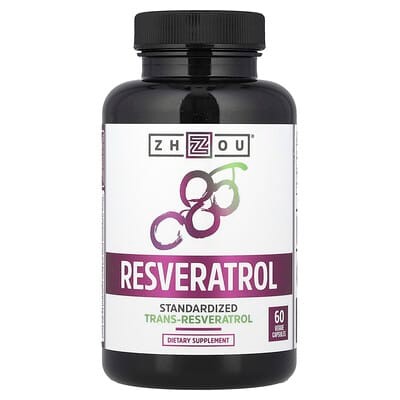
Exceptionally high trans-resveratrol exposure is clearly disclosed but too aggressive for most routine users.
Exceptionally high trans-resveratrol exposure is clearly disclosed but too aggressive for most routine users.
 Pure Formulas Pure Formulas | $ 25.69 | |
 iHerb iHerb | $ 25.69 | |
 Vitacost Vitacost | $ 25.69 | |
 Amazon Amazon | $ 21.99 |
The capsule serving supplies 1,000 mg trans-resveratrol from Japanese knotweed. Clear isomer and source disclosure make the active easy to identify.
The amount is far higher than most products in this group and does not use an enhanced-delivery system. Higher exposure may increase digestive effects without guaranteeing proportionally better support.
It may suit a professionally reviewed high-dose protocol, not casual anti-aging or metabolism use. Two capsules and only 30 servings further reduce everyday practicality.
The clearly named trans isomer and substantial amount provide strong active depth. An unusually aggressive dose, standard delivery, and incomplete purity information weaken routine suitability.
The label names the main actives and avoids a broad hidden blend. Repeated entries, missing active yields, absent directions, and undisclosed excipients reduce clarity.
The supplied average rating is strong and the rating volume is substantial. No specific experience details were provided to judge repeated complaints or purpose alignment.
The formula provides fair value for its cost. It compares well within the category despite remaining formulation limits.

Trans-resveratrol targets oxidative, vascular, and sirtuin-related pathways linked with aging. The amount is above the usual target range, and human evidence for extending healthspan remains inconsistent.
Active yield is clearly disclosed, but the capsule lacks absorption technology and emodin-free verification. The high Japanese knotweed-derived amount may increase digestive upset, especially if residual emodin is present.

Trans-resveratrol may support endothelial signaling and antioxidant defenses, but human cardiovascular results are inconsistent. It should be viewed as an adjunct rather than a foundation for lipid or blood-pressure support.
The plant source and trans form are named at a very large amount, although the repeated listing makes the true form contribution unclear. Resveratrol may increase bleeding tendency with anticoagulant or antiplatelet medicines.

Trans-resveratrol may support SIRT1 and NF-kB signaling relevant to metabolic and age-related inflammation. Human findings are mixed, and absorption is a major limitation for standard oral resveratrol.
The 1,000 mg amount is unusually high and may cause nausea, diarrhea, or abdominal discomfort. No lipid carrier or advanced delivery method is disclosed, and resveratrol may increase bleeding risk with anticoagulant or antiplatelet medicines.

Trans-resveratrol provides antioxidant support that may help the skin handle environmental stress. Its evidence for visible skin outcomes is less direct than the evidence for established structural or hydration actives.
The unusually large serving lacks an absorption aid and emodin-free verification. People taking anticoagulants should discuss this high resveratrol intake with a clinician because it may increase bleeding risk.

Trans-resveratrol may influence insulin signaling and mitochondrial regulation, giving it a plausible metabolism role. Human findings are inconsistent, and poor oral bioavailability limits confidence in a meaningful metabolism boost.
The high amount is clearly disclosed but sits above common supportive use and lacks an absorption-enhancing delivery system. Japanese knotweed without emodin-removal verification may cause digestive upset, and the high resveratrol exposure may increase bruising risk with anticoagulant or antiplatelet medicines.
| Ingredient | Amount per serving |
|---|---|
Resveratrol (Polygonum cuspidatum, Trans-Resveratrol) | 1000 mg |
The label clearly provides trans-resveratrol and pairs it with its Japanese knotweed source. The 1000 mg serving is above the usual target range and may be harder to tolerate, while the capsule lacks advanced absorption technology. Active-dose value is excellent, but the absence of emodin-free verification is a notable safety gap.
Published studies used for the product analysis and the top-ranked studies for each ingredient and goal.