Product Image

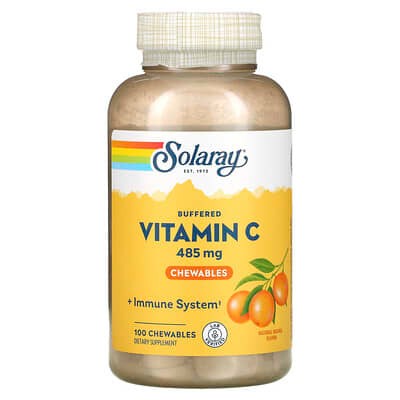
Buffered Vitamin C Chewable 500 mg Natural Orange Flavor

Solaray
4.7
★ ★ ★ ★ ★
(959 ratings)
Vitamin C 500 mg
Acerola 15 mg
Product Image
Score85
A practical buffered vitamin C chewable with good label clarity; the botanical extras play only a minor role.
How scoring works
Quantity:100 Tablet(s) • (100 servings)
Goals:
Immunity
General Health
Skin Health
Anti-Inflammatory Support

Score 85

A practical buffered vitamin C chewable with good label clarity; the botanical extras play only a minor role.
How scoring works
$16.69($0.16 per serving)
iHerb
$ 16.69
Pure Formulas
$ 16.69
Vitacost
$ 16.69
Report prices

Analysis

Calcium ascorbate supplies a meaningful vitamin C amount in a buffered form that may be easier on the stomach. The elemental calcium contribution is clearly stated, which improves label clarity.

Acerola, rose hips, and citrus bioflavonoids broaden the antioxidant theme but are present only in small amounts. Most of the benefit therefore comes from vitamin C rather than the botanical additions.

A chewable format and low serving burden make the product easy to use regularly. It fits foundational antioxidant, immune, and collagen support, but it is not a complete formula for skin or vision needs.

Who is it for
  • People who prefer chewable vitamin C
  • Users sensitive to plain ascorbic acid
Best for
  • Foundational vitamin C support
  • Simple immune and collagen support

Pros

  • Buffered calcium ascorbate form
  • Clearly stated calcium contribution
  • Convenient single-tablet serving

Cons

  • Botanical additions are lightly dosed
  • Narrow single-nutrient focus
  • Contains a small carbohydrate load

Nutrient quality

89 Highest impact

Buffered calcium ascorbate is a useful form at a meaningful amount. The accompanying fruit and bioflavonoid ingredients are small but do not disrupt the focused formula.
Ingredient transparency

87 Highest impact

All active amounts are disclosed without a proprietary blend and the single-tablet serving is clear. Non-active chewable ingredients and fuller use directions are not supplied.

Customer satisfaction

71 High impact

The average rating is strong, with a large review count supporting the signal. No detailed reviews are supplied to assess recurring complaints or experiences tied to the intended use.

Value for money

90 Highest impact

The buffered form and long supply provide strong routine value. Minor fruit and bioflavonoid additions add limited benefit without overwhelming the core ingredient.

Report analysis

Goals

Immunity
Impact
Highest effect
A+ Goal FitA+ Strength of SupportC+ CoverageB+ Formula Quality
Vitamin C · 500 mg

Buffered calcium ascorbate supplies a meaningful Vitamin C amount for immune-cell and antioxidant support. Its nutritional role is well established, and the buffered form may be gentler than plain ascorbic acid.

Acerola, rose hips, and citrus bioflavonoids broaden the antioxidant theme only modestly at their stated amounts. The chewable carbohydrate content makes the formula less streamlined than a plain capsule.

Study evidence
Vitamin C Supportive 53 studies
General Health
Impact
Highest effect
B+ Goal FitA- Strength of SupportD+ CoverageA Formula Quality
Vitamin C · 500 mg

Buffered calcium ascorbate provides a useful vitamin C amount with better stomach comfort than plain ascorbic acid. Small acerola, rose hip, and citrus bioflavonoid additions complement its antioxidant focus.

The formula remains narrow and cannot replace broad nutritional coverage. The supporting plant ingredients are modest, so most of the practical benefit comes from vitamin C itself.

Study evidence
Vitamin C Supportive 56 studies
Skin Health
Impact
Highest effect
B Goal FitA- Strength of SupportC CoverageA- Formula Quality
Vitamin C · 500 mg

Buffered calcium ascorbate with small acerola, rose-hip, and bioflavonoid additions provides a direct cofactor for collagen synthesis and contributes antioxidant protection. Its skin support is meaningful but limited to one main nutrient pathway.

The amount is well aligned with substantial vitamin C supplementation. Buffered calcium ascorbate offers good tolerance and clearly disclosed delivery.

Study evidence
Vitamin C Supportive 53 studies
Impact
High effect
B- Goal FitA- Strength of SupportC- CoverageB+ Formula Quality
Vitamin C · 500 mg

Buffered vitamin C provides a meaningful antioxidant dose that may help protect tissues from oxidative stress. Calcium ascorbate is a gentler delivery form, while small amounts of citrus flavonoids and botanicals add limited support.

The formula remains focused rather than broadly anti-inflammatory. It fits foundational antioxidant support better than targeted coverage of inflammatory enzymes or immune signaling.

Study evidence
Vitamin C Supportive 50 studies
Impact
Moderate effect
D Goal FitB- Strength of SupportD CoverageC Formula Quality
Vitamin C · 500 mg

Buffered vitamin C offers relevant antioxidant support with a form that may be gentler than plain ascorbic acid. Acerola, rose hips, and citrus bioflavonoids provide only small secondary additions.

No carotenoids, zinc, vitamin E, or retinal lipids are included. The formula is clear and focused but remains too narrow for broad vision support.

Study evidence
Vitamin C Disputed 24 studies

Ingredients

IngredientAmount per serving
Calories
10 Calorie(s)
Total Carbohydrates
1 Gram(s)
Vitamin C (Calcium Ascorbate)
500 mg
Calcium (Calcium Ascorbate)
16 mg
Acerola Cherry
15 mg
Rose Hips
15 mg
Bioflavonoid Concentrate (Citrus)
20 mg
Adults 18–50
Report overview
B+ Active Ingredient Quality & BioavailabilityB Dose, Safety & Label TransparencyA+ Value

Buffered calcium ascorbate offers good stomach comfort and a stronger delivery form than plain ascorbic acid. The 500 mg serving fits the preferred dose range and the active amount is plainly stated. Cost efficiency is excellent for a buffered chewable.

Acerola · 15 mg OverallScore27
F Active Ingredient Quality & BioavailabilityF Dose, Safety & Label TransparencyD+ Value

The formula is primarily buffered calcium ascorbate rather than an acerola-focused supplement. Acerola is present only in a small, unstandardized amount, so its natural vitamin C contribution cannot be verified. The exact acerola amount is disclosed, but the label omits its scientific name and plant part.

Loading alternative details
Report alternatives

Sources

Published studies used for the product analysis and the top-ranked studies for each ingredient and goal.


  1. Efficacy of Vitamin C as Glucocorticoid Substitute for Reducing Pain and Inflammation After Total Hip Arthroplasty: A Randomized Controlled Trial.
    Jiang W; Xu H; Jiang X; Zhan Y; Ju Y; Xie J; Huang Z; Huang Q; Pei F · The Journal of bone and joint surgery. American volume · 2025
    Randomized trial107 participantsAnti-Inflammatory Support forVitamin C
  2. The Impact of Vitamin C on Analgesic, Anti-inflammatory, and Hemostatic Outcomes After Total Hip and Knee Arthroplasty: A Systematic Review and Meta-Analysis.
    Moftakhari Hajimirzaei S; Bagherzadeh Cham M; Dolikhani M; Tabatabaee SM; Ebrahimpour A · The archives of bone and joint surgery · 2026
    Meta-analysis1,162 participants10 studies pooledAnti-Inflammatory Support forVitamin C
  3. The impact of vitamin C supplementation on the perioperative outcomes after total hip and knee arthroplasty: a systematic review and meta-analysis.
    Liu X; Guo J; Li Y; Yang Y; Liu M; Gao Q; Yang Y; Wu X; Yue C · BMC musculoskeletal disorders · 2026
    Meta-analysis852 participants8 studies pooledAnti-Inflammatory Support forVitamin C
  4. Therapeutic Impact of Ascorbic Acid on Oral and Periodontal Tissues: A Systematic Literature Review.
    Ruzijevaite G; Acaite E; Jagelaviciene E · Medicina (Kaunas, Lithuania) · 2025
    Systematic review811 participants17 studies pooledAnti-Inflammatory Support forVitamin C
  5. Oral vitamin C administration reduces early recurrence rates after electrical cardioversion of persistent atrial fibrillation and attenuates associated inflammation.
    Korantzopoulos P; Kolettis TM; Kountouris E; Dimitroula V; Karanikis P; Pappa E; Siogas K; Goudevenos JA · International journal of cardiology · 2005
    Randomized trial44 participantsAnti-Inflammatory Support forVitamin C
  6. Dietary intake and blood concentrations of antioxidants and the risk of cardiovascular disease, total cancer, and all-cause mortality: a systematic review and dose-response meta-analysis of prospective studies.
    Aune D; Keum N; Giovannucci E; Fadnes LT; Boffetta P; Greenwood DC; Tonstad S; Vatten LJ; Riboli E; Norat T · The American journal of clinical nutrition · 2019
    Meta-analysis69 studies pooledGeneral Health forVitamin C
  7. Scientific Opinion on the substantiation of a health claim related to vitamin C and increasing non haem iron absorption pursuant to Article 14 of Regulation (EC) No 1924/2006.
    EFSA Panel on Dietetic Products, Nutrition and Allergies (NDA) · EFSA journal. European Food Safety Authority · 2026
    Guideline / consensusGeneral Health forVitamin C
  8. Vitamin C Depletion and All-Cause Mortality in Renal Transplant Recipients.
    Sotomayor CG; Eisenga MF; Gomes Neto AW; Ozyilmaz A; Gans ROB; Jong WHA; Zelle DM; Berger SP; Gaillard CAJM; Navis GJ; Bakker SJ · Nutrients · 2018
    Cohort study598 participantsGeneral Health forVitamin C
  9. Associations of Serum Biomarkers of Fruit and Vegetable Intake With the Risk of Cause-Specific Mortality and All-Cause Mortality: A National Prospective Cohort Study.
    Pu L; Zhang R; Wang X; Zhao T; Sun H; Han L · Frontiers in nutrition · 2022
    Cohort study12,530 participantsGeneral Health forVitamin C
  10. Relation between plasma ascorbic acid and mortality in men and women in EPIC-Norfolk prospective study: a prospective population study. European Prospective Investigation into Cancer and Nutrition.
    Khaw KT; Bingham S; Welch A; Luben R; Wareham N; Oakes S; Day N · Lancet (London, England) · 2001
    Cohort study19,496 participantsGeneral Health forVitamin C
  11. Vitamin C and contribution to the normal function of the immune system: evaluation of a health claim pursuant to Article 14 of Regulation (EC) No 1924/2006.
    EFSA Panel on Dietetic Products, Nutrition and Allergies (NDA) · EFSA journal. European Food Safety Authority · 2026
    Guideline / consensusImmunity forVitamin C
  12. Therapeutic effects of high-dose vitamin C supplementation in patients with COVID-19: a meta-analysis.
    Sun L; Zhao JH; Fan WY; Feng B; Liu WW; Chen RQ; Ban C; Dang AG; Wang M; Luo KT; Zhou GY; Yu FF; Ba Y · Nutrition reviews · 2024
    Meta-analysis2,334 participants14 studies pooledImmunity forVitamin C
  13. Effect of micronutrient supplements on influenza and other respiratory tract infections among adults: a systematic review and meta-analysis.
    Abioye AI; Bromage S; Fawzi W · BMJ global health · 2021
    Meta-analysisImmunity forVitamin C
  14. New evidence for antioxidant properties of vitamin C.
    Vojdani A; Bazargan M; Vojdani E; Wright J · Cancer detection and prevention · 2001
    Randomized trial20 participantsImmunity forVitamin C
  15. Enhanced Vitamin C Delivery: A Systematic Literature Review Assessing the Efficacy and Safety of Alternative Supplement Forms in Healthy Adults.
    Calder PC; Kreider RB; McKay DL · Nutrients · 2025
    Systematic review13 studies pooledImmunity forVitamin C
  16. Evaluation of the anti-wrinkle effect of an ascorbic acid-loaded dissolving microneedle patch via a double-blind, placebo-controlled clinical study.
    Lee C; Yang H; Kim S; Kim M; Kang H; Kim N; An S; Koh J; Jung H · International journal of cosmetic science · 2017
    Randomized trial23 participantsSkin Health forVitamin C
  17. Comparative Study on the Outcome of Periorbital Wrinkles Treated with Laser-Assisted Delivery of Vitamin C or Vitamin C Plus Growth Factors: A Randomized, Double-blind, Clinical Trial.
    Machado BHB; Frame J; Zhang J; Najlah M · Aesthetic plastic surgery · 2021
    Randomized trial149 participantsSkin Health forVitamin C
  18. Randomized trial of topical ascorbic acid in DMSO versus imiquimod for the treatment of basal cell carcinoma.
    Burke B; Bailie JE · Biomedicine & pharmacotherapy = Biomedecine & pharmacotherapie · 2022
    Randomized trial25 participantsSkin Health forVitamin C
  19. Vitamin C improves healing of foot ulcers: a randomised, double-blind, placebo-controlled trial.
    Gunton JE; Girgis CM; Lau T; Vicaretti M; Begg L; Flood V · The British journal of nutrition · 2022
    Randomized trial16 participantsSkin Health forVitamin C
  20. Dietary nutrient intakes and skin-aging appearance among middle-aged American women.
    Cosgrove MC; Franco OH; Granger SP; Murray PG; Mayes AE · The American journal of clinical nutrition · 2007
    Cross-sectional study4,025 participantsSkin Health forVitamin C
  21. Role of Oral Vitamin 'C' on Astigmatic Errors in Phacoemulsification.
    Mohan S; Sah K; Khattri M; Ahmad L; Sachan SK · Current eye research · 2021
    Randomized trial400 participantsVision Support forVitamin C
  22. Ascorbic acid metabolites are involved in intraocular pressure control in the general population.
    Hysi PG; Khawaja AP; Menni C; Tamraz B; Wareham N; Khaw KT; Foster PJ; Benet LZ; Spector TD; Hammond CJ · Redox biology · 2019
    Observational studyVision Support forVitamin C
  23. Nutritional modulation of cataract.
    Weikel KA; Garber C; Baburins A; Taylor A · Nutrition reviews · 2014
    Narrative reviewVision Support forVitamin C
  24. Dietary n-3 Fatty Acid, α-Tocopherol, Zinc, vitamin D, vitamin C, and β-carotene are Associated with Age-Related Macular Degeneration in Japan.
    Aoki A; Inoue M; Nguyen E; Obata R; Kadonosono K; Shinkai S; Hashimoto H; Sasaki S; Yanagi Y · Scientific reports · 2017
    Case-control study530 participantsVision Support forVitamin C
  25. Adherence to a Mediterranean diet, lifestyle and age-related macular degeneration: the Coimbra Eye Study - report 3.
    Raimundo M; Mira F; Cachulo MDL; Barreto P; Ribeiro L; Farinha C; Laíns I; Nunes S; Alves D; Figueira J; Merle BM; Delcourt C; Santos L; Silva R · Acta ophthalmologica · 2019
    Case-control study883 participantsVision Support forVitamin C