
Nutrient quality
The multivitamin includes broad coverage and several suitable forms. Unmapped age-based panels and a carbohydrate-heavy liquid base prevent a confident dose assessment.
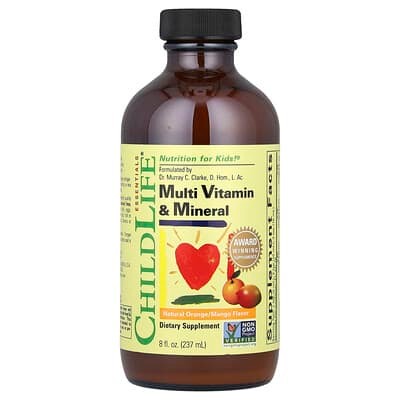
.
 iHerb iHerb | $ 18.99 | |
 Pure Formulas Pure Formulas | $ 18.99 | |
 Vitacost Vitacost | $ 18.05 | |
| Vitacost | $ 19.89 | |
 Amazon Amazon | $ 14.99 | |
 Walmart Walmart | $ 25.35 |
Broad vitamin and mineral coverage includes several favorable forms, but the supplied label appears to combine multiple age-based serving panels. Repeated amounts, modest choline and minerals, added carbohydrate, and a relatively high serving cost make exact dose quality and value difficult to judge.
Manganese gluconate offers a reasonably absorbable organic form, but the age-based servings provide maintenance-level or trace amounts rather than the collection's targeted dose. The liquid label shows the elemental amount for each serving size, which supports careful age-appropriate use.
The strongest practical fit is general nutritional support. The supplied evidence leaves meaningful uncertainty.
The multivitamin includes broad coverage and several suitable forms. Unmapped age-based panels and a carbohydrate-heavy liquid base prevent a confident dose assessment.
.Repeated panels show different nutrient amounts without linking them to age or serving size. Missing liquid-base ingredients add another major transparency gap.
.The aggregate satisfaction signal is strong and supported by extensive volume. Missing review details prevent assessment of taste, tolerance, or ease of use.
.Broad coverage has potential value, but the applicable serving panel is unclear. Clearer children’s multivitamins are easier to use safely and compare on cost.
.| Ingredient | Amount per serving |
|---|---|
Calories | 30 Calorie(s) |
Total Carbohydrates | 9 Gram(s) |
Vitamin A (Beta-Carotene, Vitamin A Palmitate) | 750 mcg |
Vitamin C (Ascorbic Acid, Sodium Ascorbate) | 203 mg |
Vitamin D3 (Cholecalciferol) | 10.5 mcg |
Vitamin E (D-Alpha-Tocopherol) | 19.5 mg |
Thiamine (Thiamine Hydrochloride) | 3 mg |
Riboflavin (Riboflavin 5-Phosphate) | 3 mg |
Niacin (Niacinamide) | 15 mg |
Vitamin B6 (Pyridoxine Hydrochloride) | 3 mg |
Folate (Folic Acid) | 330 mcg |
Vitamin B12 (Cyanocobalamin) | 9 mcg |
Biotin (D-Biotin) | 98 mcg |
Pantothenic Acid (d-Panthenol) | 10.5 mg |
Choline (Choline Bitartrate) | 30 mg |
Calcium (Calcium Lactate) | 83 mg |
Iodine (Potassium Iodide) | 75 mcg |
Magnesium (Magnesium Lactate) | 23 mg |
Zinc (Zinc Gluconate) | 7.5 mg |
Selenium (L-Selenomethionine) | 53 mcg |
Manganese (Manganese Gluconate) | 2.3 mg |
Chromium (Chromium Picolinate) | 10.5 mcg |
Sodium | 15 mg |
Potassium (Potassium Citrate) | 23 mg |
Inositol | 30 mg |
Pantothenic Acid (D-Panthenol) | 7 mg |
Manganese (Manganese Gluconate) | 1.5 mg |
Potassium (Potassium Citrate) | 15 mg |
Manganese gluconate offers a reasonably absorbable organic form, but the age-based servings provide maintenance-level or trace amounts rather than the collection's targeted dose. The liquid label shows the elemental amount for each serving size, which supports careful age-appropriate use. Its serving cost is high for manganese, though the broad vitamin and mineral formula serves a wider purpose.
The liquid multivitamin includes only a small amount of choline bitartrate, making it a minor supporting nutrient rather than a focused dose. Liquid measurement offers flexibility, and the choline amount is presented on the label. Its broad vitamin and mineral profile may have value, but choline efficiency is limited.
Synthetic folic acid reaches an adequate folate-equivalent amount at the largest listed age-based serving. Multiple age directions and repeated nutrient amounts make the label harder to interpret, while vitamin B12 falls just below the preferred level. The liquid multivitamin is expensive for a basic folate source.