Product Image

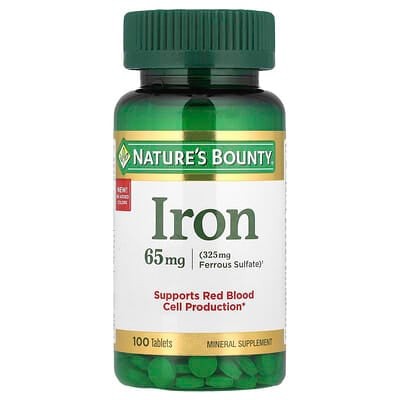
Iron 65 mg

4.7
★ ★ ★ ★ ★
(38566 ratings)
Iron 65 mg
Product Image
Score75
Ferrous sulfate is effective but commonly causes more digestive effects than chelated iron. No vitamin C or blood-cell cofactors are included, and the aggressive amount increases the need for monitoring.
How scoring works
Tablet
Quantity:100 Tablet(s) • (100 servings)
Goals:
Hair Health
Energy
Productivity Boost

Score 75

Ferrous sulfate is effective but commonly causes more digestive effects than chelated iron. No vitamin C or blood-cell cofactors are included, and the aggressive amount increases the need for monitoring.
How scoring works
$5.45($0.05 per serving)
iHerb
$ 5.45
Vitacost
$ 6.03
Amazon
$ 5.45
Walmart
$ 8.17
Report prices

Analysis

ferrous sulfate supplies 65 mg of iron in one tablet. Ferrous sulfate is effective but commonly causes more digestive effects than chelated iron.

The unusually high amount is suited to clinician-directed deficiency treatment rather than routine wellness use. The one-tablet serving is inexpensive and simple.

No vitamin C or blood-cell cofactors are included, and the aggressive amount increases the need for monitoring. Iron status and the reason for supplementation should guide duration and dose.

Who is it for
  • Adults specifically directed to use high-dose iron
  • People correcting deficiency under monitoring
  • Users who tolerate ferrous sulfate
Best for
  • Clinician-guided iron repletion
  • Very low-cost high-potency dosing
  • Short-term correction when prescribed

Pros

  • Provides a high 65 mg iron amount
  • Effective conventional form
  • One-tablet serving
  • Very low serving cost

Cons

  • High risk of constipation and nausea
  • Too strong for casual supplementation
  • No absorption or blood-cell cofactors

Warnings

  • The 65 mg ferrous sulfate serving has a high likelihood of constipation, nausea, and abdominal pain.
  • Use iron for a confirmed need; unnecessary intake can accumulate, particularly in people with hemochromatosis or other iron-overload conditions.
  • Iron can reduce absorption of levothyroxine and some tetracycline or quinolone antibiotics, so separate doses as directed by a pharmacist.
  • Keep iron supplements away from children because accidental ingestion can cause serious iron poisoning.

Nutrient quality

68 High impact

A potent iron amount can serve deficiency treatment at low cost. The high dose and less gentle sulfate form create major safety and tolerance concerns.

.
Ingredient transparency

84 Highest impact

The iron form and amount are specific, with no hidden blend. Intake directions and non-active ingredients were not included in the supplied details.

.

Customer satisfaction

73 High impact

The available satisfaction metric is favorable and the sample provides useful confidence. Specific experience details are absent, so repeated complaints and purpose fit remain uncertain.

.

Value for money

75 High impact

The very low cost is offset by weaker form quality and dose-related safety concerns. Better-tolerated products offer stronger effective value for routine use.

.

Report analysis

Goals

Hair Health
Impact
High effect
B Goal FitC+ Strength of SupportD CoverageA Formula Quality
Iron · 65 mg

Iron can reduce shedding when low iron stores are disrupting the hair-growth cycle. It is unlikely to improve hair when iron status is already adequate.

Ferrous sulfate is well established but often causes more digestive upset than gentler chelated forms. The 65 mg amount exceeds the adult daily upper limit and should be reserved for a confirmed need because it can cause constipation, nausea, and excess iron accumulation.

Study evidence
Iron Disputed 25 studies
Energy
Impact
High effect
A Goal FitD Strength of SupportD- CoverageA- Formula Quality
Iron · 65 mg

Iron directly supports oxygen transport and can improve low energy when iron deficiency is present. The single tablet provides a clearly disclosed, treatment-level amount.

A 65 mg serving is well above routine daily needs and is not suited to casual long-term use without an identified need. Ferrous sulfate is effective but commonly causes nausea or constipation and lacks an absorption-supporting cofactor.

Study evidence
Iron Supportive 74 studies
Productivity Boost
Impact
Moderate effect
B- Goal FitD Strength of SupportF CoverageB- Formula Quality
Iron · 65 mg

Iron can improve energy and concentration when deficiency limits oxygen transport. The very high amount is not an appropriate general productivity aid for people with adequate iron stores.

Ferrous sulfate is effective but commonly causes nausea or constipation. Use should be tied to a confirmed need because unnecessary high-dose iron can cause toxicity or iron overload.

Study evidence
Iron Supportive 69 studies

Ingredients

IngredientAmount per serving
Iron (Ferrous Sulfate)
65 mg
Gluten Free Adults 18–50 Dairy Free Sugar Free Vegetarian
Report overview
F Active Ingredient Quality & BioavailabilityA- Dose, Safety & Label TransparencyA+ Value

The 65 mg iron dose is high enough for deficiency-focused use but sits above routine daily needs. Ferrous sulfate is effective yet commonly less gentle on the stomach, with constipation or nausea more likely than with chelated forms. The one-tablet serving is inexpensive, although the formula lacks absorption-supporting nutrients.

Loading alternative details
Report alternatives

Sources

Published studies used for the product analysis and the top-ranked studies for each ingredient and goal.

  1. Large-dose intravenous ferric carboxymaltose injection for iron deficiency anemia in heavy uterine bleeding: a randomized, controlled trial.
    Van Wyck DB; Mangione A; Morrison J; Hadley PE; Jehle JA; Goodnough LT · Transfusion · 2010
    Randomized trial477 participantsEnergy forIron
  2. The Effect of Parenteral or Oral Iron Supplementation on Fatigue, Sleep, Quality of Life and Restless Legs Syndrome in Iron-Deficient Blood Donors: A Secondary Analysis of the IronWoMan RCT.
    Macher S; Herster C; Holter M; Moritz M; Matzhold EM; Stojakovic T; Pieber TR; Schlenke P; Drexler C; Amrein K · Nutrients · 2021
    Randomized trial176 participantsEnergy forIron
  3. Ferric carboxymaltose vs. oral iron in the treatment of pregnant women with iron deficiency anemia: an international, open-label, randomized controlled trial (FER-ASAP).
    Breymann C; Milman N; Mezzacasa A; Bernard R; Dudenhausen J; FER-ASAP investigators · Journal of perinatal medicine · 2018
    Randomized trial252 participantsEnergy forIron
  4. Effect of iron therapy on fatigue symptoms in non-anaemic iron deficient women of reproductive age- A Randomized Controlled Trial.
    Sultana N; Bajwa FA; Sikandar MZ; Haider MM; Majeed T · JPMA. The Journal of the Pakistan Medical Association · 2026
    Randomized trial164 participantsEnergy forIron
  5. Intravenous iron isomaltoside treatment of women suffering from severe fatigue after postpartum hemorrhage.
    Holm C; Thomsen LL; Langhoff-Roos J · The journal of maternal-fetal & neonatal medicine : the official journal of the European Association of Perinatal Medicine, the Federation of Asia and Oceania Perinatal Societies, the International Society of Perinatal Obstetricians · 2019
    Randomized trial85 participantsEnergy forIron
  6. The Association Between Alopecia Areata and Iron Deficiency Anemia: A Large-Scale Population-Based Case-Control Study.
    Davidovici B; Drutin Y; Ben-Tov A; Mimouni D; Wohl Y · Journal of personalized medicine · 2026
    Case-control study100,203 participantsHair Health forIron
  7. Iron Deficiency and Nonscarring Alopecia in Women: Systematic Review and Meta-Analysis.
    Treister-Goltzman Y; Yarza S; Peleg R · Skin appendage disorders · 2022
    Meta-analysis10,029 participants36 studies pooledHair Health forIron
  8. Comparative Analysis of Postoperative Hair Loss and Micronutrient Deficiencies After One-Anastomosis Gastric Bypass Versus Sleeve Gastrectomy.
    Chinisaz F; Maleki T; Najjari K; Miratashi Yazdi SA · Obesity surgery · 2026
    Cohort study261 participantsHair Health forIron
  9. Assessment of Serum Ferritin Levels in Female Patients With Telogen Effluvium.
    Thamotharan N; Harikumar MV; Sundaram M; Swaminathan A; Rangarajan S · Cureus · 2026
    Cross-sectional study100 participantsHair Health forIron
  10. Diagnosis and treatment of female alopecia: Focusing on the iron deficiency-related alopecia.
    Lin CS; Chan LY; Wang JH; Chang CH · Tzu chi medical journal · 2023
    Cohort study155 participantsHair Health forIron
  11. Effects of daily iron supplementation in primary-school-aged children: systematic review and meta-analysis of randomized controlled trials.
    Low M; Farrell A; Biggs BA; Pasricha SR · CMAJ : Canadian Medical Association journal = journal de l'Association medicale canadienne · 2014
    Meta-analysis7,089 participants32 studies pooledProductivity Boost forIron
  12. Consumption of Iron-Biofortified Beans Positively Affects Cognitive Performance in 18- to 27-Year-Old Rwandan Female College Students in an 18-Week Randomized Controlled Efficacy Trial.
    Murray-Kolb LE; Wenger MJ; Scott SP; Rhoten SE; Lung'aho MG; Haas JD · The Journal of nutrition · 2017
    Randomized trial150 participantsProductivity Boost forIron
  13. Functional consequences of iron supplementation in iron-deficient female cotton mill workers in Beijing, China.
    Li R; Chen X; Yan H; Deurenberg P; Garby L; Hautvast JG · The American journal of clinical nutrition · 1994
    Randomized trial80 participantsProductivity Boost forIron
  14. The Effect of Iron-Fortified Lentils on Blood and Cognitive Status among Adolescent Girls in Bangladesh.
    Barnett AL; Wenger MJ; Yunus FM; Jalal C; DellaValle DM · Nutrients · 2023
    Randomized trial359 participantsProductivity Boost forIron
  15. Daily iron supplementation for improving anaemia, iron status and health in menstruating women.
    Low MS; Speedy J; Styles CE; De-Regil LM; Pasricha SR · The Cochrane database of systematic reviews · 2016
    Meta-analysis8,506 participants67 studies pooledProductivity Boost forIron