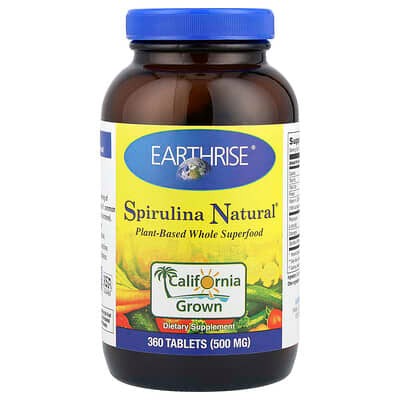
Product Image

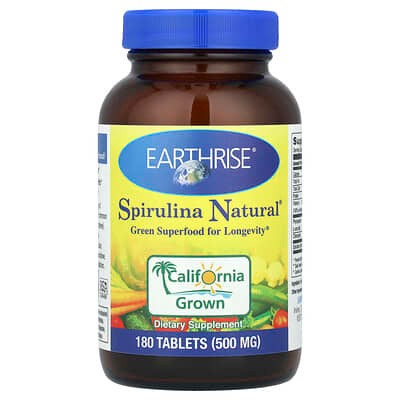
Spirulina Natural Tablets

Earthrise
4.8
★ ★ ★ ★ ★
(1547 ratings)
Vitamin A 7000 IU
Chlorophyll 30 mg
Gamma Linolenic Acid 30 mg
Protein (unspecified) 2 Gram(s)
Product Image
Score80
Useful zeaxanthin, carotenoids, and phycocyanin support the spirulina’s value, while unclear vitamin A attribution and low GLA limit more targeted use.
How scoring works
Quantity:180 Tablet(s) • (60 servings)
Goals:
Vision Support
Skin Health

Score 80

Useful zeaxanthin, carotenoids, and phycocyanin support the spirulina’s value, while unclear vitamin A attribution and low GLA limit more targeted use.
How scoring works
$14.30($0.23 per serving)
iHerb
$ 14.30
Amazon
$ 22.99
Report prices

Analysis

Zeaxanthin at 2.9 mg and total carotenoids at 11 mg give the formula its clearest relevance to vision support. Phycocyanin adds broader antioxidant value, while taking the tablets with a meal containing fat may help the carotenoids absorb.

Skin support is less direct because the 30 mg of gamma-linolenic acid is modest compared with a targeted GLA supplement. Chlorophyll is quantified, but its exact chemical form is not identified, and the stated vitamin A amount is not cleanly linked to beta-carotene.

Three tablets provide the full spirulina serving and the bottle offers a practical supply. It fits someone who wants spirulina as a food-based source of pigments and protein, not someone seeking a concentrated eye formula or meaningful GLA dose.

Who is it for
  • Adults seeking spirulina-based carotenoids
  • People wanting broad antioxidant support from a simple algae tablet
Best for
  • Zeaxanthin and mixed carotenoid intake
  • General spirulina supplementation

Pros

  • Provides 2.9 mg of zeaxanthin
  • Quantifies phycocyanin and chlorophyll
  • Supplies three grams of spirulina
  • Practical serving value

Cons

  • Vitamin A attribution is unclear
  • No lutein amount is disclosed
  • GLA amount is too low for targeted use
  • Dry tablets lack a lipid carrier

Warnings

  • Vitamin K is present at 22 mcg; people using warfarin should keep intake consistent under prescriber guidance.

Nutrient quality

80 High impact

Natural carotenoids and phycocyanin are useful, but chlorophyll form and vitamin A attribution are unclear. Spirulina, phycocyanin, carotenoids, and zeaxanthin are meaningful, while gamma-linolenic acid is modest.

.
Ingredient transparency

80 High impact

Most pigments and nutrients have amounts, but the beta-carotene line is malformed and vitamin A attribution is unclear. Most actives are named clearly, but one blank ingredient line and several unspecified forms reduce clarity.

.

Customer satisfaction

72 High impact

The supplied aggregate rating is very strong. No complaint themes or purpose-specific experience details are supplied.

.

Value for money

88 Highest impact

The useful spirulina and carotenoid profile supports good qualitative value. The whole-food formula is not inflated by many low-value extras.

.

Report analysis

Goals

Vision Support
Impact
High effect
C+ Goal FitB+ Strength of SupportC CoverageB Formula Quality
carotenoids · 11 mgVitamin A · 7000 IU

Spirulina supplies 2.9 mg of zeaxanthin and a broader carotenoid mixture that can contribute to macular pigment and antioxidant defense. The absence of a disclosed lutein amount and lipid carrier limits comparison with established eye formulas.

The three-gram spirulina dose and carotenoid amounts are clearly stated. Taking the tablets with a fat-containing meal may help absorption of the fat-soluble carotenoids.

Study evidence
Vitamin A Supportive 65 studies
Skin Health
Impact
Moderate effect
C- Goal FitC Strength of SupportC CoverageB Formula Quality
Gamma Linolenic Acid · 30 mg

Carotenoids, phycocyanin, and a small amount of gamma-linolenic acid offer antioxidant and barrier-related skin support. Evidence for spirulina is less specific to visible skin outcomes than evidence for collagen, ceramides, or targeted omega fats.

The spirulina and carotenoid amounts are useful, but the gamma-linolenic acid amount is too modest for targeted barrier support. Key pigments are quantified, though vitamin A attribution and lipid-protection details remain unclear.

Study evidence
Gamma Linolenic Acid Supportive 9 studies
Vitamin A Supportive 106 studies

Ingredients

IngredientAmount per serving
Calories
10 {Calories}
Total Fat
0 Gram(s)
Total Carbohydrates
1 Gram(s)
Protein
2 Gram(s)
Vitamin A
7000 IU
Vitamin K
22 mcg
Iron
1.7 mg
Sodium
25 mg
C-Phycocyanin
185 mg
Chlorophyll
30 mg
Gamma-Linolenic Acid
30 mg
Total Carotenoids
11 mg
Zeaxanthin
2.9 mg
Spirulina
3 Gram(s)
Gluten Free Adults 18–50 Kosher Vegetarian
Report overview
Vitamin A · 7000 IU OverallScore76
C+ Active Ingredient Quality & BioavailabilityB+ Dose, Safety & Label TransparencyB+ Value

Spirulina supplies natural beta-carotene alongside a broader carotenoid mixture, giving the formula a strong provitamin A profile. The dose is useful, but the dry tablets require fat-containing food and the label does not cleanly link the stated vitamin A amount to beta-carotene. Standardized value is good for the amount supplied.

Chlorophyll · 30 mg OverallScore68
D- Active Ingredient Quality & BioavailabilityB Dose, Safety & Label TransparencyA+ Value

The labeled chlorophyll amount meets the collection median, but its exact chemical form and botanical origin are not clearly stated. The tablet is a broad spirulina food rather than an optimized chlorophyll delivery system. Its low cost per active amount supports good value, while the simple formula avoids harsh laxatives and artificial colors.

Gamma Linolenic Acid · 30 mg OverallScore29
F Active Ingredient Quality & BioavailabilityF Dose, Safety & Label TransparencyF Value

Spirulina supplies a clearly listed amount of gamma-linolenic acid, but the daily serving is modest for a product chosen specifically for this fatty acid. The source naturally contains a low concentration of GLA, and the label gives no extraction or antioxidant protection details. Although the bottle is inexpensive, the small active amount makes its value per unit of GLA weak.

Loading alternative details
Report alternatives

Sources

Published studies used for the product analysis and the top-ranked studies for each ingredient and goal.

  1. Efficacy and Tolerability of Topical 0.1% Stabilized Bioactive Retinol for Photoaging: A Vehicle-Controlled Integrated Analysis.
    Farris P; Berson D; Bhatia N; Goldberg D; Lain E; Mariwalla K; Zeichner J; Miller D; McGuire T; Kizoulis M · Journal of drugs in dermatology : JDD · 2024
    Meta-analysis471 participants6 studies pooledSkin Health forVitamin A
  2. Biomarkers of Tretinoin Precursors and Tretinoin Efficacy in Patients With Moderate to Severe Facial Photodamage: A Randomized Clinical Trial.
    Chien AL; Kim DJ; Cheng N; Shin J; Leung SG; Nelson AM; Zang J; Suh H; Rainer B; Wallis L; Okoye GA; Loss M; Kang S · JAMA dermatology · 2022
    Randomized trial24 participantsSkin Health forVitamin A
  3. Photodecomposition of vitamin A and photobiological implications for the skin.
    Fu PP; Xia Q; Yin JJ; Cherng SH; Yan J; Mei N; Chen T; Boudreau MD; Howard PC; Wamer WG · Photochemistry and photobiology · 2007
    Narrative reviewSkin Health forVitamin A
  4. Meta-analysis of placebo-controlled studies of the efficacy of Epogam in the treatment of atopic eczema. Relationship between plasma essential fatty acid changes and clinical response.
    Morse PF; Horrobin DF; Manku MS; Stewart JC; Allen R; Littlewood S; Wright S; Burton J; Gould DJ; Holt PJ · The British journal of dermatology · 1989
    Meta-analysis9 studies pooledSkin Health forGamma Linolenic Acid
  5. Evening primrose oil (Epogam) in the treatment of chronic hand dermatitis: disappointing therapeutic results.
    Whitaker DK; Cilliers J; de Beer C · Dermatology (Basel, Switzerland) · 1997
    Randomized trial39 participantsSkin Health forGamma Linolenic Acid
  6. Effect of Evening Primrose Oil on Korean Patients With Mild Atopic Dermatitis: A Randomized, Double-Blinded, Placebo-Controlled Clinical Study.
    Chung BY; Park SY; Jung MJ; Kim HO; Park CW · Annals of dermatology · 2022
    Randomized trial50 participantsSkin Health forGamma Linolenic Acid
  7. Effect of short-term, high-dose retinol on dark adaptation in aging and early age-related maculopathy.
    Owsley C; McGwin G; Jackson GR; Heimburger DC; Piyathilake CJ; Klein R; White MF; Kallies K · Investigative ophthalmology & visual science · 2006
    Randomized trial104 participantsVision Support forVitamin A
  8. Vitamin A and fish oils for retinitis pigmentosa.
    Rayapudi S; Schwartz SG; Wang X; Chavis P · The Cochrane database of systematic reviews · 2014
    Systematic review866 participants3 studies pooledVision Support forVitamin A
  9. Long-term effects of fenretinide on retinal function.
    Decensi A; Fontana V; Fioretto M; Rondanina G; Torrisi R; Orengo MA; Costa A · European journal of cancer (Oxford, England : 1990) · 1997
    Clinical trial42 participantsVision Support forVitamin A
  10. Reduced levels of prostaglandin precursors in the blood of atopic patients: defective delta-6-desaturase function as a biochemical basis for atopy.
    Manku MS; Horrobin DF; Morse N; Kyte V; Jenkins K; Wright S; Burton JL · Prostaglandins, leukotrienes, and medicine · 1983
    Non-randomized trial50 participantsSkin Health forGamma Linolenic Acid
  11. Effect of borage oil consumption on fatty acid metabolism, transepidermal water loss and skin parameters in elderly people.
    Brosche T; Platt D · Archives of gerontology and geriatrics · 2005
    Non-randomized trial29 participantsSkin Health forGamma Linolenic Acid
  12. Effects of oral supplementation with evening primrose oil for six weeks on plasma essential fatty acids and uremic skin symptoms in hemodialysis patients.
    Yoshimoto-Furuie K; Yoshimoto K; Tanaka T; Saima S; Kikuchi Y; Shay J; Horrobin DF; Echizen H · Nephron · 1999
    Randomized trial16 participantsSkin Health forGamma Linolenic Acid
  13. Tensile properties and contours of aging facial skin. A controlled double-blind comparative study of the effects of retinol, melibiose-lactose and their association.
    Piérard-Franchimont C; Castelli D; Cromphaut IV; Bertin C; Ries G; Cauwenbergh G; Piérard GE · Skin research and technology : official journal of International Society for Bioengineering and the Skin (ISBS) [and] International Society for Digital Imaging of Skin (ISDIS) [and] International Society for Skin Imaging (ISSI) · 2016
    Randomized trial120 participantsSkin Health forVitamin A
  14. Antiaging action of retinol: from molecular to clinical.
    Bellemère G; Stamatas GN; Bruère V; Bertin C; Issachar N; Oddos T · Skin pharmacology and physiology · 2009
    Randomized trial48 participantsSkin Health forVitamin A
  15. An Updated Review of Topical Tretinoin in Dermatology: From Acne and Photoaging to Skin Cancer.
    Balado-Simó P; Morgado-Carrasco D; Gómez-Armayones S; López-Ferrer A; Barco D; Ferrándiz-Pulido C; Podlipnik S · Journal of clinical medicine · 2025
    Narrative reviewSkin Health forVitamin A
  16. Novel Cyclized Hexapeptide-9 Outperforms Retinol Against Skin Aging: A Randomized, Double-Blinded, Active- and Vehicle-Controlled Clinical Trial.
    Chang H; Tao K; Yang Y; Wang Y; Ge M; Wang X; Tang S; Yu H · Journal of cosmetic dermatology · 2025
    Randomized trialSkin Health forVitamin A
  17. A randomized trial of vitamin A and vitamin E supplementation for retinitis pigmentosa.
    Berson EL; Rosner B; Sandberg MA; Hayes KC; Nicholson BW; Weigel-DiFranco C; Willett W · Archives of ophthalmology (Chicago, Ill. : 1960) · 1993
    Randomized trial601 participantsVision Support forVitamin A
  18. Efficacy and safety of retinol palmitate ophthalmic solution in the treatment of dry eye: a Japanese Phase II clinical trial.
    Toshida H; Funaki T; Ono K; Tabuchi N; Watanabe S; Seki T; Otake H; Kato T; Ebihara N; Murakami A · Drug design, development and therapy · 2018
    Randomized trial66 participantsVision Support forVitamin A
  19. Vitamin A supplementation for preventing morbidity and mortality in children from six months to five years of age.
    Imdad A; Mayo-Wilson E; Haykal MR; Regan A; Sidhu J; Smith A; Bhutta ZA · The Cochrane database of systematic reviews · 2022
    Meta-analysis1,223,856 participants47 studies pooledVision Support forVitamin A
  20. Vitamin A supplementation improves retinal function in infants at risk of retinopathy of prematurity.
    Mactier H; McCulloch DL; Hamilton R; Galloway P; Bradnam MS; Young D; Lavy T; Farrell L; Weaver LT · The Journal of pediatrics · 2012
    Randomized trial89 participantsVision Support forVitamin A