
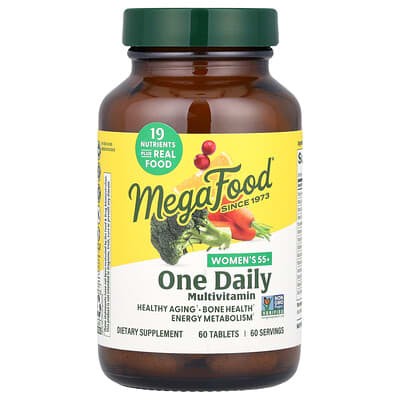

$29.99 $0.49 per serving


Product analysis
Women Over 55 One Daily supplies vitamins and minerals that support normal metabolism, blood formation and immune function when intake is low. Its unidentified botanical blend makes the added plant ingredients difficult to judge.
AI assessment of the formula, label and price. How scoring works
Nutrient Quality41
Manganese and molybdenum use favorable mineral forms, while most other forms cannot be compared confidently. Missing botanical identities and mixture proportions leave further uncertainty.
Ingredient Transparency77
Amounts and most nutrient forms are disclosed. The botanical blend components and the proportions of the mixed chromium forms are missing.
Value For Money41
Value varies by nutrient, with favorable comparisons for vitamin K and molybdenum but a high cost for selenium. Most other nutrient comparisons remain uncertain.
Customer Satisfaction87
Customer ratings are very positive. The large number of ratings offers a broad view of sentiment, without proving effectiveness.
Product Focus18
The broad nutrient mix fits everyday nutritional and immune support. Its unidentified botanical blend makes the full ingredient selection less clear.
- Format
Tablet - Container
- 60 Tablet(s)
- Per serving
- $0.49
- Also available
 Women Over 55 One Daily$55.99
- Customer rating
- 4.8 · 1,928 ratings
Goals

Impact
Highest effect
Folate · 200 mcg DFEVitamin B12 · 4.8 mcgVitamin D · 40 mcgVitamin K · 80 mcgSelenium · 55 mcgZinc · 9.5 mgVitamin C · 90 mg
Iodine helps fill a gap that can impair thyroid function. The declared B vitamins contribute to nutrient availability for normal metabolism and blood formation. Vitamin C provides a nutritional contribution rather than evidence of extra protection from illness at high intake. Higher amounts do not establish extra benefit once intake is adequate.
How this product is rated for Everyday Health
Ingredient fit85
The known ingredients have a focused relationship to the retained nutritional functions. Some amounts fall below the comparison references or remain unresolved.
Goal fit
The retained ingredients closely match the comparison focus; this describes nutritional relevance rather than comprehensive health improvement.
Dose adequacy
The retained amounts provide partial or unresolved coverage of the saved comparison references, rather than demonstrating complete nutritional intake.
Pathways100
The strongest retained connection is energy metabolism cofactors. Several nutritional functions contribute.
Depth
The strongest retained connection is energy metabolism cofactors, based on the known ingredient amounts.
Breadth
Several nutritional functions meet the saved coverage threshold, giving a broad contribution across the retained functions.
Evidence82
Vitamin B9 (Folate) provides the strongest retained evidence. The supplied context supports nutritional availability or limited population-specific findings, without establishing broad health improvements beyond adequate intake.
Evidence strength
Vitamin B9 (Folate) supplies the strongest retained evidence. Its supplied context limits expectations to nutritional or population-specific outcomes.
Studied preparation
The retained preparations match the saved criteria; no superiority of chemical form or delivery is established.
Formulation logic100
The supplied checks identify no configured conflict or missing required partner. The retained amount thresholds remain comparison references rather than treatment doses.
Partner coverage
The retained ingredients have no missing required partner under the saved criteria; this does not establish an added combination benefit.
Conflicts
No configured ingredient conflict was identified from the supplied amounts.
Effective doses
The retained amounts meet the saved minimum comparison threshold, which is not proof of a clinical effective dose.

Impact
High effect
Vitamin C · 90 mgZinc · 9.5 mgVitamin A · 180 mcg RAEVitamin D · 40 mcgSelenium · 55 mcg
Zinc contributes to normal immune nutrition. Vitamin B6, B12 and folate can help fill low intake that would otherwise impair immune-cell function. These nutrient roles do not establish extra infection protection when intake is adequate.
How this product is rated for Immunity
Ingredient fit61
Relevant ingredients provide the immune connection. Vitamin C, Vitamin A are declared but not counted at the supplied amounts.
Goal fit
Relevant ingredients contribute alongside ingredients serving other purposes; those additional purposes do not establish an immune benefit.
Dose adequacy
Declared amounts make varying contributions; larger quantities do not establish an optimal prevention or treatment dose.
Pathways80
The saved findings concentrate on lymphocyte function and immune regulation. These ingredient associations do not establish clinical immune protection.
Depth
The strongest saved association is lymphocyte function and immune regulation, without establishing a measured immune or infection outcome.
Breadth
Two immune-related areas meet the saved coverage threshold; other areas receive less or no contribution.
Evidence100
Zinc leads the counted contribution. Normal nutrient roles and any regular-use cold findings retain their specific limitations.
Evidence strength
Zinc provides the strongest counted contribution, retaining its nutritional or regular-use respiratory-evidence limitations.
Studied preparation
The counted preparations are accepted in the saved comparison; this does not independently establish clinical equivalence or product superiority.
Formulation logic100
No required partner or configured conflict was found. Counted amounts meet the saved inclusion threshold, without establishing an extra combination benefit.
Partner coverage
No required partner is missing for the counted ingredients; this does not establish an added immune benefit from combining them.
Conflicts
No configured formulation conflict was found at the supplied amounts and partner declarations.
Effective doses
All counted ingredients meet the saved amount inclusion threshold, without proving a dose that prevents or treats infection.
Ingredients
| Ingredient | Amount per serving | Score |
|---|---|---|
Vitamin A (Beta-Carotene, Carrot) | 180 mcg RAE | |
Vitamin C (organic Orange) | 90 mg | |
Vitamin D3 (Cholecalciferol) | 40 mcg | |
Vitamin E (D-Alpha-Tocopherol) | 12 mg | |
Vitamin K (Phytonadione, Cabbage) | 80 mcg | |
Thiamin (Thiamine Hydrochloride, S. cerevisiae) | 1.2 mg | |
Riboflavin (organic Brown Rice) | 1.3 mg | |
Niacin (Niacinamide, S. cerevisiae) | 16 mg NE | |
Vitamin B6 (Pyridoxine Hydrochloride, S. cerevisiae) | 3 mg | |
Folate (L-5-Methyltetrahydrofolate, Broccoli) | 200 mcg DFE | |
Vitamin B12 (Methylcobalamin, S. cerevisiae) | 4.8 mcg | |
Biotin (organic Brown Rice) | 55 mcg | |
Pantothenic Acid (Calcium D-Pantothenate, organic Brown Rice) | 5 mg | |
Iodine (fermented Iodine Glycinate) | 80 mcg | |
Zinc (Zinc Bisglycinate) | 9.5 mg | |
Selenium (Selenium Glycinate) | 55 mcg | |
Manganese (fermented Manganese Bisglycinate) | 2.3 mg | |
GTF Chromium (Chromium Glutamate, Chromium Nicotinate, fermented Chromium Glycinate) | 40 mcg | |
Molybdenum (fermented Molybdenum Bisglycinate) | 45 mcg | |
Fruit Phenolic Blend | 100 mg |
Manganese (fermented Manganese Bisglycinate) · 2.3 mg OverallScore84
Each serving provides 2.3 mg of manganese, an amount the evaluation associates with nutritional maintenance. It uses manganese bisglycinate, an amino acid chelate chosen for absorption and stability.
How this ingredient is rated
Active Ingredient Quality & Bioavailability100
Manganese bisglycinate is an amino acid chelate chosen for absorption and stability.
Manganese Chemical Form
Manganese bisglycinate is an amino acid chelate chosen for its absorption and stability.
Dose, Safety & Label Transparency86
Each serving clearly lists 2.3 mg of manganese, an amount the evaluation associates with nutritional maintenance.
Manganese Dosage Efficacy & Safety
The 2.3 mg per serving is suited to nutritional maintenance in the evaluation, though less aligned with its bone and joint support goal.
Elemental Weight Disclosure
The manganese amount is clearly stated as 2.3 mg per serving.
Value50
At about $0.50 per whole-product serving, the product is midrange in the comparison.
Price per Serving vs. Median
At about $0.50 per whole-product serving, the product is midrange in the comparison.
Molybdenum (fermented Molybdenum Bisglycinate) · 45 mcg OverallScore76
Each serving supplies a relatively small 45 mcg of molybdenum as molybdenum bisglycinate. A whole-product serving costs about $0.50.
How this ingredient is rated
Active Ingredient Quality & Bioavailability85
Molybdenum bisglycinate is a named chelated form. The saved facts identify no branded source for the bisglycinate.
Molybdenum Chemical Form
Molybdenum bisglycinate is a named chelated form.
Branded or Patented Source
The saved facts identify no branded source for the bisglycinate.
Dose, Safety & Label Transparency64
The 45 mcg of molybdenum per serving falls at the low end of the evaluation. The serving amount does not exceed the adult upper limit in the evaluation; it does not include molybdenum from other sources.
Elemental Dose Optimization
The 45 mcg of molybdenum per serving falls at the low end of the evaluation.
Upper Limit (UL) Safety Compliance
The serving amount does not exceed the adult upper limit in the evaluation; it does not include molybdenum from other sources.
Value80
A whole-product serving costs about $0.50 and provides 45 mcg of molybdenum.
Price per Effective Serving
A whole-product serving costs about $0.50 and provides 45 mcg of molybdenum.
Selenium (Selenium Glycinate) · 55 mcg OverallScore51
Each serving provides 55 mcg of selenium as Selenium Glycinate, a modest amount in the evaluation. The whole-product price works out to about $1.82 per 200 mcg of selenium, a relatively high cost in this comparison.
How this ingredient is rated
Active Ingredient Quality & Bioavailability53
The saved facts name Selenium Glycinate, which the evaluation treats as a generic form. A more specific isomer is not identified in the saved facts.
Selenium Chemical Form
Selenium Glycinate is treated as a generic selenium form in the evaluation.
Form Transparency & Isomer Specificity
The saved facts name Selenium Glycinate but do not identify a more specific isomer.
Dose, Safety & Label Transparency70
A serving contains 55 mcg of selenium, which is a modest amount in the evaluation and falls below the evaluation’s upper boundary. Selenium from other sources contributes to total intake.
Dosage Efficacy Sweet Spot
The 55 mcg per serving is a modest amount in the evaluation.
Safety Margin & UL Adherence
The 55 mcg per serving is below the evaluation’s upper boundary; selenium from food and other supplements contributes to total intake.
Value10
The selenium-normalized cost is high in the evaluation, although the price belongs to the complete product.
Price per 200 mcg Serving
The whole-product price works out to about $1.82 per 200 mcg of selenium.
Alternative products
Report alternatives
Sources
Published studies used for the product analysis and the top-ranked studies for each ingredient and goal.
- Intakes of Folate, Vitamin B6, and Vitamin B12 in Relation to All-Cause and Cause-Specific Mortality: A National Population-Based Cohort.
- The responsiveness of plasma homocysteine to small increases in dietary folic acid: a primary care study.
- Associations of Serum Folate and Homocysteine Concentrations with All-Cause, Cardiovascular Disease, and Cancer Mortality in Men and Women in Korea: the Cardiovascular Disease Association Study.
- The concept of folic acid supplementation and its role in prevention of neural tube defect among pregnant women: PRISMA.
- Systematic review of adverse health outcomes associated with high serum or red blood cell folate concentrations.
- Associations of selenium status with all-cause and cause-specific mortality: a systematic review and meta-analysis of cohort studies.
- Dietary Antioxidants, Circulating Antioxidant Concentrations, Total Antioxidant Capacity, and Risk of All-Cause Mortality: A Systematic Review and Dose-Response Meta-Analysis of Prospective Observational Studies.
- The efficacy and safety of selenium supplementation versus placebo in the treatment of Graves' orbitopathy: A systematic review and meta-analysis of randomised controlled trials.
- Associations of plasma metal concentrations with the risks of all-cause and cardiovascular disease mortality in Chinese adults.
- Updates on clinical studies of selenium supplementation in radiotherapy.
- Oral Vitamin B12 versus Placebo for the Prevention of Chemotherapy-Induced Peripheral Neuropathy in Gynecological Cancer Patients: A Randomized, Double-Blind, Placebo-Controlled Trial.
- Vitamin B12 Supplementation in Diabetic Neuropathy: A 1-Year, Randomized, Double-Blind, Placebo-Controlled Trial.
- A single-center randomized controlled trial of local methylcobalamin injection for subacute herpetic neuralgia.
- Local Injection of Methylcobalamin Combined with Lidocaine for Acute Herpetic Neuralgia.
- The Effect of Vitamin B12 and Folic Acid Supplementation on Serum Homocysteine, Anemia Status and Quality of Life of Patients with Multiple Sclerosis.
- Dietary intake and blood concentrations of antioxidants and the risk of cardiovascular disease, total cancer, and all-cause mortality: a systematic review and dose-response meta-analysis of prospective studies.
- Scientific Opinion on the substantiation of a health claim related to vitamin C and increasing non haem iron absorption pursuant to Article 14 of Regulation (EC) No 1924/2006.
- Vitamin C Depletion and All-Cause Mortality in Renal Transplant Recipients.
- Associations of Serum Biomarkers of Fruit and Vegetable Intake With the Risk of Cause-Specific Mortality and All-Cause Mortality: A National Prospective Cohort Study.
- Relation between plasma ascorbic acid and mortality in men and women in EPIC-Norfolk prospective study: a prospective population study. European Prospective Investigation into Cancer and Nutrition.