
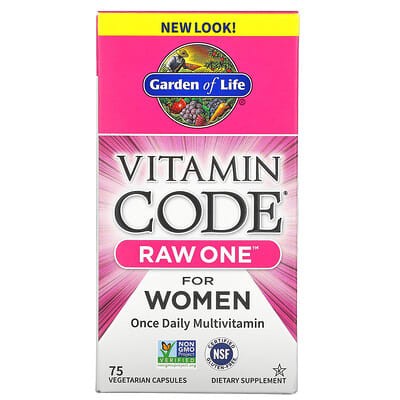
Raw One for Women

Goals
$28.21 $0.37 per serving


Product analysis
Raw One for Women offers broad nutritional support for normal energy use, blood formation and bone maintenance when intake is low. Unidentified blends make the complete formula harder to assess.
AI assessment of the formula, label and price. How scoring works
Nutrient Quality38
Manganese has a favorable identified form, but most other nutrients cannot be confidently compared for absorption. The molybdenum source and unnamed botanical preparations leave additional uncertainty.
Ingredient Transparency76
Amounts are stated throughout, and most nutrient sources or forms are named. Two blends have unidentified contents, preventing a complete check of the formula.
Value For Money46
The serving cost is favorable for vitamin K and manganese, while iron offers moderate value. Most other nutrient contributions remain difficult to compare for value.
Customer Satisfaction92
Customer ratings are very positive across a large review base. No specific experiences explain which features buyers found useful.
Product Focus14
The formula provides broad nutrition, with benefits most likely when a dietary shortfall is present. The unidentified blends prevent a complete assessment, and the nutritional roles do not establish additional longevity or heart protection.
- Format
Capsule - Container
- 75 Capsule(s)
- Per serving
- $0.37
- Customer rating
- 4.8 · 7,935 ratings
Goals

Impact
Highest effect
Folate · 800 mcg DFEVitamin B12 · 4.8 mcgVitamin D · 25 mcgVitamin K · 120 mcgSelenium · 27.5 mcgZinc · 5.5 mgVitamin C · 90 mg
B vitamins supply nutrients used in normal energy metabolism and blood formation. Selenium supplies a nutrient involved in normal immune and antioxidant functions. Vitamin D and Vitamin K contribute to mineral nutrition and bone maintenance. Iron is useful when low intake contributes to iron deficiency. The nutritional contributions are most useful when intake is low; extra benefit with adequate intake is not established.
How this product is rated for Everyday Health
Ingredient fit84
Vitamin B9 (Folate) and the other relevant nutrients provide the main connection to general health. Additional actives make the formula less focused on this goal.
Goal fit
Relevant nutrients contribute to general health, alongside other actives with less direct support for this goal.
Dose adequacy
The relevant amounts provide partial nutritional contributions relative to the saved comparison amounts.
Pathways100
The strongest area is energy metabolism cofactors. Contributions also reach the saved coverage level across energy metabolism cofactors, one-carbon metabolism and blood formation, bone and mineral metabolism.
Depth
The strongest supported area is energy metabolism cofactors, through the relevant nutrient contributions.
Breadth
The supported areas reaching the saved coverage level are energy metabolism cofactors, one-carbon metabolism and blood formation, bone and mineral metabolism.
Evidence82
Vitamin B9 (Folate) provides the strongest supported contribution. The supplied context limits routine expectations to filling nutritional gaps rather than improving outcomes in adequately nourished adults.
Evidence strength
Vitamin B9 (Folate) provides the strongest supported contribution here; usefulness remains conditional on the relevant nutritional or population context.
Studied preparation
The relevant preparations match those recognized by the saved findings; this does not establish superiority of a form or delivery method.
Formulation logic100
The relevant ingredients can contribute independently, and no configured conflict was found. Their presence together does not establish an added combination benefit.
Partner coverage
The relevant ingredients can contribute independently or have their required partners present; no extra combination benefit is established.
Conflicts
No configured ingredient conflict was identified in the supplied findings.
Effective doses
All ingredients retained for contribution meet the saved amount threshold; that threshold does not prove a clinical benefit.

Impact
Moderate effect
Folate · 800 mcg DFEVitamin B12 · 4.8 mcgVitamin K · 120 mcgVitamin D · 25 mcg
Vitamin D and B12 support muscle, bone and neurological function, especially when a dietary gap exists. Vitamin C contributes to collagen formation, while vitamin E and selenium participate in antioxidant defenses. Folate and zinc add nutritional support, without established additional longevity benefits in well-nourished adults.
How this product is rated for Longevity
Ingredient fit52
6 ingredients contribute to the saved healthy-aging assessment, alongside a broader set of active ingredients that makes the focus less specific. The contributing amounts meet only part of the saved dose benchmarks.
Goal fit
6 ingredients contribute to the saved healthy-aging assessment, alongside a broader set of active ingredients that makes the focus less specific.
Dose adequacy
The contributing amounts meet only part of the saved dose benchmarks.
Pathways43
The strongest recorded contribution concerns antioxidant defence. The saved findings reach the coverage threshold in antioxidant defence.
Depth
The strongest recorded contribution concerns antioxidant defence.
Breadth
The saved findings reach the coverage threshold in antioxidant defence.
Evidence83
Vitamin D provides the strongest qualifying evidence in the saved assessment; the relevant benefit remains limited to its reviewed outcome. The qualifying ingredients match the preparations used in the saved evidence review.
Evidence strength
Vitamin D provides the strongest qualifying evidence in the saved assessment; the relevant benefit remains limited to its reviewed outcome.
Studied preparation
The qualifying ingredients match the preparations used in the saved evidence review.
Formulation logic100
The contributing ingredients can work alone or have their required partner present. No ingredient conflicts were recorded in the saved assessment. All contributing ingredients reach the saved meaningful-dose threshold.
Partner coverage
The contributing ingredients can work alone or have their required partner present.
Conflicts
No ingredient conflicts were recorded in the saved assessment.
Effective doses
All contributing ingredients reach the saved meaningful-dose threshold.

Impact
High effect
Vitamin K · 120 mcgVitamin B12 · 4.8 mcgVitamin B6 · 1.7 mgFolate · 800 mcg DFEVitamin D · 25 mcg
Thiamin and selenium can address deficiencies linked to heart disease, without established extra benefit when intake is adequate. Folate supports homocysteine metabolism, but lowering that marker does not establish routine cardiovascular protection. B6 and B12 fall below the saved inclusion threshold. K1 does not match the specific MK-7 arterial-stiffness evidence, and vitamin D does not establish routine event prevention.
How this product is rated for Heart Health
Ingredient fit59
Relevant contributions sit within a broader formula whose other actives reduce its focus on heart health.
Goal fit
The formula contains relevant ingredients alongside actives outside this goal.
Dose adequacy
Included nutrients receive varying amount recognition; B6 and B12 fall below inclusion.
Pathways60
The strongest saved pathway finding concerns homocysteine metabolism; changing this marker does not establish cardiovascular protection.
Depth
The strongest finding concerns homocysteine metabolism.
Breadth
Only homocysteine metabolism reaches the saved coverage threshold.
Evidence89
Folate leads the saved evidence finding; included ingredients meet its preparation criteria.
Evidence strength
Folate leads the saved evidence comparison; this does not establish cardiovascular event prevention.
Studied preparation
The included ingredients meet the saved preparation criteria, without establishing superiority of their declared forms.
Formulation logic100
No required partner is missing and no configured conflict is identified among the included contributions.
Partner coverage
The included contributions have no missing required ingredient partner.
Conflicts
No configured conflict was identified in the supplied findings.
Effective doses
The included contributions meet the saved minimum amount criterion; this is not a proven clinical threshold.

Impact
High effect
Vitamin K · 120 mcgVitamin D · 25 mcgSelenium · 27.5 mcgVitamin B12 · 4.8 mcgVitamin B6 · 1.7 mgVitamin E · 15 mgFolate · 800 mcg DFENiacin · 16 mgVitamin C · 90 mg
Folate gives this formula its main connection to homocysteine metabolism. Changes in homocysteine do not establish fewer cardiovascular events, and the favorable folate findings apply to specific population and treatment settings. Thiamin can help correct deficiency-related impairment of heart function. The other retained nutrients broaden nutritional coverage, but vitamin D and the declared vitamin K do not establish routine cardiovascular protection.
How this product is rated for Cardiovascular Support
Ingredient fit56
Relevant cardiovascular nutrients sit within a broader formula serving other nutritional purposes. Some retained ingredients provide partial comparison amounts, limiting their contribution despite their presence.
Goal fit
Relevant cardiovascular nutrients sit within a broader formula serving other nutritional purposes.
Dose adequacy
Some retained ingredients provide partial comparison amounts, limiting their contribution despite their presence.
Pathways58
Homocysteine metabolism is the only substantially covered role; other cardiovascular areas receive little support.
Depth
Homocysteine metabolism is the strongest role, but improvement in this marker does not establish prevention of cardiovascular events.
Breadth
Homocysteine metabolism is the only substantially covered role; other cardiovascular areas receive little support.
Evidence69
Vitamin B9 (Folate) leads the saved findings. Homocysteine-related support does not establish fewer cardiovascular events.
Evidence strength
Vitamin B9 (Folate) leads the saved findings. Homocysteine-related support does not establish fewer cardiovascular events.
Studied preparation
The retained preparations match those recognized in the supplied comparison; this does not establish broad clinical benefit.
Formulation logic100
The retained ingredients can contribute independently or have the partners required by the supplied comparison. No conflict among the combinations evaluated was identified in the supplied findings.
Partner coverage
The retained ingredients can contribute independently or have the partners required by the supplied comparison.
Conflicts
No conflict among the combinations evaluated was identified in the supplied findings.
Effective doses
All retained ingredients reach a meaningful comparison amount; ingredients with smaller or unresolved amounts do not gain that contribution.
Ingredients
| Ingredient | Amount per serving | Score |
|---|---|---|
Vitamin A (Beta-Carotene) | 900 mcg | |
Vitamin C (organic Amla) | 90 mg | |
Vitamin D (D3) | 25 mcg | |
Vitamin E (D-Alpha-Tocopherol) | 15 mg | |
Vitamin K (K1) | 120 mcg | |
Thiamin (S. cerevisiae) | 1.2 mg | |
Riboflavin (S. cerevisiae) | 1.3 mg | |
Niacin (Niacinamide) | 16 mg | |
Vitamin B6 (S. cerevisiae) | 1.7 mg | |
Folate (S. cerevisiae) | 800 mcg DFE | |
Vitamin B12 (Methylcobalamin) | 4.8 mcg | |
Biotin (S. cerevisiae) | 30 mcg | |
Pantothenic Acid (S. cerevisiae) | 5 mg | |
Iron (Brown Rice Chelate) | 5.4 mg | |
Zinc (Brown Rice Chelate) | 5.5 mg | |
Selenium (S. cerevisiae) | 27.5 mcg | |
Manganese (Brown Rice Chelate) | 2.3 mg | |
Chromium (S. cerevisiae) | 35 mcg | |
Molybdenum (Brown Rice Chelate) | 45 mcg | |
organic Emblic (Amla, Phyllanthus emblica) fruit extract | 200 mg | |
Raw Organic Fruit & Vegetable Blend | 20 mg | |
Raw Probiotic & Enzyme Blend | 8 mg |
Manganese (Brown Rice Chelate) · 2.3 mg OverallScore78
Each serving lists 2.3 mg of manganese as manganese chelate. The saved facts do not specify the chelate’s exact binding ingredient, limiting comparisons of the form.
How this ingredient is rated
Active Ingredient Quality & Bioavailability70
The source is identified as manganese chelate, but the specific binding ingredient is not named in the saved facts.
Manganese Chemical Form
The form is manganese chelate; the exact binding ingredient is not specified in the saved facts.
Dose, Safety & Label Transparency86
The serving lists 2.3 mg of elemental manganese. The stated mineral amount can be compared across servings.
Manganese Dosage Efficacy & Safety
The 2.3 mg per serving falls below the evaluation’s preferred comparison band.
Elemental Weight Disclosure
The elemental manganese amount is stated as 2.3 mg per serving.
Value80
The whole-product serving costs about $0.38; that price covers the full product serving, not manganese alone.
Price per Serving vs. Median
The evaluated price is about $0.38 per whole-product serving.
Iron (Brown Rice Chelate) · 5.4 mg OverallScore38
A serving supplies a small 5.4 mg of iron, but its chemical form is unknown. Zinc is also listed, which the evaluation flags as a potential competitor for iron absorption.
How this ingredient is rated
Active Ingredient Quality & Bioavailability0
The chemical form of iron is unknown.
Iron Chemical Form & Bioavailability
The saved facts do not identify an iron compound, so its form cannot be assessed.
Absorption Support & Blocker Avoidance
Zinc is also listed, alongside 90 mg of vitamin C; the evaluation flags zinc as a possible competitor for iron absorption.
Dose, Safety & Label Transparency70
The amount of iron is specified as 5.4 mg per serving.
Elemental Iron Label Clarity
The saved facts identify 5.4 mg of iron itself per serving.
Dosage Effectiveness & Safety Range
A serving provides a small 5.4 mg of iron.
Value50
The whole-product serving price is in the middle of the evaluated range.
Price per Effective Serving
A serving of the whole product costs about $0.38.
Molybdenum (Brown Rice Chelate) · 45 mcg OverallScore42
Each serving provides 45 mcg of molybdenum. The available facts do not identify its chemical form, which limits comparison of the source.
How this ingredient is rated
Active Ingredient Quality & Bioavailability0
The available facts do not identify the molybdenum form or a branded source.
Molybdenum Chemical Form
The molybdenum chemical form is not identified in the available facts.
Branded or Patented Source
The available facts do not identify a branded molybdenum source.
Dose, Safety & Label Transparency64
A serving provides 45 mcg of molybdenum. On its own, that amount is below the adult upper limit.
Elemental Dose Optimization
The recorded elemental molybdenum amount is 45 mcg per serving.
Upper Limit (UL) Safety Compliance
The amount in one serving is below the adult upper limit; intake from other sources is not included.
Value80
The whole-product serving costs about $0.38.
Price per Effective Serving
The price is about $0.38 per whole-product serving.
Alternative products
Report alternatives
Sources
Published studies used for the product analysis and the top-ranked studies for each ingredient and goal.
- Associations of dietary folate, vitamin B6 and B12 intake with cardiovascular outcomes in 115664 participants: a large UK population-based cohort.
- Folate, Homocysteine, and Adverse Outcomes After Ischemic Stroke.
- Effect of folic acid on endothelial function following acute myocardial infarction.
- Folic acid enhances endothelial function and reduces blood pressure in smokers: a randomized controlled trial.
- 5-methyltetrahydrofolate, the active form of folic acid, restores endothelial function in familial hypercholesterolemia.
- The current state of niacin in cardiovascular disease prevention: a systematic review and meta-regression.
- Effects of niacin on apo A1 and B levels: a systematic review and meta-analysis of randomised controlled trials.
- Effect of lipid-lowering therapies on lipoprotein(a) levels: a comprehensive meta-analysis of randomized controlled trials.
- Extended-release niacin vs gemfibrozil for the treatment of low levels of high-density lipoprotein cholesterol. Niaspan-Gemfibrozil Study Group.
- Equivalent efficacy of a time-release form of niacin (Niaspan) given once-a-night versus plain niacin in the management of hyperlipidemia.
- Effect of supplementation with high-selenium yeast on plasma lipids: a randomized trial.
- Association of selenium and cadmium with heart failure and mortality based on the National Health and Nutrition Examination Survey.
- Higher serum selenium concentration is associated with lower risk of all-cause and cardiovascular mortality among individuals with chronic kidney disease: A population-based cohort study of NHANES.
- Selenium status in the body and cardiovascular disease: a systematic review and meta-analysis.
- Associations of selenium status with all-cause and cause-specific mortality: a systematic review and meta-analysis of cohort studies.
- Vitamin B12 Status and Cardiovascular Risk: Novel Insights from NMR-Based Lipoprotein Profiling in 20,665 Adults.
- Pregnancy Metal Mixtures and Blood Pressure and Hypertension in Mid-Life: A Prospective U.S. Cohort Study.
- Vitamin B12 Deficiency, Hyperhomocysteinemia, and Diabetes as Metabolic Determinants of Cardiovascular Risk in Mexican Women.
- Impact of serum vitamin (Vitamin D, Vitamin B12) and trace element (Fe, Zn, Cu) levels on major adverse cardiovascular events and poor prognosis in STEMI patients undergoing primary PCI.
- Vasoplegic syndrome after cardiovascular surgery: A review of pathophysiology and outcome-oriented therapeutic management.