
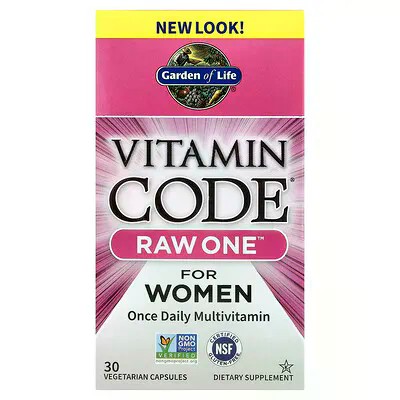
Raw One for Women

Goals
$20.19 $0.67 per serving


Product analysis
Raw One for Women supplies nutrients involved in normal metabolism, blood formation and bone functions when intake is low. Its unnamed blend components make part of the formula harder to compare.
AI assessment of the formula, label and price. How scoring works
Nutrient Quality39
Manganese has favorable chelate evidence, while the molybdenum description does not identify a clear chemical form. Most other form comparisons remain uncertain, and the blend components are unnamed.
Ingredient Transparency76
Ingredient amounts are stated, making the serving quantities clear. Some forms and the blend components are unspecified, leaving part of the formula unclear.
Value For Money40
The vitamin K and manganese comparisons suggest moderate value, while iron appears less economical. Molybdenum’s unresolved form and missing comparisons for other nutrients leave total value uncertain.
Customer Satisfaction74
Customer feedback is very favorable, with a modest number of ratings. Specific experiences and benefits cannot be inferred from the ratings.
Product Focus14
The clearest role is filling dietary gaps relevant to normal metabolism and bone functions. The full combination’s wider effects are uncertain, and the named culture and chelate sources do not establish superior outcomes.
- Format
Capsule - Container
- 30 Capsule(s)
- Per serving
- $0.67
- Customer rating
- 4.8 · 153 ratings
Goals

Impact
Highest effect
Folate · 800 mcg DFEVitamin B12 · 4.8 mcgVitamin D · 25 mcgVitamin K · 120 mcgSelenium · 27.5 mcgZinc · 5.5 mgVitamin C · 90 mg

Impact
High effect
Vitamin K · 120 mcgVitamin B12 · 4.8 mcgVitamin B6 · 1.7 mgFolate · 800 mcg DFEVitamin D · 25 mcg

Impact
High effect
Vitamin K · 120 mcgVitamin D · 25 mcgManganese · 2.3 mgZinc · 5.5 mgVitamin C · 90 mg
Ingredients
| Ingredient | Amount per serving | Score |
|---|---|---|
Vitamin A (Beta-Carotene) | 900 mcg | |
Vitamin C (organic Amla) | 90 mg | |
Vitamin D (D3) | 25 mcg | |
Vitamin E (D-Alpha-Tocopherol) | 15 mg | |
Vitamin K (K1) | 120 mcg | |
Thiamin (S. cerevisiae) | 1.2 mg | |
Riboflavin (S. cerevisiae) | 1.3 mg | |
Niacin (Niacinamide) | 16 mg | |
Vitamin B6 (S. cerevisiae) | 1.7 mg | |
Folate (S. cerevisiae) | 800 mcg DFE | |
Vitamin B12 (Methylcobalamin) | 4.8 mcg | |
Biotin (Saccharomyces cerevisiae) | 30 mcg | |
Pantothenic Acid (S. cerevisiae) | 5 mg | |
Iron (Brown Rice Chelate) | 5.4 mg | |
Zinc (Brown Rice Chelate) | 5.5 mg | |
Selenium (S. cerevisiae) | 27.5 mcg | |
Manganese (Brown Rice Chelate) | 2.3 mg | |
Chromium (S. cerevisiae) | 35 mcg | |
Molybdenum (Brown Rice Chelate) | 45 mcg | |
organic Emblic (Amla, Phyllanthus emblica) fruit extract | 200 mg | |
Raw Organic Fruit & Vegetable Blend | 20 mg | |
Raw Probiotic & Enzyme Blend | 8 mg |
Manganese (Brown Rice Chelate) · 2.3 mg OverallScore72
It provides 2.3 mg of manganese per serving at a moderate cost. The manganese comes from manganese chelate.
How this ingredient is rated
Active Ingredient Quality & Bioavailability70
The manganese comes from manganese chelate.
Manganese Chemical Form
The manganese comes from manganese chelate.
Dose, Safety & Label Transparency86
The manganese amount is clearly stated. 2.3 mg per serving can support nutritional maintenance, though it may contribute less to targeted bone matrix support.
Manganese Dosage Efficacy & Safety
2.3 mg per serving can support nutritional maintenance, though it may contribute less to targeted bone matrix support.
Elemental Weight Disclosure
The label states 2.3 mg of manganese per serving.
Value50
The cost per serving is moderate.
Price per Serving vs. Median
The cost per serving is moderate.
Iron (Brown Rice Chelate) · 5.4 mg OverallScore32
A serving provides 5.4 mg of iron at a high cost per serving. The iron form is unknown.
How this ingredient is rated
Active Ingredient Quality & Bioavailability0
The iron form is unknown. It also contains 90 mg of vitamin C, plus zinc, folate and B12; zinc may compete with iron absorption.
Iron Chemical Form & Bioavailability
The iron form is unknown.
Absorption Support & Blocker Avoidance
It also contains 90 mg of vitamin C, plus zinc, folate and B12; zinc may compete with iron absorption.
Dose, Safety & Label Transparency70
The serving lists 5.4 mg of iron, a small amount.
Elemental Iron Label Clarity
The iron amount is stated as 5.4 mg per serving.
Dosage Effectiveness & Safety Range
The serving lists 5.4 mg of iron, a small amount.
Value20
The cost per serving is high.
Price per Effective Serving
The cost per serving is high.
Molybdenum (Brown Rice Chelate) · 45 mcg OverallScore36
The serving supplies 45 mcg molybdenum at a moderate cost per serving. The molybdenum form is not specified. That leaves its form and source quality unclear.
How this ingredient is rated
Active Ingredient Quality & Bioavailability0
The molybdenum form is not specified. No branded molybdenum source is identified.
Molybdenum Chemical Form
The molybdenum form is not specified.
Branded or Patented Source
No branded molybdenum source is identified.
Dose, Safety & Label Transparency64
45 mcg is a relatively low amount per serving. The amount is below the adult upper intake limit, although intake from other sources also counts.
Elemental Dose Optimization
45 mcg is a relatively low amount per serving.
Upper Limit (UL) Safety Compliance
At 45 mcg per serving, the amount is below the adult upper intake limit of 2,000 mcg; total daily intake also matters.
Value50
The cost per serving is moderate.
Price per Effective Serving
The cost per serving is moderate.
Alternative products
Report alternatives
Sources
Published studies used for the product analysis and the top-ranked studies for each ingredient and goal.
- Association between RBC folate and lumbar bone mineral density in postmenopausal women, a cross-sectional study from NHANES 2009-2018.
- Genetic variants modify the associations of concentrations of methylmalonic acid, vitamin B-12, vitamin B-6, and folate with bone mineral density.
- Adequate Intake and Supplementation of B Vitamins, in Particular Folic Acid, can Play a Protective Role in Bone Health.
- Relation of homocysteine, folate, and vitamin B12 to bone mineral density of postmenopausal women.
- Dietary intake of folate, but not vitamin B2 or B12, is associated with increased bone mineral density 5 years after the menopause: results from a 10-year follow-up study in early postmenopausal women.
- Risk of Environmental Chemicals on Bone Fractures Is Independent of Low Bone Mass in US Adults: Insights from 2017 to 2018 NHANES.
- The Manganese-Bone Connection: Investigating the Role of Manganese in Bone Health.
- Associations of multiple metals with bone mineral density: A population-based study in US adults.
- Sex-specific associations of urinary mixed-metal concentrations with femoral bone mineral density among older people: an NHANES (2017-2020) analysis.
- Relationship between blood manganese and bone mineral density and bone mineral content in adults: A population-based cross-sectional study.
- Evaluating the Protective Role of Vitamin A Supplementation in Periodontal Health: A Comprehensive Systematic Review and Meta-Analysis.
- Dietary vitamin A intake and bone health in the elderly: the Rotterdam Study.
- Vitamin A and its dervatives effect on bone mineral density, a systematic review.
- Association of vitamins with bone mineral density and osteoporosis measured by dual-energy x-ray absorptiometry: a cross-sectional study.
- Association of dietary consumption and serum levels of vitamin A and β-carotene with bone mineral density in Chinese adults.
- Effect of Vitamin B12 and Folic Acid Supplementation on Bone Mineral Density and Quantitative Ultrasound Parameters in Older People with an Elevated Plasma Homocysteine Level: B-PROOF, a Randomized Controlled Trial.
- Plasma B vitamins, homocysteine, and their relation with bone loss and hip fracture in elderly men and women.
- Relation between homocysteine and B-vitamin status indicators and bone mineral density in older Americans.
- The role of B-vitamin intake, B-vitamin-rich dietary patterns, the B-vitamin deficiency index in bone mineral density among school-aged children.
- Hyperhomocysteinemia is Associated with Inflammation, Bone Resorption, Vitamin B12 and Folate Deficiency and MTHFR C677T Polymorphism in Postmenopausal Women with Decreased Bone Mineral Density.