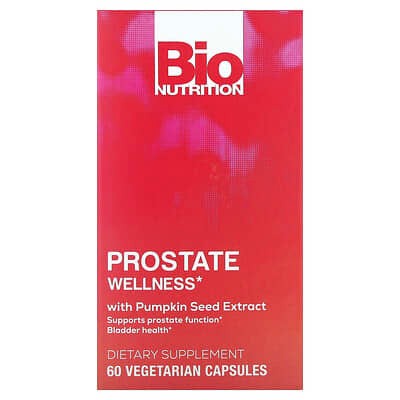
Prostate Wellness

Prostate Wellness

Bio Nutrition4.6 (80 ratings)
Format:Capsule Quantity: 60 Capsule(s) · 30 servings
Goals
$20.27 $0.67 per serving

About this product

The formula combines a substantial 500 mg of saw palmetto with beta-sitosterol, nettle, pygeum, pumpkin seed extract, and lycopene, giving it a clear prostate-focused profile. However, most of those botanicals do not have a disclosed extract form or standardization, so their quality is harder to judge.

Zinc citrate and pyridoxine hydrochloride are clearly identified, and the zinc dose sits in a useful middle range. Vitamin D is present at a modest amount that was too low to contribute meaningfully in several goal assessments, while selenium and copper had provisional quality findings.

Every ingredient amount is listed, but forms are missing for more than half of the actives. It fits someone seeking a broad prostate-support blend more than someone wanting a fully standardized botanical formula or a general daily multivitamin.

Who is it for
  • Adults looking for a multi-ingredient prostate-support formula
  • People who prefer capsules and want clearly listed ingredient amounts
  • Users comfortable with a blend that does not disclose standardization for most botanicals
Best for
  • Broad prostate-focused botanical coverage
  • Combining saw palmetto, nettle, pygeum, beta-sitosterol, pumpkin seed, and lycopene
  • Adding zinc and vitamin B6 alongside plant extracts

Pros

  • Includes 500 mg of saw palmetto extract
  • Provides zinc citrate at 15 mg
  • Lists the amount of every active ingredient
  • Lycopene is supplied at 10 mg
  • Combines several complementary prostate-focused botanicals

Cons

  • Most botanical forms and standardizations are not disclosed
  • Vitamin D is modest and did not count toward several goal findings
  • Selenium and copper quality findings rely on provisional fallback data
  • Value findings were mixed across the formula

Warnings

  • The 20 mg vitamin B6 dose may be unsuitable for prolonged use alongside other high-B6 supplements because cumulative intake can affect nerve tolerance.
  • Saw palmetto may be relevant for people using anticoagulant or hormone-related medicines; discuss the combination with a clinician before use.


Product analysis

59 out of 100

Prostate Wellness combines plant ingredients with vitamins and minerals that can help fill dietary gaps. Several botanical preparations are unspecified, making it harder to compare the blend with specific extracts.

AI assessment of the formula, label and price. How scoring works

Nutrient Quality52

Vitamin D, vitamin B6 and zinc have the clearest favorable form information. Many botanical preparations are unspecified, while selenium and copper quality remains uncertain.

Ingredient Transparency80

The ingredient amounts are clearly stated. Several botanical preparations are unspecified, which limits detailed comparisons with other blends.

Value For Money40

Value is mixed where a comparison is possible. Stinging nettle compares more favorably than vitamin D, zinc and lycopene, while several other ingredients remain uncertain.

Customer Satisfaction69

Customer ratings are favorable. The relatively small number of ratings leaves the feedback less settled.

Product Focus60

The blend spreads its ingredients across several possible uses. Nutrient-gap support is clearest, while hair, skin and testosterone benefits depend on the person and the specific preparation.

Format
Capsule
Container
60 Capsule(s)
Per serving
$0.67
Customer rating
4.6 · 80 ratings
Report analysis

Goals

Hair Health
Impact
Moderate effect
C Ingredient FitF PathwaysA EvidenceA+ Formulation Logic
Vitamin D · 400 IUZinc · 15 mg

Saw palmetto may help some types of thinning hair, but the declared generic material cannot be assumed to work like the specific extracts associated with improved hair counts. Zinc may help reduce shedding when low zinc is the cause; extra zinc has no clear regrowth benefit when you already get enough.

How this product is rated for Hair Health

Ingredient fit61

Saw palmetto may help some types of thinning hair, but the exact extract matters.
Goal fit
Saw palmetto may help some types of thinning hair, but the exact extract matters.
Dose adequacy
Saw Palmetto: 500 mg; Copper: 0.5 mg; Selenium: 50 mcg; Zinc: 15 mg. These are serving amounts, not assumed daily intake.

Pathways16

The saw palmetto connection concerns hormone-related thinning; it does not apply to every cause of hair loss.
Depth
The saw palmetto connection concerns hormone-related thinning; it does not apply to every cause of hair loss.
Breadth
The ingredients relate to a particular type of thinning, rather than all causes of hair loss.

Evidence93

Saw Palmetto cannot be assumed to match the specific preparations associated with hair benefits.
Evidence strength
Saw palmetto may help some types of thinning hair, but the exact extract matters.
Studied preparation
Saw Palmetto cannot be assumed to match the specific preparations associated with hair benefits.

Formulation logic95

Some serving amounts remain unresolved. No particular ingredient conflict is identified.
Partner coverage
The relevant ingredients do not require another ingredient partner for their described roles.
Conflicts
No particular ingredient conflict is identified in this combination.
Effective doses
Vitamin D serving amounts are unresolved, limiting what can be said about those amounts.
Study evidence
Copper Adverse 4 studies
Selenium Disputed 7 studies
Vitamin D Disputed 34 studies
Zinc Supportive 22 studies
Immunity
Impact
High effect
C- Ingredient FitD- PathwaysA+ EvidenceA+ Formulation Logic
Zinc · 15 mgVitamin D · 400 IUSelenium · 50 mcg

Zinc supports normal immune-cell function, with vitamin B6 and copper helping restore function when intake is low. Selenium contributes to antioxidant systems, though extra benefit is not established when selenium status is adequate. Vitamin D is present at a smaller amount that was not counted. The supported contribution is nutritional rather than a promise to prevent infection.

How this product is rated for Immunity

Ingredient fit55

Zinc, vitamin B6, copper and selenium supply the relevant immune contributions within a broader product purpose. Zinc supplies a partial amount contribution in the saved comparison.
Goal fit
Zinc, vitamin B6, copper and selenium supply the relevant immune contributions within a broader product purpose.
Dose adequacy
Zinc supplies a partial amount contribution in the saved comparison.

Pathways43

The supported coverage centres on immune-cell regulation.
Depth
The strongest contribution is in immune-cell regulation.
Breadth
The supported coverage centres on immune-cell regulation.

Evidence100

Zinc supplies the strongest supported contribution at the stated amount, within the clinical limits described for it.
Evidence strength
Zinc supplies the strongest supported contribution at the stated amount; its clinical limits still apply.
Studied preparation
The supplied findings accept the contributing nutrient preparations, without establishing superior clinical effects from their forms.

Formulation logic100

The included contributions meet the saved amount criterion; this does not prove prevention of infection.
Partner coverage
The included contributions have no unmet required ingredient partner.
Conflicts
No listed ingredient conflict was identified in the supplied findings.
Effective doses
The included contributions meet the saved amount criterion; this does not prove prevention of infection.
Study evidence
Selenium Mixed 37 studies
Vitamin D Supportive 85 studies
Zinc Supportive 73 studies
Everyday Health
Impact
High effect
C- Ingredient FitC+ PathwaysB+ EvidenceA+ Formulation Logic
Vitamin D · 400 IUSelenium · 50 mcgZinc · 15 mg

Selenium and zinc supply nutrients relevant to normal antioxidant and immune functions, while B6 contributes to nutrient metabolism. These nutrients can help fill dietary gaps, without establishing additional health benefits when intake is already adequate. The vitamin D declaration is below the saved amount-counting threshold.

How this product is rated for Everyday Health

Ingredient fit55

Selenium, zinc and B6 provide the recognized nutritional fit. Selenium and zinc receive partial recognition; B6 meets the comparison, while vitamin D was not counted.
Goal fit
Selenium, zinc and B6 provide the recognized nutritional fit.
Dose adequacy
Selenium and zinc receive partial recognition; B6 meets the comparison, while vitamin D was not counted.

Pathways66

Antioxidant defence and blood formation contribute, with lesser energy-metabolism coverage.
Depth
Antioxidant defence and blood formation contribute, with lesser energy-metabolism coverage.
Breadth
Two nutrient-related pathways reach the breadth threshold.

Evidence82

Selenium drives the strongest recognized contribution. The supported contribution is nutrient availability without demonstrated additional outcomes in replete adults.
Evidence strength
Selenium drives the strongest recognized contribution. The supported contribution is nutrient availability without demonstrated additional outcomes in replete adults.
Studied preparation
The counted nutrient declarations match the saved preparation criteria; no chemical form or delivery superiority is established.

Formulation logic100

No configured formulation conflict was matched. All ingredients included in this amount check meet the saved minimum threshold; that does not establish a clinically effective dose.
Partner coverage
Recognized ingredients can stand alone or have their required partners; this does not establish an added combination benefit.
Conflicts
No configured formulation conflict was matched.
Effective doses
All ingredients included in this amount check meet the saved minimum threshold; that does not establish a clinically effective dose.
Study evidence
Selenium Supportive 70 studies
Vitamin D Supportive 115 studies
Zinc Supportive 60 studies
Inflammation
Impact
Moderate effect
D+ Ingredient FitF PathwaysC+ EvidenceA+ Formulation Logic
Vitamin D · 400 IU

Zinc may help with low-grade inflammation when low zinc levels are contributing to it. That conditional benefit doesn't mean extra zinc broadly reduces inflammation when intake is already adequate. Stinging nettle's effects depend on the plant part and preparation, so its presence here doesn't by itself predict a useful anti-inflammatory effect throughout the body.

How this product is rated for Inflammation

Ingredient fit53

The serving declares 15 mg Zinc, 10 mg Lycopene, 250 mg Stinging Nettle; these amounts alone do not establish a clinical anti-inflammatory effect.
Goal fit
Stinging nettle provides the principal connection to this goal; its presence alone does not predict relief.
Dose adequacy
The serving declares 15 mg Zinc, 10 mg Lycopene, 250 mg Stinging Nettle; these amounts alone do not establish a clinical anti-inflammatory effect.

Pathways16

Ingredient mechanisms alone do not predict broad clinical relief from inflammation.
Depth
Ingredient mechanisms alone do not predict broad clinical relief from inflammation.
Breadth
The ingredients do not demonstrate broad clinical effects across multiple inflammatory processes.

Evidence68

Effects from particular nettle preparations cannot be transferred to arbitrary leaf or root extracts.
Evidence strength
Effects from particular nettle preparations cannot be transferred to arbitrary leaf or root extracts.
Studied preparation
Identifiable ingredient preparations permit comparison without guaranteeing an anti-inflammatory benefit.

Formulation logic100

No particular conflict or missing required partner is identified. Combining the ingredients does not itself establish an added anti-inflammatory effect.
Partner coverage
No missing required partner is identified.
Conflicts
No particular ingredient conflict is identified.
Effective doses
The declared amounts permit reference comparisons, which do not establish effective symptom relief.
Study evidence
Lycopene Supportive 15 studies
Selenium Supportive 34 studies
Vitamin D Supportive 101 studies
Zinc Supportive 64 studies
Skin Health
Impact
High effect
C- Ingredient FitC PathwaysA- EvidenceA+ Formulation Logic
Zinc · 15 mgCopper · 500 mcgSelenium · 50 mcgLycopene · 10 mg

Lycopene has limited, mixed evidence for reducing some UV-related skin responses. Its declared active amount connects more directly with those studies than total tomato extract mass would, but neither the food-matrix findings nor the capsule findings establish sunscreen-like protection. Zinc and vitamin B6 relate to skin problems caused by deficiency, with no established additional cosmetic benefit when intake is adequate.

How this product is rated for Skin Health

Ingredient fit60

The declared skin-related ingredients receive recognition according to their amounts, with scientific preparation and population limits.
Goal fit
The skin-related ingredients sit within a broader formula that also serves other purposes.
Dose adequacy
The declared amounts receive partial overall recognition; some are smaller than the reference exposures or have unresolved preparation relevance.

Pathways60

The strongest represented route is uv antioxidant defence, with limited breadth beyond it.
Depth
The strongest represented route is uv antioxidant defence, which describes the saved ingredient connection rather than proof of visible skin improvement.
Breadth
Only uv antioxidant defence is substantially represented; other routes have limited or absent coverage.

Evidence89

The relevant skin findings remain limited to the specific nutrient, preparation or study population.
Evidence strength
Copper supplies the leading saved evidence contribution; its role does not establish routine cosmetic benefit beyond the supplied evidence.
Studied preparation
The contributing preparations are accepted as studied in the saved findings; specific scientific preparation limitations still apply.

Formulation logic100

The contributing ingredients meet the saved minimum amount criterion and have no missing required partners or configured conflicts.
Partner coverage
The contributing ingredients have no missing required partners in the supplied findings.
Conflicts
No configured ingredient conflict was identified in the supplied facts.
Effective doses
All contributing ingredients meet the saved minimum amount criterion; this is not a proven cosmetic-effect dose.
Study evidence
Copper Supportive 16 studies
Lycopene Supportive 20 studies
Selenium Supportive 22 studies
Zinc Supportive 66 studies
Testosterone Support
Impact
Moderate effect
D+ Ingredient FitF PathwaysA- EvidenceA+ Formulation Logic
Zinc · 15 mgVitamin D · 400 IU

Zinc may help restore testosterone when low zinc levels are contributing to the problem. Zinc deficiency can lower testosterone, so the benefit depends on nutritional status rather than simply taking a larger amount. If you already get enough zinc, an increase in testosterone isn't expected.

How this product is rated for Testosterone Support

Ingredient fit55

Zinc is relevant to the goal, but the ingredient amount and preparation still limit expectations.
Goal fit
Zinc provides the clearest goal-related connection, while other ingredients have less certain or unrelated roles.
Dose adequacy
Per serving: Zinc 15 mg, Stinging Nettle 250 mg, Selenium 50 mcg, Vitamin B6 20 mg, Vitamin D 10 mcg. These amounts don't guarantee higher testosterone.

Pathways12

Selenium and other ingredients relate to testosterone production, but routine hormone benefits remain uncertain.
Depth
Selenium and other ingredients relate to testosterone production, but routine hormone benefits remain uncertain.
Breadth
The ingredients do not provide a reliable expectation of benefits across multiple testosterone-related processes.

Evidence88

Zinc is most relevant when a deficiency contributes to low testosterone; extra zinc is not expected to raise it when intake is adequate.
Evidence strength
Zinc is most relevant when a deficiency contributes to low testosterone; extra zinc is not expected to raise it when intake is adequate.
Studied preparation
The preparation details for vitamin B6 or nettle do not provide a reliable basis for expecting a testosterone increase.

Formulation logic100

Copper is present, so the specific concern about high zinc without copper does not apply.
Partner coverage
No additional partner ingredient is required for the ingredient roles described here.
Conflicts
Copper is present, so the specific concern about high zinc without copper does not apply.
Effective doses
Declared amounts vary across ingredients; reaching a comparison amount does not itself show that testosterone will increase.
Study evidence
Selenium No effect 16 studies
Vitamin D Supportive 56 studies
Zinc Disputed 7 studies

Ingredients

IngredientAmount per servingScore
Vitamin D3 (Cholecalciferol)
400 IU 57
Vitamin B6 (Pyridoxine Hydrochloride)
20 mg 76
Zinc (Zinc Citrate)
15 mg 72
Selenium (Selenium Selenite)
50 mcg
Copper (Copper Gluconate)
500 mcg
Saw Palmetto extract
500 mg 25
Beta-Sitosterol
100 mg
Stinging Nettle extract
250 mg 66
African Pygeum extract
250 mg
Lycopene
10 mg 77
Pumpkin seed extract
250 mg
Gluten Free Men 18–50 Sugar Free Halal Vegetarian
Report overview
B+ Active Ingredient Quality & BioavailabilityA- Dose, Safety & Label TransparencyF Value
A serving provides 15 mg of zinc as zinc citrate. The whole-product serving costs about $0.68.
How this ingredient is rated

Active Ingredient Quality & Bioavailability80

The saved form is zinc citrate.
Zinc Form Bioavailability
The saved form is zinc citrate.

Dose, Safety & Label Transparency85

The serving lists 15 mg of elemental zinc and 0.5 mg of copper.
Elemental Dose Transparency
The declared elemental zinc amount is 15 mg per serving, with the source form identified.
Zinc Dosage Safety & Effectiveness
The declared elemental zinc amount is 15 mg per serving.
Zinc-to-Copper Mineral Balance
The same serving lists 0.5 mg of copper with 15 mg of zinc; their ratio does not establish safety.

Value30

The whole-product serving costs about $0.68 and provides 15 mg of zinc.
Price Per Serving Efficiency
The recorded whole-product cost is about $0.68 per serving.
F Composition And Label DisclosureA+ Composition And Label DisclosureB- Commercial Price And Usability
Each serving lists 250 mg of nettle extract. The saved facts do not establish which nettle plant part is used.
How this ingredient is rated

Composition and Label Disclosure30

The saved facts do not establish which nettle plant part is used. The saved facts identify the preparation as nettle extract, without a specified ratio or marker claim.
Root or Leaf Identity Disclosure
The saved facts do not establish which nettle plant part is used.
Nettle Preparation and Marker Detail
The saved facts identify the preparation as nettle extract, without a specified ratio or marker claim.

Composition and Label Disclosure100

Each serving lists 250 mg of nettle extract.
Nettle Amount Disclosure
Each serving lists 250 mg of nettle extract.

Commercial Price and Usability70

The whole-product price is about $0.68 per serving.
Selected-Serving Price Comparison
The whole-product price is about $0.68 per serving.
A+ Ingredient Form & Label QualityC Dose, Safety & Label TransparencyD+ Value
Report alternatives

Sources

Published studies used for the product analysis and the top-ranked studies for each ingredient and goal.

  1. Associations of selenium status with all-cause and cause-specific mortality: a systematic review and meta-analysis of cohort studies.
    Cui Z; Xie R; Lu X; Schomburg L; Brenner H; Schöttker B · Redox biology · 2025
    Meta-analysis95 participants20 studies pooledEveryday Health forSelenium
  2. Dietary Antioxidants, Circulating Antioxidant Concentrations, Total Antioxidant Capacity, and Risk of All-Cause Mortality: A Systematic Review and Dose-Response Meta-Analysis of Prospective Observational Studies.
    Jayedi A; Rashidy-Pour A; Parohan M; Zargar MS; Shab-Bidar S · Advances in nutrition (Bethesda, Md.) · 2019
    Meta-analysis507,251 participants41 studies pooledEveryday Health forSelenium
  3. The efficacy and safety of selenium supplementation versus placebo in the treatment of Graves' orbitopathy: A systematic review and meta-analysis of randomised controlled trials.
    Sharabati I; Qafesha RM; Hindawi MD; Amro S; Ayesh BM · Clinical endocrinology · 2024
    Meta-analysis4 studies pooledEveryday Health forSelenium
  4. Associations of plasma metal concentrations with the risks of all-cause and cardiovascular disease mortality in Chinese adults.
    Shi L; Yuan Y; Xiao Y; Long P; Li W; Yu Y; Liu Y; Liu K; Wang H; Zhou L; Yang H; Li X; He M; Wu T · Environment international · 2021
    Cohort study6,155 participantsEveryday Health forSelenium
  5. Updates on clinical studies of selenium supplementation in radiotherapy.
    Puspitasari IM; Abdulah R; Yamazaki C; Kameo S; Nakano T; Koyama H · Radiation oncology (London, England) · 2015
    Systematic review16 studies pooledEveryday Health forSelenium
  6. Vitamin D supplementation for prevention of mortality in adults.
    Bjelakovic G; Gluud LL; Nikolova D; Whitfield K; Wetterslev J; Simonetti RG; Bjelakovic M; Gluud C · The Cochrane database of systematic reviews · 2014
    Meta-analysis95,286 participants159 studies pooledEveryday Health forVitamin D
  7. Effect of vitamin D on gastrointestinal symptoms and health-related quality of life in irritable bowel syndrome patients: a randomized double-blind clinical trial.
    Abbasnezhad A; Amani R; Hajiani E; Alavinejad P; Cheraghian B; Ghadiri A · Neurogastroenterology and motility · 2018
    Randomized trial90 participantsEveryday Health forVitamin D
  8. The impact of vitamin D administration on mortality in COVID-19 patients: a systematic review and meta-analysis of randomized controlled trials.
    Kow CS; Ramachandram DS; Hasan SS; Wong Z; Thiruchelvam K · Inflammopharmacology · 2024
    Meta-analysis2,495 participants19 studies pooledEveryday Health forVitamin D
  9. Vitamin D Status and Mortality: A Systematic Review of Observational Studies.
    Heath AK; Kim IY; Hodge AM; English DR; Muller DC · International journal of environmental research and public health · 2019
    Systematic review84 studies pooledEveryday Health forVitamin D
  10. Meta-analysis of long-term vitamin D supplementation on overall mortality.
    Zheng Y; Zhu J; Zhou M; Cui L; Yao W; Liu Y · PloS one · 2014
    Meta-analysis42 studies pooledEveryday Health forVitamin D
  11. Effectiveness of sodium bicarbonate and zinc chloride mouthwashes in the treatment of oral mucositis and quality of life in patients with cancer under chemotherapy.
    Mohammadi F; Oshvandi K; Kamallan SR; Khazaei S; Ranjbar H; Ahmadi-Motamayel F; Gillespie M; Jenabi E; Vafaei SY · Nursing open · 2022
    Randomized trial144 participantsEveryday Health forZinc
  12. Zinc supplementation in young children with acute diarrhea in India.
    Sazawal S; Black RE; Bhan MK; Bhandari N; Sinha A; Jalla S · The New England journal of medicine · 1995
    Randomized trial937 participantsEveryday Health forZinc
  13. Associations of mortality with ocular disorders and an intervention of high-dose antioxidants and zinc in the Age-Related Eye Disease Study: AREDS Report No. 13.
    Clemons TE; Kurinij N; Sperduto RD; AREDS Research Group · Archives of ophthalmology (Chicago, Ill. : 1960) · 2004
    Randomized trial4,753 participantsEveryday Health forZinc
  14. Effects of zinc and probiotic co-supplementation on inflammation, gastrointestinal symptoms, quality of life, and mood in irritable bowel syndrome patients.
    Rezazadegan M; Soheilipour M; Amani R · Scientific reports · 2026
    Randomized trial84 participantsEveryday Health forZinc
  15. Effect of zinc sulfate supplementation on premenstrual syndrome and health-related quality of life: Clinical randomized controlled trial.
    Siahbazi S; Behboudi-Gandevani S; Moghaddam-Banaem L; Montazeri A · The journal of obstetrics and gynaecology research · 2018
    Randomized trial142 participantsEveryday Health forZinc
  16. Menkes disease and response to copper histidine: An Indian case series.
    Yoganathan S; Sudhakar SV; Arunachal G; Thomas M; Subramanian A; George R; Danda S · Annals of Indian Academy of Neurology · 2022
    Case series4 participantsHair Health forCopper
  17. Trace element levels in alopecia areata.
    Bhat YJ; Manzoor S; Khan AR; Qayoom S · Indian journal of dermatology, venereology and leprology · 2009
    Case-control study100 participantsHair Health forCopper
  18. UV damage to hair and the effect of antioxidants and metal chelators.
    Millington KR; Marsh JM · International journal of cosmetic science · 2021
    In vitro / ex vivo studyHair Health forCopper
  19. Preserving fibre health: reducing oxidative stress throughout the life of the hair fibre.
    Marsh JM; Davis MG; Lucas RL; Reilman R; Styczynski PB; Li C; Mamak M; McComb DW; Williams RE; Godfrey S; Navqi KR; Chechik V · International journal of cosmetic science · 2016
    In vitro / ex vivo studyHair Health forCopper
  20. The Safety and Efficacy of a Proprietary Bioactive Fatty Acids Extract From Saw Palmetto (Serenoa repens) for Promoting Hair Growth and Reducing Hair Loss in Adults With Self-Perceived Thinning Hair: 90-Day Results.
    Ablon G · Journal of cosmetic dermatology · 2025
    Randomized trial60 participantsHair Health forSaw Palmetto



