No linked studies yet.
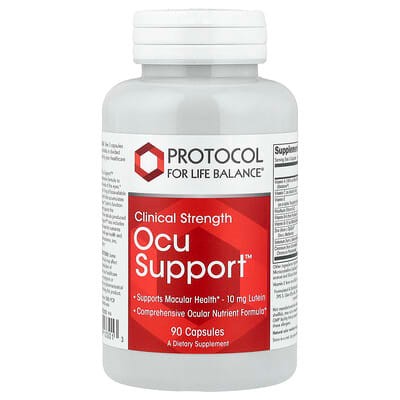
Clinical Strength Ocu Support
Product analysis
Clinical Strength Ocu Support supplies lutein for the eye pigment involved in filtering blue light, alongside nutrients that can help fill dietary gaps. Its mixed formula should not be assumed to improve everyday vision or match combinations used for specific eye conditions.
AI assessment of the formula, label and price. How scoring works
Nutrient Quality37
Natural vitamin E and the named chromium form are strengths of the ingredient selection. Several other forms are unspecified or cannot be compared confidently, leaving the quality picture incomplete.
Ingredient Transparency71
All ingredient amounts are disclosed, and many forms are named. Missing forms and the undisclosed proportions of the ginkgo components make some preparation comparisons difficult.
Value For Money37
Value is limited for several ingredients, particularly riboflavin, chromium and CoQ10. Vitamin A and rutin offer more moderate value, while several other contributions remain uncertain.
Customer Satisfaction74
Customer feedback is strongly positive. The relatively small review base is useful buying context, without proving eye-health effects.
Product Focus37
Eye health is the clearest purpose, led by lutein and supporting nutrients. The extensive mix makes it harder to tell which additional ingredients meaningfully contribute.
- Format
Capsule - Container
- 90 Capsule(s)
- Per serving
- $1.16
- Customer rating
- 4.8 · 113 ratings
Goals
Declared lutein relates to macular pigment and blue-light filtering, with the amount contributing to the saved finding. Vitamin C and other antioxidant nutrients have evidence within a defined combination for selected people with age-related macular degeneration, rather than general visual improvement. Vitamin A also supports the visual cycle when intake is inadequate. Bilberry benefits depend on a specific studied extract, so generic or unresolved bilberry cannot inherit them.
How this product is rated for Eye Health
Ingredient fit53
Goal fit
Dose adequacy
Pathways80
Depth
Breadth
Evidence100
Evidence strength
Studied preparation
Formulation logic92
Partner coverage
Conflicts
Effective doses
Lutein has limited support for selected skin-tone and UV-response outcomes, but this serving's zeaxanthin amount differs from the studied combination. Vitamin C, zinc, riboflavin and B6 can support skin when their intake is low, without established extra benefit in adequately nourished adults. Vitamin A and E retain IU declarations but lack resolved amounts for this calculation.

How this product is rated for Skin Health
Ingredient fit53
Goal fit
Dose adequacy
Pathways51
Depth
Breadth
Evidence100
Evidence strength
Studied preparation
Formulation logic94
Partner coverage
Conflicts
Effective doses
Ingredients
| Ingredient | Amount per serving | Score |
|---|---|---|
Vitamin A (Beta-Carotene) | 10000 IU | |
Vitamin C (Ascorbic Acid) | 250 mg | |
Vitamin E (D-Alpha-Tocopheryl Succinate) | 100 IU | |
Riboflavin | 15 mg | |
Vitamin B6 (Pyridoxine Hydrochloride) | 10 mg | |
Vitamin B12 (Methylcobalamin) | 100 mcg | |
Zinc (L-OptiZinc Zinc-L-Methionine) | 7.5 mg | |
Selenium (SelenoPure L-Selenomethionine) | 50 mcg | |
Chromium (Chromemate Chromium Polynicotinate) | 50 mcg | |
Citrus Bioflavonoid Complex | 100 mg | |
Rutin powder (Sophora japonica) | 100 mg | |
Eyebright | 100 mg | |
Green Tea extract | 50 mg | |
Taurine | 50 mg | |
N-Acetyl Cysteine | 50 mg | |
Bilberry extract (Total Anthocyanins) | 25 mg | |
Alpha Lipoic Acid | 25 mg | |
Grape seed extract (Polyphenols) | 25 mg | |
Ginkgo biloba extract (Ginkgoflavonglycosides, Terpene Lactones) | 20 mg | |
CoQ10 (Ubiquinone) | 10 mg | |
Lutein (FloraGLO Marigold flowers extract) | 10 mg | |
Zeaxanthin (FloraGLO Marigold flowers extract) | 500 mcg | |
L-Glutathione | 2.5 mg |
How this ingredient is rated
Composition and Label Disclosure
Composition and Label Disclosure100
Declared Active Rutin Amount
Commercial Price and Usability50
Whole-Product Cost per 100 mg Declared Rutin Preparation
How this ingredient is rated
Active Ingredient Quality & Bioavailability50
Vitamin A Chemical Form & Source
Dose, Safety & Label Transparency83
Dosage Efficacy & Safety Thresholds
Label Transparency of Specific Forms
Value50
Price per 5,000 IU Dose
How this ingredient is rated
Active Ingredient Quality & Bioavailability46
Natural (d-alpha) vs. Synthetic (dl-alpha)
Mixed Tocopherol Isomer Diversity
Tocotrienol Complex Inclusion
Dose, Safety & Label Transparency85
Therapeutic Dosage Range
Label Transparency and Isomer Specificity
Value40
Cost per Natural-Form Therapeutic Serving
Alternative products
Sources
Published studies used for the product analysis and the top-ranked studies for each ingredient and goal.

- Effect of Ginkgo biloba extracts in the prevention of posterior capsule opacification after cataract surgery: A randomized clinical trial.
- Effect of Ginkgo biloba extract on preexisting visual field damage in normal tension glaucoma.
- [Ginkgo extract in impaired vision--treatment with special extract EGb 761 of impaired vision due to dry senile macular degeneration].
- Short-term effects of Ginkgo biloba extract on peripapillary retinal blood flow in normal tension glaucoma.
- [The course of color vision in early diabetic retinopathy treated with Ginkgo biloba extract. A preliminary double-blind versus placebo study].
- U.S. Multicenter Clinical Trial of Corneal Collagen Crosslinking for Treatment of Corneal Ectasia after Refractive Surgery.
- United States Multicenter Clinical Trial of Corneal Collagen Crosslinking for Keratoconus Treatment.
- EpiSmart Crosslinking for Keratoconus: A Phase 2 Study.
- Prospective Randomized Trial of Corneal Cross-linking Riboflavin Dosing Frequencies for Treatment of Keratoconus and Corneal Ectasia.
- Corneal collagen cross-linking for keratoconus: results of 3-year follow-up in Pakistani population.
- A randomized, double-masked study on the treatment of retinal vein occlusion with troxerutin
- Efficacy and safety of AZR-MD-001 selenium sulfide ophthalmic ointment in adults with meibomian gland dysfunction: A vehicle-controlled, randomized clinical trial.
- The efficacy and safety of selenium supplementation versus placebo in the treatment of Graves' orbitopathy: A systematic review and meta-analysis of randomised controlled trials.
- Efficacy and safety of AZR-MD-001 selenium sulfide ophthalmic ointment in adults with meibomian gland dysfunction over six months of treatment: A Phase 2, vehicle-controlled, randomized extension trial.
- AZR-MD-001 0.5% selenium sulfide ophthalmic ointment for the treatment of contact lens discomfort: A vehicle-controlled, randomized, clinical trial.
- The effect of a biweekly novel selenium sulfide-containing topical treatment in symptomatic contact lens wearers: An exploratory study.
- Effects of taurine supplementation on VDT work induced visual stress.
- A randomized trial of vitamin A and vitamin E supplementation for retinitis pigmentosa.
- Efficacy and safety of retinol palmitate ophthalmic solution in the treatment of dry eye: a Japanese Phase II clinical trial.
- Vitamin A supplementation for preventing morbidity and mortality in children from six months to five years of age.