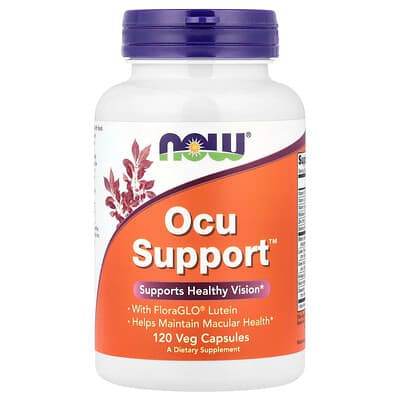
Ocu Support

Ocu Support

NOW4.6 (928 ratings)
Format:Capsule Quantity: 120 Capsule(s) · 40 servings
Goals

About this product

The formula is most clearly aimed at eye nutrition. Lutein at 10 mg supports macular pigment and light filtering, while beta-carotene supplies vitamin A for the normal visual cycle. Zeaxanthin is present at 500 mcg, but the saved assessment found that amount too low to count toward its eye-health dose curve.

Vitamins C and E, riboflavin, zinc, and selenium add antioxidant and general nutritional support. Zinc and selenium use well-regarded forms, and nearly every ingredient amount and form is disclosed. Bilberry, rutin, green tea, and N-acetyl cysteine broaden the blend, though the available findings are less certain about their practical contribution.

Several trade-offs matter for regular use. The 25 mg zinc serving does not disclose accompanying copper, the beta-carotene amount is high at 25,000 IU, and the green tea extract does not state its EGCG or caffeine amount. It fits adults seeking a broad eye-focused antioxidant blend, but it is less convincing for goals such as gut health or raising metabolic rate.

Who is it for
  • Adults looking for an eye-focused nutrient and antioxidant blend
  • People who value clearly listed ingredient amounts and mostly identified forms
  • Those who want lutein alongside vitamins A, C, and E, zinc, and selenium
Best for
  • Macular pigment and light-filtering support
  • General eye nutrition when dietary intake may be uneven
  • Broad antioxidant and micronutrient coverage

Pros

  • Provides 10 mg of lutein, the clearest eye-focused ingredient in the blend
  • Uses well-regarded zinc monomethionine and selenomethionine forms
  • Discloses amounts for all listed active ingredients
  • Combines carotenoids with vitamins C and E, zinc, and selenium
  • Offers a wide mix of nutrients and plant extracts in one serving

Cons

  • Zeaxanthin is only 500 mcg and was below the saved eye-health dose threshold
  • Bilberry support is uncertain for the specific extract provided
  • Green tea lists EGCG without stating its amount or concentration
  • Standard riboflavin requires conversion before use
  • The formula is less focused on its many secondary goals

Warnings

  • A serving supplies 25 mg of zinc without a disclosed copper amount, so long-term mineral balance is unclear.
  • The 25,000 IU beta-carotene amount is above the saved 15,000 IU dose boundary; people advised to avoid high-dose beta-carotene should check suitability before use.
  • The green tea extract does not disclose caffeine quantity or confirm that the whole product is caffeine-free, which matters for caffeine-sensitive users.

Product analysis

65 out of 100

Ocu Support combines nutrients and plant extracts in a supplement aimed at eye health. The zinc and selenium forms are strengths, while value varies considerably between ingredients.

AI assessment of the formula, label and price. How scoring works

Nutrient Quality54

Zinc and selenium use highly regarded forms, while riboflavin uses a basic form. Quality conclusions for the other ingredients remain uncertain.

Ingredient Transparency97

All ingredient amounts and almost every form are disclosed, making the label relatively easy to compare. N-acetyl cysteine is the only ingredient with an unspecified form.

Value For Money39

Value varies: vitamin A is economical, but zinc and especially selenium are expensive for what they provide. Riboflavin and rutin fall in the middle, while value for several other ingredients remains uncertain.

Customer Satisfaction79

Customer ratings are strongly positive across a substantial review pool. They show satisfaction without proving eye-health benefits.

Product Focus67

The combination appears well aligned with its intended benefits. It covers a broad set of goals, with no ingredients confirmed to be unnecessary.

Format
Capsule
Container
120 Capsule(s)
Per serving
$0.57
Customer rating
4.6 · 928 ratings
Report analysis

Goals

Immunity
Impact
Highest effect
C Ingredient FitA+ PathwaysA+ EvidenceA+ Formulation Logic
Vitamin C · 300 mgZinc · 25 mgVitamin A · 25000 IUSelenium · 100 mcg

Ocu Support supplies 300 mg of vitamin C and 25 mg of zinc per serving, supporting normal immune cell function. Regular vitamin C use may also modestly shorten colds. Vitamin A, supplied as beta-carotene, relates to normal immune function and the barriers that help protect the body.

Selenium contributes to normal immune function and the body’s antioxidant defenses; the serving provides 100 mcg. These nutrient roles are the clearest basis for its immunity contribution, while extra respiratory benefits from vitamin E or this green tea extract remain uncertain.

How this product is rated for Immunity

Ingredient fit64

Several ingredients relate to normal immune function, although Ocu Support also contains ingredients aimed at other goals. Amounts provide uneven support across the ingredients assessed.
Goal fit
The saved assessment identifies six ingredients relevant to immunity alongside four actives outside this goal, with the product linked to nine goals overall.
Dose adequacy
The saved amount assessment is mixed across six ingredients. Vitamin A has no usable amount in mcg RAE, so its amount could not contribute to that finding.

Pathways100

The saved findings show broader coverage of immune cell activity, immune regulation, and oxidative and inflammatory balance. Coverage of barrier defenses is more limited.
Depth
Oxidative and inflammatory balance is the most strongly covered area in the saved assessment.
Breadth
Three areas meet the saved coverage threshold: innate immune cell activity, lymphocyte function and immune regulation, and oxidative and inflammatory balance.

Evidence98

Vitamin C leads the saved evidence finding. The preparation assessment is favorable for most assessed ingredients, with green tea the exception.
Evidence strength
Vitamin C meets the saved amount threshold and carries the highest evidence rating used for this goal.
Studied preparation
The saved assessment recognizes research preparation matches for five ingredients; green tea has no such match.

Formulation logic96

The saved assessment finds the assessed ingredients have their required partners or can work alone, with no flagged ingredient conflicts. Vitamin A is the exception in the amount check.
Partner coverage
All assessed ingredients can work alone or have the partner required by the saved assessment.
Conflicts
No configured ingredient conflict was triggered by the known amounts, including the two zinc-related checks.
Effective doses
Five of six assessed ingredients meet the saved minimum amount threshold. Vitamin A falls below it because its usable nutrient activity amount is unavailable.
Study evidence
Green Tea Not classified 2 studies
Selenium Mixed 37 studies
Vitamin A Supportive 107 studies
Vitamin C Supportive 53 studies
Vitamin E Supportive 21 studies
Zinc Supportive 73 studies
Impact
Highest effect
B- Ingredient FitA+ PathwaysA+ EvidenceA+ Formulation Logic
Zinc · 25 mgVitamin E · 134 mgVitamin C · 300 mgVitamin A · 25000 IU

Ocu Support supplies 10 mg of active lutein, its clearest contribution to vision support. Lutein relates to macular pigment and light filtering, and may help with selected aspects of contrast sensitivity, although evidence for sharper eyesight is limited.

Vitamin A supports the normal visual cycle, particularly when intake is low. Vitamins C and E, riboflavin, selenium and zinc relate to normal eye nutrition and antioxidant defenses, but extra amounts have no clear routine vision benefit for adequately nourished adults. The 100 mg bilberry extract has a less certain connection to screen-related focusing comfort because support is specific to a different preparation.

How this product is rated for Eye Health

Ingredient fit73

Lutein gives the blend a clear vision focus, while the saved assessment finds uneven amounts across the relevant ingredients.
Goal fit
Eight ingredients were counted toward vision support, alongside green tea and N-acetyl cysteine for other purposes. Its links to several goals make it less narrowly focused on vision.
Dose adequacy
Lutein has a substantial declared amount, while several other ingredients provide partial amounts against the saved references. Vitamin A has no usable amount in the required unit.

Pathways100

The saved findings cover macular pigment, antioxidant defenses in the retina and lens, and the visual cycle. Focusing-muscle function and eye circulation have much less coverage.
Depth
Antioxidant defense in the retina and lens is the most strongly covered area in the saved assessment.
Breadth
Three areas meet the saved coverage target: macular pigment and light filtering, retinal and lens antioxidant defense, and photoreceptor structure and the visual cycle.

Evidence99

Lutein provides the clearest direct link to limited visual-performance support. Most counted ingredients match preparations recognized in the saved assessment, with bilberry the exception.
Evidence strength
The 10 mg of declared active lutein supplies the strongest evidence link among the counted ingredients, with limited support for selected contrast-related aspects of vision.
Studied preparation
Most ingredients counted at a sufficient amount match the preparations recognized by the saved assessment. The bilberry extract is not identified as the specific preparation used for screen-related focusing support.

Formulation logic97

The saved assessment finds the required ingredient partners covered and no matched formulation conflict. Seven of eight counted ingredients meet its minimum amount threshold.
Partner coverage
All counted ingredients either stand alone under the saved assessment or have their required partner present.
Conflicts
No configured ingredient conflict was matched. The zinc amount did not trigger the high-zinc-without-copper adjustment.
Effective doses
Seven of eight counted ingredients meet the saved minimum amount threshold. Vitamin A falls short because its IU declaration was not converted to the required amount unit.
Study evidence
Riboflavin Supportive 69 studies
Rutin Not classified 1 study
Selenium Supportive 15 studies
Vitamin A Supportive 65 studies
Vitamin C Disputed 24 studies
Vitamin E Disputed 35 studies
Zinc Supportive 39 studies
Skin Health
Impact
High effect
B- Ingredient FitC PathwaysA+ EvidenceA+ Formulation Logic
Zinc · 25 mgVitamin C · 300 mgSelenium · 100 mcgGreen Tea · 150 mgVitamin E · 134 mg

Ocu Support supplies 10 mg of lutein, an amount associated with modest improvements in skin tone and responses to UV exposure in small human trials with zeaxanthin. Lutein and zeaxanthin have also been linked to hydration and elasticity, although evidence is limited. Vitamin E and selenium support antioxidant systems in skin.

Vitamin C supports normal collagen production, while zinc helps skin repair. Riboflavin helps maintain healthy skin, and vitamin A supports normal renewal of its outer layers. These nutrients mainly support adequate nutrition; extra intake has no established added skin benefit when needs are already met.

How this product is rated for Skin Health

Ingredient fit73

Several ingredients relate to skin nutrition and antioxidant protection, though their amounts make uneven contributions. The saved findings also reflect ingredients aimed at other goals.
Goal fit
Eight ingredients were counted as relevant to skin health, alongside three other actives; the product is also linked to nine goals.
Dose adequacy
The saved amount assessment is mixed: green tea and vitamin C contribute partly, while vitamin A has no usable amount in the assessed unit.

Pathways60

The saved findings concentrate on antioxidant defence against UV-related stress, with limited coverage of other skin functions.
Depth
Antioxidant defence against UV-related stress is the most fully covered area in the saved assessment.
Breadth
Only antioxidant defence reaches the saved coverage threshold. Collagen structure, water binding and barrier lipids have no recorded coverage.

Evidence100

The saved evidence findings are led by vitamin C and record matching preparations for seven ingredients at qualifying amounts.
Evidence strength
Vitamin C leads the saved evidence finding at its qualifying amount. Its normal role in collagen production is distinct from added cosmetic benefit in people already getting enough.
Studied preparation
The saved assessment identifies seven ingredients at qualifying amounts in preparations used in research.

Formulation logic97

The saved findings show no missing ingredient partners or matched conflicts. Seven of the eight assessed ingredients meet the saved minimum amount threshold.
Partner coverage
Every assessed ingredient can contribute alone or has its required partner present.
Conflicts
No ingredient conflicts were recorded in the saved assessment.
Effective doses
Seven of eight assessed ingredients meet the saved minimum amount threshold; vitamin A falls below it because its usable amount is unresolved.
Study evidence
Green Tea Supportive 37 studies
Selenium Supportive 22 studies
Vitamin A Supportive 106 studies
Vitamin C Supportive 53 studies
Vitamin E Supportive 38 studies
Zinc Supportive 66 studies
Everyday Health
Impact
High effect
C Ingredient FitB+ PathwaysB+ EvidenceA+ Formulation Logic
Selenium · 100 mcgZinc · 25 mgVitamin C · 300 mg

Ocu Support supplies riboflavin for normal energy metabolism, plus vitamin C, zinc and selenium for antioxidant and normal immune functions. These nutrients may help fill dietary gaps; the practical contribution depends on how much you already get from food.

A serving provides 20 mg of riboflavin, well above the adult daily reference of 1.1–1.3 mg. More than enough riboflavin does not imply extra energy or added benefit once needs are met.

How this product is rated for Everyday Health

Ingredient fit65

Riboflavin, vitamin C, zinc and selenium provide the main general-health contribution. The saved findings show a broader mix of other actives and stronger amount coverage for riboflavin, zinc and selenium than for vitamin C.
Goal fit
Four nutrients relate directly to the assessed goal, alongside seven other actives. The product’s links to nine goals also make its focus broader.
Dose adequacy
The saved amount assessment is strongest for riboflavin, zinc and selenium, with vitamin C contributing less at 300 mg.

Pathways80

The clearest coverage is antioxidant and normal immune support, with a further contribution to energy metabolism. These cover two of the three target areas in the saved assessment.
Depth
Antioxidant and immune defence is the most strongly covered area, through vitamin C, zinc and selenium.
Breadth
Antioxidant and immune defence and energy metabolism reach the saved coverage threshold. Other areas have little or no coverage.

Evidence82

Selenium leads the saved evidence assessment among the four contributing nutrients. Their declared preparations all meet the saved preparation criteria.
Evidence strength
Selenium provides the strongest saved evidence contribution at the declared amount. Its relevance here is nutritional support, particularly when intake is low.
Studied preparation
All four contributing nutrients meet the saved preparation criteria at amounts counted by the assessment.

Formulation logic100

The four contributing nutrients have no missing required partners and all meet the saved minimum amount criteria. No conflict deduction was applied, although the caffeine amount remains unresolved.
Partner coverage
Each contributing nutrient can make its assessed contribution alone or has the partner it needs.
Conflicts
No configured conflict was counted. Caffeine is present, but its unresolved amount prevents the caffeine thresholds from being checked.
Effective doses
All four contributing nutrients meet the saved minimum amount threshold, including vitamin C despite its smaller contribution to the amount assessment.
Study evidence
Selenium Supportive 70 studies
Vitamin C Supportive 56 studies
Zinc Supportive 60 studies
Hair Health
Impact
High effect
C Ingredient FitC PathwaysA+ EvidenceA Formulation Logic
Zinc · 25 mgVitamin C · 300 mg

Ocu Support provides 25 mg of zinc per selected serving. Zinc may help when a dietary shortfall contributes to shedding; extra zinc is not expected to improve hair growth when intake is already adequate.

Vitamin C supports normal collagen formation and iron absorption, while selenium contributes to antioxidant defenses. These are nutritional roles rather than a promise of regrowth. Riboflavin is a supporting B vitamin, with no independent hair-growth benefit assigned in the supplied assessment.

How this product is rated for Hair Health

Ingredient fit63

Several relevant nutrients give Ocu Support a moderate saved fit for hair health, alongside ingredients aimed at other goals.
Goal fit
Five ingredients were considered for goal fit, alongside six actives outside the assessed hair goal. Links to nine goals also reflect a broader focus.
Dose adequacy
Zinc and selenium meet the saved amount benchmarks, while vitamin C partly meets its benchmark. Vitamin A has no usable amount in the required unit for this comparison.

Pathways60

The saved findings concentrate on antioxidant protection around hair follicles, with limited breadth across other assessed aspects of hair health.
Depth
Antioxidant protection around hair follicles is the most fully covered area in the saved assessment.
Breadth
Only antioxidant protection reaches the saved coverage threshold. Hair-fibre building blocks, androgen signalling and stress-hormone regulation have no recorded coverage.

Evidence98

Zinc drives the strong saved evidence finding, with its relevance mainly tied to correcting low intake. The three ingredients meeting the amount threshold also satisfy the saved preparation check.
Evidence strength
Zinc supplies the strongest evidence contribution among ingredients meeting the saved amount threshold. Its practical relevance to shedding depends on whether zinc intake is low.
Studied preparation
The saved assessment accepts the preparations of all three ingredients meeting its amount threshold. Ordinary tocopheryl vitamin E is excluded from the separate mixed-tocotrienol hair evidence.

Formulation logic94

The saved assessment finds required partners covered and no matched ingredient conflicts. Three of four assessed nutrients meet its minimum amount threshold.
Partner coverage
Each assessed ingredient can contribute alone or has the partner required by the saved assessment.
Conflicts
No ingredient conflicts were matched in the saved assessment.
Effective doses
Selenium, vitamin C and zinc meet the saved minimum amount threshold. Vitamin A falls below it because no comparable amount was assigned.
Study evidence
Selenium Disputed 7 studies
Vitamin A Disputed 13 studies
Vitamin E No effect 3 studies
Zinc Supportive 22 studies
Nail Health
Impact
High effect
C+ Ingredient FitD+ PathwaysC EvidenceA+ Formulation Logic

Ocu Support supplies vitamin C, which is needed to make collagen, and zinc, which supports the growth of cells in the nail-forming tissue. Zinc may help nail quality when intake is inadequate, but extra zinc has no established nail benefit when needs are already met.

These are nutritional links rather than strong evidence for improving nail growth or brittleness in generally well-nourished adults. The supplied evidence also gives little support for a routine nail benefit from vitamin E, selenium or N-acetyl cysteine.

How this product is rated for Nail Health

Ingredient fit65

The saved assessment finds a mixed fit for nails, with generally substantial amounts of the nutrients it counted and a broader ingredient mix aimed at other goals.
Goal fit
Four nutrients were counted toward nails, alongside seven other active ingredients and links to nine goals, giving a moderate degree of nail focus.
Dose adequacy
The saved amount comparison was generally favorable for the four counted nutrients. Vitamin C at 300 mg made a smaller contribution than the other three relative to their reference amounts.

Pathways51

The saved assessment places the strongest coverage in nutrients associated with nail formation, with less coverage of the surrounding matrix and none for structural protein supply.
Depth
Nutrients associated with nail formation were the strongest area, though coverage remained partial.
Breadth
Only the nail-formation area reached the saved coverage threshold. Matrix support fell below it, and structural protein supply had no coverage.

Evidence65

Vitamin E led the saved evidence comparison, while most of the counted nutrients matched preparations recorded in the evidence review. These findings do not imply a reliable improvement in nail growth or strength.
Evidence strength
Vitamin E provided the strongest evidence finding among the counted nutrients at the supplied amounts, but that finding was moderate within the saved comparison.
Studied preparation
The saved preparation comparison matched vitamin C, vitamin E and zinc to preparations used in the reviewed evidence; selenium did not match.

Formulation logic100

The saved assessment found the counted nutrients adequately paired and no flagged ingredient conflicts. All four passed its minimum amount check.
Partner coverage
Each of the four counted nutrients was recorded as able to work alone or as having its required partner present.
Conflicts
No conflict was flagged. Selenium at 100 mcg per serving was below the 400 mcg level used for the excessive-selenium check.
Effective doses
All four counted nutrients passed the saved minimum amount check; passing that check is not a promise of a nail benefit.
Study evidence
Selenium Adverse 1 study
Vitamin C Supportive 1 study
Vitamin E Supportive 6 studies
Zinc No effect 1 study
Impact
Moderate effect
C Ingredient FitF PathwaysA+ EvidenceA Formulation Logic
Riboflavin · 20 mgZinc · 25 mgGreen Tea · 150 mg

Ocu Support provides riboflavin to help the body release energy from food, zinc for normal enzyme and endocrine function, and selenium for enzymes that activate thyroid hormone. These roles support everyday metabolism; extra amounts are not shown here to raise energy expenditure when nutrient needs are already met.

Green tea extract adds catechins, which may have a small, short-term role in energy expenditure in defined preparations. Its eligible dose and caffeine content remain unresolved in the supplied facts, so a specific metabolism-boosting contribution cannot be assigned.

How this product is rated for Metabolism Support

Ingredient fit60

Riboflavin, selenium and zinc provide normal metabolic support at amounts the saved assessment accepted. Green tea’s usable amount remains unresolved, and the broader ingredient mix makes the product less focused on this goal.
Goal fit
Four ingredients were included in the saved goal-fit assessment, alongside eight other active ingredients and links to nine goals. The resulting finding reflects a broad-purpose formula.
Dose adequacy
Riboflavin, selenium and zinc met the saved dose comparisons. Green tea received no dose credit because its eligible amount was unavailable.

Pathways0

The saved assessment found no coverage of the pathways used to judge a direct increase in energy expenditure. The nutrient contributions relate to normal metabolic function.
Depth
No direct energy-expenditure pathway had measurable coverage in the saved assessment.
Breadth
None of the assessed energy-expenditure pathways reached the saved coverage threshold.

Evidence100

Zinc led the saved evidence finding, with riboflavin and selenium also accepted in assessed preparations. Their normal nutrient functions should be distinguished from an increase in metabolic rate.
Evidence strength
Zinc at 25 mg supplied the strongest accepted evidence contribution in the saved assessment. Its role is support for normal enzyme and endocrine function.
Studied preparation
The saved assessment accepted the preparations of riboflavin, selenium and zinc at the amounts used in its dose comparison.

Formulation logic94

The saved assessment found the required ingredient partnerships covered and no matched conflicts. Three of the four assessed ingredients met its dose threshold; green tea was the exception.
Partner coverage
Each assessed ingredient was recorded as able to work alone or having its required partner.
Conflicts
No ingredient conflict triggered a deduction in the saved assessment. The caffeine amount remained unknown.
Effective doses
Riboflavin, selenium and zinc met the saved dose threshold. Green tea did not because an eligible amount was unavailable.
Study evidence
Green Tea Supportive 31 studies
Selenium Mixed 28 studies
Zinc Supportive 12 studies

Ingredients

IngredientAmount per servingScore
Vitamin A (Beta-Carotene)
25000 IU 67
Vitamin C (Ascorbic Acid)
300 mg
Vitamin E (D-Alpha-Tocopheryl Succinate)
134 mg
Riboflavin
20 mg 48
Zinc (L-OptiZinc Monomethionine)
25 mg 73
Selenium (L-Selenomethionine)
100 mcg 77
Bilberry extract (Anthocyanins)
100 mg
Lutein (FloraGLO Marigold flowers extract)
10 mg
Green Tea extract (EGCG)
150 mg 29
N-Acetyl Cysteine
100 mg
Rutin powder (Sophora japonica)
100 mg 83
Zeaxanthin (FloraGLO Marigold flowers extract)
500 mcg
Gluten Free Adults 18–50 Kosher Dairy Free
Report overview
A+ Active Ingredient Quality & BioavailabilityC+ Dose, Safety & Label TransparencyF Value
Each serving provides 25 mg of zinc as L-monomethionine sulfate, a form the evaluation views favorably for absorption. The copper amount is unknown, so the zinc-to-copper balance cannot be assessed.
How this ingredient is rated

Active Ingredient Quality & Bioavailability100

The zinc is zinc l-monomethionine sulfate, a form the evaluation views favorably for absorption.
Zinc Form Bioavailability
The evaluation views zinc l-monomethionine sulfate favorably for absorption.

Dose, Safety & Label Transparency67

The labeled 25 mg of zinc per serving is a substantial amount in the evaluation; the copper amount is unknown.
Elemental Dose Transparency
The label gives 25 mg of elemental zinc per serving and identifies its source.
Zinc Dosage Safety & Effectiveness
Each serving provides 25 mg zinc, a substantial amount in the evaluation.
Zinc-to-Copper Mineral Balance
The copper amount is unknown, so the zinc-to-copper ratio cannot be assessed.

Value30

The whole product costs about $0.58 per serving, relatively high in the evaluation.
Price Per Serving Efficiency
The price is about $0.58 per whole-product serving.
A+ Active Ingredient Quality & BioavailabilityA- Dose, Safety & Label TransparencyF Value
Each serving supplies 100 mcg of selenium as L-selenomethionine, an amount the evaluation places at the maintenance level. The whole-product price works out to about $1.16 per 200 mcg of selenium.
How this ingredient is rated

Active Ingredient Quality & Bioavailability100

Selenium is identified as L-selenomethionine; the L form is specified.
Selenium Chemical Form
The stated selenium form is L-selenomethionine, an identified organic form.
Form Transparency & Isomer Specificity
The name identifies the L form of selenomethionine.

Dose, Safety & Label Transparency88

The serving supplies 100 mcg of selenium, an amount the evaluation places at the maintenance level. It is below the upper limit used in the evaluation.
Dosage Efficacy Sweet Spot
The 100 mcg per serving is an amount the evaluation places at the maintenance level.
Safety Margin & UL Adherence
The 100 mcg selenium serving is below the upper limit used in the evaluation; intake from other sources also contributes to the total.

Value10

Based on the whole-product serving price, 200 mcg of selenium costs about $1.16.
Price per 200 mcg Serving
Based on the whole-product serving price, 200 mcg of selenium costs about $1.16.
D+ Active Ingredient Quality & BioavailabilityC+ Dose, Safety & Label TransparencyA+ Value
Each serving provides a high 25,000 IU of vitamin A as beta-carotene. The source is identified as entirely beta-carotene, a provitamin A form.
How this ingredient is rated

Active Ingredient Quality & Bioavailability50

Beta-carotene is identified as the source of all the listed vitamin A.
Vitamin A Chemical Form & Source
Beta-carotene is a provitamin A source.

Dose, Safety & Label Transparency67

The serving supplies a high 25,000 IU of vitamin A, entirely from beta-carotene.
Dosage Efficacy & Safety Thresholds
The 25,000 IU of vitamin A per serving is a high amount from beta-carotene.
Label Transparency of Specific Forms
The available source information identifies beta-carotene as the entire vitamin A source.

Value100

The whole-product price is about $0.12 per 5,000 IU of vitamin A.
Price per 5,000 IU Dose
The whole-product price is about $0.12 per 5,000 IU of vitamin A.
Report alternatives

Sources

Published studies used for the product analysis and the top-ranked studies for each ingredient and goal.

  1. Associations of selenium status with all-cause and cause-specific mortality: a systematic review and meta-analysis of cohort studies.
    Cui Z; Xie R; Lu X; Schomburg L; Brenner H; Schöttker B · Redox biology · 2025
    Meta-analysis95 participants20 studies pooledEveryday Health forSelenium
  2. Dietary Antioxidants, Circulating Antioxidant Concentrations, Total Antioxidant Capacity, and Risk of All-Cause Mortality: A Systematic Review and Dose-Response Meta-Analysis of Prospective Observational Studies.
    Jayedi A; Rashidy-Pour A; Parohan M; Zargar MS; Shab-Bidar S · Advances in nutrition (Bethesda, Md.) · 2019
    Meta-analysis507,251 participants41 studies pooledEveryday Health forSelenium
  3. The efficacy and safety of selenium supplementation versus placebo in the treatment of Graves' orbitopathy: A systematic review and meta-analysis of randomised controlled trials.
    Sharabati I; Qafesha RM; Hindawi MD; Amro S; Ayesh BM · Clinical endocrinology · 2024
    Meta-analysis4 studies pooledEveryday Health Eye Health forSelenium
  4. Associations of plasma metal concentrations with the risks of all-cause and cardiovascular disease mortality in Chinese adults.
    Shi L; Yuan Y; Xiao Y; Long P; Li W; Yu Y; Liu Y; Liu K; Wang H; Zhou L; Yang H; Li X; He M; Wu T · Environment international · 2021
    Cohort study6,155 participantsEveryday Health forSelenium
  5. Updates on clinical studies of selenium supplementation in radiotherapy.
    Puspitasari IM; Abdulah R; Yamazaki C; Kameo S; Nakano T; Koyama H · Radiation oncology (London, England) · 2015
    Systematic review16 studies pooledEveryday Health forSelenium
  6. Dietary intake and blood concentrations of antioxidants and the risk of cardiovascular disease, total cancer, and all-cause mortality: a systematic review and dose-response meta-analysis of prospective studies.
    Aune D; Keum N; Giovannucci E; Fadnes LT; Boffetta P; Greenwood DC; Tonstad S; Vatten LJ; Riboli E; Norat T · The American journal of clinical nutrition · 2019
    Meta-analysis69 studies pooledEveryday Health forVitamin C
  7. Scientific Opinion on the substantiation of a health claim related to vitamin C and increasing non haem iron absorption pursuant to Article 14 of Regulation (EC) No 1924/2006.
    EFSA Panel on Dietetic Products, Nutrition and Allergies (NDA) · EFSA journal. European Food Safety Authority · 2026
    Guideline / consensusEveryday Health forVitamin C
  8. Vitamin C Depletion and All-Cause Mortality in Renal Transplant Recipients.
    Sotomayor CG; Eisenga MF; Gomes Neto AW; Ozyilmaz A; Gans ROB; Jong WHA; Zelle DM; Berger SP; Gaillard CAJM; Navis GJ; Bakker SJ · Nutrients · 2018
    Cohort study598 participantsEveryday Health forVitamin C
  9. Associations of Serum Biomarkers of Fruit and Vegetable Intake With the Risk of Cause-Specific Mortality and All-Cause Mortality: A National Prospective Cohort Study.
    Pu L; Zhang R; Wang X; Zhao T; Sun H; Han L · Frontiers in nutrition · 2022
    Cohort study12,530 participantsEveryday Health forVitamin C
  10. Relation between plasma ascorbic acid and mortality in men and women in EPIC-Norfolk prospective study: a prospective population study. European Prospective Investigation into Cancer and Nutrition.
    Khaw KT; Bingham S; Welch A; Luben R; Wareham N; Oakes S; Day N · Lancet (London, England) · 2001
    Cohort study19,496 participantsEveryday Health forVitamin C
  11. Effectiveness of sodium bicarbonate and zinc chloride mouthwashes in the treatment of oral mucositis and quality of life in patients with cancer under chemotherapy.
    Mohammadi F; Oshvandi K; Kamallan SR; Khazaei S; Ranjbar H; Ahmadi-Motamayel F; Gillespie M; Jenabi E; Vafaei SY · Nursing open · 2022
    Randomized trial144 participantsEveryday Health forZinc
  12. Zinc supplementation in young children with acute diarrhea in India.
    Sazawal S; Black RE; Bhan MK; Bhandari N; Sinha A; Jalla S · The New England journal of medicine · 1995
    Randomized trial937 participantsEveryday Health forZinc
  13. Associations of mortality with ocular disorders and an intervention of high-dose antioxidants and zinc in the Age-Related Eye Disease Study: AREDS Report No. 13.
    Clemons TE; Kurinij N; Sperduto RD; AREDS Research Group · Archives of ophthalmology (Chicago, Ill. : 1960) · 2004
    Randomized trial4,753 participantsEveryday Health forZinc
  14. Effects of zinc and probiotic co-supplementation on inflammation, gastrointestinal symptoms, quality of life, and mood in irritable bowel syndrome patients.
    Rezazadegan M; Soheilipour M; Amani R · Scientific reports · 2026
    Randomized trial84 participantsEveryday Health forZinc
  15. Effect of zinc sulfate supplementation on premenstrual syndrome and health-related quality of life: Clinical randomized controlled trial.
    Siahbazi S; Behboudi-Gandevani S; Moghaddam-Banaem L; Montazeri A · The journal of obstetrics and gynaecology research · 2018
    Randomized trial142 participantsEveryday Health forZinc
  16. U.S. Multicenter Clinical Trial of Corneal Collagen Crosslinking for Treatment of Corneal Ectasia after Refractive Surgery.
    Hersh PS; Stulting RD; Muller D; Durrie DS; Rajpal RK; U.S. Crosslinking Study Group · Ophthalmology · 2017
    Randomized trial179 participantsEye Health forRiboflavin
  17. United States Multicenter Clinical Trial of Corneal Collagen Crosslinking for Keratoconus Treatment.
    Hersh PS; Stulting RD; Muller D; Durrie DS; Rajpal RK; United States Crosslinking Study Group · Ophthalmology · 2017
    Randomized trial205 participantsEye Health forRiboflavin
  18. EpiSmart Crosslinking for Keratoconus: A Phase 2 Study.
    Epstein RJ; Belin MW; Gravemann D; Littner R; Rubinfeld RS · Cornea · 2023
    Randomized trial2,228 participantsEye Health forRiboflavin
  19. Prospective Randomized Trial of Corneal Cross-linking Riboflavin Dosing Frequencies for Treatment of Keratoconus and Corneal Ectasia.
    Price MO; Fairchild K; Feng MT; Price FW · Ophthalmology · 2019
    Randomized trial510 participantsEye Health forRiboflavin
  20. Corneal collagen cross-linking for keratoconus: results of 3-year follow-up in Pakistani population.
    Khan WA; Zaheer N; Khan S · Canadian journal of ophthalmology. Journal canadien d'ophtalmologie · 2015
    Non-randomized trial66 participantsEye Health forRiboflavin