
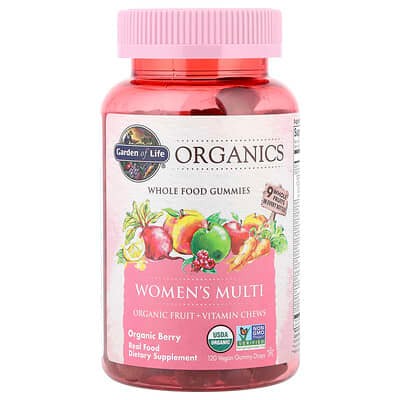
Women's Multi Organic Berry

Goals
$26.59 $0.88 per serving


Product analysis
Women's Multi Organic Berry can help fill vitamin and mineral gaps, with useful nutritional roles in normal metabolism and bone health. Most ingredient forms are not identified, which makes comparisons with other multivitamins harder.
AI assessment of the formula, label and price. How scoring works
Nutrient Quality23
Most forms are not identified, leaving the quality of much of the formula uncertain. Vitamin D and B12 have named forms or sources, but the vitamin D mixture proportions are unclear.
Ingredient Transparency53
Every amount is stated, but only a small part of the formula has named forms. The vitamin D mixture also lacks clear proportions, limiting a full comparison.
Value For Money36
The vitamin K and folate comparisons offer weak value. There is not enough information to judge the value of most other ingredients.
Customer Satisfaction86
Customer ratings are positive across a large number of responses. That gives the satisfaction picture a broad base without proving health benefits or safety.
Product Focus47
The clearest purpose is covering nutritional gaps, with bone-related nutritional support among the main roles. The long ingredient list makes it a broad multivitamin rather than a tightly focused formula.
- Format
Gummy - Container
- 120 Gummy(ies)
- Per serving
- $0.88
- Also available
 Women's Multi 40+ Organic Berry$26.59
- Customer rating
- 4.5 · 9,249 ratings
Goals

Impact
Highest effect
Folate · 400 mcgVitamin B12 · 3.6 mcgVitamin D · 20 mcgVitamin K · 120 mcgSelenium · 25 mcgZinc · 1.5 mgVitamin C · 90 mg

Impact
Moderate effect
Folate · 400 mcgVitamin B12 · 3.6 mcgVitamin K · 120 mcgVitamin D · 20 mcg

Impact
Moderate effect
Vitamin K · 120 mcgVitamin B12 · 3.6 mcgVitamin B6 · 3.4 mgFolate · 400 mcgVitamin D · 20 mcg

Impact
High effect
Vitamin K · 120 mcgVitamin D · 20 mcgManganese · 0.2 mgZinc · 1.5 mgVitamin C · 90 mg
Ingredients
| Ingredient | Amount per serving | Score |
|---|---|---|
Calories | 35 Calorie(s) | |
Total Carbohydrates | 8 Gram(s) | |
Vitamin A | 450 mcg | |
Vitamin C | 90 mg | |
Vitamin D (Lichen, Vitamin D3) | 20 mcg | |
Vitamin E | 11.5 mg | |
Vitamin K | 120 mcg | |
Thiamin | 0.6 mg | |
Riboflavin | 0.5 mg | |
Niacin | 8 mg | |
Vitamin B6 | 3.4 mg | |
Folate | 400 mcg | |
Vitamin B12 (Methylcobalamin) | 3.6 mcg | |
Biotin | 105 mcg | |
Pantothenic Acid | 4 mg | |
Zinc | 1.5 mg | |
Selenium | 25 mcg | |
Manganese | 0.2 mg | |
Chromium | 35 mcg |
Folate · 400 mcg OverallScore2
Vitamin K · 120 mcg OverallScore16
Alternative products
Report alternatives
Sources
Published studies used for the product analysis and the top-ranked studies for each ingredient and goal.
- Association between RBC folate and lumbar bone mineral density in postmenopausal women, a cross-sectional study from NHANES 2009-2018.
- Genetic variants modify the associations of concentrations of methylmalonic acid, vitamin B-12, vitamin B-6, and folate with bone mineral density.
- Adequate Intake and Supplementation of B Vitamins, in Particular Folic Acid, can Play a Protective Role in Bone Health.
- Relation of homocysteine, folate, and vitamin B12 to bone mineral density of postmenopausal women.
- Dietary intake of folate, but not vitamin B2 or B12, is associated with increased bone mineral density 5 years after the menopause: results from a 10-year follow-up study in early postmenopausal women.
- Risk of Environmental Chemicals on Bone Fractures Is Independent of Low Bone Mass in US Adults: Insights from 2017 to 2018 NHANES.
- The Manganese-Bone Connection: Investigating the Role of Manganese in Bone Health.
- Associations of multiple metals with bone mineral density: A population-based study in US adults.
- Sex-specific associations of urinary mixed-metal concentrations with femoral bone mineral density among older people: an NHANES (2017-2020) analysis.
- Relationship between blood manganese and bone mineral density and bone mineral content in adults: A population-based cross-sectional study.
- Evaluating the Protective Role of Vitamin A Supplementation in Periodontal Health: A Comprehensive Systematic Review and Meta-Analysis.
- Dietary vitamin A intake and bone health in the elderly: the Rotterdam Study.
- Vitamin A and its dervatives effect on bone mineral density, a systematic review.
- Association of vitamins with bone mineral density and osteoporosis measured by dual-energy x-ray absorptiometry: a cross-sectional study.
- Association of dietary consumption and serum levels of vitamin A and β-carotene with bone mineral density in Chinese adults.
- Effect of Vitamin B12 and Folic Acid Supplementation on Bone Mineral Density and Quantitative Ultrasound Parameters in Older People with an Elevated Plasma Homocysteine Level: B-PROOF, a Randomized Controlled Trial.
- Plasma B vitamins, homocysteine, and their relation with bone loss and hip fracture in elderly men and women.
- Relation between homocysteine and B-vitamin status indicators and bone mineral density in older Americans.
- The role of B-vitamin intake, B-vitamin-rich dietary patterns, the B-vitamin deficiency index in bone mineral density among school-aged children.
- Hyperhomocysteinemia is Associated with Inflammation, Bone Resorption, Vitamin B12 and Folate Deficiency and MTHFR C677T Polymorphism in Postmenopausal Women with Decreased Bone Mineral Density.