
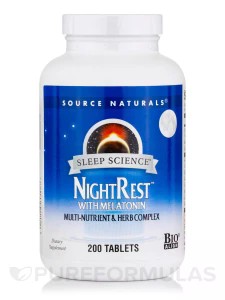

$13.65 $0.27 per serving


Product analysis
NightRest with Melatonin may help with sleep timing and falling asleep, with magnesium adding possible support for selected people with poor sleep. The other calming ingredients have limited or mixed findings, making their added benefit uncertain.
AI assessment of the formula, label and price. How scoring works
Nutrient Quality24
Quality remains uncertain across much of the blend. Magnesium has a named preparation, but most other ingredient forms are unspecified.
Ingredient Transparency66
Amounts are disclosed, helping you compare servings. Almost all ingredient preparations are unspecified, limiting comparison of the particular forms used.
Value For Money42
Value is mixed, with moderate GABA value but less favorable taurine and glycine comparisons. Magnesium, melatonin and the herbs remain uncertain on value, preventing a clear judgment of the full blend.
Customer Satisfaction72
The small pool of customer ratings is very positive. Such limited feedback offers little confidence about how widely that satisfaction is shared.
Product Focus83
The intended uses are closely related sleep and calming support, with melatonin providing the clearest sleep-timing role. GABA and magnesium have conditional or limited stress findings, and the small glycine amount adds little support.
- Format
Tablet - Container
- 100 Tablet(s)
- Per serving
- $0.27
- Customer rating
- 4.8 · 25 ratings
Goals

Impact
Highest effect
Magnesium · 300 mgMelatonin · 5 mgGlycine · 250 mg
Melatonin supports sleep timing and onset, while magnesium may offer a small improvement in sleep complaints in adults reporting poor sleep. Chamomile and lemon balm have some sleep-quality findings, but studies used particular amounts and preparations and results are mixed. GABA adds limited sleep evidence. Glycine is far below the 3 g used in a small sleep study, and taurine's saved contribution does not establish a sleep-specific human benefit.
How this product is rated for Sleep Support
Ingredient fit84
Melatonin and magnesium are the main contributors, with smaller herbal and GABA contributions.
Goal fit
Most counted ingredients relate to sleep, with a small contribution from ingredients serving other purposes.
Dose adequacy
Melatonin and magnesium are strongly represented by amount; the herbs contribute less, and glycine is too low to count.
Pathways80
The saved findings combine timing from melatonin with calming-related coverage from the blend.
Depth
Calming is the strongest represented route across the counted blend.
Breadth
Timing and calming are substantially represented, while other sleep-related routes remain limited.
Evidence98
Melatonin leads the evidence; magnesium, GABA and herbs have qualified findings, while taurine lacks established sleep-specific human evidence.
Evidence strength
Melatonin supplies the strongest direct sleep evidence.
Studied preparation
Most counted ingredients receive preparation recognition; taurine does not have a studied sleep preparation.
Formulation logic100
The counted ingredients need no missing partner, and no evaluated conflict is identified.
Partner coverage
The counted ingredients can contribute without an additional required partner.
Conflicts
No evaluated ingredient conflict is identified in the supplied facts.
Effective doses
All counted ingredients meet the saved minimum amount requirement; this does not establish a proven effective dose.
Taurine Not classified
No linked studies yet.

Impact
Highest effect
Magnesium · 300 mgGlycine · 250 mgGABA · 500 mg
GABA has limited short-term task-stress findings, but narrow settings and food preparations leave lasting supplement benefit uncertain. Magnesium may support calming when magnesium status is low or in selected clinical settings; broad lasting everyday stress relief remains uncertain. Melatonin mainly relates to sleep-associated recovery or selected anxiety settings, rather than established broad psychological stress relief.
How this product is rated for Stress Relief
Ingredient fit83
The declared ingredients are closely focused on this goal, though their roles also relate to other goals. The included amounts largely meet the saved references, with some providing only partial exposure compared with those references.
Goal fit
The declared ingredients are closely focused on this goal, though their roles also relate to other goals.
Dose adequacy
The included amounts largely meet the saved references, with some providing only partial exposure compared with those references.
Pathways80
The main recorded connection is neural calming. Coverage is concentrated in a limited set of stress-related processes, leaving other aspects without substantial support.
Depth
The strongest recorded connection concerns neural calming, with substantial coverage from the included ingredients.
Breadth
Coverage is concentrated in a limited set of stress-related processes, leaving other aspects without substantial support.
Evidence91
GABA provides the strongest recorded evidence. The qualifying preparations match the supplied evidence.
Evidence strength
GABA provides the strongest recorded ingredient evidence at a qualifying amount; its population and outcome limitations still apply.
Studied preparation
The qualifying preparations match those recognized in the supplied evidence; this does not show that the finished product was tested.
Formulation logic100
The ingredients work independently or have the required partner in the supplied findings. No listed formulation conflict was matched in the supplied findings. This is limited to the specified checks.
Partner coverage
The ingredients work independently or have the required partner in the supplied findings.
Conflicts
No listed formulation conflict was matched in the supplied findings. This is limited to the specified checks.
Effective doses
All ingredients included in this finding meet its minimum amount threshold; the threshold is not proof of clinical effectiveness.
Ingredients
| Ingredient | Amount per serving | Score |
|---|---|---|
Calories | 5 Calorie(s) | |
Magnesium (Magnesium Chelate) | 300 mg | |
Sodium | 5 mg | |
GABA | 500 mg | |
Taurine | 300 mg | |
Glycine | 250 mg | |
Chamomile flower extract | 220 mg | |
Lemon Balm aerial parts extract | 140 mg | |
Skullcap | 70 mg | |
Melatonin | 5 mg |
GABA · 500 mg OverallScore79
Each serving provides 500 mg of GABA, with the amount disclosed separately. The whole-product serving costs about $0.27, a middle-range price in this evaluation.
How this ingredient is rated
Active Ingredient Quality & Bioavailability70
GABA is evaluated as a generic form; the saved facts do not establish its production method.
GABA Source & Production Method
GABA is evaluated as a generic form; the saved facts do not establish its production method.
Dose, Safety & Label Transparency93
500 mg of GABA is disclosed per serving, and the other-ingredients screen found a flow-agent term.
GABA Dosage Adequacy & Transparency
The GABA amount is disclosed as 500 mg per serving.
Label Purity & Excipient Quality
The other-ingredients screen found an ingredient on its flow-agent list.
Value70
A whole-product serving costs about $0.27, a middle-range price in this evaluation.
Price per Effective Dose
A whole-product serving costs about $0.27, a middle-range price in this evaluation.
Glycine · 250 mg OverallScore24
Each serving provides 250 mg of glycine, a relatively small amount. The whole-product price works out to about $1.09 per gram of glycine, a relatively high cost on that basis.
How this ingredient is rated
Active Ingredient Quality & Bioavailability0
The saved facts do not establish a qualifying glycine grade, purity certification, or manufacturing-practice claim.
Glycine Sourcing and Purity Standards
The saved facts do not establish a qualifying glycine grade, purity certification, or manufacturing-practice claim.
Dose, Safety & Label Transparency46
The serving discloses 250 mg of glycine. Ordinary excipients are recorded.
Clinically Relevant Dosage
The serving contains 250 mg of glycine, a relatively small amount.
Label Transparency and Yield Disclosure
The glycine amount is individually disclosed as 250 mg per serving.
Clean Label and Excipient Quality
The saved facts record ordinary excipients; they do not establish that the complete ingredient list is minimal.
Value30
The whole-product price works out to about $1.09 per gram of glycine, a relatively high cost on that basis.
Cost Efficiency per 1,000mg of Glycine
The whole-product price works out to about $1.09 per gram of glycine, a relatively high cost on that basis.
Taurine · 300 mg OverallScore47
Alternative products
Report alternatives
Sources
Published studies used for the product analysis and the top-ranked studies for each ingredient and goal.
- Safety and Efficacy of Gamma-Aminobutyric Acid from Fermented Rice Germ in Patients with Insomnia Symptoms: A Randomized, Double-Blind Trial.
- Analysis of the Effects of Known Sleep-Support Supplements in Relation to Life Habits, Sleep Conditions, and Sleep Problems.
- Reduced γ-aminobutyric acid in occipital and anterior cingulate cortices in primary insomnia: a link to major depressive disorder?
- GABA Supplementation, Increased Heart-Rate Variability, Emotional Response, Sleep Efficiency and Reduced Depression in Sedentary Overweight Women Undergoing Physical Exercise: Placebo-Controlled, Randomized Clinical Trial.
- The effect of glycine administration on the characteristics of physiological systems in human adults: A systematic review.
- New therapeutic strategy for amino acid medicine: glycine improves the quality of sleep.
- The effects of glycine on subjective daytime performance in partially sleep-restricted healthy volunteers.
- Effects of magnesium and potassium supplementation on insomnia and sleep hormones in patients with diabetes mellitus.
- Association of magnesium intake with sleep duration and sleep quality: findings from the CARDIA study.
- Lidocaine vs. magnesium: effect on analgesia after a laparoscopic cholecystectomy.
- The effect of magnesium supplementation on primary insomnia in elderly: A double-blind placebo-controlled clinical trial.
- A randomized, double-blind, placebo-controlled, multicenter study assessing the efficacy of magnesium oxide monohydrate in the treatment of nocturnal leg cramps.
- Meta-analysis: melatonin for the treatment of primary sleep disorders.
- Melatonin treatment for age-related insomnia.
- The Effectiveness of Melatonin for Sleep Disturbances in Parkinson' Disease: Systematic Review and Meta-Analysis.
- Nightly treatment of primary insomnia with prolonged release melatonin for 6 months: a randomized placebo controlled trial on age and endogenous melatonin as predictors of efficacy and safety.
- Effects of exogenous melatonin on sleep: a meta-analysis.
- Oral intake of γ-aminobutyric acid affects mood and activities of central nervous system during stressed condition induced by mental tasks.
- Relieving occupational fatigue by consumption of a beverage containing γ-amino butyric acid.
- Cortical gamma-aminobutyric acid and glutamate in posttraumatic stress disorder and their relationships to self-reported sleep quality.