
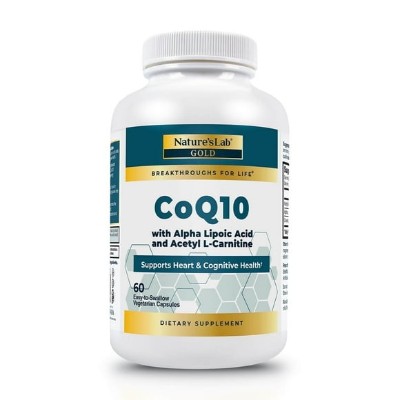
CoQ10 + Alpha Lipoic Acid + Acetyl L-Carnitine HCl

Goals
$23.98 $0.79 per serving

Product analysis
CoQ10 + Alpha Lipoic Acid + Acetyl L-Carnitine HCl combines ingredients involved in the body’s energy processes. The unspecified CoQ10 preparation makes its possible fatigue benefit harder to predict.
AI assessment of the formula, label and price. How scoring works
Nutrient Quality26
The detailed preparations are not clear enough for a confident quality comparison. In particular, the CoQ10 description does not distinguish between its main forms.
Ingredient Transparency75
The ingredient amounts are disclosed, making quantity comparisons possible. Most preparation details are omitted, limiting like-for-like comparisons.
Value For Money44
The acetyl L-carnitine contribution is relatively costly for a comparable amount. Uncertain value from the other ingredients prevents a firm conclusion about the whole combination.
Customer Satisfaction72
The available customer ratings are very favorable. The small review pool gives limited breadth to that feedback.
Product Focus59
The ingredients share a connection to cellular energy, giving the mixture a coherent theme. Its broader focus, memory and productivity uses have less direct support for healthy adults.
- Format
Capsule - Container
- 60 Capsule(s)
- Per serving
- $0.79
- Customer rating
- 4.8 · 36 ratings
Goals

Impact
High effect
Acetyl L-Carnitine · 500 mgCoenzyme Q-10 · 200 mg
CoQ10 has limited, preparation-specific support for fatigue relief, but this product does not identify its ubiquinol or ubiquinone form. That uncertainty limits transfer of the findings to this serving. Acetyl L-carnitine also receives recognition in the saved result, although evidence from older adults with clinical fatigue does not establish routine energy benefit.
How this product is rated for Energy
Ingredient fit69
Acetyl L-Carnitine anchors the recognized ingredient fit, with declared amounts partly meeting the saved comparisons.
Goal fit
Recognized energy-related ingredients share the formula with ingredients serving other goals, reducing its focus.
Dose adequacy
The declared amounts partly meet the saved comparisons, limiting the size of the recognized contribution.
Pathways48
The saved coverage is concentrated in mitochondrial energy production.
Depth
The strongest saved coverage concerns mitochondrial energy production; this does not independently prove a noticeable energy benefit.
Breadth
Coverage reaches the saved threshold for mitochondrial energy production, with no comparable breadth across other energy pathways.
Evidence86
Acetyl L-Carnitine leads the recognized evidence, but the supplied context limits how broadly its findings apply.
Evidence strength
Acetyl L-Carnitine supplies the strongest recognized evidence here, subject to the population and application limits described for it.
Studied preparation
The CoQ10 redox form is unidentified, limiting the match to studied preparations.
Formulation logic100
No required partner is missing, and no configured sedative conflict is present. The recognized amounts reach the saved minimum comparison.
Partner coverage
The recognized ingredients have no missing required partner for their assigned contributions.
Conflicts
No configured sedative conflict applies: valerian, kava, qualifying tryptophan and melatonin are absent.
Effective doses
All recognized ingredients reach the saved minimum amount comparison; that threshold is not proof of a clinical energy effect.

Impact
Moderate effect
Coenzyme Q-10 · 200 mg
Acetyl L-carnitine and CoQ10 connect the blend to mitochondrial energy production, with 500 mg and 200 mg per serving respectively. Alpha lipoic acid also has a mitochondrial cofactor role. The saved findings focus on cellular energy, while the CoQ10 preparation does not match the one linked to the reviewed skin findings and evidence for broad aging benefits remains limited.
How this product is rated for Longevity
Ingredient fit81
The ingredients are closely focused on the reviewed goal, though the product is also linked to other uses. The assessed amounts provide relatively strong dose coverage, with some limits.
Goal fit
The ingredients are closely focused on the reviewed goal, though the product is also linked to other uses.
Dose adequacy
The assessed amounts provide relatively strong dose coverage, with some limits.
Pathways46
The strongest contribution is to antioxidant defence, with partial coverage. Antioxidant defence is the one substantially covered area; the other reviewed aging pathways have little support.
Depth
The strongest contribution is to antioxidant defence, with partial coverage.
Breadth
Antioxidant defence is the one substantially covered area; the other reviewed aging pathways have little support.
Evidence49
Acetyl L-Carnitine provides the strongest evidence contribution among the assessed ingredients, within the limits of the reviewed outcomes. Coenzyme Q-10. Shared rubric rule. does not match the preparation used for the reviewed findings; the remaining assessed ingredients have better preparation support.
Evidence strength
Acetyl L-Carnitine provides the strongest evidence contribution among the assessed ingredients, within the limits of the reviewed outcomes.
Studied preparation
Coenzyme Q-10. Shared rubric rule. does not match the preparation used for the reviewed findings; the remaining assessed ingredients have better preparation support.
Formulation logic100
2 of 2 assessed ingredients reach meaningful amounts in the saved assessment. No ingredient conflict was identified in the saved assessment.
Partner coverage
The assessed ingredients can contribute on their own or have their relevant partner present.
Conflicts
No ingredient conflict was identified in the saved assessment.
Effective doses
2 of 2 assessed ingredients reach meaningful amounts in the saved assessment.

Impact
High effect
Coenzyme Q-10 · 200 mgAcetyl L-Carnitine · 500 mg
Coenzyme Q10 participates in mitochondrial electron transport, while acetyl L-carnitine has a physiological connection to fatty-acid handling. Those mechanisms do not establish a routine increase in resting or daily calorie expenditure from these supplements. Alpha-lipoic-acid weight or redox findings likewise do not establish measured thermogenesis, and the combination does not demonstrate an additional metabolism boost.
How this product is rated for Metabolism Support
Ingredient fit81
Coenzyme Q-10 provide the main connection. The included amounts provide only a partial match to reference exposures; this does not establish effective doses for raising calorie expenditure.
Goal fit
Coenzyme Q-10 provide the main metabolic connection, within a formula also associated with other health goals.
Dose adequacy
The included amounts provide only a partial match to reference exposures; this does not establish effective doses for raising calorie expenditure.
Pathways55
The main connection concerns mitochondrial energy processes, which are not proof of increased whole-body calorie expenditure. The main coverage is concentrated in one area, rather than broad evidence for increased calorie expenditure.
Depth
The main connection concerns mitochondrial energy processes, which are not proof of increased whole-body calorie expenditure.
Breadth
The main coverage is concentrated in one area, rather than broad evidence for increased calorie expenditure.
Evidence71
CoQ10’s mitochondrial role and metabolic-marker findings do not establish a routine increase in whole-body energy expenditure.
Evidence strength
CoQ10’s mitochondrial role and metabolic-marker findings do not establish a routine increase in whole-body energy expenditure.
Studied preparation
Acetyl L-Carnitine lacks a confirmed studied-preparation match; the remaining included ingredient has a closer match in the saved comparison.
Formulation logic100
No missing required partner or configured conflict was identified. The included amounts meet the minimum exposure comparison without demonstrating an extra benefit from combining them.
Partner coverage
No missing required partner was identified; the combination does not establish an additional metabolic-rate effect.
Conflicts
No configured ingredient conflict was identified in the supplied facts.
Effective doses
The included ingredients meet the minimum exposure comparison, which does not establish an effective thermogenic or weight-loss dose.

Impact
Moderate effect
Acetyl L-Carnitine · 500 mg
Acetyl L-carnitine relates to cellular energy handling and acetylcholine production, providing a biological connection to brain function. The 500 mg amount receives partial recognition in the saved assessment, but the supplied clinical evidence comes from disease cohorts and does not establish routine memory or focus improvement in healthy adults.
How this product is rated for Cognitive Support
Ingredient fit51
The saved assessment identifies 1 goal-related ingredients alongside 2 other actives, so the formula serves a broader purpose than cognitive support alone. The saved amount assessment considers 1 ingredients; undisclosed individual amounts limit the contribution that can be assigned.
Goal fit
The saved assessment identifies 1 goal-related ingredients alongside 2 other actives, so the formula serves a broader purpose than cognitive support alone.
Dose adequacy
The saved amount assessment considers 1 ingredients; undisclosed individual amounts limit the contribution that can be assigned.
Pathways40
The strongest saved connection is cerebral energy buffering, with 50.0 coverage in the assessment. One reviewed mechanism reaches the saved coverage threshold, so the support remains concentrated.
Depth
The strongest saved connection is cerebral energy buffering, with 50.0 coverage in the assessment.
Breadth
One reviewed mechanism reaches the saved coverage threshold, so the support remains concentrated.
Evidence79
The saved evidence finding is led by Acetyl L-Carnitine, among ingredients meeting the assessment’s amount requirement; this does not imply uniform cognitive benefit. The saved assessment recognizes preparation matches for the ingredients meeting its amount requirement, within the limitations of their underlying evidence.
Evidence strength
The saved evidence finding is led by Acetyl L-Carnitine, among ingredients meeting the assessment’s amount requirement; this does not imply uniform cognitive benefit.
Studied preparation
The saved assessment recognizes preparation matches for the ingredients meeting its amount requirement, within the limitations of their underlying evidence.
Formulation logic100
The saved findings identify no missing required partner among the assessed ingredients. No configured ingredient conflict was identified in the saved assessment. 1 of 1 credited ingredients meet the saved minimum amount criterion.
Partner coverage
The saved findings identify no missing required partner among the assessed ingredients.
Conflicts
No configured ingredient conflict was identified in the saved assessment.
Effective doses
1 of 1 credited ingredients meet the saved minimum amount criterion.

Impact
Moderate effect
Acetyl L-Carnitine · 500 mgAcetyl L-Carnitine · 500 mg
Acetyl L-carnitine at 500 mg relates to cellular energy processes, but the supplied fatigue evidence comes from a neurological illness context. That evidence gives little basis for expecting improved everyday focus or work output in healthy adults.
How this product is rated for Productivity Boost
Ingredient fit51
The saved findings identify 1 relevant ingredients alongside 2 other active ingredients (Alpha Lipoic Acid, Coenzyme Q-10). The saved amount assessment is partial; undisclosed individual amounts reduce certainty about the contribution.
Goal fit
The saved findings identify 1 relevant ingredients alongside 2 other active ingredients (Alpha Lipoic Acid, Coenzyme Q-10).
Dose adequacy
The saved amount assessment is partial; undisclosed individual amounts reduce certainty about the contribution.
Pathways14
The strongest assessed area is brain energy buffering, with limited coverage. 0 of 3 assessed target areas reach the saved coverage threshold.
Depth
The strongest assessed area is brain energy buffering, with limited coverage.
Breadth
0 of 3 assessed target areas reach the saved coverage threshold.
Evidence67
Acetyl L-Carnitine is the strongest evidence contributor at an eligible amount in the saved findings; that comparison does not establish improved work output. The eligible ingredients match the preparations accepted in the saved assessment.
Evidence strength
Acetyl L-Carnitine is the strongest evidence contributor at an eligible amount in the saved findings; that comparison does not establish improved work output.
Studied preparation
The eligible ingredients match the preparations accepted in the saved assessment.
Formulation logic100
The assessed ingredients can contribute alone or have their required partners. No configured ingredient conflicts were identified in the supplied facts. 1 of 1 assessed ingredients meet the saved minimum amount threshold.
Partner coverage
The assessed ingredients can contribute alone or have their required partners.
Conflicts
No configured ingredient conflicts were identified in the supplied facts.
Effective doses
1 of 1 assessed ingredients meet the saved minimum amount threshold.

Impact
Moderate effect
Acetyl L-carnitine at 500 mg relates to cellular energy processes, but the supplied clinical findings do not support a clear general cognitive benefit in healthy adults. Disease-specific results offer limited guidance for everyday brain health.
How this product is rated for Brain Health
Ingredient fit51
The saved findings identify 1 relevant ingredients and 2 other active ingredients (Alpha Lipoic Acid, Coenzyme Q-10). The saved findings show partial alignment of disclosed amounts with the comparison amounts.
Goal fit
The saved findings identify 1 relevant ingredients and 2 other active ingredients (Alpha Lipoic Acid, Coenzyme Q-10).
Dose adequacy
The saved findings show partial alignment of disclosed amounts with the comparison amounts.
Pathways19
The strongest identified area is Cerebral energy metabolism. 0 of 3 areas reach the saved coverage threshold.
Depth
The strongest identified area is Cerebral energy metabolism.
Breadth
0 of 3 areas reach the saved coverage threshold.
Evidence76
Acetyl L-Carnitine provides the strongest eligible evidence contribution in the saved findings. The saved findings match the eligible preparations to studied preparations.
Evidence strength
Acetyl L-Carnitine provides the strongest eligible evidence contribution in the saved findings.
Studied preparation
The saved findings match the eligible preparations to studied preparations.
Formulation logic100
The assessed ingredients can work alone or have their identified partner present. No matched ingredient conflict was recorded. 1 of 1 assessed ingredients reach the saved minimum comparison amount.
Partner coverage
The assessed ingredients can work alone or have their identified partner present.
Conflicts
No matched ingredient conflict was recorded.
Effective doses
1 of 1 assessed ingredients reach the saved minimum comparison amount.
Ingredients
| Ingredient | Amount per serving | Score |
|---|---|---|
N-Acetyl L-Carnitine HCl | 500 mg | |
Alpha Lipoic Acid | 300 mg | |
Co-Enzyme Q-10 (CoQ10) | 200 mg |
Acetyl L-Carnitine · 500 mg OverallScore85
Each serving provides 500 mg of acetyl L-carnitine HCl, with the amount clearly stated. The whole-product cost works out to about $0.80 per 500 mg of acetyl L-carnitine.
How this ingredient is rated
Active Ingredient Quality & Bioavailability88
The identified carnitine form is acetyl L-carnitine HCl. No manufacturing or purity-testing claim is recorded in the available facts.
ALCAR vs. Standard Carnitine Form
Acetyl L-carnitine is the only carnitine form identified in the saved facts.
Advanced Sourcing and Salt Specificity
The saved facts identify the HCl form. No manufacturing or purity-testing claim is recorded in the available facts.
Dose, Safety & Label Transparency100
The stated amount is 500 mg per serving.
Clinical Dosage Efficacy
500 mg of acetyl L-carnitine is provided per serving.
Label Transparency and Proprietary Blends
The amount of acetyl L-carnitine is stated as 500 mg per serving.
Value50
The whole-product cost is about $0.80 per 500 mg of acetyl L-carnitine.
Price per 500mg Acetyl L-Carnitine
The whole-product cost is about $0.80 per 500 mg of acetyl L-carnitine.
Alternative products
Report alternatives
Sources
Published studies used for the product analysis and the top-ranked studies for each ingredient and goal.
- Acetyl-L-carnitine treatment in minimal hepatic encephalopathy.
- Long-term acetyl-L-carnitine treatment in Alzheimer's disease.
- Pharmaco-electroencephalographic and clinical effects of the cholinergic substance--acetyl-L-carnitine--in patients with organic brain syndrome.
- Acetyl-L-carnitine improves cognitive functions in severe hepatic encephalopathy: a randomized and controlled clinical trial.
- Acetyl-L-carnitine in the treatment of mildly demented elderly patients.
- A double-blind, parallel, multicenter comparison of L-acetylcarnitine with placebo on the attention deficit hyperactivity disorder in fragile X syndrome boys.
- Acetyl L-carnitine (ALC) treatment in elderly patients with fatigue.
- Oral acetyl-L-carnitine therapy reduces fatigue in overt hepatic encephalopathy: a randomized, double-blind, placebo-controlled study.
- The supplementation of acetyl-L-carnitine decreases fatigue and increases quality of life in patients with hepatitis C treated with pegylated interferon-α 2b plus ribavirin.
- Acetyl-L-carnitine reduces depression and improves quality of life in patients with minimal hepatic encephalopathy.
- A prospective study to evaluate the efficacy and safety of oral acetyl-L-carnitine for the treatment of chemotherapy-induced peripheral neuropathy.
- Metabolomic biomarkers for (R, S)-ketamine and (S)-ketamine in treatment-resistant depression and healthy controls: A systematic review.
- Effects of Coenzyme Q10 on Statin-Induced Myopathy: An Updated Meta-Analysis of Randomized Controlled Trials.
- Coenzyme Q10 Supplementation in Athletes: A Systematic Review.
- Effectiveness of Coenzyme Q10 Supplementation for Reducing Fatigue: A Systematic Review and Meta-Analysis of Randomized Controlled Trials.
- Antifatigue effects of coenzyme Q10 during physical fatigue.
- Effect of coenzyme Q10 supplementation on fatigue: A systematic review of interventional studies.
- Acetyl-L-carnitine Slows the Progression from Prefrailty to Frailty in Older Subjects: A Randomized Interventional Clinical Trial.
- Coenzyme Q10 and Degenerative Disorders Affecting Longevity: An Overview.
- Coenzyme Q10 Supplementation in Aging and Disease.