
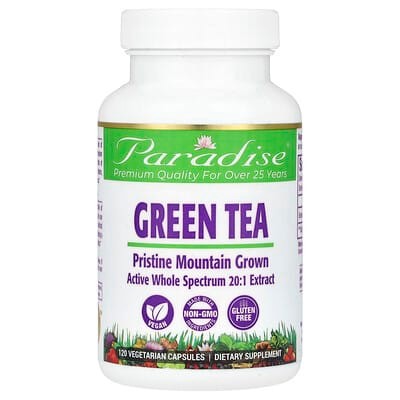

$13.49 $0.11 per serving


Product analysis
Green Tea supplies compounds with antioxidant activity. Its active-compound amounts are unclear, making it difficult to compare with the preparations used in research.
AI assessment of the formula, label and price. How scoring works
Nutrient Quality20
The detailed tea form is not disclosed, leaving its quality uncertain. The tea amount does not identify the amounts of active compounds.
Ingredient Transparency63
The amount of green tea material is disclosed. Its detailed form is missing, and that amount does not establish caffeine, theanine or EGCG exposure.
Value For Money40
The active EGCG amount is unknown, preventing a useful cost comparison for that compound. The value of the tea serving remains uncertain.
Customer Satisfaction72
Customer ratings are positive. The smaller review pool leaves more uncertainty, and ratings do not prove effectiveness or safety.
Product Focus70
The ingredient has antioxidant relevance across several proposed aims. The evidence does not establish routine cognitive improvements, inflammation relief or longer life from this declaration.
- Format
Capsule - Container
- 120 Capsule(s)
- Per serving
- $0.11
- Customer rating
- 4.6 · 232 ratings
Goals

Impact
High effect
Green Tea · 250 mg
Green tea has antioxidant relevance, but the supplied metabolic-syndrome trial found most inflammatory markers unchanged. Its limited serum-amyloid finding does not establish routine clinical benefit or a preparation-matched generic EGCG dose. The serving contains 250 mg of green tea material; extract mass and active EGCG mass are not interchangeable.
How this product is rated for Inflammation
Ingredient fit75
The declared active ingredients are relatively focused on relevant roles, though their other uses also affect the finding. Amounts provide a limited match to the saved comparison ranges; unresolved quantities cannot establish a contribution.
Goal fit
The declared active ingredients are relatively focused on relevant roles, though their other uses also affect the finding.
Dose adequacy
Amounts provide a limited match to the saved comparison ranges; unresolved quantities cannot establish a contribution.
Pathways13
The strongest saved finding concerns oxidative stress, which does not itself establish clinical inflammation relief. None of the assessed routes reaches the saved coverage threshold.
Depth
The strongest saved finding concerns oxidative stress, which does not itself establish clinical inflammation relief.
Breadth
None of the assessed routes reaches the saved coverage threshold.
Evidence73
Green Tea leads the saved evidence finding, but the scientific context limits claims of routine clinical benefit. Recognized preparation matching does not remove those limitations.
Evidence strength
Green Tea leads the saved evidence finding, but the scientific context limits claims of routine clinical benefit.
Studied preparation
The counted preparations match those recognized in the saved findings; the supplied population and outcome limitations still apply.
Formulation logic100
Counted ingredients meet the saved amount threshold and partner requirements, with no configured conflict identified. These findings do not establish synergy or comprehensive safety.
Partner coverage
The counted ingredients work independently or have their required partner in the saved findings.
Conflicts
No configured ingredient conflict was identified; this does not assess every possible interaction.
Effective doses
All counted ingredients clear the saved amount threshold, a comparison rule rather than a proven effective dose.

Impact
High effect
Green Tea · 250 mg
Green tea supplies compounds associated with antioxidant activity. The supplied information does not establish preservation of age-related function or longer life from this extract, and beverage, extract and active EGCG amounts cannot be treated as equivalent.
How this product is rated for Longevity
Ingredient fit80
The ingredient selection and amounts provide a partial picture of how this formula relates to age-related outcomes.
Goal fit
The relevant ingredients make up most of the formula, although it is also linked to other goals.
Dose adequacy
The included amounts only partly meet the saved amount references; unknown amounts cannot establish a contribution.
Pathways45
The represented mechanisms describe ingredient roles; they do not themselves establish preservation of function or longer life.
Depth
The strongest represented mechanism is antioxidant defence, a mechanistic connection rather than proof of slower aging.
Breadth
Coverage is concentrated in one mechanism rather than spread across several aging-related functions.
Evidence82
The human findings remain specific to the ingredient, preparation and outcome described.
Evidence strength
Green Tea supplies the strongest included evidence contribution, while its specific human-outcome limitations still apply.
Studied preparation
The saved findings recognize the included preparations; this does not expand their supported outcomes or populations.
Formulation logic100
Partner requirements, identified conflicts and minimum amounts are considered separately, without assuming combination benefits.
Partner coverage
The included contributors can act independently or have the required partner; this does not establish added benefit from combining them.
Conflicts
No matching ingredient conflict was identified in the supplied assessment.
Effective doses
All included contributors meet the saved minimum amount threshold, which is not a proven minimum effective human dose.

Impact
High effect
Green Tea · 250 mg
Green tea can contain caffeine and theanine, but the declared 250 mg tea amount establishes neither compound's exposure. Antioxidant activity alone does not demonstrate better memory or attention. The saved comparison assigns partial amount recognition and an oxidative-protection contribution, but the supplied scientific context does not establish a routine cognitive benefit for this declaration.
How this product is rated for Cognitive Support
Ingredient fit75
Green tea is the single relevant ingredient in the saved findings.
Goal fit
Green tea is the single relevant ingredient in the saved findings.
Dose adequacy
The tea amount receives partial recognition; caffeine and theanine quantities cannot be inferred.
Pathways19
Oxidative and inflammatory protection has partial saved coverage.
Depth
Oxidative and inflammatory protection has partial saved coverage.
Breadth
No pathway reaches the saved breadth threshold.
Evidence81
The supplied context does not establish routine cognitive benefit from tea extract mass alone.
Evidence strength
The supplied context does not establish routine cognitive benefit from tea extract mass alone.
Studied preparation
The saved findings recognize the included preparations; this does not remove the ingredient-specific limits on cognitive benefit.
Formulation logic100
The included ingredients require no missing partner, and no configured conflict was found.
Partner coverage
No required partner is missing for the included ingredients; this does not imply added benefit from combining them.
Conflicts
No configured ingredient conflict was found in the supplied facts.
Effective doses
All included ingredients meet the saved minimum amount threshold; that threshold is not proof of cognitive benefit.
Ingredients
| Ingredient | Amount per serving | Score |
|---|---|---|
Green Tea leaf extract | 250 mg |
Green Tea · 250 mg OverallScore8
Each serving contains 250 mg of green tea leaf extract. Its EGCG content is not established in the saved facts, so the amount cannot be compared on that basis.
How this ingredient is rated
Composition and Label Disclosure20
The extract is identified, but its EGCG concentration is unknown.
Declared Green Tea Marker Concentration
The serving contains 250 mg of green tea leaf extract; no marker concentration is recorded.
Composition and Label Disclosure0
The whole-product caffeine amount is unknown from the saved facts.
Whole-Product Caffeine Disclosure
No caffeine information is recorded in the saved facts, so the whole-product amount is unknown.
Commercial Price and Usability0
The EGCG amount is unavailable for a cost comparison.
Cost per 200 mg Declared EGCG
An EGCG price comparison is unavailable because the saved facts do not establish the EGCG amount.
Alternative products
Report alternatives
Sources
Published studies used for the product analysis and the top-ranked studies for each ingredient and goal.
- Safety and efficacy of cognitive training plus epigallocatechin-3-gallate in young adults with Down's syndrome (TESDAD): a double-blind, randomised, placebo-controlled, phase 2 trial.
- Association between tea consumption and risk of cognitive disorders: A dose-response meta-analysis of observational studies.
- Investigating the Impact of Tea Consumption on Cognitive Function and Exploring Tea-Genetic Interactions in Older Adults Aged 65-105 Years: Findings from the 2002-2018 CLHLS Data.
- Consumption of green tea, but not black tea or coffee, is associated with reduced risk of cognitive decline.
- Green Tea Consumption and the Risk of Incident Dementia in Elderly Japanese: The Ohsaki Cohort 2006 Study.
- The effects of green tea on acne vulgaris: A systematic review and meta-analysis of randomized clinical trials.
- Green Tea Catechin Association with Ultraviolet Radiation-Induced Erythema: A Systematic Review and Meta-Analysis.
- Efficacy of (-)-epigallocatechin gallate delivered by a new-type scaler tip during scaling and root planing on chronic periodontitis: a split-mouth, randomized clinical trial.
- Camellia Sinensis Mouthwashes in Oral Care: a Systematic Review.
- Skin photoprotection by green tea: antioxidant and immunomodulatory effects.
- Green tea and coffee intake and risk of cognitive decline in older adults: the National Institute for Longevity Sciences, Longitudinal Study of Aging.
- Associations of green tea, coffee, and soft drink consumption with longitudinal changes in leukocyte telomere length.
- Can teatime increase one's lifetime?
- Influences of tea consumption on self-rated health and life satisfaction among older adults: Evidence from the CLHLS.
- Double-blinded, placebo-controlled trial of green tea extracts in the clinical and histologic appearance of photoaging skin.