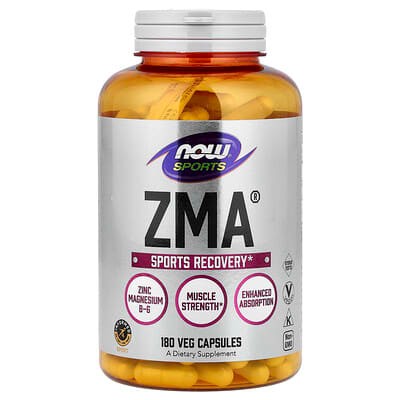
ZMA

ZMA

NOW Sports4.7 (22,146 ratings)
Format:Capsule Quantity: 180 Capsule(s) · 60 servings
Goals

About this product

The main value is combined mineral supplementation for someone whose magnesium and zinc intake is low. The selected serving supplies 450 mg elemental magnesium, 30 mg zinc and 15 mg B6, which contribute to normal nutrient functions. These amounts do not establish extra energy, muscle performance or higher testosterone once nutritional needs are met.

Magnesium offers a possible sleep benefit, but the effect is uncertain and does not establish an immediate sleep-inducing action. The added zinc and B6 do not establish a stronger sleep effect from the combination. Their normal nervous-system roles also provide limited grounds for expecting better memory, attention or work performance.

Dose and disclosure details weigh heavily in the purchase decision. The magnesium amount exceeds the main comparison range in the supplied findings, B6 is above their adult upper-limit reference, and copper intake cannot be assessed from the available formula details. Magnesium aspartate is named, but zinc-source descriptions differ across the saved records and the ingredient findings leave blend proportions unknown.

Who is it for
  • Adults seeking both magnesium and zinc for low dietary intake
  • People considering mineral supplementation rather than a dedicated hormone or sleep aid
Best for
  • Combined mineral intake
  • Nutritional support for normal muscle and energy functions

Pros

  • Clearly states elemental magnesium and zinc amounts
  • Names magnesium aspartate as the magnesium source
  • Uses a small set of active nutrients

Cons

  • Zinc-source records differ and blend proportions are not given
  • No copper amount is available
  • Higher magnesium amount does not establish greater benefit
  • No reliable cognitive, performance or testosterone enhancement established

Warnings

  • Vitamin B6 at 15 mg is above the supplied 12 mg daily adult upper-limit reference; review ongoing use before adding B6 from other supplements.
  • Check overlapping intake before combining this 450 mg magnesium and 30 mg zinc serving with additional mineral products.


Product analysis

66 out of 100

ZMA may help fill gaps in magnesium, zinc and vitamin B6 that affect normal muscle and immune function. Magnesium may modestly improve sleep in poor sleepers, although the evidence is uncertain.

AI assessment of the formula, label and price. How scoring works

Nutrient Quality59

The named vitamin B6 and magnesium forms make those ingredients easier to assess. The zinc form remains unclear on the label, limiting a complete quality comparison.

Ingredient Transparency88

All three ingredient amounts are listed, making the serving straightforward to compare. The vitamin B6 and magnesium forms are disclosed, while the zinc form is not clearly stated.

Value For Money43

Vitamin B6 and magnesium offer moderate value at the full serving cost. Zinc is relatively costly for the amount provided, limiting the price appeal of the combination.

Customer Satisfaction91

Customer ratings are favorable and supported by a very large review count. They offer a broad picture of satisfaction without establishing sleep or hormone benefits.

Product Focus59

The main value is nutritional support when magnesium, zinc or vitamin B6 intake is low. The wide range of intended uses does not establish separate added benefits for well-nourished adults.

Format
Capsule
Container
180 Capsule(s)
Per serving
$0.50
Customer rating
4.7 · 22,146 ratings
Report analysis

Goals

Everyday Health
Impact
Highest effect
A- Ingredient FitA+ PathwaysA- EvidenceA+ Formulation Logic
Magnesium · 450 mgZinc · 30 mg

Magnesium contributes to normal energy processes and mineral nutrition. Zinc contributes to ordinary immune and antioxidant functions. These nutrients can help fill dietary gaps; amounts above nutritional adequacy do not establish additional general-health benefits.

How this product is rated for Everyday Health

Ingredient fit89

The retained nutrients provide nutritional contributions, with the serving amounts determining how fully the saved references are covered.
Goal fit
The retained nutrients account for the formula’s active focus, although their nutritional roles extend beyond this goal.
Dose adequacy
The retained serving amounts meet their saved references; this does not imply extra benefit from exceeding ordinary nutritional needs.

Pathways100

The strongest saved area is energy metabolism cofactors; breadth depends on the other retained nutrient contributions.
Depth
The saved findings are strongest for energy metabolism cofactors, reflecting the retained nutrients’ nutritional roles.
Breadth
The saved findings cover energy metabolism cofactors, one-carbon metabolism and blood formation, bone and mineral metabolism, antioxidant and immune defence.

Evidence86

Magnesium provides the strongest saved evidence connection, limited here to conditional nutritional usefulness.
Evidence strength
Magnesium leads the saved evidence finding; its practical general-health role is filling a dietary gap rather than guaranteeing disease prevention.
Studied preparation
The retained ingredients meeting the amount threshold match recognized preparation categories; no superior form or delivery benefit is established.

Formulation logic100

No configured partner gap or ingredient conflict was found; retained amount coverage varies by nutrient.
Partner coverage
The saved findings identify no missing required ingredient partner.
Conflicts
No configured ingredient conflict was matched.
Effective doses
All retained nutrients meet the saved amount threshold, which is a comparison reference rather than proof of added health benefits.
Study evidence
Magnesium Supportive 114 studies
Zinc Supportive 60 studies
Immunity
Impact
Highest effect
A- Ingredient FitB+ PathwaysA+ EvidenceA+ Formulation Logic
Magnesium · 450 mgZinc · 30 mg

Zinc contributes to normal immune function, and vitamin B6 can help fill low intake that would otherwise impair immune-cell activity. The formula's magnesium does not have established routine adult immune benefits in the supplied context. Combining these nutrients does not establish additional protection against infection.

How this product is rated for Immunity

Ingredient fit89

Relevant nutrient declarations provide the immune connection. Small or unresolved amounts limit some contributions without establishing ingredient absence.
Goal fit
The relevant declared ingredients connect with immune support; additional ingredients and other product purposes make the focus less exclusive.
Dose adequacy
Declared amounts contribute to varying degrees; the comparison does not make higher quantities a proven prevention or treatment dose.

Pathways80

The saved findings concentrate on lymphocyte function and immune regulation. These associations do not establish clinical immune protection.
Depth
The strongest saved association is lymphocyte function and immune regulation, which does not establish a measured immune or infection outcome.
Breadth
Two immune-related areas meet the saved coverage threshold; the remaining areas contribute less or nothing.

Evidence100

Zinc leads the counted contribution. Normal nutrient functions and any regular-use cold findings retain their distinct limitations.
Evidence strength
Zinc provides the strongest counted contribution, with the specific nutritional or regular-use limitations retained.
Studied preparation
The counted preparations are accepted in the saved comparison; this does not independently establish clinical equivalence or an advantage for this product.

Formulation logic100

No required partner or configured conflict was found. Counted ingredient amounts meet the saved inclusion threshold, without proving an extra combination benefit.
Partner coverage
No required partner is missing for the counted ingredients, without establishing an added immune benefit from combining them.
Conflicts
No configured formulation conflict was found at the supplied ingredient amounts and partner declarations.
Effective doses
All counted ingredients meet the saved inclusion threshold; this does not prove an effective infection-prevention or treatment dose.
Study evidence
Magnesium Supportive 8 studies
Zinc Supportive 73 studies
Bone Health
Impact
Highest effect
A- Ingredient FitB+ PathwaysA+ EvidenceA+ Formulation Logic
Magnesium · 450 mgZinc · 30 mg

Magnesium contributes to normal bone metabolism and can help fill a dietary shortfall; the serving supplies 450 mg. Zinc participates in bone-forming cell functions, although this does not establish additional bone-density or fracture benefits when intake is adequate. The supplied information does not support a separate skeletal benefit from the vitamin B6 in this formula.

How this product is rated for Bone Health

Ingredient fit88

The formula is focused on nutrients included in the bone-health comparison. The declared amounts support the saved ingredient findings, but the comparison amounts are not proven thresholds for bone benefits.
Goal fit
The formula is focused on nutrients included in the bone-health comparison.
Dose adequacy
The declared amounts support the saved ingredient findings, but the comparison amounts are not proven thresholds for bone benefits.

Pathways80

The supplied findings emphasize collagen matrix formation. Ingredient roles and represented processes do not demonstrate a clinical bone outcome.
Depth
The strongest represented process is collagen matrix formation; this describes ingredient roles rather than demonstrated improvement in bone strength.
Breadth
The main represented processes are bone mineral supply, collagen matrix formation; other bone processes have less support from this serving.

Evidence98

Zinc leads the saved ingredient comparison, although its normal bone-related functions do not establish extra skeletal benefit in adequately nourished adults.
Evidence strength
Zinc leads the saved ingredient comparison, although its normal bone-related functions do not establish extra skeletal benefit in adequately nourished adults.
Studied preparation
The declared preparations meet the saved comparison’s criteria; this does not establish independent bone-outcome benefits for every ingredient.

Formulation logic100

The included nutrients have no unmet partner requirement in the supplied findings. No ingredient conflict was identified by the supplied checks.
Partner coverage
The included nutrients have no unmet partner requirement in the supplied findings.
Conflicts
No ingredient conflict was identified by the supplied checks.
Effective doses
The included contributions meet the saved amount comparison, which is not proof that each amount improves bone outcomes.
Study evidence
Magnesium Supportive 48 studies
Zinc Supportive 33 studies
Testosterone Support
Impact
Highest effect
A- Ingredient FitB- PathwaysA EvidenceA+ Formulation Logic
Magnesium · 450 mgZinc · 30 mg

Zinc helps maintain testosterone when zinc deficiency has lowered it; extra zinc has not shown an increase in zinc-replete men. Magnesium contributes to nutrient adequacy, but the supplied exercise-related study does not establish routine testosterone enhancement or a general effective amount. The zinc, magnesium and B6 combination trial did not improve androgen concentrations.

How this product is rated for Testosterone Support

Ingredient fit88

Magnesium, Vitamin B6 and Zinc are the main ingredients counted toward testosterone-related support.
Goal fit
Magnesium, Vitamin B6 and Zinc are the main ingredients counted toward testosterone-related support.
Dose adequacy
The declared serving amounts receive substantial consideration; this compares amounts with supplied reference ranges, without proving a testosterone-related effect.

Pathways70

The strongest saved connection is to free-testosterone availability, based on the counted ingredients; this does not itself demonstrate a testosterone increase. One testosterone-related-related area reaches the saved coverage threshold, leaving the other areas less represented.
Depth
The strongest saved connection is to free-testosterone availability, based on the counted ingredients; this does not itself demonstrate a testosterone increase.
Breadth
One testosterone-related-related area reaches the saved coverage threshold, leaving the other areas less represented.

Evidence91

Zinc provides the strongest saved evidence contribution here; its population and outcome limitations still apply.
Evidence strength
Zinc provides the strongest saved evidence contribution here; its population and outcome limitations still apply.
Studied preparation
Vitamin B6 does not meet the saved studied-preparation criterion, limiting the overall preparation match.

Formulation logic100

No listed ingredient conflict was matched in the supplied findings; this does not establish medication compatibility.
Partner coverage
The counted ingredients require no missing partner under the supplied findings; this does not imply an added benefit from combining them.
Conflicts
No listed ingredient conflict was matched in the supplied findings; this does not establish medication compatibility.
Effective doses
All counted ingredients meet the saved minimum amount criterion; this does not establish proven testosterone-raising doses.
Study evidence
Magnesium Disputed 5 studies
Zinc Disputed 7 studies
Impact
Highest effect
A- Ingredient FitB+ PathwaysA+ EvidenceA+ Formulation Logic
Magnesium · 450 mg

Magnesium may modestly improve reported sleep quality in poor sleepers, although evidence is uncertain and does not establish an acute sleep-inducing effect. The selected serving is three capsules. Zinc has no consistent independent sleep benefit, and B6's normal neurotransmitter role does not show that additional B6 improves sleep. Their inclusion therefore does not establish a stronger clinical effect for the combination.

How this product is rated for Sleep Support

Ingredient fit86

The three nutrients receive credit, while links to many goals reduce sleep specificity.
Goal fit
The three nutrients receive credit, while links to many goals reduce sleep specificity.
Dose adequacy
Their declared amounts largely meet the supplied comparison ranges.

Pathways80

Calming-related coverage is strongest. The saved findings also cover a precursor-related route without establishing an independent B6 sleep benefit.
Depth
Calming-related coverage is strongest.
Breadth
The saved findings also cover a precursor-related route without establishing an independent B6 sleep benefit.

Evidence98

Magnesium supplies the strongest evidence, with limited clinical certainty. The declared nutrient preparations are accepted without establishing superiority of their forms.
Evidence strength
Magnesium supplies the strongest evidence, with limited clinical certainty.
Studied preparation
The declared nutrient preparations are accepted without establishing superiority of their forms.

Formulation logic100

The credited ingredients meet the saved amount inclusion criteria and require no missing partner. No listed ingredient conflict was found.
Partner coverage
The credited ingredients can contribute alone or have their required partner.
Conflicts
No listed ingredient conflict was found in the supplied facts.
Effective doses
Each credited ingredient meets the amount inclusion criterion; this does not establish a clinically effective dose.
Study evidence
Magnesium Supportive 23 studies
Zinc Supportive 14 studies
Energy
Impact
High effect
B+ Ingredient FitF PathwaysA- EvidenceA+ Formulation Logic
Magnesium · 450 mg

Magnesium and vitamin B6 can help reduce tiredness when intake is deficient. This reflects correction of nutrient-related fatigue, rather than an immediate stimulant effect. The declared quantities reach the saved amount comparisons, but higher amounts do not establish extra energy when nutritional intake is adequate. No energy pathway receives coverage in the saved findings.

How this product is rated for Energy

Ingredient fit80

Magnesium contributes a relevant declared amount, with formula focus and serving quantity shaping the ingredient finding.
Goal fit
Relevant ingredients sit within a broader formula containing ingredients aimed at other goals.
Dose adequacy
The declared serving reaches the saved amount comparison; that does not establish greater benefit from larger amounts.

Pathways0

No energy pathway receives coverage. A nutrient contribution for deficiency-related fatigue remains separate from a stimulant effect or extra energy in adequate adults.
Depth
No energy pathway receives coverage; the nutrient contribution remains distinct from an alertness or general fatigue-relief effect.
Breadth
No energy area reaches the saved coverage target, so broad energy effects are not established.

Evidence88

Magnesium leads the saved evidence finding. The supplied context limits expectations according to nutrient status, preparation and the population studied.
Evidence strength
Magnesium provides the leading evidence contribution; its nutritional-status, population and preparation limits still determine the benefit that can be described.
Studied preparation
The included ingredients match the saved preparation comparisons; this does not establish a tested whole-product fatigue regimen.

Formulation logic100

The included ingredients meet the saved minimum amount comparisons, with no missing partner or configured conflict. These findings do not establish a combined benefit or overall safety.
Partner coverage
No missing required partner limits the included ingredients; this does not establish added benefit from combining them.
Conflicts
No configured ingredient conflict was identified; this does not establish overall safety or cover every possible interaction.
Effective doses
The included ingredients meet the saved minimum amount comparison, which is not proof of a clinically effective personal fatigue dose.
Study evidence
Magnesium Supportive 4 studies

Ingredients

IngredientAmount per servingScore
Vitamin B6 (Pyridoxine Hydrochloride)
15 mg 78
Magnesium (Magnesium Aspartate)
450 mg 65
Zinc Mono-L-Methionine Sulfate
30 mg 66
Gluten Free Adults 18–50 Kosher Dairy Free
Report overview
Zinc · 30 mg OverallScore66
B+ Active Ingredient Quality & BioavailabilityC+ Dose, Safety & Label TransparencyF Value
+7
A serving supplies 30 mg of zinc from aspartate and L-methionine. The individual form proportions and copper amount are unknown in the available information, limiting assessment of the mix and zinc-to-copper balance.
How this ingredient is rated

Active Ingredient Quality & Bioavailability84

The zinc sources are Zinc Aspartate and zinc l-methionine; their individual proportions are unknown.
Zinc Form Bioavailability
The zinc sources are Zinc Aspartate and zinc l-methionine; their individual proportions are unknown.

Dose, Safety & Label Transparency67

The 30 mg zinc amount is identified, but the copper amount is unknown, so their balance cannot be assessed.
Elemental Dose Transparency
The elemental zinc amount and its source are identified.
Zinc Dosage Safety & Effectiveness
The 30 mg serving falls in the evaluation’s preferred amount band.
Zinc-to-Copper Mineral Balance
The copper amount is unknown in the available information, so the zinc-to-copper balance cannot be assessed.

Value30

The whole-product serving costs about $0.50, relatively high in this comparison.
Price Per Serving Efficiency
The whole-product serving costs about $0.50, relatively high in this comparison.
D Active Ingredient Quality & BioavailabilityA- Dose, Safety & Label TransparencyD+ Value
+7
Each serving supplies 450 mg of magnesium as aspartate. A qualifying cofactor is recorded, and the whole-product serving costs about $0.50.
How this ingredient is rated

Active Ingredient Quality & Bioavailability49

Magnesium aspartate is the recorded form and receives an intermediate assessment for absorption potential.
Magnesium Form & Absorption Potential
Magnesium aspartate is the recorded form and receives an intermediate assessment for absorption potential.
Patented Materials & Chelation Quality
The saved chelation status is unspecified, with no specific material or fully reacted claim recorded.

Dose, Safety & Label Transparency88

A serving supplies 450 mg of elemental magnesium. A qualifying cofactor is also recorded.
Elemental Yield Transparency
The elemental magnesium amount is recorded as 450 mg per serving.
Therapeutic Dosage Alignment
A serving provides 450 mg of elemental magnesium.
Synergistic Formulation Logic
A qualifying cofactor is recorded; the calcium-to-magnesium ratio is 0 to 1.

Value50

A whole-product serving costs about $0.50 and supplies 450 mg of magnesium.
Price Per Elemental Quality
A whole-product serving costs about $0.50 and supplies 450 mg of magnesium.
A+ Ingredient Form & Label QualityC+ Dose, Safety & Label TransparencyD+ Value
+2
Each serving provides 15 mg of vitamin B6, which exceeds the European adult daily upper limit on its own. The named source is pyridoxine hydrochloride.
How this ingredient is rated

Ingredient Form & Label Quality100

The B6 source is identified as pyridoxine hydrochloride. The evaluation flags none of the checked colors, titanium-related additives or talc; other excipients may still be present.
Vitamin B6 Form Identification
The saved details identify pyridoxine hydrochloride as the vitamin B6 source.
Clean Label and Excipient Purity
The evaluation flags none of the checked colors, titanium-related additives or talc; other excipients may still be present.

Dose, Safety & Label Transparency69

15 mg of B6 per serving exceeds the European adult daily upper limit on its own. The source is identified.
Vitamin B6 Dose & Safety Policy
Each serving provides 15 mg of B6. A single serving exceeds the European adult daily upper limit for vitamin B6.
Label Transparency
The saved details identify the B6 source as pyridoxine hydrochloride.

Value51

The whole-product price works out to about $0.033 per mg of declared vitamin B6.
Vitamin B6 Price Efficiency
The whole-product price works out to about $0.033 per mg of declared vitamin B6.
Report alternatives

Sources

Published studies used for the product analysis and the top-ranked studies for each ingredient and goal.

  1. Association between Serum Magnesium and Fractures: A Systematic Review and Meta-Analysis of Observational Studies.
    Dominguez LJ; Veronese N; Ciriminna S; Pérez-Albela JL; Vásquez-López VF; Rodas-Regalado S; Di Bella G; Parisi A; Tagliaferri F; Barbagallo M · Nutrients · 2023
    Meta-analysis119,755 participants4 studies pooledBone Health forMagnesium
  2. Bioabsorbable Magnesium-Based Materials Potential and Safety in Bone Surgery: A Systematic Review.
    Hung CH; Kwok YC; Yip J; Wong HH; Leung YY · Craniomaxillofacial trauma & reconstruction · 2025
    Systematic review386 participants8 studies pooledBone Health forMagnesium
  3. Vascularized bone grafting fixed by biodegradable magnesium screw for treating osteonecrosis of the femoral head.
    Zhao D; Huang S; Lu F; Wang B; Yang L; Qin L; Yang K; Li Y; Li W; Wang W; Tian S; Zhang X; Gao W; Wang Z; Zhang Y; Xie X; Wang J; Li J · Biomaterials · 2016
    Randomized trial48 participantsBone Health forMagnesium
  4. An update on magnesium and bone health.
    Rondanelli M; Faliva MA; Tartara A; Gasparri C; Perna S; Infantino V; Riva A; Petrangolini G; Peroni G · Biometals : an international journal on the role of metal ions in biology, biochemistry, and medicine · 2022
    Narrative reviewBone Health forMagnesium
  5. Sex-specific differences in the association of magnesium intake with femoral neck bone mineral density among older adults.
    Wang B; Tan X; Yao X; Zhu Z · Endocrine connections · 2025
    Cross-sectional study1,343 participantsBone Health forMagnesium
  6. The Effects of the AGE Inhibitor Pyridoxamine on Bone in Older Women With Type 2 Diabetes: A Randomized Clinical Trial.
    Brossfield AV; McMahon DJ; Fernando J; Omeragic B; Majeed R; Agarwal S; Sroga GE; Wang B; Vashishth D; Rubin MR · The Journal of clinical endocrinology and metabolism · 2025
    Randomized trial55 participantsBone Health forVitamin B6
  7. Dietary B vitamin intake and risk of hip fracture: the Singapore Chinese Health Study.
    Dai Z; Wang R; Ang LW; Yuan JM; Koh WP · Osteoporosis international : a journal established as result of cooperation between the European Foundation for Osteoporosis and the National Osteoporosis Foundation of the USA · 2014
    Cohort study63,257 participantsBone Health forVitamin B6
  8. Hip fracture patients may be vitamin B6 deficient. Controlled study of serum pyridoxal-5'-phosphate.
    Reynolds TM; Marshall PD; Brain AM · Acta orthopaedica Scandinavica · 1993
    Case-control study103 participantsBone Health forVitamin B6
  9. Degree of mineralization-related collagen crosslinking in the femoral neck cancellous bone in cases of hip fracture and controls.
    Saito M; Fujii K; Marumo K · Calcified tissue international · 2006
    Case-control study50 participantsBone Health forVitamin B6
  10. Adequate Intake and Supplementation of B Vitamins, in Particular Folic Acid, can Play a Protective Role in Bone Health.
    Rondanelli M; Tartara A; Fossari F; Vecchio V; Faliva MA; Naso M; Perna S; Nichetti M; Peroni G · Current aging science · 2022
    Narrative review35,298 participants29 studies pooledBone Health forVitamin B6
  11. Increased incidence of fractures in middle-aged and elderly men with low intakes of phosphorus and zinc.
    Elmståhl S; Gullberg B; Janzon L; Johnell O; Elmståhl B · Osteoporosis international : a journal established as result of cooperation between the European Foundation for Osteoporosis and the National Osteoporosis Foundation of the USA · 1999
    Cohort study6,576 participantsBone Health forZinc
  12. Zinc Supplementation Increases Procollagen Type 1 Amino-Terminal Propeptide in Premenarcheal Girls: A Randomized Controlled Trial.
    Berger PK; Pollock NK; Laing EM; Chertin V; Bernard PJ; Grider A; Shapses SA; Ding KH; Isales CM; Lewis RD · The Journal of nutrition · 2016
    Randomized trial147 participantsBone Health forZinc
  13. Randomized controlled trial of prenatal zinc supplementation and fetal bone growth.
    Merialdi M; Caulfield LE; Zavaleta N; Figueroa A; Costigan KA; Dominici F; Dipietro JA · The American journal of clinical nutrition · 2004
    Randomized trial242 participantsBone Health forZinc
  14. The effects of zinc supplementation on serum zinc, alkaline phosphatase activity and fracture healing of bones.
    Sadighi A; Roshan MM; Moradi A; Ostadrahimi A · Saudi medical journal · 2009
    Randomized trial60 participantsBone Health forZinc
  15. Is Zinc an Important Trace Element on Bone-Related Diseases and Complications? A Meta-analysis and Systematic Review from Serum Level, Dietary Intake, and Supplementation Aspects.
    Ceylan MN; Akdas S; Yazihan N · Biological trace element research · 2021
    Meta-analysis40 studies pooledBone Health forZinc
  16. Circulating and dietary magnesium and risk of cardiovascular disease: a systematic review and meta-analysis of prospective studies.
    Del Gobbo LC; Imamura F; Wu JH; de Oliveira Otto MC; Chiuve SE; Mozaffarian D · The American journal of clinical nutrition · 2013
    Meta-analysis313,041 participants16 studies pooledCardiovascular Support forMagnesium
  17. Magnesium and the risk of cardiovascular events: a meta-analysis of prospective cohort studies.
    Qu X; Jin F; Hao Y; Li H; Tang T; Wang H; Yan W; Dai K · PloS one · 2013
    Meta-analysis532,979 participants19 studies pooledCardiovascular Support forMagnesium
  18. Quantitative Association Between Serum/Dietary Magnesium and Cardiovascular Disease/Coronary Heart Disease Risk: A Dose-Response Meta-analysis of Prospective Cohort Studies.
    Zhao L; Hu M; Yang L; Xu H; Song W; Qian Y; Zhao M · Journal of cardiovascular pharmacology · 2020
    Meta-analysis544,581 participants18 studies pooledCardiovascular Support Heart Health forMagnesium
  19. Comparative Efficacy of Nutraceuticals on Endothelial Function: A Systematic Review and Network Meta-Analysis.
    Norouzzadeh M; Rashedi MH; Mahdavi-Mazdeh G; Kosari A; Shahinfar H · Current atherosclerosis reports · 2026
    Meta-analysisCardiovascular Support Heart Health forMagnesium
  20. Serum magnesium, mortality, and cardiovascular disease in chronic kidney disease and end-stage renal disease patients: a systematic review and meta-analysis.
    Xiong J; He T; Wang M; Nie L; Zhang Y; Wang Y; Huang Y; Feng B; Zhang J; Zhao J · Journal of nephrology · 2020
    Meta-analysis200,934 participants20 studies pooledCardiovascular Support forMagnesium