
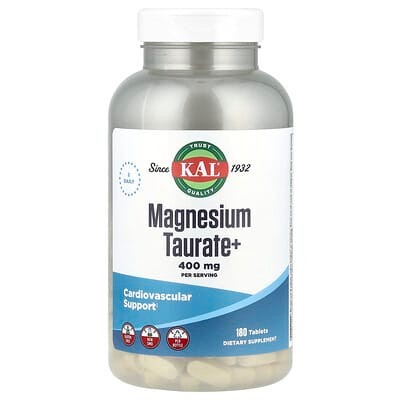

$34.99 $0.38 per serving


Product analysis
Magnesium Taurate + combines magnesium and vitamin B6 to support normal nerve and energy functions when intake is low. Sleep benefits may be modest and remain uncertain.
AI assessment of the formula, label and price. How scoring works
Nutrient Quality86
Magnesium and vitamin B6 are supplied in clearly identified forms. The herbal blend lacks an individual breakdown, limiting assessment of that part of the formula.
Ingredient Transparency65
Ingredient amounts are disclosed, making serving contents easier to compare. Some forms and blend components are unspecified, limiting a fuller comparison.
Value For Money85
Magnesium offers favorable value and vitamin B6 offers good value at the full serving cost. The carbohydrate contribution cannot be compared reliably.
Customer Satisfaction97
Customers report high satisfaction across 52,547 ratings. Reviews do not establish effectiveness or safety.
Product Focus34
Magnesium and B6 give the formula a clear nutritional basis despite its many health connections. Potential sleep and stress benefits remain limited, and the named forms do not establish better results.
- Format
Tablet - Container
- 180 Tablet(s)
- Per serving
- $0.38
- Also available
 Magnesium Taurate+ 400 mg$20.09
- Customer rating
- 4.9 · 52,547 ratings
Goals

Impact
High effect
Magnesium · 400 mgVitamin B6 · 25 mg
Magnesium supports normal nerve function and may help with stress when intake is low or in selected clinical settings. Vitamin B6 contributes to neurotransmitter metabolism and has some anxiety evidence, though stress findings often involve combinations. Its amount offers partial support in the saved findings. Rosemary declarations remain unresolved, so they cannot establish an additional contribution.
How this product is rated for Stress Relief
Ingredient fit81
The relevant ingredients give this formula a clear connection to stress support, alongside broader wellness uses. The disclosed amounts provide partial coverage of the saved references, limiting how strongly the formula matches those amount expectations.
Goal fit
The relevant ingredients give this formula a clear connection to stress support, alongside broader wellness uses.
Dose adequacy
The disclosed amounts provide partial coverage of the saved references, limiting how strongly the formula matches those amount expectations.
Pathways70
The strongest saved finding concerns neural calming, rather than equal support across every aspect of stress. The saved findings cover neural calming, mood and neurotransmitter synthesis. These ingredient roles do not establish distinct clinical benefits.
Depth
The strongest saved finding concerns neural calming, rather than equal support across every aspect of stress.
Breadth
The saved findings cover neural calming, mood and neurotransmitter synthesis. These ingredient roles do not establish distinct clinical benefits.
Evidence76
Magnesium provides the strongest supplied support here; study populations, preparations and outcomes limit how broadly relief can be expected.
Evidence strength
Magnesium provides the strongest supplied support here; study populations, preparations and outcomes limit how broadly relief can be expected.
Studied preparation
The counted preparations meet the saved preparation check, without proving that every formulation produces the same effects.
Formulation logic93
B6 lacks its configured B-vitamin partner, limiting the saved combination finding. No specified ingredient conflict was identified in the saved findings.
Partner coverage
B6 lacks its configured B-vitamin partner, limiting the saved combination finding.
Conflicts
No specified ingredient conflict was identified in the saved findings.
Effective doses
All counted ingredients meet the saved minimum amount criterion; this does not establish independent stress relief from each ingredient.

Impact
Highest effect
Magnesium · 400 mg
Magnesium and vitamin B6 contribute to normal energy metabolism when intake is low. Magnesium also contributes to bone mineral functions, while B6 supports normal blood-related metabolism. The supplied magnesium taurate and pyridoxal phosphate forms do not establish added benefit over other forms. Ginger remains unresolved in the imported facts, so no contribution can be assigned to it.
How this product is rated for Everyday Health
Ingredient fit91
The recognized ingredients reach the saved amount references; this does not imply additional benefit beyond adequate intake.
Goal fit
The relevant ingredients fit routine nutritional roles, although the product is linked to several health aims.
Dose adequacy
The recognized ingredients reach the saved amount references; this does not imply additional benefit beyond adequate intake.
Pathways100
The strongest represented area is energy metabolism cofactors, reflecting the recognized ingredients and their amounts.
Depth
The strongest represented area is energy metabolism cofactors, reflecting the recognized ingredients and their amounts.
Breadth
The more substantially represented areas are energy metabolism cofactors, one-carbon metabolism and blood formation, bone and mineral metabolism.
Evidence86
Magnesium provides the strongest recognized basis here; the supplied context still limits expectations for routine benefits in adequately nourished adults.
Evidence strength
Magnesium provides the strongest recognized basis here; the supplied context still limits expectations for routine benefits in adequately nourished adults.
Studied preparation
The recognized preparations meet the saved check; this does not establish superiority of the named forms or broad clinical benefits.
Formulation logic100
None of the defined ingredient-conflict conditions was triggered by the supplied facts.
Partner coverage
The recognized ingredients can contribute independently or have their required partners present; no added combined benefit is established.
Conflicts
None of the defined ingredient-conflict conditions was triggered by the supplied facts.
Effective doses
All recognized ingredients meet the saved minimum amount threshold; this is not a proven clinical treatment threshold.

Impact
High effect
Magnesium · 400 mgVitamin B6 · 25 mg
Magnesium offers a possible contribution to vascular function, with inconsistent findings for blood pressure and arterial stiffness and greater plausibility in low-status or elevated-pressure settings. B6 contributes to homocysteine metabolism without establishing cardiovascular-event prevention. The taurate form does not establish a superior cardiovascular effect or a separate declared taurine dose.
How this product is rated for Cardiovascular Support
Ingredient fit91
The declared ingredients are concentrated on the cardiovascular roles considered here.
Goal fit
The declared ingredients are concentrated on the cardiovascular roles considered here.
Dose adequacy
The declared amounts provide varying exposure to relevant ingredients; comparison with study amounts does not establish a daily regimen.
Pathways80
Homocysteine metabolism is the strongest represented role, but this does not establish fewer cardiovascular events.
Depth
Homocysteine metabolism is the strongest represented role, but this does not establish fewer cardiovascular events.
Breadth
Vascular mineral balance and homocysteine metabolism are represented, without establishing broad cardiovascular protection.
Evidence79
Magnesium has inconsistent arterial-stiffness and blood-pressure findings, with greater plausibility in low-status or elevated-pressure settings.
Evidence strength
Magnesium has inconsistent arterial-stiffness and blood-pressure findings, with greater plausibility in low-status or elevated-pressure settings.
Studied preparation
The saved preparation comparison accepts the qualifying ingredients, but that finding does not extend the evidence beyond the populations and outcomes described.
Formulation logic100
The qualifying ingredients have no missing required partners, and the supplied checks identify no matching conflicts.
Partner coverage
No required partner is missing for the credited ingredients; this does not establish an extra benefit from combining them.
Conflicts
No matching formulation conflict was identified in the supplied checks.
Effective doses
All qualifying ingredients meet the saved minimum amount threshold, which is an exposure comparison rather than proof of effectiveness.

Impact
Highest effect
Magnesium · 400 mg
Magnesium supports normal nerve function and may offer a modest sleep-quality benefit in selected adults reporting poor sleep. Evidence remains limited, and the taurate form does not establish superior sleep effects. Vitamin B6 contributes to normal neurotransmitter metabolism, but additional B6 does not establish additional sleep improvement; its P5P form does not change that limitation.
How this product is rated for Sleep Support
Ingredient fit91
Magnesium supplies the clearest sleep-related fit. The saved amount findings describe formulation suitability rather than a guaranteed effect.
Goal fit
The relevant ingredients support sleep-related functions, although the product also addresses broader nutritional or wellness needs.
Dose adequacy
Magnesium has a disclosed amount that substantially meets the saved amount reference; this does not establish a guaranteed sleep response.
Pathways80
The strongest findings involve nerve-related functions and normal neurotransmitter metabolism, without proving extra sleep benefit from B6. The saved findings cover nerve-related functions and neurotransmitter metabolism; these do not establish separate clinical sleep benefits.
Depth
The strongest findings involve nerve-related functions and normal neurotransmitter metabolism, without proving extra sleep benefit from B6.
Breadth
The saved findings cover nerve-related functions and neurotransmitter metabolism; these do not establish separate clinical sleep benefits.
Evidence98
Magnesium provides the strongest supplied sleep evidence here, but findings are limited and concern selected poor-sleep populations.
Evidence strength
Magnesium provides the strongest supplied sleep evidence here, but findings are limited and concern selected poor-sleep populations.
Studied preparation
The saved preparation check was met, but it does not establish equal sleep effects across magnesium salts.
Formulation logic100
The credited ingredients can be considered without a required missing partner. No specified sleep-related ingredient conflict was identified in the supplied findings.
Partner coverage
The credited ingredients do not require an additional partner in the saved findings; this does not establish added benefit from combining them.
Conflicts
No specified sleep-related ingredient conflict was identified in the supplied findings.
Effective doses
The counted ingredients meet the saved minimum amount criterion, which does not prove that each independently improves sleep.

Impact
Highest effect
Magnesium · 400 mg
Magnesium supports normal bone metabolism and can fill low dietary intake. The 400 mg elemental serving reaches the supplied reference range, without proving extra benefit from the taurate form. B6 also receives a saved contribution, but homocysteine lowering and combined-vitamin studies do not establish independent B6 benefit for bone density or fracture prevention.
How this product is rated for Bone Health
Ingredient fit91
Magnesium supplies the clearest nutritional bone role; B6 is also counted in the saved findings.
Goal fit
Both nutrients receive saved contributions, although the product is linked to several goals.
Dose adequacy
Both magnesium and B6 meet their full saved amount references; this does not establish a bone-treatment dose for B6.
Pathways77
Mineral supply leads the saved findings, with additional collagen-related coverage assigned to B6.
Depth
Magnesium provides the strongest coverage through mineral supply.
Breadth
Mineral supply and collagen formation meet the saved coverage criterion; B6's assignment does not establish independent improvement in bone outcomes.
Evidence95
Magnesium leads the saved evidence finding. Nutritional support and bone-density findings do not by themselves establish fracture prevention.
Evidence strength
Magnesium provides the strongest saved evidence basis here, with the population and nutritional limitations of its supporting findings.
Studied preparation
Both declared preparations meet the saved criterion; no superior bone benefit is established for magnesium taurate or the P5P form of B6.
Formulation logic100
No required partner is missing, and no configured ingredient conflict was found.
Partner coverage
The counted ingredients work alone or have their configured partners.
Conflicts
No configured ingredient conflict was identified in the supplied facts.
Effective doses
All counted ingredients meet the saved minimum amount criterion; this is not proof of a clinical bone benefit.

Impact
High effect
Magnesium · 400 mg
Magnesium and B6 can help reduce tiredness when low intake or deficiency impairs normal function. Their declared amounts meet the saved nutrient comparisons without establishing extra energy once needs are met. Magnesium taurate and the B6 form do not establish a superior fatigue effect, and their combination does not establish an additional benefit.
How this product is rated for Energy
Ingredient fit91
Magnesium anchors the relevant saved findings. The counted serving amounts meet their comparisons.
Goal fit
Magnesium gives the formula a clear connection to this goal, while its links to other goals reduce exclusive focus.
Dose adequacy
Magnesium meets the saved serving-amount comparison; this does not establish an optimal intake or greater benefit from larger amounts.
Pathways0
The nutrient findings do not establish coverage of specific alertness or exercise-energy processes.
Depth
No specific alertness or exercise-energy process receives coverage; nutrient-related fatigue support remains distinct from these processes.
Breadth
No process reaches the coverage comparison; this does not rule out conditional nutrient-related fatigue support.
Evidence88
Magnesium leads the evidence finding for nutrient-related fatigue; added benefit in nutritionally replete adults is not established.
Evidence strength
Magnesium leads the evidence finding for nutrient-related fatigue; added benefit in nutritionally replete adults is not established.
Studied preparation
The counted declarations meet the saved preparation comparison, without establishing superiority of their particular forms or a completed clinical regimen.
Formulation logic100
No missing required partner or listed sedating conflict is identified. Counted ingredients meet the minimum amount comparison.
Partner coverage
No counted ingredient lacks a required partner under the supplied findings; this does not establish extra benefit from combining ingredients.
Conflicts
No valerian, kava or qualifying tryptophan conflict is triggered, and the melatonin condition does not apply; this is a limited conflict check.
Effective doses
All counted ingredients meet the saved minimum amount comparison; smaller or unresolved ingredients remain excluded from this finding.
Ingredients
| Ingredient | Amount per serving | Score |
|---|---|---|
Total Carbohydrates | 1 Gram(s) | |
Vitamin B-6 (Pyridoxal 5-Phosphate) | 25 mg | |
Magnesium (Magnesium Taurate) | 400 mg | |
ActiSorb Base | 10 mg |
Vitamin B6 (Pyridoxal 5-Phosphate) · 25 mg OverallScore80
Each serving provides 25 mg of vitamin B6 as pyridoxal 5-phosphate. That exceeds the European adult daily upper limit before B6 from food or other supplements is counted.
How this ingredient is rated
Ingredient Form & Label Quality100
The identified B6 source is pyridoxal 5-phosphate. None of the checked additives were flagged in the evaluation; other ingredients may still be present.
Vitamin B6 Form Identification
The identified B6 source is pyridoxal 5-phosphate.
Clean Label and Excipient Purity
None of the checked additives were flagged in the evaluation; other ingredients may still be present.
Dose, Safety & Label Transparency60
A serving contains 25 mg of B6, exceeding the European adult daily upper limit before other sources are counted. The amount and chemical source are identified.
Vitamin B6 Dose & Safety Policy
A serving contains 25 mg of B6, exceeding the European adult daily upper limit before other sources are counted.
Label Transparency
The amount and chemical source are identified.
Value80
The whole-product price is about $0.016 per mg of vitamin B6.
Vitamin B6 Price Efficiency
The whole-product price is about $0.016 per mg of vitamin B6.
Magnesium (Magnesium Taurate) · 400 mg OverallScore88
A serving supplies 400 mg of magnesium as magnesium taurinate. The whole-product serving costs about $0.39.
How this ingredient is rated
Active Ingredient Quality & Bioavailability70
The declared magnesium comes as magnesium taurinate.
Magnesium Form & Absorption Potential
The identified form is magnesium taurinate.
Patented Materials & Chelation Quality
The saved facts do not identify a qualifying branded or fully chelated claim.
Dose, Safety & Label Transparency100
The serving declares 400 mg of magnesium.
Elemental Yield Transparency
The label declares 400 mg of elemental magnesium per serving.
Therapeutic Dosage Alignment
The serving provides 400 mg of magnesium.
Synergistic Formulation Logic
The evaluation identifies a qualifying cofactor; the saved facts do not name which one.
Value100
About $0.39 per whole-product serving. It provides 400 mg of magnesium.
Price Per Elemental Quality
About $0.39 per whole-product serving.
Alternative products
Report alternatives
Sources
Published studies used for the product analysis and the top-ranked studies for each ingredient and goal.
- Association between Serum Magnesium and Fractures: A Systematic Review and Meta-Analysis of Observational Studies.
- Bioabsorbable Magnesium-Based Materials Potential and Safety in Bone Surgery: A Systematic Review.
- Vascularized bone grafting fixed by biodegradable magnesium screw for treating osteonecrosis of the femoral head.
- An update on magnesium and bone health.
- Sex-specific differences in the association of magnesium intake with femoral neck bone mineral density among older adults.
- The Effects of the AGE Inhibitor Pyridoxamine on Bone in Older Women With Type 2 Diabetes: A Randomized Clinical Trial.
- Dietary B vitamin intake and risk of hip fracture: the Singapore Chinese Health Study.
- Hip fracture patients may be vitamin B6 deficient. Controlled study of serum pyridoxal-5'-phosphate.
- Degree of mineralization-related collagen crosslinking in the femoral neck cancellous bone in cases of hip fracture and controls.
- Adequate Intake and Supplementation of B Vitamins, in Particular Folic Acid, can Play a Protective Role in Bone Health.
- Circulating and dietary magnesium and risk of cardiovascular disease: a systematic review and meta-analysis of prospective studies.
- Magnesium and the risk of cardiovascular events: a meta-analysis of prospective cohort studies.
- Quantitative Association Between Serum/Dietary Magnesium and Cardiovascular Disease/Coronary Heart Disease Risk: A Dose-Response Meta-analysis of Prospective Cohort Studies.
- Comparative Efficacy of Nutraceuticals on Endothelial Function: A Systematic Review and Network Meta-Analysis.
- Serum magnesium, mortality, and cardiovascular disease in chronic kidney disease and end-stage renal disease patients: a systematic review and meta-analysis.
- Association between serum pyridoxal 5'-phosphate levels and all-cause, cardiovascular mortality, and cardiovascular disease in adults: a population-based cohort study.
- Folate and vitamin B6 rapidly normalize endothelial dysfunction in children with type 1 diabetes mellitus.
- Pyridoxine improves endothelial function in cardiac transplant recipients.
- Folate and vitamin B6 from diet and supplements in relation to risk of coronary heart disease among women.
- Efficacy and safety of pyridoxal 5'-phosphate (MC-1) in high-risk patients undergoing coronary artery bypass graft surgery: the MEND-CABG II randomized clinical trial.