
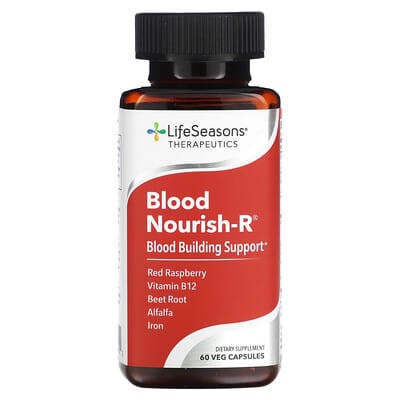

$27.99 $0.93 per serving


Product analysis
Blood Nourish-R combines iron and B vitamins that support normal blood formation, with the greatest benefit when nutrient intake or levels are low.
AI assessment of the formula, label and price. How scoring works
Nutrient Quality49
Thiamin and folate have clearly identified forms, while several botanical preparations are unspecified. Quality information remains incomplete for the iron, B12 and remaining herbs.
Ingredient Transparency83
All ingredient amounts are disclosed. Several botanical forms are missing, limiting comparisons between preparations.
Value For Money35
The full serving cost is relatively high for the iron, thiamin, folate and nettle contributions. Value for B12 remains uncertain.
Customer Satisfaction71
Customer ratings are very positive. The small review history gives a narrower picture of satisfaction.
Product Focus60
Blood formation and fatigue related to low nutrient levels are the clearest purposes. The iron amount exceeds the adult upper intake limit and may cause stomach or bowel upset.
- Format
Capsule - Container
- 60 Capsule(s)
- Per serving
- $0.93
- Customer rating
- 4.7 · 55 ratings
Goals

Impact
High effect
Thiamin · 25 mgVitamin B12 · 1000 mcgIron · 50 mg
Iron, B12 and folate can help reduce tiredness when low intake or deficiency impairs normal function or blood-cell production. They do not establish extra energy when nutritional status is adequate. The high iron amount earns no additional benefit beyond the saved comparison limit, and its chelated form does not establish a distinct fatigue advantage. The broader botanical formula does not establish acute alertness.
How this product is rated for Energy
Ingredient fit72
Iron anchors the relevant saved findings. Other ingredients and differing amount comparisons limit the formula’s concentration on this goal.
Goal fit
Relevant ingredients sit within a broader formula, reducing the proportion concentrated on energy-related support.
Dose adequacy
Some ingredients meet their serving-amount comparisons while others make partial contributions; these comparisons do not measure the size of a fatigue benefit.
Pathways0
The nutrient findings do not establish coverage of specific alertness or exercise-energy processes.
Depth
No specific alertness or exercise-energy process receives coverage; nutrient-related fatigue support remains distinct from these processes.
Breadth
No process reaches the coverage comparison; this does not rule out conditional nutrient-related fatigue support.
Evidence98
Iron leads the evidence finding for nutrient-related fatigue; added benefit in nutritionally replete adults is not established.
Evidence strength
Iron leads the evidence finding for nutrient-related fatigue; added benefit in nutritionally replete adults is not established.
Studied preparation
The counted declarations meet the saved preparation comparison, without establishing superiority of their particular forms or a completed clinical regimen.
Formulation logic100
No missing required partner or listed sedating conflict is identified. Counted ingredients meet the minimum amount comparison.
Partner coverage
No counted ingredient lacks a required partner under the supplied findings; this does not establish extra benefit from combining ingredients.
Conflicts
No valerian, kava or qualifying tryptophan conflict is triggered, and the melatonin condition does not apply; this is a limited conflict check.
Effective doses
All counted ingredients meet the saved minimum amount comparison; smaller or unresolved ingredients remain excluded from this finding.

Impact
Moderate effect
Iron · 50 mg
Iron may help with diffuse shedding when iron deficiency is the cause. Taking more iron doesn't imply extra regrowth when your levels are adequate. The added B vitamins relate to nutrient adequacy, but they don't show that this combination will treat hair loss from other causes. The amount in one serving also doesn't determine the right replacement regimen for an individual.
How this product is rated for Hair Health
Ingredient fit68
Iron's practical hair benefit concerns correcting deficiency, rather than routine regrowth.
Goal fit
Iron's practical hair benefit concerns correcting deficiency, rather than routine regrowth.
Dose adequacy
One selected serving declares Thiamin (B1) 25 mg, Vitamin B12 1000 mcg, Nettle root and plant sterols 100 mg. These amounts alone don't demonstrate hair regrowth.
Pathways0
No specific hair mechanism has a meaningful ingredient contribution here; nutrient adequacy remains distinct from a demonstrated hair effect.
Depth
No specific hair mechanism has a meaningful ingredient contribution here; nutrient adequacy remains distinct from a demonstrated hair effect.
Breadth
The ingredients don't provide broad, substantial contributions across the described hair mechanisms.
Evidence78
Iron's practical hair benefit concerns correcting deficiency, rather than routine regrowth.
Evidence strength
Iron's practical hair benefit concerns correcting deficiency, rather than routine regrowth.
Studied preparation
The declared ingredients match the relevant preparation categories, but that doesn't guarantee the same hair outcome for everyone.
Formulation logic100
The relevant ingredients have no missing required partners or identified conflicts. Amount comparisons don't guarantee a hair benefit.
Partner coverage
No required ingredient partner is missing from the relevant combinations.
Conflicts
No particular ingredient conflict is identified.
Effective doses
The relevant declared amounts reach at least a quarter of their comparison curves; these comparisons aren't minimum effective doses.

Impact
Moderate effect
Iron · 50 mgVitamin B12 · 1000 mcgVitamin B12 · 1000 mcg
Iron, B12 and folate support normal red blood cell formation and may help fatigue when a nutritional deficiency is responsible. The 50 mg iron serving is a substantial amount, but a higher amount does not imply improved work performance in someone with adequate iron status.
How this product is rated for Productivity Boost
Ingredient fit72
Iron, B12 and folate provide the main relevant contributions. The relevant amounts meet the saved comparison amounts; this is not proof of greater work performance.
Goal fit
Iron, B12 and folate provide the main relevant contributions.
Dose adequacy
The relevant amounts meet the saved comparison amounts; this is not proof of greater work performance.
Pathways0
The saved findings identify nutritional support without direct coverage of the assessed productivity mechanisms.
Depth
The saved findings identify nutritional support without direct coverage of the assessed productivity mechanisms.
Breadth
No assessed route reaches the saved threshold for broad coverage.
Evidence70
Vitamin B12 provides the strongest evidence finding among the relevant ingredients. Benefits for everyday work still depend on the setting and nutritional status. The saved findings accept the preparations of ingredients meeting its dose criterion.
Evidence strength
Vitamin B12 provides the strongest evidence finding among the relevant ingredients. Benefits for everyday work still depend on the setting and nutritional status.
Studied preparation
The saved findings accept the preparations of ingredients meeting its dose criterion.
Formulation logic100
The relevant ingredients can contribute without a required additional partner. No conflicts were identified in the saved assessment.
Partner coverage
The relevant ingredients can contribute without a required additional partner.
Conflicts
No ingredient conflicts were identified in the saved assessment.
Effective doses
All ingredients included in the saved dose check meet its minimum contribution threshold.
Ingredients
| Ingredient | Amount per serving | Score |
|---|---|---|
Vitamin B1 (Thiamine Hydrochloride) | 25 mg | |
Folate (Calcium Folinate) | 400 mcg | |
Vitamin B12 (Methylcobalamin) | 1000 mcg | |
Iron (Ferrous Bisglycinate Chelate) | 50 mg | |
Alfalfa (ConcenTrace Trace Minerals) | 100 mg | |
Beet | 100 mg | |
Burdock | 100 mg | |
Nettle leaf extract | 100 mg | |
Red Raspberry | 100 mg |
Vitamin B12 (Methylcobalamin) · 1000 mcg OverallScore84
A serving lists 1,000 mcg of vitamin B12 as methylcobalamin. At the whole-product price, that corresponds to about $0.93 per 1,000 mcg of B12.
How this ingredient is rated
Active Ingredient Quality & Bioavailability100
The stated B12 form is methylcobalamin.
Bioactive B12 Form Selection
The stated B12 form is methylcobalamin.
Dose, Safety & Label Transparency100
The label identifies 1,000 mcg of B12 per serving and names its form.
Therapeutic Dosage Level
The stated vitamin B12 amount is 1,000 mcg per serving.
Label and Form Transparency
The stated 1,000 mcg of B12 per serving is identified as methylcobalamin.
Value20
The whole-product price corresponds to about $0.93 per 1,000 mcg of B12.
Price per 1,000 mcg B12
Using the whole-product serving price, the cost is about $0.93 per 1,000 mcg of B12.
Iron (Ferrous Bisglycinate Chelate) · 50 mg OverallScore69
A serving provides 50 mg of iron as ferrous bisglycinate, a relatively high amount. Vitamin B12 and folate are also listed, while the vitamin C amount is unknown.
How this ingredient is rated
Active Ingredient Quality & Bioavailability78
ferrous bisglycinate is the named iron source. Vitamin B12 and folate are listed, while the vitamin C amount is unknown.
Iron Chemical Form & Bioavailability
Ferrous bisglycinate is the named form and is favored by the evaluation; that classification does not establish superior absorption.
Absorption Support & Blocker Avoidance
Vitamin B12 and folate are listed, but the amount of vitamin C is unknown in the saved facts.
Dose, Safety & Label Transparency85
The label declares 50 mg of iron per serving and identifies the source.
Elemental Iron Label Clarity
The label gives an iron amount of 50 mg per serving; the source is also identified.
Dosage Effectiveness & Safety Range
The serving declares 50 mg iron, a relatively high amount.
Value20
The whole-product serving costs about $0.93.
Price per Effective Serving
The evaluated price is about $0.93 per whole-product serving.
Thiamin (Thiamine Hydrochloride) · 25 mg OverallScore65
Alternative products
Report alternatives
Sources
Published studies used for the product analysis and the top-ranked studies for each ingredient and goal.
- Large-dose intravenous ferric carboxymaltose injection for iron deficiency anemia in heavy uterine bleeding: a randomized, controlled trial.
- The Effect of Parenteral or Oral Iron Supplementation on Fatigue, Sleep, Quality of Life and Restless Legs Syndrome in Iron-Deficient Blood Donors: A Secondary Analysis of the IronWoMan RCT.
- Ferric carboxymaltose vs. oral iron in the treatment of pregnant women with iron deficiency anemia: an international, open-label, randomized controlled trial (FER-ASAP).
- Effect of iron therapy on fatigue symptoms in non-anaemic iron deficient women of reproductive age- A Randomized Controlled Trial.
- Intravenous iron isomaltoside treatment of women suffering from severe fatigue after postpartum hemorrhage.
- Influence of thiamin supplementation on the health and general well-being of an elderly Irish population with marginal thiamin deficiency.
- Randomised clinical trial: high-dose oral thiamine versus placebo for chronic fatigue in patients with quiescent inflammatory bowel disease.
- Dietary reference values for thiamin.
- Effects of thiamine supplementation on exercise-induced fatigue.
- Long-term maintenance treatment with 300 mg thiamine for fatigue in patients with inflammatory bowel disease: results from an open-label extension of the TARIF study.
- A new perspective on vitamin B12 deficiency in rheumatology: a case-based review.
- Effects of Vitamin B12 Supplementation on Cognitive Function, Depressive Symptoms, and Fatigue: A Systematic Review, Meta-Analysis, and Meta-Regression.
- Patients' experiences with methylcobalamin injections in amyotrophic lateral sclerosis.
- Cobalamin deficiency: clinical picture and radiological findings.
- Vitamin B12 Deficiency: Common Questions and Answers.
- Hair Loss After Metabolic and Bariatric Surgery: a Systematic Review and Meta-analysis.
- Quantitative Analysis of Selected Circulating Hematological Biomarkers, Essential Minerals, Vitamins, and Thyroid Hormones in Females Affected by Hair Loss.
- Twelve weeks of protracted venous infusion of fluorouracil (5-FU) is as effective as 6 months of bolus 5-FU and folinic acid as adjuvant treatment in colorectal cancer.
- Role of oxaliplatin combined with 5-fluorouracil and folinic acid in the first- and second-line treatment of advanced colorectal cancer.
- Phase I-II study of vinorelbine in combination with 5-fluorouracil and folinic acid as first-line chemotherapy in metastatic breast cancer: a regimen with a low subjective toxic burden.