





Iron Supportive
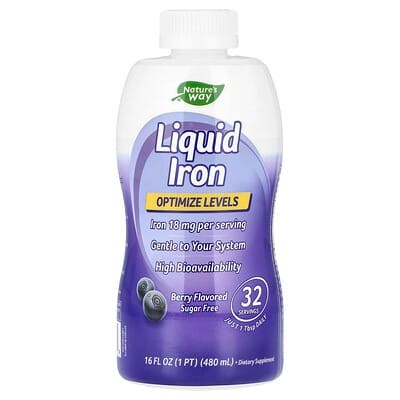
Liquid Iron 18 mg Sugar Free Berry Flavored
Goals
$8.20 $0.25 per serving
Product analysis
AI assessment of the formula, label and price. How scoring works
Nutrient Quality36
Ingredient Transparency75
Value For Money88
Customer Satisfaction86
Product Focus61
- Format
Liquid - Container
- 16 Liquid(s)
- Per serving
- $0.25
- Customer rating
- 4.5 · 9,399 ratings
Goals
Impact
High effect
Iron · 18 mg
Liquid Iron 18 mg Sugar Free Berry Flavored fits energy needs when low iron contributes to fatigue. Its 18 mg of iron as ferric glycinate supports iron intake, but a fatigue benefit depends on an actual shortfall.

Impact
Moderate effect
Iron · 18 mg
Liquid Iron 18 mg Sugar Free Berry Flavored fits hair health most clearly when iron deficiency contributes to shedding. Its 18 mg iron serving supplies a disclosed amount for filling that nutritional gap.
Iron Disputed

Impact
Moderate effect
Iron · 18 mg
Liquid Iron 18 mg Sugar Free Berry Flavored has a narrow fit for productivity when low iron contributes to fatigue or poor concentration. Its 18 mg of iron as ferric glycinate supports iron intake; the label cannot establish whether you need it.
Iron Supportive

Ingredients
| Ingredient | Amount per serving | Score |
|---|---|---|
Calories | 10 Calorie(s) | |
Total Carbohydrates | 2 Gram(s) | |
Iron (Ferric Glycinate) | 18 mg |
Iron (Ferric Glycinate) · 18 mg OverallScore79
Nature's Way Liquid Iron 18 mg Sugar Free Berry Flavored offers 18 mg of iron per serving, an amount commonly used for iron supplementation, and is good value at $0.07 per 5 mg of iron. The iron comes as Ferric Glycinate. The vitamin C amount is unknown, so absorption support cannot be established. The full product costs $0.26 per serving.
Alternative products
Report alternatives
Sources
Published studies used for the product analysis and the top-ranked studies for each ingredient and goal.
- Large-dose intravenous ferric carboxymaltose injection for iron deficiency anemia in heavy uterine bleeding: a randomized, controlled trial.
- The Effect of Parenteral or Oral Iron Supplementation on Fatigue, Sleep, Quality of Life and Restless Legs Syndrome in Iron-Deficient Blood Donors: A Secondary Analysis of the IronWoMan RCT.
- Ferric carboxymaltose vs. oral iron in the treatment of pregnant women with iron deficiency anemia: an international, open-label, randomized controlled trial (FER-ASAP).
- Effect of iron therapy on fatigue symptoms in non-anaemic iron deficient women of reproductive age- A Randomized Controlled Trial.
- Intravenous iron isomaltoside treatment of women suffering from severe fatigue after postpartum hemorrhage.
- Ferric carboxymaltose in patients with heart failure and iron deficiency.
- Marginal iron deficiency without anemia impairs aerobic adaptation among previously untrained women.
- Ferric Carboxymaltose Versus Ferrous Fumarate in Anemic Children with Inflammatory Bowel Disease: The POPEYE Randomized Controlled Clinical Trial.
- Daily iron supplementation for improving anaemia, iron status and health in menstruating women.
- Altered metabolic response of iron-depleted nonanemic women during a 15-km time trial.
- The Association Between Alopecia Areata and Iron Deficiency Anemia: A Large-Scale Population-Based Case-Control Study.
- Iron Deficiency and Nonscarring Alopecia in Women: Systematic Review and Meta-Analysis.
- Comparative Analysis of Postoperative Hair Loss and Micronutrient Deficiencies After One-Anastomosis Gastric Bypass Versus Sleeve Gastrectomy.
- Assessment of Serum Ferritin Levels in Female Patients With Telogen Effluvium.
- Diagnosis and treatment of female alopecia: Focusing on the iron deficiency-related alopecia.
- Effects of daily iron supplementation in primary-school-aged children: systematic review and meta-analysis of randomized controlled trials.
- Consumption of Iron-Biofortified Beans Positively Affects Cognitive Performance in 18- to 27-Year-Old Rwandan Female College Students in an 18-Week Randomized Controlled Efficacy Trial.
- Functional consequences of iron supplementation in iron-deficient female cotton mill workers in Beijing, China.
- The Effect of Iron-Fortified Lentils on Blood and Cognitive Status among Adolescent Girls in Bangladesh.