
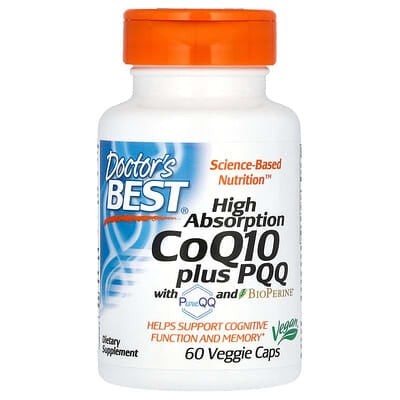
High Absorption CoQ10 plus PQQ with PureQQ and BioPerine

Goals
$34.99 $0.58 per serving


Product analysis
High Absorption CoQ10 plus PQQ with PureQQ and BioPerine may offer limited support for blood-vessel function and fatigue in some settings. Its usefulness for everyday energy is less certain.
AI assessment of the formula, label and price. How scoring works
Nutrient Quality34
The CoQ10 and black pepper forms are named, while the PQQ form is not. There is not enough information for a firm quality judgment about the complete mixture.
Ingredient Transparency88
All listed amounts are disclosed, helping you compare servings. The PQQ form remains unclear.
Value For Money40
CoQ10 offers limited value in the serving-cost comparison. There is not enough information to judge the value of the added PQQ and black pepper.
Customer Satisfaction92
Customer feedback is very positive across thousands of reviews. That satisfaction does not establish a noticeable energy or heart-health effect.
Product Focus66
CoQ10 provides the main connection to vessel function and fatigue, with limited evidence from specific settings. The added ingredients do not establish a better cardiovascular response or an immediate energy boost.
- Format
Capsule - Container
- 60 Veggie Cap(s)
- Per serving
- $0.58
- Customer rating
- 4.8 · 6,937 ratings
Goals

Impact
High effect
Coenzyme Q-10 · 100 mg
CoQ10 in the ubiquinone form has limited support for fatigue relief, distinct from an immediate alertness effect. Its role in cellular energy production does not by itself prove a noticeable energy boost, and clinical disease findings do not transfer to routine healthy use. The serving falls short of the full saved amount comparison.
How this product is rated for Energy
Ingredient fit73
Coenzyme Q-10 anchors the recognized ingredient fit, with declared amounts partly meeting the saved comparisons.
Goal fit
Coenzyme Q-10 is central to the product’s recognized energy connection, although the product is also linked to other goals.
Dose adequacy
The declared amounts partly meet the saved comparisons, limiting the size of the recognized contribution.
Pathways17
The saved coverage is concentrated in mitochondrial energy production.
Depth
The strongest saved coverage concerns mitochondrial energy production; this does not independently prove a noticeable energy benefit.
Breadth
No energy pathway reaches the saved breadth threshold.
Evidence84
Coenzyme Q-10 leads the recognized evidence, but the supplied context limits how broadly its findings apply.
Evidence strength
Coenzyme Q-10 supplies the strongest recognized evidence here, subject to the population and application limits described for it.
Studied preparation
The saved findings accept the qualifying preparations; this does not establish form superiority.
Formulation logic100
No required partner is missing, and no configured sedative conflict is present. The recognized amounts reach the saved minimum comparison.
Partner coverage
The recognized ingredients have no missing required partner for their assigned contributions.
Conflicts
No configured sedative conflict applies: valerian, kava, qualifying tryptophan and melatonin are absent.
Effective doses
All recognized ingredients reach the saved minimum amount comparison; that threshold is not proof of a clinical energy effect.

Impact
Moderate effect
Coenzyme Q-10 · 100 mg
CoQ10 at 100 mg supports mitochondrial energy production, and PQQ at 20 mg has limited attention and memory findings for particular preparations. Piperine may improve CoQ10 absorption, but this combination has only a qualified connection to age-related function.
How this product is rated for Longevity
Ingredient fit76
The relevant ingredients give the formula a aging-relateded connection to this goal. The amounts assessed provide a partial match to the saved comparison levels.
Goal fit
The relevant ingredients give the formula a aging-relateded connection to this goal.
Dose adequacy
The amounts assessed provide a partial match to the saved comparison levels.
Pathways12
The strongest connection is mitochondrial energy production, with limited coverage. Coverage does not reach the saved threshold across direct aging-related mechanisms.
Depth
The strongest connection is mitochondrial energy production, with limited coverage.
Breadth
Coverage does not reach the saved threshold across direct aging-related mechanisms.
Evidence30
Coenzyme Q-10 provides the strongest evidence connection among ingredients counted at relevant amounts, with limited scope for everyday aging-related benefits. The materials assessed are not matched to preparations used in the supplied aging-related trials.
Evidence strength
Coenzyme Q-10 provides the strongest evidence connection among ingredients counted at relevant amounts, with limited scope for everyday aging-related benefits.
Studied preparation
The materials assessed are not matched to preparations used in the supplied aging-related trials.
Formulation logic100
The assessed ingredients can work alone or have their relevant partner present. No ingredient conflict was found in the supplied checks. All ingredients counted in this check meet its minimum amount threshold.
Partner coverage
The assessed ingredients can work alone or have their relevant partner present.
Conflicts
No ingredient conflict was found in the supplied checks.
Effective doses
All ingredients counted in this check meet its minimum amount threshold.

Impact
Moderate effect
Coenzyme Q-10 · 100 mg
Coenzyme Q10 participates in the energy-making machinery inside cells, but this role does not show that taking it increases whole-body calorie use. Changes in metabolic markers are different from a faster resting metabolism.
How this product is rated for Metabolism Support
Ingredient fit59
Coenzyme Q10 participates in the energy-making machinery inside cells, but this role does not show that taking it increases whole-body calorie use.
Goal fit
The list combines nutrients and other actives with different metabolic roles, rather than one uniform calorie-burning action.
Dose adequacy
Coenzyme Q-10 100 mg. These are serving amounts compared with ingredient reference ranges, not guaranteed calorie-burning doses.
Pathways17
Coenzyme Q10 connects with mitochondrial energy processes; these do not directly demonstrate increased whole-body energy expenditure.
Depth
Coenzyme Q10 connects with mitochondrial energy processes; these do not directly demonstrate increased whole-body energy expenditure.
Breadth
The connection is concentrated in cellular energy processes, rather than several direct ways of increasing calorie use.
Evidence75
Coenzyme Q10 effects on metabolic markers do not show a routine rise in whole-body calorie use.
Evidence strength
Coenzyme Q10 effects on metabolic markers do not show a routine rise in whole-body calorie use.
Studied preparation
The ingredient forms are recognized, but that alone does not make their metabolic effects transferable to routine calorie burning.
Formulation logic100
No particular ingredient conflict or missing required partner is identified.
Partner coverage
No missing required partner is identified for the relevant ingredients.
Conflicts
No particular ingredient conflict is identified.
Effective doses
The relevant declared amounts reach portions of their comparison ranges; those ranges are not validated minimum doses for increasing calorie use.

Impact
High effect
Coenzyme Q-10 · 100 mg
Coenzyme Q10, declared as ubiquinone, has limited support from small studies of vascular, blood-pressure or lipid measurements. Its 100 mg serving largely meets the preparation's saved comparison, with the contribution concentrated in endothelial function. These selected-population results do not establish routine cardiovascular-event prevention. Piperine does not establish an additional heart-health contribution or a superior CoQ10 response, and the wider formula reduces goal focus.
How this product is rated for Heart Health
Ingredient fit72
Conventional CoQ10 gives the main preparation-specific contribution, with other actives reducing overall focus.
Goal fit
The wider formula broadens focus beyond the credited CoQ10 contribution.
Dose adequacy
The 100 mg CoQ10 serving largely meets its preparation-specific exposure comparison.
Pathways53
Endothelial nitric-oxide function is the strongest assigned area. Only endothelial function reaches substantial coverage.
Depth
Endothelial nitric-oxide function has the strongest saved coverage; that assignment does not establish prevention of cardiovascular events.
Breadth
Only endothelial function reaches substantial coverage.
Evidence98
CoQ10 leads the saved support finding, limited to small selected-population vascular and blood-pressure measurements.
Evidence strength
Coenzyme Q10 leads the saved evidence finding, within the preparation, population and outcome limits of the supplied context.
Studied preparation
Credited preparations meet the saved criteria; this does not extend selected-population or surrogate findings to general event prevention.
Formulation logic100
Credited ingredients clear the saved amount threshold and have no assessed missing partner or conflict.
Partner coverage
Credited ingredients work alone or have their relevant partners; no additional combination benefit follows from this finding.
Conflicts
No assessed ingredient conflict was triggered.
Effective doses
All credited ingredients clear the saved minimum amount threshold, which is not proof of cardiovascular benefit.

Impact
Moderate effect
Coenzyme Q-10 · 100 mg
CoQ10 may affect some inflammatory blood markers, but the useful effects are limited and depend on the context. The connection is clearest for ubiquinone in people with coronary artery disease taking statins. That doesn't mean the same benefit applies to everyday users or that taking it reliably relieves inflammatory symptoms.
How this product is rated for Inflammation
Ingredient fit52
CoQ10 may affect some inflammatory blood markers, but the useful effects are limited and depend on the context. The connection is clearest for ubiquinone in people with coronary artery disease taking statins.
Goal fit
The declared ingredients relate to inflammation, with preparation and context limiting how broadly their effects apply.
Dose adequacy
Pyrroloquinoline Quinone 20 mg and Coenzyme Q-10 100 mg per label serving; these amounts don't by themselves guarantee benefit.
Pathways13
The ingredients relate most directly to oxidative stress and cellular energy processes; that connection alone doesn't guarantee symptom relief.
Depth
The ingredients relate most directly to oxidative stress and cellular energy processes; that connection alone doesn't guarantee symptom relief.
Breadth
The pathway connection doesn't imply that several distinct anti-inflammatory effects will occur in everyday use.
Evidence93
A change in inflammatory blood markers can be relevant, but it doesn't automatically translate into noticeable relief or a routine benefit for everyone.
Evidence strength
CoQ10 may affect some inflammatory blood markers, but the useful effects are limited and depend on the context.
Studied preparation
Preparation descriptions are compatible with the applicable ingredient categories; they don't imply equivalent benefits for every user.
Formulation logic100
No particular ingredient conflict is identified. Preparation identity and the declared amounts still affect what you can expect.
Partner coverage
No required ingredient partner is missing for the applicable ingredients.
Conflicts
No particular ingredient conflict is identified.
Effective doses
The applicable declared amounts fall within their comparison ranges, which aren't minimum effective doses.

Impact
High effect
Coenzyme Q-10 · 100 mg
Coenzyme Q10 provides the main cardiovascular connection through limited support for blood-vessel function and blood-pressure or lipid markers. The declared ubiquinone amount makes a partial contribution in the saved findings. The supporting studies involved people with abnormal lipids or vessel function, so broad benefits in healthy adults remain uncertain. A higher amount does not establish greater benefit or prevention of cardiovascular events.
How this product is rated for Cardiovascular Support
Ingredient fit72
Relevant ingredients sit within a broader formula, so cardiovascular support is only part of its focus. The declared amounts provide partial support, with smaller or unresolved amounts limiting the contribution.
Goal fit
Relevant ingredients sit within a broader formula, so cardiovascular support is only part of its focus.
Dose adequacy
The declared amounts provide partial support, with smaller or unresolved amounts limiting the contribution.
Pathways53
The strongest saved connection is endothelial nitric-oxide function. One aspect reaches substantial coverage; support across other aspects is limited or absent.
Depth
The strongest saved connection is endothelial nitric-oxide function.
Breadth
One aspect reaches substantial coverage; support across other aspects is limited or absent.
Evidence88
The supplied studies support specific marker or nutrient roles, with the limitations described for the relevant ingredients.
Evidence strength
Coenzyme Q-10 provides the strongest amount-qualified evidence connection, subject to its population and outcome limitations.
Studied preparation
The preparations that qualify by amount match those accepted in the supplied evidence; this does not establish superiority over other forms.
Formulation logic100
The contributing ingredients work independently or have the partners required by the supplied findings. No listed formulation conflict was identified in the supplied facts.
Partner coverage
The contributing ingredients work independently or have the partners required by the supplied findings.
Conflicts
No listed formulation conflict was identified in the supplied facts.
Effective doses
All contributing ingredients meet the saved minimum amount check; this is not a guarantee of clinical benefit.
Ingredients
| Ingredient | Amount per serving | Score |
|---|---|---|
Coenzyme Q10 (Ubiquinone) | 100 mg | |
PQQ | 20 mg | |
Black Pepper ext. (Piperine) | 5 mg |
Coenzyme Q-10 (Ubiquinone) · 100 mg OverallScore62
Each serving supplies 100 mg of CoQ10 as ubiquinone and includes BioPerine. The whole-product serving also contains PQQ and costs about $0.58.
How this ingredient is rated
Active Ingredient Quality & Bioavailability64
CoQ10 is ubiquinone and BioPerine is present as an absorption enhancer.
Molecular Form: Ubiquinol vs. Ubiquinone
The CoQ10 is ubiquinone, a form the body converts to ubiquinol.
Formulation & Absorption Enhancers
BioPerine is present as an absorption enhancer; its amount and effect on absorption are not established here.
Dose, Safety & Label Transparency71
The serving provides 100 mg of ubiquinone. A standard filler is also identified.
Clinical Dosage Alignment
The serving provides 100 mg of ubiquinone, an amount recognized by the evaluation.
Label Transparency & Fillers
The amount is stated, and the evaluation identifies a standard filler.
Value40
A whole-product serving costs about $0.58 and provides 100 mg of CoQ10.
Price Per Effective Serving
A whole-product serving costs about $0.58 and provides 100 mg of CoQ10.
Alternative products
Report alternatives
Sources
Published studies used for the product analysis and the top-ranked studies for each ingredient and goal.
- Effects of Coenzyme Q10 Supplementation on Lipid Profiles in Adults: A Meta-analysis of Randomized Controlled Trials.
- Six-month supplementation with high dose coenzyme Q10 improves liver steatosis, endothelial, vascular and myocardial function in patients with metabolic-dysfunction associated steatotic liver disease: a randomized double-blind, placebo-controlled trial.
- The effect of coenzyme Q10 on morbidity and mortality in chronic heart failure: results from Q-SYMBIO: a randomized double-blind trial.
- [Coenzyme Q-10 in the treatment of patients with chronic heart failure and reduced left ventricular ejection fraction: systematic review and meta-analysis].
- Effect of coenzyme Q10 in Europeans with chronic heart failure: A sub-group analysis of the Q-SYMBIO randomized double-blind trial.
- Effects of Coenzyme Q10 on Statin-Induced Myopathy: An Updated Meta-Analysis of Randomized Controlled Trials.
- Coenzyme Q10 Supplementation in Athletes: A Systematic Review.
- Effectiveness of Coenzyme Q10 Supplementation for Reducing Fatigue: A Systematic Review and Meta-Analysis of Randomized Controlled Trials.
- Antifatigue effects of coenzyme Q10 during physical fatigue.
- Effect of coenzyme Q10 supplementation on fatigue: A systematic review of interventional studies.
- Ubiquinol Ameliorates Endothelial Dysfunction in Subjects with Mild-to-Moderate Dyslipidemia: A Randomized Clinical Trial.
- Dose-Response Effect of Coenzyme Q10 Supplementation on Blood Pressure among Patients with Cardiometabolic Disorders: A Grading of Recommendations Assessment, Development, and Evaluation (GRADE)-Assessed Systematic Review and Meta-Analysis of Randomized Controlled Trials.
- Effects of Coenzyme Q10 on Lipid, Glycemic, and Inflammatory Markers in Metabolic Disorders: A Systematic Review and Meta-Analysis.
- Treatment of coenzyme Q10 for 24 weeks improves lipid and glycemic profile in dyslipidemic individuals.
- The effect of coenzyme Q10 supplementation on inflammatory and endothelial dysfunction markers in overweight/obese polycystic ovary syndrome patients.
- The effects of coenzyme Q10 supplementation on metabolic profiles and parameters of mental health in women with polycystic ovary syndrome.
- Efficacy and Optimal Dose of Coenzyme Q10 Supplementation on Inflammation-Related Biomarkers: A GRADE-Assessed Systematic Review and Updated Meta-Analysis of Randomized Controlled Trials.
- Can coenzyme Q10 supplementation effectively reduce human tumor necrosis factor-α and interleukin-6 levels in chronic inflammatory diseases? A systematic review and meta-analysis of randomized controlled trials.
- Promising efficacy of coenzyme Q10 supplementation as adjunctive therapy in juvenile idiopathic arthritis: a randomized-controlled pilot study.
- Coenzyme Q10 and Degenerative Disorders Affecting Longevity: An Overview.