
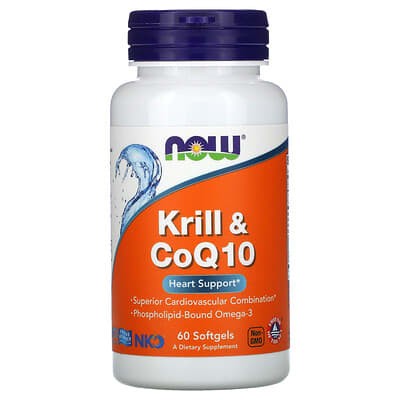

$26.00 $0.86 per serving


Product analysis
Krill & CoQ10 may offer limited support for blood-vessel function through its Q10 ingredient. The serving cost compares poorly for the Q10 content, limiting value.
AI assessment of the formula, label and price. How scoring works
Nutrient Quality20
The main ingredient listing leaves forms unspecified, so form quality remains unclear. That limits direct comparison with clearly identified oil and Q10 preparations.
Ingredient Transparency63
Listed amounts are stated, making serving contents easy to check. Ingredient forms are unspecified, limiting detailed comparisons.
Value For Money24
The Q10 serving compares poorly on cost. Krill-oil value remains uncertain, so the combination cannot be compared confidently as a whole.
Customer Satisfaction74
Customer feedback is positive across several hundred reviews. That provides useful satisfaction context without establishing cardiovascular benefits.
Product Focus63
Q10 provides the clearest connection to blood-vessel research, with limited findings in selected groups. The small or unresolved omega-3 amounts do not establish additional benefit from the oil's total weight.
- Format
Softgel - Container
- 60 Softgel(s)
- Per serving
- $0.86
- Customer rating
- 4.6 · 468 ratings
Goals

Impact
Highest effect
Coenzyme Q-10 · 100 mg
CoQ10 offers limited support for blood-vessel and blood-pressure measures based on small studies in selected populations. Its 100 mg per serving receives substantial partial amount recognition. The small EPA and DHA amounts are below the saved contribution thresholds, and the astaxanthin declaration remains unresolved. These findings do not establish prevention of heart attacks or other cardiovascular events.
How this product is rated for Heart Health
Ingredient fit86
CoQ10 contributes; EPA and DHA are too low to count and astaxanthin remains unresolved.
Goal fit
CoQ10 contributes; EPA and DHA are too low to count and astaxanthin remains unresolved.
Dose adequacy
CoQ10 receives substantial partial amount recognition.
Pathways53
The saved findings concentrate on blood-vessel function, with no other pathway reaching meaningful coverage.
Depth
The strongest covered pathway is blood-vessel function.
Breadth
One listed pathway reaches the coverage threshold.
Evidence98
CoQ10 leads the recognized evidence contribution. The saved preparation recognition does not establish event prevention or remove the specific evidence limitations above.
Evidence strength
CoQ10 provides the strongest recognized evidence contribution at the supplied amounts.
Studied preparation
Credited ingredients at recognized amounts meet the saved preparation criterion.
Formulation logic100
No required partner is missing and no configured conflict was identified. All credited amounts pass the saved minimum contribution threshold.
Partner coverage
All credited ingredients work alone or have their required partner.
Conflicts
No configured conflict was identified.
Effective doses
All credited amounts pass the saved minimum contribution threshold; this is not proof of clinical efficacy.
DHA (Docosahexaenoic Acid) Not classified
No linked studies yet.

Impact
Lower effect
Coenzyme Q-10 · 100 mg

Impact
High effect
Coenzyme Q-10 · 100 mg
CoQ10 has limited blood-pressure, lipid and vessel-lining marker findings in people with dyslipidemia. Its 100 mg serving contributed to the saved result, but the unspecified preparation limits equivalence to studied products. EPA supplied limited triglyceride-related coverage, while DHA at 60 mg per serving did not contribute. The oil's total weight does not establish additional active EPA or DHA.
How this product is rated for Cardiovascular Support
Ingredient fit76
CoQ10 and EPA provide the relevant contributing ingredients.
Goal fit
CoQ10 and EPA provide the relevant contributing ingredients.
Dose adequacy
Contributing amounts received partial recognition; the small DHA amount did not contribute.
Pathways53
Vessel-lining nitric-oxide function was the strongest saved finding. Only vessel-lining function reached the saved coverage criterion.
Depth
Vessel-lining nitric-oxide function was the strongest saved finding; coverage does not prove clinical benefit.
Breadth
Only vessel-lining function reached the saved coverage criterion.
Evidence88
CoQ10 drove the saved evidence finding; the supplied research limits interpretation to its studied population and outcomes.
Evidence strength
CoQ10 drove the saved evidence finding; the supplied research limits interpretation to its studied population and outcomes.
Studied preparation
The saved result recognized the contributing preparations; this does not establish equivalence of every form or outcome.
Formulation logic100
No required partner was missing and no listed conflict was matched. The contributing ingredients met the saved minimum amount criterion.
Partner coverage
No contributing ingredient lacked a required partner; this does not establish synergy.
Conflicts
No listed ingredient conflict was matched in the saved result.
Effective doses
All contributing ingredients met the saved minimum amount criterion; this does not establish a clinically effective cardiovascular dose.

Impact
Moderate effect
Coenzyme Q-10 · 100 mg
Coenzyme Q-10 helps cells transfer energy, but that role doesn't mean taking it makes your whole body burn more calories. The active omega-3 amount remains unresolved, so the oil ingredient can't clarify the expectation of a metabolism boost.
How this product is rated for Metabolism Support
Ingredient fit59
Coenzyme Q-10 100 mg per serving; the amount alone does not predict a metabolism increase. The mix also serves purposes beyond a direct increase in calorie use.
Goal fit
Coenzyme Q-10 relates to metabolism, but its normal role and a calorie-burning effect are distinct.
Dose adequacy
Coenzyme Q-10 100 mg per serving; the amount alone does not predict a metabolism increase.
Pathways17
Coenzyme Q-10 relates to cellular energy processes, which do not by themselves predict greater calorie use.
Depth
Coenzyme Q-10 relates to cellular energy processes, which do not by themselves predict greater calorie use.
Breadth
Coenzyme Q-10 relates to cellular energy processes, which do not by themselves predict greater calorie use.
Evidence75
Cellular energy roles do not show that Coenzyme Q-10 increases whole-body calorie use.
Evidence strength
Cellular energy roles do not show that Coenzyme Q-10 increases whole-body calorie use.
Studied preparation
The ingredient forms do not by themselves resolve whether ordinary users will burn more calories.
Formulation logic100
Some active amounts remain unresolved. No particular ingredient conflict or missing required partner is identified.
Partner coverage
No missing required partner is identified for the relevant ingredients.
Conflicts
No particular ingredient conflict is identified.
Effective doses
Omega-3 amounts remain unresolved; this is different from known absence.

Impact
Moderate effect
Coenzyme Q-10 · 100 mg
Coenzyme Q10 has a limited connection to inflammation through changes in certain inflammation markers. That connection concerns people with coronary artery disease who were taking statins, so it doesn't show what to expect in everyday use. Changes in markers also don't tell you whether you'll feel less pain or other inflammatory symptoms.
How this product is rated for Inflammation
Ingredient fit52
Coenzyme Q10 is the ingredient with a relevant, but context-dependent, connection to inflammation.
Goal fit
Coenzyme Q10 is the ingredient with a relevant, but context-dependent, connection to inflammation. Krill Oil has no distinct anti-inflammatory benefit identified here.
Dose adequacy
The serving declares 100 mg CoQ10, below the 300 mg comparison amount; serving frequency is not specified.
Pathways13
The relevant connection is oxidative and mitochondrial stress, involving reactive molecules and the parts of cells that use energy.
Depth
The relevant connection is oxidative and mitochondrial stress, involving reactive molecules and the parts of cells that use energy.
Breadth
The connection is concentrated in oxidative stress rather than spanning several distinct inflammation-related processes.
Evidence93
Coenzyme Q10 has limited relevance to inflammation markers in people with coronary artery disease taking statins. Ordinary CoQ10 corresponds to ubiquinone; a different redox form is not specified.
Evidence strength
Coenzyme Q10 has limited relevance to inflammation markers in people with coronary artery disease taking statins.
Studied preparation
Ordinary CoQ10 corresponds to ubiquinone; a different redox form is not specified.
Formulation logic100
The relevant ingredient can act without an additional partner. No particular ingredient conflict is identified.
Partner coverage
No additional partner ingredient is required for the relevant ingredient’s individual role.
Conflicts
No particular ingredient conflict is identified.
Effective doses
The serving declares 100 mg CoQ10, below the 300 mg comparison amount; serving frequency is not specified.

Impact
Lower effect
Coenzyme Q-10 · 100 mg
Ingredients
| Ingredient | Amount per serving | Score |
|---|---|---|
Calories | 10 Calorie(s) | |
Total Fat | 1 Gram(s) | |
Neptune Krill Oil | 1 Gram(s) | |
Coenzyme Q10 | 100 mg |
Coenzyme Q-10 · 100 mg OverallScore38
A serving provides 100 mg of CoQ10, but its molecular form is unknown. The whole-product serving costs about $0.87.
How this ingredient is rated
Active Ingredient Quality & Bioavailability12
The molecular form of CoQ10 is unknown.
Molecular Form: Ubiquinol vs. Ubiquinone
The saved facts do not establish whether the CoQ10 is ubiquinol or ubiquinone, limiting a form-specific comparison.
Formulation & Absorption Enhancers
The saved facts do not establish a qualifying liposomal or similar delivery claim or a black pepper extract enhancer.
Dose, Safety & Label Transparency72
The serving amount is stated as 100 mg of CoQ10.
Clinical Dosage Alignment
A serving supplies 100 mg of CoQ10, with its molecular form unknown.
Label Transparency & Fillers
The CoQ10 amount is stated; the evaluation records no flagged fillers or concerning additives in the available details.
Value20
The evaluation considers whole-product serving cost alongside the CoQ10 amount and form.
Price Per Effective Serving
A serving of the whole product costs about $0.87 and supplies 100 mg of CoQ10.
Alternative products
Report alternatives
Sources
Published studies used for the product analysis and the top-ranked studies for each ingredient and goal.
- Effects of Coenzyme Q10 Supplementation on Lipid Profiles in Adults: A Meta-analysis of Randomized Controlled Trials.
- Six-month supplementation with high dose coenzyme Q10 improves liver steatosis, endothelial, vascular and myocardial function in patients with metabolic-dysfunction associated steatotic liver disease: a randomized double-blind, placebo-controlled trial.
- The effect of coenzyme Q10 on morbidity and mortality in chronic heart failure: results from Q-SYMBIO: a randomized double-blind trial.
- [Coenzyme Q-10 in the treatment of patients with chronic heart failure and reduced left ventricular ejection fraction: systematic review and meta-analysis].
- Effect of coenzyme Q10 in Europeans with chronic heart failure: A sub-group analysis of the Q-SYMBIO randomized double-blind trial.
- Effects of Coenzyme Q10 on Statin-Induced Myopathy: An Updated Meta-Analysis of Randomized Controlled Trials.
- Coenzyme Q10 Supplementation in Athletes: A Systematic Review.
- Effectiveness of Coenzyme Q10 Supplementation for Reducing Fatigue: A Systematic Review and Meta-Analysis of Randomized Controlled Trials.
- Antifatigue effects of coenzyme Q10 during physical fatigue.
- Effect of coenzyme Q10 supplementation on fatigue: A systematic review of interventional studies.
- Ubiquinol Ameliorates Endothelial Dysfunction in Subjects with Mild-to-Moderate Dyslipidemia: A Randomized Clinical Trial.
- Dose-Response Effect of Coenzyme Q10 Supplementation on Blood Pressure among Patients with Cardiometabolic Disorders: A Grading of Recommendations Assessment, Development, and Evaluation (GRADE)-Assessed Systematic Review and Meta-Analysis of Randomized Controlled Trials.
- Effects of Coenzyme Q10 on Lipid, Glycemic, and Inflammatory Markers in Metabolic Disorders: A Systematic Review and Meta-Analysis.
- Treatment of coenzyme Q10 for 24 weeks improves lipid and glycemic profile in dyslipidemic individuals.
- Effects of eicosapentaenoic acid on major coronary events in hypercholesterolaemic patients (JELIS): a randomised open-label, blinded endpoint analysis.
- Effects of EPA on coronary artery disease in hypercholesterolemic patients with multiple risk factors: sub-analysis of primary prevention cases from the Japan EPA Lipid Intervention Study (JELIS).
- Effects of omega-3 fatty acids on coronary revascularization and cardiovascular events: a meta-analysis.
- Incremental effects of eicosapentaenoic acid on cardiovascular events in statin-treated patients with coronary artery disease.
- Omega-3 Fatty Acids for the Management of Hypertriglyceridemia: A Science Advisory From the American Heart Association.
- The effect of coenzyme Q10 supplementation on inflammatory and endothelial dysfunction markers in overweight/obese polycystic ovary syndrome patients.