



Green Tea Supportive
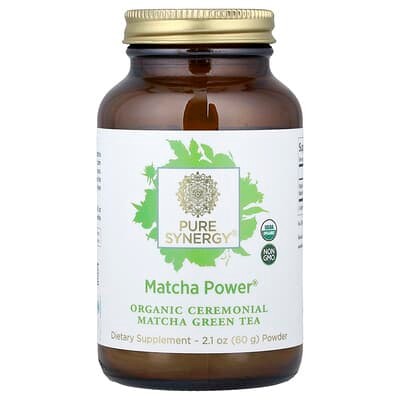
$38.00 $0.95 per serving
Product analysis
Pure Synergy Matcha Power is a single-ingredient tea powder intended to support alertness and focus, providing 1,500 mg of organic matcha per teaspoon. It is good value for the amount of tea, though the caffeine and L-theanine content are not quantified, making a specific attention effect difficult to predict.
AI assessment of the formula, label and price. How scoring works
Nutrient Quality20
Organic matcha is the sole active ingredient. The tea weight is known, but its concentration of active compounds is not, so its nutritional potency is uncertain.
Ingredient Transparency63
The amount of matcha is clearly stated. More detail about its active compound concentrations would help compare it with other teas.
Value For Money100
The matcha is competitively priced by preparation weight. That comparison cannot be used to estimate the cost of the actual EGCG content.
Customer Satisfaction70
Customers rate the powder highly, at 4.54 out of 5. The 190 ratings provide a useful indication of satisfaction.
Product Focus59
The powder is focused on one ingredient with a modest fit across several wellness uses. Its active compound concentrations are unknown, limiting the certainty of those benefits.
- Format
Powder - Container
- 2 Powder
- Per serving
- $0.95
- Customer rating
- 4.5 · 190 ratings
Goals

Impact
Highest effect
Green Tea · 1500 mg
Matcha Power has an uncertain fit for longevity. Its 1500 mg of green tea connects to antioxidant activity, but tea material and active EGCG amounts are not interchangeable.

Impact
High effect
Green Tea · 1500 mg
Matcha Power has a limited fit for broad inflammation support. Its 1,500 mg of matcha supplies green tea material, whose supplied inflammation evidence is restricted to selected marker changes. Matcha mass cannot be treated as an equivalent amount of EGCG.
Green Tea Mixed

Impact
Limited evidence
Green Tea · 1500 mg
Green Tea Supportive

Impact
Highest effect
Green Tea · 1500 mg
Matcha Power has no clearly supported direct cognitive benefit in the supplied facts. Its 1,500 mg green tea material gives it a protective-process connection through antioxidant-related compounds. That material amount does not establish a caffeine or theanine exposure for a specific attention effect.
Green Tea Supportive
Ingredients
| Ingredient | Amount per serving | Score |
|---|---|---|
organic japanese ceremonial-grade Matcha Green Tea | 1500 mg |
Green Tea · 1500 mg OverallScore44
Pure Synergy Matcha Power offers green tea with limited composition details: the serving contains 1500 mg of matcha. The matcha has no stated EGCG or polyphenol concentration. Caffeine is mentioned, but the amount is not specified. At $0.13 per 200 mg of green tea preparation, the comparison suggests good value; $0.95 per serving for the full formula. The estimate uses preparation weight, not EGCG yield.
Alternative products
Report alternatives
Sources
Published studies used for the product analysis and the top-ranked studies for each ingredient and goal.
- Safety and efficacy of cognitive training plus epigallocatechin-3-gallate in young adults with Down's syndrome (TESDAD): a double-blind, randomised, placebo-controlled, phase 2 trial.
- Association between tea consumption and risk of cognitive disorders: A dose-response meta-analysis of observational studies.
- Investigating the Impact of Tea Consumption on Cognitive Function and Exploring Tea-Genetic Interactions in Older Adults Aged 65-105 Years: Findings from the 2002-2018 CLHLS Data.
- Consumption of green tea, but not black tea or coffee, is associated with reduced risk of cognitive decline.
- Green Tea Consumption and the Risk of Incident Dementia in Elderly Japanese: The Ohsaki Cohort 2006 Study.
- The effects of green tea on acne vulgaris: A systematic review and meta-analysis of randomized clinical trials.
- Green Tea Catechin Association with Ultraviolet Radiation-Induced Erythema: A Systematic Review and Meta-Analysis.
- Efficacy of (-)-epigallocatechin gallate delivered by a new-type scaler tip during scaling and root planing on chronic periodontitis: a split-mouth, randomized clinical trial.
- Camellia Sinensis Mouthwashes in Oral Care: a Systematic Review.
- Skin photoprotection by green tea: antioxidant and immunomodulatory effects.
- Green tea and coffee intake and risk of cognitive decline in older adults: the National Institute for Longevity Sciences, Longitudinal Study of Aging.
- Associations of green tea, coffee, and soft drink consumption with longitudinal changes in leukocyte telomere length.
- Can teatime increase one's lifetime?
- Influences of tea consumption on self-rated health and life satisfaction among older adults: Evidence from the CLHLS.
- Double-blinded, placebo-controlled trial of green tea extracts in the clinical and histologic appearance of photoaging skin.
- Effect of green tea on glucose control and insulin sensitivity: a meta-analysis of 17 randomized controlled trials.
- Green tea extract ingestion, fat oxidation, and glucose tolerance in healthy humans.
- Efficacy of a green tea extract rich in catechin polyphenols and caffeine in increasing 24-h energy expenditure and fat oxidation in humans.
- A 60-Day Green Tea Extract Supplementation Counteracts the Dysfunction of Adipose Tissue in Overweight Post-Menopausal and Class I Obese Women.
- Epigallocatechin gallate alleviates non-alcoholic fatty liver disease through the inhibition of the expression and activity of Dipeptide kinase 4.