
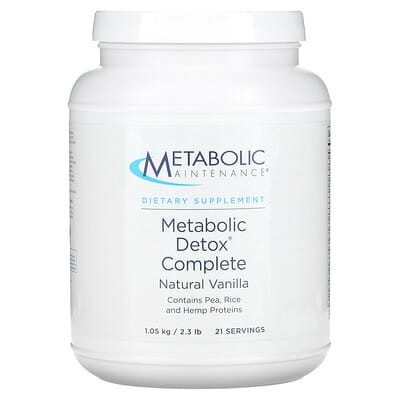
Metabolic Detox Complete Natural Vanilla

Goals
$84.00 $4.00 per serving

Product analysis
Metabolic Detox Complete Natural Vanilla supplies a broad nutrient mix that may help when intake is low, but several of its amino-acid contributions are relatively expensive.
AI assessment of the formula, label and price. How scoring works
Nutrient Quality30
Several vitamin and mineral forms are identified, while many other preparations are unspecified. Unclear proportions within some mixed forms limit a more complete comparison.
Ingredient Transparency63
Nearly all listed amounts are disclosed, but many preparations remain unspecified. Composition details for some mixed nutrients are also missing, limiting precise comparisons.
Value For Money35
Several amino acids and other ingredient contributions are relatively expensive at the full serving cost. Many remaining comparisons are uncertain, so the extensive ingredient list does not establish good value.
Customer Satisfaction72
Customer feedback is strongly positive. The relatively small review pool limits how representative that feedback may be.
Product Focus47
The formula mainly provides conditional nutritional and antioxidant support. Its very broad mix does not establish routine toxin removal or general inflammation relief, and the small choline serving adds little to the liver-related purpose.
- Format
Powder - Container
- 1 KG(s)
- Per serving
- $4.00
- Customer rating
- 4.8 · 24 ratings
Goals

Impact
Highest effect
Folate · 333 mcg DFEVitamin B12 · 25 mcgVitamin B6 · 10 mgMolybdenum · 100 mcgSelenium · 70 mcgMagnesium · 150 mgGlutamine · 1000 mgOmega-3 · 500 mgVitamin E · 133 mgZinc · 10 mgVitamin C · 500 mgCholine · 50 mgTaurine · 250 mgRiboflavin · 3 mgGlycine · 1500 mg
Folate and selenium have conditional nutritional relevance, with metal-related findings limited to exposed populations and specific preparations. Choline supports normal liver function when intake is low, but the 50 mg serving is too small to count here. Glycine and glutamine research concerns combinations or selected gut conditions rather than general toxin clearance. Silymarin and NAC's specific clinical contexts likewise do not establish routine toxin removal.
How this product is rated for Liver & Detox
Ingredient fit58
Conditional nutrient connections sit within a broad formula; choline, betaine, B12 and green tea are too low to count.
Goal fit
Conditional nutrient connections sit within a broad formula; choline, betaine, B12 and green tea are too low to count.
Dose adequacy
Thirteen ingredients qualify for saved amount recognition; several other declared amounts remain below the counting threshold.
Pathways100
Liver cell integrity and fat export lead the saved findings.
Depth
Liver cell integrity and fat export lead the saved findings.
Breadth
Liver-related processes, glutathione and conjugation, and gut binding and elimination are substantially represented.
Evidence98
Folate leads the saved evidence finding. Molybdenum, riboflavin and vitamin B6 lack the saved studied-preparation finding.
Evidence strength
Folate leads the saved evidence finding; the supplied context limits what can be concluded about routine toxin clearance.
Studied preparation
Molybdenum, riboflavin and vitamin B6 lack the saved studied-preparation finding.
Formulation logic100
All thirteen credited ingredients meet the saved amount threshold. No configured conflict was identified.
Partner coverage
Every credited ingredient works alone or has its required partner in the saved findings.
Conflicts
No configured ingredient conflict was identified in the saved findings.
Effective doses
All thirteen credited ingredients meet the saved amount threshold.
Riboflavin Not classified
No linked studies yet.
Vitamin B6 Not classified
No linked studies yet.

Impact
High effect
Vitamin D · 20 mcgGlycine · 1500 mgVitamin E · 133 mgTaurine · 250 mgVitamin C · 500 mgGreen Tea · 50 mg
Selenium and vitamins C and E support antioxidant functions, while magnesium and zinc can address nutrient gaps associated with low-grade inflammation. Those roles do not establish extra benefit with adequate intake; vitamin C’s inflammation signal was limited to elevated baseline CRP. Vitamin D has a transient inflammatory-marker finding, and glycine’s proposed signalling role lacks a transferable clinical regimen. Fish oil is present, but a usable combined EPA+DHA amount is unresolved.
How this product is rated for Inflammation
Ingredient fit51
The formula includes ingredients for other purposes, which reduces its focus on inflammation-related support. The counted amounts provide partial rather than complete exposure coverage; this is an amount comparison, not proof of benefit.
Goal fit
The formula includes ingredients for other purposes, which reduces its focus on inflammation-related support.
Dose adequacy
The counted amounts provide partial rather than complete exposure coverage; this is an amount comparison, not proof of benefit.
Pathways80
The strongest recorded connection is oxidative and mitochondrial stress, with substantial coverage in the saved comparison. Two routes reach the breadth threshold.
Depth
The strongest recorded connection is oxidative and mitochondrial stress, with substantial coverage in the saved comparison.
Breadth
Two pathways reach the saved coverage threshold; inflammatory gene signalling and oxidative stress.
Evidence96
Glycine supplies the strongest recorded evidence contribution; its assigned strength does not establish a clinical benefit. The supplied scientific context limits how these recorded contributions translate into routine clinical benefit.
Evidence strength
Glycine supplies the strongest recorded evidence contribution; its assigned strength does not establish a clinical benefit.
Studied preparation
The counted preparations match those recognized in the saved comparison; this does not establish equivalent clinical results.
Formulation logic100
Partner requirements are met and no configured conflict was recorded. The counted ingredients reach the saved amount threshold.
Partner coverage
The counted ingredients can stand alone or have the partners required by the saved comparison; no added benefit from combining them is established.
Conflicts
No configured ingredient conflict was recorded; this finding is limited to the interactions checked.
Effective doses
The counted ingredients meet the saved minimum amount threshold; that threshold is not a proven effective dose.
Ingredients
| Ingredient | Amount per serving | Score |
|---|---|---|
Calories | 165 Calorie(s) | |
Total Fat | 5 Gram(s) | |
Cholesterol | 0 mg | |
Sodium | 230 mg | |
Total Carbohydrates | 11 Gram(s) | |
Protein | 20 Gram(s) | |
Vitamin A | 1650 mcg RAE | |
Vitamin C (Calcium Ascorbate) | 500 mg | |
Vitamin D3 | 20 mcg | |
Vitamin E (D-Alpha-Tocopherol Acetate, Mixed Tocopherols) | 133 mg | |
Vitamin K (Vitamin K1, Vitamin K2) | 70 mcg | |
Thiamine (Thiamine Mononitrate) | 3 mg | |
Riboflavin (Riboflavin 5-Phosphate) | 3 mg | |
Niacin (Niacinamide) | 15 mg NE | |
Vitamin B6 (Pyridoxal 5-Phosphate) | 10 mg | |
Folate | 333 mcg DFE | |
Vitamin B12 (Methylcobalamin) | 25 mcg | |
Biotin | 150 mcg | |
Pantothenic Acid (Calcium D-Pantothenate) | 20 mg | |
Calcium (Calcium Ascorbate, Calcium Citrate) | 200 mg | |
Iron | 3 mg | |
Phosphorus | 340 mg | |
Iodine (Potassium Iodide) | 100 mcg | |
Magnesium (Magnesium Glycinate) | 150 mg | |
Zinc (Zinc Glycinate) | 10 mg | |
Selenium (L-Selenomethionine) | 70 mcg | |
Copper (Copper Glycinate) | 1 mg | |
Manganese (Manganese Glycinate) | 2 mg | |
Chromium (Chromium Niacinate) | 70 mcg | |
Molybdenum (Molybdenum Glycinate) | 100 mcg | |
Potassium (Potassium Citrate) | 190 mg | |
Choline (Choline Bitartrate) | 50 mg | |
Boron (Boron Citrate) | 500 mcg | |
Vanadium (Vanadyl Sulfate) | 100 mcg | |
Inositol | 50 mg | |
Flaxseed | 2000 mg | |
Medium Chain Triglyceride | 3000 mg | |
Omega-3 Fatty Acids | 500 mg | |
Inulin | 2000 mg | |
Glycine | 1500 mg | |
L-Glutamine | 1000 mg | |
L-Lysine (L-Lysine Hydrochloride) | 250 mg | |
Taurine | 250 mg | |
N-Acetyl Cysteine | 250 mg | |
L-Methionine | 100 mg | |
L-Tyrosine | 100 mg | |
Methylsulfonylmethane | 100 mg | |
Silymarin (Milk Thistle seed extract) | 100 mg | |
Trimethylglycine | 200 mg | |
Calcium D-Glucarate | 100 mg | |
Green Tea Leaf Extract | 50 mg |
Flax · 2000 mg OverallScore40
Each serving lists 2,000 mg of flax, but its preparation is not identified in the saved facts. A whole-product serving costs about $4.00.
How this ingredient is rated
Composition and Label Disclosure
No separate rule is evaluated in this group.
Composition and Label Disclosure60
A serving lists 2,000 mg of flax. The saved facts do not identify the flax preparation.
Amount and Label Disclosure
A serving lists 2,000 mg of flax. The saved facts do not identify the flax preparation.
Commercial Price and Usability0
A whole-product serving costs about $4.00.
Commercial Price per Labeled Serving
A whole-product serving costs about $4.00.
Glutamine · 1000 mg OverallScore59
A serving provides 1 g of L-glutamine. Allocating the whole-product price to that amount works out to about $4.00 per gram.
How this ingredient is rated
Active Ingredient Quality & Bioavailability70
The identified form is L-glutamine; no specific grade is recorded in the available facts.
Glutamine Grade & Purity
L-glutamine is the named form, with no specific grade recorded in the saved facts.
Dose, Safety & Label Transparency70
The serving individually declares 1 g of L-glutamine.
Therapeutic Dosage Strength
Each serving provides 1 g of L-glutamine.
Label Transparency & Blends
The L-glutamine amount is individually stated as 1 g per serving.
Value15
Allocating the whole-product price to the L-glutamine amount gives about $4.00 per gram; a whole-product serving costs about $4.00.
Price per Gram of L-Glutamine
The $4.00 per gram estimate attributes the entire whole-product cost to the declared L-glutamine.
Vanadium (Vanadyl Sulfate) · 100 mcg OverallScore75
Each serving lists 100 mcg of vanadium as vanadyl sulfate. A whole-product serving costs about $4.00.
How this ingredient is rated
Active Ingredient Quality & Bioavailability77
The vanadium is listed as vanadyl sulfate. A GMP manufacturing claim is recorded; independent purity testing is not established.
Vanadium Form Quality
The listed vanadium form is vanadyl sulfate.
Manufacturing & Purity Signals
A GMP manufacturing claim is recorded, but independent purity testing is not established in the saved facts.
Dose, Safety & Label Transparency100
The label lists 100 mcg of vanadium per serving, aligned with the evaluation's supplemental target.
Dose Efficacy & Safety Balance
100 mcg per serving is aligned with the evaluation's supplemental target.
Elemental Weight Transparency
The label lists 100 mcg of vanadium per serving.
Value20
A whole-product serving costs about $4.00.
Price Per Serving Efficiency
A whole-product serving costs about $4.00.
Alternative products
Report alternatives
Sources
Published studies used for the product analysis and the top-ranked studies for each ingredient and goal.
- Dose-dependent effects of fish oil on cardio-metabolic biomarkers in healthy middle-aged and elderly Chinese people: a double-blind randomized controlled trial.
- Eicosapentaenoic acid supplementation alleviates pruritus, enhances skin moisture, and mitigates depression in maintenance hemodialysis patients.
- Lowering effects of fish oil supplementation on proinflammatory markers in hypertension: results from a randomized controlled trial.
- The effects of ω-3 fish oil emulsion-based parenteral nutrition plus combination treatment for acute paraquat poisoning.
- Effects of Omega-3 Fatty Acid Intake in Patients Undergoing Dialysis: A Systematic Review and Meta-Analysis of Randomized Controlled Trials.
- Comparisons of the effects of different flaxseed products consumption on lipid profiles, inflammatory cytokines and anthropometric indices in patients with dyslipidemia related diseases: systematic review and a dose-response meta-analysis of randomized controlled trials.
- The effects of n-3 fatty acids from flaxseed oil on genetic and metabolic profiles in patients with gestational diabetes mellitus: a randomised, double-blind, placebo-controlled trial.
- Effect of flaxseed consumption on flow-mediated dilation and inflammatory biomarkers in patients with coronary artery disease: a randomized controlled trial.
- A comparison between the effects of flaxseed oil and fish oil supplementation on cardiovascular health in type 2 diabetic patients with coronary heart disease: A randomized, double-blinded, placebo-controlled trial.
- Effect of flaxseed oil on serum systemic and vascular inflammation markers and oxidative stress in hemodialysis patients: a randomized controlled trial.
- Glycine treatment decreases proinflammatory cytokines and increases interferon-gamma in patients with type 2 diabetes.
- Effect of oral glycine on the clinical, spirometric and inflammatory status in subjects with cystic fibrosis: a pilot randomized trial.
- Subgingival air polishing (glycine powder) versus minocycline hydrochloride: efficacy in residual periodontal pockets following endoscope-assisted scaling and root planing.
- Long-term Implant Maintenance: A Systematic Review of Home and Professional Care Strategies in Supportive Implant Therapy.
- Analysis of the factors influencing the occurrence of peri-implantitis in patients with implant-supported restoration and study on the maintenance effect of subgingival sandblasting.
- The effects of green tea on acne vulgaris: A systematic review and meta-analysis of randomized clinical trials.
- Green Tea Catechin Association with Ultraviolet Radiation-Induced Erythema: A Systematic Review and Meta-Analysis.
- Efficacy of (-)-epigallocatechin gallate delivered by a new-type scaler tip during scaling and root planing on chronic periodontitis: a split-mouth, randomized clinical trial.
- Camellia Sinensis Mouthwashes in Oral Care: a Systematic Review.
- Skin photoprotection by green tea: antioxidant and immunomodulatory effects.