
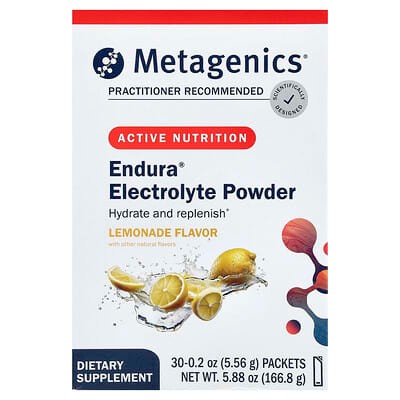

$49.95 $1.66 per serving


Product analysis
Endura Lemonade Flavor can help replace electrolytes lost in sweat, with usefulness depending on exercise duration and conditions. Added taurine has limited support for endurance benefits, so electrolyte replacement is the clearer reason to choose it.
AI assessment of the formula, label and price. How scoring works
Nutrient Quality38
B5 and chromium use favorable named forms, while chloride and potassium use ordinary mineral salts. The quality of many other ingredients remains uncertain, and several preparation details are missing.
Ingredient Transparency88
Ingredient quantities and most preparations are disclosed, helping compare the selected serving. Several added ingredients remain unspecified, including taurine and L-alanyl-glutamine.
Value For Money40
Potassium has favorable value, but several other contributions are costly at the full serving price. Missing comparisons for much of the mixture leave the value of the complete electrolyte blend uncertain.
Customer Satisfaction74
Customer ratings are strongly favorable. The small review base gives only a limited picture of the range of customer experiences.
Product Focus40
Sweat-related electrolyte replacement is the clearest practical use. Numerous added nutrients broaden the mixture, while the taurine contribution offers only limited support for endurance beyond that role.
- Format
Powder - Container
- 5 Ounce(s)
- Per serving
- $1.66
- Customer rating
- 4.9 · 71 ratings
Goals

Impact
Moderate effect
Magnesium · 150 mg
Sodium, chloride and potassium contribute to replacing electrolytes lost in sweat, with usefulness depending on exercise duration, conditions and fluid intake. Magnesium supports normal muscle function when intake is inadequate.
Taurine at 500 mg has a limited endurance connection, based on small, event-specific exercise findings; it does not support a broad promise of greater strength or recovery.
How this product is rated for Fitness
Ingredient fit45
The relevant ingredients provide a partial connection to fitness.
Goal fit
Many other actives serve different goals, limiting focus on fitness.
Dose adequacy
The relevant ingredients provide partial amount coverage.
Pathways12
The saved coverage is concentrated in muscle energy and buffering.
Depth
muscle energy and buffering is the strongest area.
Breadth
No area reaches substantial coverage.
Evidence70
The evidence contribution depends on the ingredient and exercise context.
Evidence strength
Magnesium supplies the strongest saved evidence contribution.
Studied preparation
The saved preparation check is satisfied.
Formulation logic100
The saved partner and conflict checks are satisfied, with the amount findings noted below.
Partner coverage
No required partner is missing.
Conflicts
No configured ingredient conflict was found.
Effective doses
All relevant ingredients meet the saved minimum amount comparison.

Impact
Moderate effect
Magnesium · 150 mgTaurine · 500 mg
Vitamin C supports collagen formation and vitamin E contributes to antioxidant defenses, while magnesium supports normal energy metabolism. Taurine is an aging-related research candidate, but animal lifespan findings have not established human lifespan benefits.
The 500 mg taurine amount and these nutrient functions provide a limited, qualified connection to maintaining function with age.
How this product is rated for Longevity
Ingredient fit45
Relevant ingredients share the formula with ingredients aimed at other purposes. The amounts assessed provide a partial match to the saved comparison levels.
Goal fit
Relevant ingredients share the formula with ingredients aimed at other purposes.
Dose adequacy
The amounts assessed provide a partial match to the saved comparison levels.
Pathways19
The strongest connection is antioxidant defence, with limited coverage. Coverage does not reach the saved threshold across direct aging-related mechanisms.
Depth
The strongest connection is antioxidant defence, with limited coverage.
Breadth
Coverage does not reach the saved threshold across direct aging-related mechanisms.
Evidence100
Magnesium provides the strongest evidence connection among ingredients counted at relevant amounts, meeting the saved framework's top comparison. The ingredients counted at relevant amounts match the preparations accepted in the saved findings.
Evidence strength
Magnesium provides the strongest evidence connection among ingredients counted at relevant amounts, meeting the saved framework's top comparison.
Studied preparation
The ingredients counted at relevant amounts match the preparations accepted in the saved findings.
Formulation logic100
The assessed ingredients can work alone or have their relevant partner present. No ingredient conflict was found in the supplied checks. All ingredients counted in this check meet its minimum amount threshold.
Partner coverage
The assessed ingredients can work alone or have their relevant partner present.
Conflicts
No ingredient conflict was found in the supplied checks.
Effective doses
All ingredients counted in this check meet its minimum amount threshold.

Impact
Moderate effect
Vitamin E · 20.1 mgTaurine · 500 mgVitamin C · 120 mg
Magnesium may help reduce low-grade inflammation when low levels of this mineral contribute to it. This is a benefit of correcting inadequate nutrient status; taking extra when you already get enough has no clear added anti-inflammatory benefit.
How this product is rated for Inflammation
Ingredient fit40
Magnesium may help reduce low-grade inflammation when low levels of this mineral contribute to it.
Goal fit
Magnesium may help reduce low-grade inflammation when low levels of this mineral contribute to it.
Dose adequacy
Taurine: 500 mg; Vitamin C: 120 mg; Vitamin E: 20.1 mg; Magnesium: 150 mg per selected label serving; these quantities do not by themselves prove symptom relief.
Pathways17
The main connection concerns inflammatory markers or oxidative stress, rather than a demonstrated broad clinical benefit.
Depth
The main connection concerns inflammatory markers or oxidative stress, rather than a demonstrated broad clinical benefit.
Breadth
A connection with one inflammatory process does not demonstrate effects across several different processes.
Evidence87
Magnesium may help reduce low-grade inflammation when low levels of this mineral contribute to it.
Evidence strength
Magnesium may help reduce low-grade inflammation when low levels of this mineral contribute to it.
Studied preparation
The relevant material can be matched, but that alone does not show an everyday clinical benefit.
Formulation logic100
No particular ingredient conflict is identified.
Partner coverage
No additional ingredient partner is required for the roles described here.
Conflicts
No particular ingredient conflict is identified.
Effective doses
Taurine: 500 mg; Vitamin C: 120 mg; Vitamin E: 20.1 mg; Magnesium: 150 mg per selected label serving; these quantities do not by themselves prove symptom relief.

Impact
High effect
Potassium · 100 mgMagnesium · 150 mgVitamin B6 · 5 mgVitamin E · 20.1 mgTaurine · 500 mgNiacin · 10 mgVitamin C · 120 mg
Taurine, potassium and magnesium relate to blood-pressure regulation, but the supplied research depends on baseline blood pressure or mineral intake. Taurine's 500 mg per serving is below the 1.6 g daily exposure studied in prehypertension, and the mineral amounts are also partial exposures. Thiamin can correct a deficiency that impairs heart function, without established extra cardiovascular benefit when intake is adequate. The declared sodium does not trigger the saved high-sodium finding.
How this product is rated for Cardiovascular Support
Ingredient fit51
Taurine and the minerals provide the goal connection. The taurine and mineral quantities provide partial exposure compared with the supplied studies.
Goal fit
The relevant nutrients sit within a broader formula containing ingredients aimed at other goals.
Dose adequacy
The taurine and mineral quantities provide partial exposure compared with the supplied studies.
Pathways56
Vascular tone and mineral balance dominate, with a smaller homocysteine contribution. Only one pathway reaches the saved coverage benchmark, so support remains focused.
Depth
Vascular tone and mineral balance dominate, with a smaller homocysteine contribution.
Breadth
Only one pathway reaches the saved coverage benchmark, so support remains focused.
Evidence88
Taurine supplies the strongest saved evidence finding, based on a narrow prehypertension population.
Evidence strength
Taurine supplies the strongest saved evidence finding, based on a narrow prehypertension population.
Studied preparation
The saved finding accepts the counted preparations at qualifying amounts; this does not establish that the complete product was studied.
Formulation logic100
No missing required partner or configured conflict was found. All ingredients counted for this finding meet its saved amount threshold; this is not proof of clinical effectiveness.
Partner coverage
The counted ingredients do not lack a required partner under the saved finding; no added combination benefit is established.
Conflicts
No configured ingredient conflict was triggered in the supplied facts.
Effective doses
All ingredients counted for this finding meet its saved amount threshold; this is not proof of clinical effectiveness.

Impact
Moderate effect
Vitamin B6 · 5 mgMagnesium · 150 mgVitamin E · 20.1 mgVitamin C · 120 mgTaurine · 500 mgRiboflavin · 5 mg
Taurine relates to bile-acid conjugation, and vitamins C and E contribute antioxidant functions. Riboflavin, B6 and magnesium support normal metabolism, but these functions do not establish routine toxin clearance.
How this product is rated for Liver & Detox
Ingredient fit46
The ingredients span several purposes, with only part of the selection focused on liver support. The assessed amounts provide partial alignment with the saved ingredient comparisons.
Goal fit
The ingredients span several purposes, with only part of the selection focused on liver support.
Dose adequacy
The assessed amounts provide partial alignment with the saved ingredient comparisons.
Pathways42
The strongest saved coverage relates to glutathione and conjugation. One reviewed mechanism reaches the saved coverage threshold.
Depth
The strongest saved coverage relates to glutathione and conjugation.
Breadth
One reviewed mechanism reaches the saved coverage threshold.
Evidence87
Magnesium provides the strongest saved ingredient finding; the evidence remains specific to its reviewed context. Only part of the assessed ingredient selection matches the preparations in the saved comparisons.
Evidence strength
Magnesium provides the strongest saved ingredient finding; the evidence remains specific to its reviewed context.
Studied preparation
Only part of the assessed ingredient selection matches the preparations in the saved comparisons.
Formulation logic100
No missing required ingredient partner was identified. No configured conflict was identified in the saved findings. All ingredients assessed for amounts reach the saved minimum comparison level.
Partner coverage
No missing required ingredient partner was identified.
Conflicts
No configured conflict was identified in the saved findings.
Effective doses
All ingredients assessed for amounts reach the saved minimum comparison level.
Riboflavin Not classified
No linked studies yet.
Vitamin B6 Not classified
No linked studies yet.

Impact
High effect
Magnesium · 150 mgVitamin B6 · 5 mgTaurine · 500 mg
Taurine may support blood-pressure and vascular measures, with the described trial limited to people with prehypertension. Its 500 mg serving is below that trial's 1.6 g daily regimen. Magnesium and potassium add nutritional blood-pressure-related support, although magnesium results are inconsistent and potassium effects depend on starting intake and blood pressure. The B-vitamin findings do not establish prevention through homocysteine lowering.
How this product is rated for Heart Health
Ingredient fit48
The counted ingredients make differing amount contributions; the serving does not automatically establish the daily exposure used in studies.
Goal fit
Heart-related ingredients share the formula with actives serving other goals, reducing its focus on this goal.
Dose adequacy
The counted ingredients make differing amount contributions; the serving does not automatically establish the daily exposure used in studies.
Pathways52
The saved contribution is concentrated in electrolyte balance and vascular tone.
Depth
The saved contribution is concentrated in electrolyte balance and vascular tone.
Breadth
Only electrolyte balance and vascular tone reach the saved breadth threshold.
Evidence94
Taurine leads the evidence finding, based on blood-pressure and vascular changes in a selected prehypertensive population.
Evidence strength
Taurine leads the evidence finding, based on blood-pressure and vascular changes in a selected prehypertensive population.
Studied preparation
The saved finding accepts the counted declarations; specific nutrient forms do not establish superior cardiovascular outcomes.
Formulation logic100
The counted ingredients have no missing partner requirement or identified conflict. Their amounts meet the saved minimum counting criterion.
Partner coverage
The counted ingredients have no unmet partner requirement in the supplied findings.
Conflicts
No matched ingredient conflict was identified in the supplied findings.
Effective doses
All counted ingredients meet the saved minimum amount criterion, which is not a proven threshold for cardiovascular benefit.
Ingredients
| Ingredient | Amount per serving | Score |
|---|---|---|
Calories | 10 Calorie(s) | |
Total Carbohydrates | 2 Gram(s) | |
Vitamin C (Ascorbic Acid) | 120 mg | |
Vitamin E (D-Alpha-Tocopheryl Acetate) | 20.1 mg | |
Thiamine (Thiamine Mononitrate) | 2 mg | |
Riboflavin | 5 mg | |
Niacin (Niacinamide) | 10 mg | |
Vitamin B6 (Pyridoxine Hydrochloride) | 5 mg | |
Pantothenic Acid (Calcium D-Pantothenate) | 28 mg | |
Calcium (Calcium Citrate) | 50 mg | |
Phosphorous (Dipotassium Phosphate) | 20 mg | |
Magnesium (Magnesium Bis-Glycinate) | 150 mg | |
Chromium (Chromium Picolinate) | 83 mcg | |
Chloride (Sodium Chloride) | 270 mg | |
Sodium (Sodium Chloride) | 180 mg | |
Potassium (Dipotassium Phosphate) | 100 mg | |
Malic Acid | 500 mg | |
Taurine | 500 mg | |
L-Alanyl-L-Glutamine | 150 mg |
Chloride (Sodium Chloride) · 270 mg OverallScore60
A serving lists 270 mg of chloride from sodium chloride. A whole-product serving costs about $1.67.
How this ingredient is rated
Active Ingredient Quality & Bioavailability50
The named chloride source is sodium chloride.
Chloride source quality
The named chloride source is sodium chloride.
Dose, Safety & Label Transparency90
The listed serving provides 270 mg of chloride. The chloride amount and its source are identified.
Chloride amount per serving
The listed chloride amount is 270 mg per serving.
Amount and source disclosure
The chloride amount and its source are identified.
Value20
A whole-product serving costs about $1.67.
Price per serving
A whole-product serving costs about $1.67.
Sodium (Sodium Chloride) · 180 mg OverallScore66
A serving provides 180 mg of sodium from sodium chloride, a relatively small amount for replacing sodium lost through sweat. Potassium and magnesium amounts are also individually stated.
How this ingredient is rated
Active Ingredient Quality & Bioavailability75
The identified sodium source is sodium chloride. A supporting electrolyte form is assessed favorably for absorption.
Sodium Source Purity & Quality
The identified sodium source is sodium chloride.
Bioavailability of Supporting Electrolytes
A supporting electrolyte form is assessed as having favorable absorption potential.
Trace Mineral Complex & Buffering Forms
No qualifying trace-mineral complex or buffering form is recorded in the saved facts.
Dose, Safety & Label Transparency65
The serving supplies 180 mg of sodium, a small amount for athletic sweat replacement.
Sodium Dosage for Athletic Replenishment
At 180 mg per serving, the sodium amount is small for replacing sweat losses during intense activity.
Ingredient Label Transparency
Sodium is individually stated as 180 mg per serving; potassium is 100 mg; magnesium is 150 mg.
Artificial Color and Sweetener Disclosure
No artificial color or sweetener is recorded in the available ingredient information.
Value50
A whole-product serving costs about $1.67; that price covers all ingredients, not just sodium.
Price Per Serving vs. Collection Median
The whole-product price is about $1.67 per serving.
Vitamin B5 (Calcium D-Pantothenate) · 28 mg OverallScore61
28 mg of vitamin B5 per serving is costly for the amount provided. The B5 source is Calcium D-Pantothenate.
How this ingredient is rated
Active Ingredient Quality & Bioavailability90
The B5 source is Calcium D-Pantothenate.
Vitamin B5 Chemical Form
Calcium pantothenate is a stable, well-absorbed salt form.
Dose, Safety & Label Transparency52
The serving provides 28 mg of vitamin B5. The amount and Calcium D-Pantothenate source are stated.
Dosage Potency and Efficacy
The serving provides 28 mg of vitamin B5.
Label Transparency & Source Clarity
The amount and Calcium D-Pantothenate source are stated.
Value20
The cost is high for the amount of B5 provided.
Price per 500mg Vitamin B5
The cost is high for the amount of B5 provided.
Alternative products
Report alternatives
Sources
Published studies used for the product analysis and the top-ranked studies for each ingredient and goal.
- Circulating and dietary magnesium and risk of cardiovascular disease: a systematic review and meta-analysis of prospective studies.
- Magnesium and the risk of cardiovascular events: a meta-analysis of prospective cohort studies.
- Quantitative Association Between Serum/Dietary Magnesium and Cardiovascular Disease/Coronary Heart Disease Risk: A Dose-Response Meta-analysis of Prospective Cohort Studies.
- Comparative Efficacy of Nutraceuticals on Endothelial Function: A Systematic Review and Network Meta-Analysis.
- Serum magnesium, mortality, and cardiovascular disease in chronic kidney disease and end-stage renal disease patients: a systematic review and meta-analysis.
- The current state of niacin in cardiovascular disease prevention: a systematic review and meta-regression.
- Effects of niacin on apo A1 and B levels: a systematic review and meta-analysis of randomised controlled trials.
- Effect of lipid-lowering therapies on lipoprotein(a) levels: a comprehensive meta-analysis of randomized controlled trials.
- Extended-release niacin vs gemfibrozil for the treatment of low levels of high-density lipoprotein cholesterol. Niaspan-Gemfibrozil Study Group.
- Equivalent efficacy of a time-release form of niacin (Niaspan) given once-a-night versus plain niacin in the management of hyperlipidemia.
- Sex-specific associations between sodium and potassium intake and overall and cause-specific mortality: a large prospective U.S. cohort study, systematic review, and updated meta-analysis of cohort studies.
- Potassium intake, stroke, and cardiovascular disease a meta-analysis of prospective studies.
- Blood pressure response to changes in sodium and potassium intake: a metaregression analysis of randomised trials.
- Twenty-Four-Hour Urinary Sodium and Potassium Excretion and Their Associations With Blood Pressure Among Adults in China: Baseline Survey of Action on Salt China.
- Dietary Sodium and Potassium Intake and Risk of Non-Fatal Cardiovascular Diseases: The Million Veteran Program.
- Taurine Supplementation Lowers Blood Pressure and Improves Vascular Function in Prehypertension: Randomized, Double-Blind, Placebo-Controlled Study.
- Taurine ameliorates blood pressure and vascular function in patients with type 2 diabetes: Randomized, double-blind, placebo-controlled trial.
- Taurine reduces the risk for metabolic syndrome: a systematic review and meta-analysis of randomized controlled trials.
- Effects of Oral Taurine Supplementation on Cardiometabolic Risk Factors: A Meta-analysis and Systematic Review of Randomized Clinical Trials.
- The effects of taurine supplementation on glycemic control and serum lipid profile in patients with type 2 diabetes: a randomized, double-blind, placebo-controlled trial.