




Vitamin D Supportive
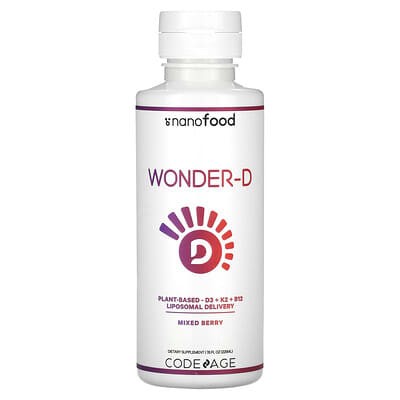
$29.99 $0.66 per serving
Product analysis
Codeage Nanofood Wonder-D Mixed Berry is a liquid vitamin supplement for bone nutrition, with 25 mcg of D3, 120 mcg of MK-7 vitamin K2 and 2.4 mcg of B12 per 5 mL. D3 supports calcium use while K2 helps activate bone proteins; the formula is fairly priced for the combination, but does not supply the bone minerals themselves.
AI assessment of the formula, label and price. How scoring works
Nutrient Quality73
D3 and MK-7 are well-regarded forms of vitamin D and K. The other vitamin and blend are less fully characterized, so their quality is harder to establish.
Ingredient Transparency56
The three vitamin doses and their forms are clearly stated. The liposomal mixture is not fully broken down, limiting how well buyers can assess what is in it.
Value For Money52
The formula is close to average value for its D3 and fairly priced for the MK-7 supplied. Value for the other components is uncertain.
Customer Satisfaction75
Customers have rated the liquid very favorably, averaging 4.83 out of 5. The 149 ratings give a useful sample of buyer feedback.
Product Focus39
The vitamins have complementary roles in bone and mineral nutrition, with immune and narrower cardiovascular uses. The blend is not fully broken down, so the complete active ingredient count and focus remain uncertain.
- Format
Liquid - Container
- 7 Fluid Ounce(s)
- Per serving
- $0.66
- Also available
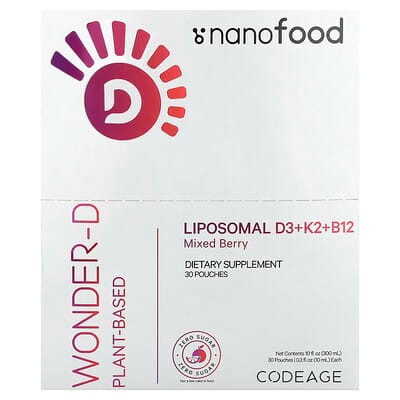 Wonder-D Liposomal D3+K2+B12 Mixed Berry$39.99
- Customer rating
- 4.8 · 149 ratings
Goals

Impact
High effect
Vitamin B12 · 2.4 mcgVitamin K · 120 mcgVitamin D · 25 mcg
Wonder-D Mixed Berry is a focused nutrient supplement with a limited longevity connection. Its 25 mcg of vitamin D can support muscle function when deficiency is present. The 120 mcg of MK-7 vitamin K2 adds a narrower arterial-flexibility link, but its specific preparation is not identified. Vitamin B12 at 2.4 mcg is a nutritional addition whose functional value depends on filling a dietary gap.
Vitamin K Supportive
Vitamin B12 No effect

Impact
Highest effect
Vitamin K · 120 mcgVitamin D · 25 mcg
Wonder-D Mixed Berry is a focused vitamin combination for calcium use and bone-protein activity. Its 25 mcg of vitamin D3 supports calcium absorption, while 120 mcg of MK-7 supports activation of bone proteins. The formula supplies no calcium or magnesium, so its practical role is vitamin support rather than adding bone minerals.
Vitamin D Supportive
Vitamin K Supportive
Vitamin B12 No effect

Impact
High effect
Vitamin B12 · 2.4 mcgVitamin D · 25 mcgVitamin K · 120 mcg
Wonder-D Mixed Berry is a focused option for everyday bone and mineral nutrition, especially when dietary intake leaves a gap. Its 25 mcg of vitamin D and 120 mcg of vitamin K2 supply nutrients with complementary roles in bone and mineral metabolism. Vitamin K provides the larger contribution in the supplied assessment, while vitamin D adds useful nutritional support.
Vitamin D Supportive
Vitamin B12 Adverse
Vitamin K Supportive

Impact
High effect
Vitamin K · 120 mcgVitamin D · 25 mcgVitamin B12 · 2.4 mcg
Wonder-D Mixed Berry has a narrow cardiovascular fit, mainly through 120 mcg MK-7 vitamin K2 and its limited support for arterial-stiffness measures. The 25 mcg vitamin D3 adds nutritional coverage, with cardiovascular relevance mainly tied to clinically indicated deficiency correction.
Vitamin D Mixed
Vitamin K Supportive
Vitamin B12 No effect
Impact
High effect
Vitamin K · 120 mcgVitamin B12 · 2.4 mcgVitamin D · 25 mcg
Wonder-D Mixed Berry offers a narrow heart-health fit through MK-7 vitamin K2. The 120 mcg serving is relevant to arterial stiffness, although the supplied evidence supports only limited cardiovascular benefit.
Vitamin D Mixed
Vitamin K Mixed
Vitamin B12 No effect
Ingredients
| Ingredient | Amount per serving | Score |
|---|---|---|
Calories | 12 Calorie(s) | |
Total Fat | 0 Gram(s) | |
Total Carbohydrates | 3 Gram(s) | |
Vitamin D3 (Cholecalciferol) | 25 mcg | |
Vitamin K2 (Menaquinone-7) | 120 mcg | |
Vitamin B12 (Methylcobalamin) | 2.4 mcg | |
Liposomal Proprietary Blend | 1500 mg |
Vitamin K (Menaquinone-7) · 120 mcg OverallScore86
Codeage Nanofood Wonder-D Mixed Berry offers a clearly labeled MK-7 form, with 120 mcg of vitamin K per serving. The isomer is not specified as trans or all-trans. Vitamin K is moderately priced at $0.44 per 80 mcg of vitamin K; the full formula costs $0.67 per serving.
Alternative products
Report alternatives
Sources
Published studies used for the product analysis and the top-ranked studies for each ingredient and goal.
- Effect of Vitamin B12 and Folic Acid Supplementation on Bone Mineral Density and Quantitative Ultrasound Parameters in Older People with an Elevated Plasma Homocysteine Level: B-PROOF, a Randomized Controlled Trial.
- Plasma B vitamins, homocysteine, and their relation with bone loss and hip fracture in elderly men and women.
- Relation between homocysteine and B-vitamin status indicators and bone mineral density in older Americans.
- The role of B-vitamin intake, B-vitamin-rich dietary patterns, the B-vitamin deficiency index in bone mineral density among school-aged children.
- Hyperhomocysteinemia is Associated with Inflammation, Bone Resorption, Vitamin B12 and Folate Deficiency and MTHFR C677T Polymorphism in Postmenopausal Women with Decreased Bone Mineral Density.
- Pregnancy vitamin D supplementation and offspring bone mineral density in childhood follow-up of a randomized controlled trial.
- Vitamin D analogs and bone: preclinical and clinical studies with eldecalcitol.
- Efficacy of vitamin D fortified foods on bone mineral density and serum bone biomarkers: A systematic review and meta-analysis of interventional studies.
- Cholecalciferol Supplementation Attenuates Bone Loss in Incident Kidney Transplant Recipients: A Prespecified Secondary Endpoint Analysis of a Randomized Controlled Trial.
- Vitamin D supplementation and bone health in post-menopausal women: a 24-month randomized controlled intervention with enhanced bioavailability formulations.
- Vitamin K and the prevention of fractures: systematic review and meta-analysis of randomized controlled trials.
- Three-year low-dose menaquinone-7 supplementation helps decrease bone loss in healthy postmenopausal women.
- Effect of combined administration of vitamin D3 and vitamin K2 on bone mineral density of the lumbar spine in postmenopausal women with osteoporosis.
- Efficacy and safety of vitamin K2 for postmenopausal women with osteoporosis at a long-term follow-up: meta-analysis and systematic review.
- Low-dose vitamin K2 (MK-4) supplementation for 12 months improves bone metabolism and prevents forearm bone loss in postmenopausal Japanese women.
- Vitamin B12 Status and Cardiovascular Risk: Novel Insights from NMR-Based Lipoprotein Profiling in 20,665 Adults.
- Pregnancy Metal Mixtures and Blood Pressure and Hypertension in Mid-Life: A Prospective U.S. Cohort Study.
- Vitamin B12 Deficiency, Hyperhomocysteinemia, and Diabetes as Metabolic Determinants of Cardiovascular Risk in Mexican Women.
- Impact of serum vitamin (Vitamin D, Vitamin B12) and trace element (Fe, Zn, Cu) levels on major adverse cardiovascular events and poor prognosis in STEMI patients undergoing primary PCI.
- Vasoplegic syndrome after cardiovascular surgery: A review of pathophysiology and outcome-oriented therapeutic management.