Product Image

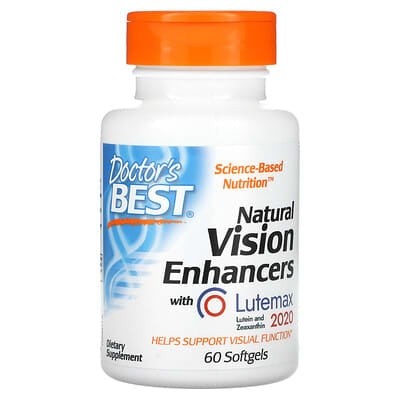
Natural Vision Enhancers

Doctor's Best
4.7
★ ★ ★ ★ ★
(6164 ratings)
Omega-3 285 mg
Fish Oil 500 mg
DHA 200 mg
EPA (Eicosapentaenoic Acid) 45 mg
Product Image
Score73
A well-targeted lutein-zeaxanthin eye formula with added DHA, but not a strong choice for broad omega-3 supplementation.
How scoring works
Quantity:60 Softgel(s) • (30 servings)
Goals:
Cardiovascular Support

Score 73

A well-targeted lutein-zeaxanthin eye formula with added DHA, but not a strong choice for broad omega-3 supplementation.
How scoring works
$15.99($0.53 per serving)
Vitacost
$ 17.59
Vitacost
$ 17.59
Pure Formulas
$ 28.71
iHerb
$ 15.99
iHerb
$ 15.99
Report prices

Analysis

Lutein at 20 mg and zeaxanthin at 4 mg provide focused macular pigment support, while 200 mg DHA contributes to retinal structure. The low 45 mg EPA amount makes the formula less relevant for cardiovascular or anti-inflammatory goals.

Named FloraGLO lutein and Optisharp zeaxanthin improve ingredient identification, and the fish oil is described as triglycerides. Independent purity results, source species, antioxidant protection, and the complete inactive-ingredient list are not supplied.

The formula best fits adults specifically seeking eye-focused carotenoids with a modest DHA addition. Anyone mainly shopping for omega-3 strength can find a much more concentrated fish oil.

Who is it for
  • Adults seeking macular carotenoids with DHA
  • People focused primarily on visual support
Best for
  • Lutein and zeaxanthin intake
  • Eye-focused rather than general omega-3 use

Pros

  • 20 mg lutein and 4 mg zeaxanthin
  • DHA-led triglyceride fish oil
  • Carotenoid ingredient sources are named

Cons

  • Only 285 mg total omega-3s
  • EPA amount is very low
  • Fish-oil purity and oxidation safeguards are not disclosed

Warnings

  • Avoid with a fish allergy because the formula contains fish oil
  • The softgel format may not suit people who have difficulty swallowing capsules
  • Do not treat the added DHA as a substitute for a high-strength omega-3 serving

Nutrient quality

83 Highest impact

Triglyceride oil and well-dosed eye carotenoids provide good form quality. Modest EPA and DHA limit alignment with cardiovascular use.

Ingredient transparency

71 High impact

Core fatty-acid quantities are visible and no proprietary blend hides the formula. Malformed entries, missing full directions, and undisclosed excipients substantially reduce clarity.

Customer satisfaction

72 High impact

The supplied average rating is very strong and the rating volume is substantial. No specific experience details were provided to judge repeated complaints or purpose alignment.

Value for money

63 Moderate impact

Quality, dose, or safety limitations weaken practical value. Better-dosed or safer alternatives are more competitive.

Report analysis

Goals

Cardiovascular Support
Impact
Moderate effect
B- Goal FitC+ Strength of SupportD CoverageC- Formula Quality
Fish Oil · 500 mg

EPA and DHA provide some cardiovascular relevance through lipid and inflammatory pathways. Lutein and zeaxanthin dominate the product’s purpose and are designed for vision rather than heart support.

The triglyceride form and separate fatty-acid amounts are clearly disclosed, but the active omega dose is modest. Fish oil may increase bruising or bleeding tendency when combined with anticoagulant or antiplatelet medicines.

Study evidence
Fish Oil Supportive 185 studies

Ingredients

IngredientAmount per serving
Calories
5 Calorie(s)
Total Fat
1 Gram(s)
Cholesterol
3 mg
Fish Oil Concentrate
500 mg
Total Omega-3 Fatty Acids
285 mg
Docosahexaenoic Acid
200 mg
Eicosapentaenoic Acid
45 mg
Lutein
20 mg
Zeaxanthin
4 mg
Gluten Free Adults 18–50
Report overview
Omega-3 · 285 mg OverallScore55
B- Active Ingredient Quality & BioavailabilityC- Dose, Safety & Label TransparencyF Value

The triglyceride fish-oil form supports good absorption, and EPA and DHA amounts are clearly separated. However, EPA and DHA make up less than half of the stated oil, while the fish source, antioxidant protection, and independent purity testing are not disclosed. The cost per amount of active EPA and DHA is relatively high, so the formula is better viewed as an eye-nutrient blend than a concentrated omega-3 option.

Fish Oil · 500 mg OverallScore36
D- Active Ingredient Quality & BioavailabilityF Dose, Safety & Label TransparencyF Value

The triglyceride form supports good absorption, but the label gives no purification method or independent quality verification. The combined EPA and DHA amount is too low for the fish-oil target despite clear individual disclosure and a moderate concentration. Cost efficiency is weak because each serving supplies little active omega-3.

DHA · 200 mg OverallScore32
D+ Active Ingredient Quality & BioavailabilityF Dose, Safety & Label TransparencyF Value

The triglyceride fish oil form supports absorption, but the DHA amount is modest for this collection. The oil has a middling concentration of DHA and EPA, and the supplied data does not show antioxidant protection or contaminant testing. The cost efficiency is also limited for the amount of DHA delivered.

Loading alternative details
Report alternatives

Sources

Published studies used for the product analysis and the top-ranked studies for each ingredient and goal.

  1. A systematic review of fish-oil supplements for the prevention and treatment of hypertension.
    Campbell F; Dickinson HO; Critchley JA; Ford GA; Bradburn M · European journal of preventive cardiology · 2013
    Meta-analysis1,524 participants17 studies pooledCardiovascular Support forFish Oil
  2. Impact of omega-3 fatty acids on hypertriglyceridemia, lipidomics, and gut microbiome in patients with type 2 diabetes.
    Lu J; Liu R; Ren H; Wang S; Hu C; Shi Z; Li M; Liu W; Wan Q; Su Q; Li Q; Zheng H; Qu S; Yang F; Ji H; Lin H; Qi H; Wu X; Wu K; Chen Y; Xu Y; Xu M; Wang T; Zheng J; Ning G; Zheng R; Bi Y; Zhong H; Wang W · Med (New York, N.Y.) · 2025
    Randomized trial309 participantsCardiovascular Support forFish Oil
  3. Vitamin D, Marine n-3 Fatty Acids, and Primary Prevention of Cardiovascular Disease Current Evidence.
    Manson JE; Bassuk SS; Cook NR; Lee IM; Mora S; Albert CM; Buring JE; VITAL Research Group · Circulation research · 2020
    Randomized trial25,871 participantsCardiovascular Support forFish Oil
  4. Marine n-3 fatty acid treatment for carotid plaques in patients with type 2 diabetes.
    Zhuang P; Liu X; Jia W; Zheng W; Wan X; Chen W; Gu J; Li Y; Lan X; Li H; Tong W; Wu Y; Wu X; Ao Y; Ye H; Wu F; Zhu L; Zhang L; Li Y; Meng D; Tian Y; Wang A; Wu S; Zhu F; Zhang Y; Shi H; Yu X; Zhang F; Zhang Y; Jiao J · Cardiovascular diabetology · 2026
    Randomized trial415 participantsCardiovascular Support forFish Oil
  5. Fish oil, enriched with polyunsaturated fatty acids of the omega-3-type accelerates the nucleation time in healthy subjects.
    Janowitz P; Swobodnik W; Wechsler JG; Janowitz A; Saal D; Ditschuneit H · Klinische Wochenschrift · 1991
    Non-randomized trial24 participantsCardiovascular Support forFish Oil
  6. Marine Omega-3 Supplementation and Cardiovascular Disease: An Updated Meta-Analysis of 13 Randomized Controlled Trials Involving 127 477 Participants.
    Hu Y; Hu FB; Manson JE · Journal of the American Heart Association · 2020
    Meta-analysis127,477 participants13 studies pooledCardiovascular Support forFish Oil
  7. Effects of fish oil-derived fatty acids on suboptimal cardiovascular health: A multicenter, randomized, double-blind, placebo-controlled trial.
    Zeng Q; Dong SY; Liu YP; Fu J; Shuai P; Zhao ZM; Li TX · Nutrition, metabolism, and cardiovascular diseases : NMCD · 2017
    Randomized trial422 participantsCardiovascular Support forFish Oil
  8. Effect of High-Dose Marine Omega-3 Fatty Acids on Atherosclerosis: A Systematic Review and Meta-Analysis of Randomized Clinical Trials.
    Sekikawa A; Cui C; Sugiyama D; Fabio A; Harris WS; Zhang X · Nutrients · 2020
    Meta-analysis6 studies pooledCardiovascular Support forFish Oil