Product Image

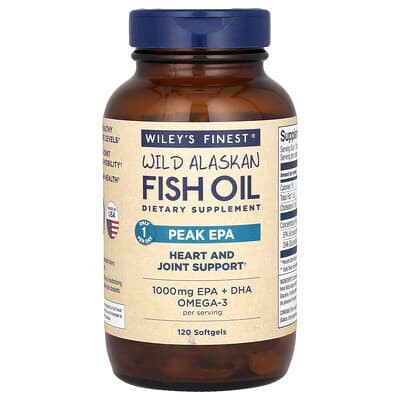
Wild Alaskan Fish Oil Peak EPA

Wiley's Finest
4.8
★ ★ ★ ★ ★
(5121 ratings)
Omega-3 60 mg
EPA (Eicosapentaenoic Acid) 750 mg
Fish Oil 1250 mg
DHA 250 mg
Product Image
Score85
A concentrated, EPA-led serving is the main strength and fits cardiovascular or inflammatory goals well. Missing form, oxidation-protection, and purity details are the chief limitations.
How scoring works
Quantity:120 Softgel(s) • (120 servings)
Goals:
Heart Health
Anti-Inflammatory Support
Cardiovascular Support
Mental Focus

Score 85

A concentrated, EPA-led serving is the main strength and fits cardiovascular or inflammatory goals well. Missing form, oxidation-protection, and purity details are the chief limitations.
How scoring works
$71.19($0.59 per serving)
Vitacost
$ 78.75
iHerb
$ 71.19
Report prices

Analysis

EPA leads the formula at 750 mg, with 250 mg of DHA and 60 mg of other omega-3 fats. That profile provides useful depth for cardiovascular and inflammatory support while still contributing some DHA.

The concentrated oil keeps the active amount high relative to total fish oil. Wild Alaskan sourcing adds context, but the label does not identify triglyceride or ethyl ester form, an antioxidant, or independent purity verification.

A one-softgel serving and long supply make the product practical for regular use. It is better suited to EPA-focused goals than to shoppers seeking a DHA-dominant formula for vision or cognitive support.

Who is it for
  • Adults seeking EPA-forward omega-3 support
  • Users who prefer a one-softgel serving
  • People prioritizing cardiovascular or inflammatory pathways
Best for
  • High-EPA daily supplementation
  • Compact softgel dosing
  • Users who want more EPA than DHA

Pros

  • Provides 750 mg of EPA
  • Supplies 1,060 mg of total omega-3 fats
  • Wild Alaskan sourcing is identified
  • Long one-softgel supply

Cons

  • Molecular form is not disclosed
  • No antioxidant protection is listed
  • Independent purity verification is not supplied
  • Less suitable for DHA-dominant goals

Warnings

  • Contains fish oil and is not suitable for people with a fish allergy
  • Fish oil may cause fishy aftertaste, reflux, or digestive discomfort in sensitive users
  • The substantial EPA and DHA amount may be relevant for people using anticoagulant or antiplatelet medicines

Nutrient quality

90 Highest impact

Concentrated wild Alaskan fish oil in a softgel with an unspecified molecular form gives the formula reasonable ingredient quality. The disclosed amounts are meaningful and the ingredient selection stays focused.

Ingredient transparency

85 Highest impact

The meaningful actives and their amounts are clearly identified. Serving guidance and the complete inactive-ingredient list are not fully supplied.

Customer satisfaction

73 High impact

The aggregate rating is strong and supported by useful review volume. No review excerpts are supplied to assess repeated complaints or purpose-specific experiences.

Value for money

91 Highest impact

Formula quality provides fair value for the category. The effective serving and focused ingredient list compare favorably with similar options.

Report analysis

Goals

Heart Health
Impact
Highest effect
A+ Goal FitA- Strength of SupportB- CoverageA+ Formula Quality
EPA (Eicosapentaenoic Acid) · 750 mg

The serving provides 750 mg EPA and 250 mg DHA, creating a strong heart-relevant omega-3 profile. EPA-led omega-3 intake is well aligned with triglyceride management and inflammatory balance.

Individual active amounts are transparent, but the molecular form, oxidation protection, and independent purity testing are not disclosed. The single-softgel format is efficient without unnecessary companion actives.

Study evidence
Anti-Inflammatory Support
Impact
Highest effect
A+ Goal FitB+ Strength of SupportB+ CoverageA Formula Quality
Fish Oil · 1250 mg

A combined 1,000 mg of EPA and DHA provides strong, direct support for the body’s inflammation-resolving pathways. The EPA-forward profile is especially relevant to inflammatory signaling.

The fish source and individual fatty-acid amounts are clear. Molecular form, purification, independent testing, and protection against oxidation are not disclosed.

Study evidence
Fish Oil Supportive 68 studies
Cardiovascular Support
Impact
Highest effect
A Goal FitB Strength of SupportC+ CoverageA Formula Quality
Fish Oil · 1250 mg

A concentrated serving provides 750 mg EPA and 250 mg DHA, giving strong direct support for triglyceride management and cardiovascular inflammation pathways. The high EPA proportion and clear fatty-acid disclosure make the dose easy to judge.

Molecular form, purification, independent testing, and oxidation protection are not disclosed, leaving important quality questions. Fish oil can increase bruising or bleeding tendency at higher intakes, especially alongside anticoagulant or antiplatelet medicines.

Study evidence
Fish Oil Supportive 185 studies
Mental Focus
Impact
High effect
C Goal FitA Strength of SupportC CoverageA+ Formula Quality

EPA and DHA may support mood and the brain environment, but they do not usually produce an immediate focus effect. The EPA-forward profile is better suited to gradual background support.

The single softgel supplies substantial and clearly disclosed omega-3 amounts. The streamlined formula offers strong depth within a narrow indirect pathway.

Study evidence

Ingredients

IngredientAmount per serving
Calories
11 {Calories}
Calories from Fat
11 {Calories}
Total Fat
1.2 Gram(s)
Saturated Fat
0 Gram(s)
Polyunsaturated Fat
1.1 Gram(s)
Trans Fat
0 Gram(s)
Cholesterol
0 mg
concentrated Fish Oil
1250 mg
Eicosapentaenoic Acid
750 mg
Docosahexaenoic Acid
250 mg
Other Omega-3 Fatty Acids
60 mg
Gluten Free Adults 18–50 Dairy Free Sugar Free
Report overview
Omega-3 · 60 mg OverallScore66
D- Active Ingredient Quality & BioavailabilityB- Dose, Safety & Label TransparencyA+ Value

The concentrated fish oil clearly separates EPA and DHA and delivers a highly concentrated active serving. Its concentrate designation suggests an ethyl ester form, while antioxidant protection and independent purity verification are not stated. Cost per disclosed active gram remains highly economical.

D Active Ingredient Quality & BioavailabilityB- Dose, Safety & Label TransparencyB+ Value

The EPA-heavy profile delivers a strong daily dose with a clear EPA advantage over DHA. Molecular form, antioxidant protection, and independent purity testing are not disclosed, leaving important quality questions. Cost per gram of EPA remains fair for the concentrated serving.

Fish Oil · 1250 mg OverallScore55
F Active Ingredient Quality & BioavailabilityB+ Dose, Safety & Label TransparencyB+ Value

Wild Alaskan sourcing pairs with a highly concentrated 1,000 mg combined EPA and DHA dose. Individual actives are clear, but molecular form, purification, independent testing, and antioxidant protection are not disclosed. Cost efficiency is favorable for the active amount supplied.

Loading alternative details
Report alternatives

Sources

Published studies used for the product analysis and the top-ranked studies for each ingredient and goal.

  1. Dose-dependent effects of fish oil on cardio-metabolic biomarkers in healthy middle-aged and elderly Chinese people: a double-blind randomized controlled trial.
    Song J; Hu M; Li C; Yang B; Ding Q; Wang C; Mao L · Food & function · 2018
    Randomized trial201 participantsAnti-Inflammatory Support forFish Oil
  2. Eicosapentaenoic acid supplementation alleviates pruritus, enhances skin moisture, and mitigates depression in maintenance hemodialysis patients.
    Lin YL; Wang CL; Chiang TI · Frontiers in nephrology · 2024
    Randomized trial60 participantsAnti-Inflammatory Support forFish Oil
  3. Lowering effects of fish oil supplementation on proinflammatory markers in hypertension: results from a randomized controlled trial.
    Yang B; Ren XL; Li ZH; Shi MQ; Ding F; Su KP; Guo XJ; Li D · Food & function · 2020
    Randomized trial77 participantsAnti-Inflammatory Support forFish Oil
  4. The effects of ω-3 fish oil emulsion-based parenteral nutrition plus combination treatment for acute paraquat poisoning.
    Meng Z; Dong Y; Gao H; Yao D; Gong Y; Meng Q; Zheng T; Cui X; Su X; Tian Y · The Journal of international medical research · 2019
    Randomized trial174 participantsAnti-Inflammatory Support forFish Oil
  5. Effects of Omega-3 Fatty Acid Intake in Patients Undergoing Dialysis: A Systematic Review and Meta-Analysis of Randomized Controlled Trials.
    Liu R; Jiang J; Fu Z; Liu C; Yao L; Quan H · Journal of the American Nutrition Association · 2022
    Meta-analysis49 studies pooledAnti-Inflammatory Support forFish Oil
  6. Marine Omega-3 Supplementation and Cardiovascular Disease: An Updated Meta-Analysis of 13 Randomized Controlled Trials Involving 127 477 Participants.
    Hu Y; Hu FB; Manson JE · Journal of the American Heart Association · 2020
    Meta-analysis127,477 participants13 studies pooledCardiovascular Support forFish Oil
  7. Impact of omega-3 fatty acids on hypertriglyceridemia, lipidomics, and gut microbiome in patients with type 2 diabetes.
    Lu J; Liu R; Ren H; Wang S; Hu C; Shi Z; Li M; Liu W; Wan Q; Su Q; Li Q; Zheng H; Qu S; Yang F; Ji H; Lin H; Qi H; Wu X; Wu K; Chen Y; Xu Y; Xu M; Wang T; Zheng J; Ning G; Zheng R; Bi Y; Zhong H; Wang W · Med (New York, N.Y.) · 2025
    Randomized trial309 participantsCardiovascular Support forFish Oil
  8. A systematic review of fish-oil supplements for the prevention and treatment of hypertension.
    Campbell F; Dickinson HO; Critchley JA; Ford GA; Bradburn M · European journal of preventive cardiology · 2013
    Meta-analysis1,524 participants17 studies pooledCardiovascular Support forFish Oil
  9. Effects of fish oil-derived fatty acids on suboptimal cardiovascular health: A multicenter, randomized, double-blind, placebo-controlled trial.
    Zeng Q; Dong SY; Liu YP; Fu J; Shuai P; Zhao ZM; Li TX · Nutrition, metabolism, and cardiovascular diseases : NMCD · 2017
    Randomized trial422 participantsCardiovascular Support forFish Oil
  10. Effect of High-Dose Marine Omega-3 Fatty Acids on Atherosclerosis: A Systematic Review and Meta-Analysis of Randomized Clinical Trials.
    Sekikawa A; Cui C; Sugiyama D; Fabio A; Harris WS; Zhang X · Nutrients · 2020
    Meta-analysis6 studies pooledCardiovascular Support forFish Oil
  11. Effects of eicosapentaenoic acid on major coronary events in hypercholesterolaemic patients (JELIS): a randomised open-label, blinded endpoint analysis.
    Yokoyama M; Origasa H; Matsuzaki M; Matsuzawa Y; Saito Y; Ishikawa Y; Oikawa S; Sasaki J; Hishida H; Itakura H; Kita T; Kitabatake A; Nakaya N; Sakata T; Shimada K; Shirato K; Japan EPA lipid intervention study (JELIS) Investigators · Lancet (London, England) · 2007
    Randomized trial18,645 participantsHeart Health forEPA (Eicosapentaenoic Acid)
  12. Effects of EPA on coronary artery disease in hypercholesterolemic patients with multiple risk factors: sub-analysis of primary prevention cases from the Japan EPA Lipid Intervention Study (JELIS).
    Saito Y; Yokoyama M; Origasa H; Matsuzaki M; Matsuzawa Y; Ishikawa Y; Oikawa S; Sasaki J; Hishida H; Itakura H; Kita T; Kitabatake A; Nakaya N; Sakata T; Shimada K; Shirato K; JELIS Investigators, Japan · Atherosclerosis · 2008
    Randomized trial14,981 participantsHeart Health forEPA (Eicosapentaenoic Acid)
  13. Effects of omega-3 fatty acids on coronary revascularization and cardiovascular events: a meta-analysis.
    Dinu M; Sofi F; Lotti S; Colombini B; Mattioli AV; Catapano AL; Casula M; Baragetti A; Wong ND; Steg PG; Ambrosio G · European journal of preventive cardiology · 2024
    Meta-analysis134,144 participants18 studies pooledHeart Health forEPA (Eicosapentaenoic Acid)
  14. Incremental effects of eicosapentaenoic acid on cardiovascular events in statin-treated patients with coronary artery disease.
    Matsuzaki M; Yokoyama M; Saito Y; Origasa H; Ishikawa Y; Oikawa S; Sasaki J; Hishida H; Itakura H; Kita T; Kitabatake A; Nakaya N; Sakata T; Shimada K; Shirato K; Matsuzawa Y; JELIS Investigators · Circulation journal : official journal of the Japanese Circulation Society · 2009
    Randomized trialHeart Health forEPA (Eicosapentaenoic Acid)
  15. Omega-3 Fatty Acids for the Management of Hypertriglyceridemia: A Science Advisory From the American Heart Association.
    Skulas-Ray AC; Wilson PWF; Harris WS; Brinton EA; Kris-Etherton PM; Richter CK; Jacobson TA; Engler MB; Miller M; Robinson JG; Blum CB; Rodriguez-Leyva D; de Ferranti SD; Welty FK; American Heart Association Council on Arteriosclerosis, Thrombosis and Vascular Biology; Council on Lifestyle and Cardiometabolic Health; Council on Cardiovascular Disease in the Young; Council on Cardiovascular and Stroke Nursing; and Council on Clinical Cardiology · Circulation · 2020
    OtherHeart Health forEPA (Eicosapentaenoic Acid)
  16. The influence of n-3 polyunsaturated fatty acids on cognitive function in individuals without dementia: a systematic review and dose-response meta-analysis.
    Suh SW; Lim E; Burm SY; Lee H; Bae JB; Han JW; Kim KW · BMC medicine · 2024
    Meta-analysis9,660 participants24 studies pooledMental Focus forEPA (Eicosapentaenoic Acid)
  17. EPA supplementation improves teacher-rated behaviour and oppositional symptoms in children with ADHD.
    Gustafsson PA; Birberg-Thornberg U; Duchén K; Landgren M; Malmberg K; Pelling H; Strandvik B; Karlsson T · Acta paediatrica (Oslo, Norway : 1992) · 2011
    Randomized trial92 participantsMental Focus forEPA (Eicosapentaenoic Acid)
  18. Docosahexaenoic Acid (DHA) and Eicosapentaenoic Acid (EPA)-Should They Be Mandatory Supplements in Pregnancy?
    Amza M; Haj Hamoud B; Sima RM; Dinu MD; Gorecki GP; Popescu M; Gică N; Poenaru MO; Pleș L · Biomedicines · 2024
    Narrative reviewMental Focus forEPA (Eicosapentaenoic Acid)
  19. Supplementation with oil rich in eicosapentaenoic acid, but not in docosahexaenoic acid, improves global cognitive function in healthy, young adults: results from randomized controlled trials.
    Patan MJ; Kennedy DO; Husberg C; Hustvedt SO; Calder PC; Khan J; Forster J; Jackson PA · The American journal of clinical nutrition · 2021
    Randomized trial310 participantsMental Focus forEPA (Eicosapentaenoic Acid)