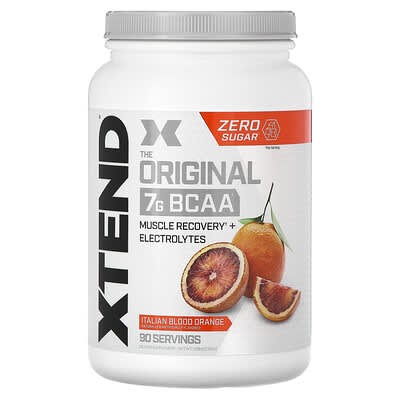
Product Image

The Original Italian Blood Orange

XTEND
4.6
★ ★ ★ ★ ★
(11086 ratings)
Leucine 3500 mg
Valine 1750 mg
Isoleucine 1750 mg
Sodium 220 mg
Glutamine 2500 mg
Potassium 180 mg
Product Image
Score76
A full 2:1:1 BCAA serving and moderate glutamine make it practical for workout amino-acid support. Limited electrolyte detail and a small citrulline amount narrow its usefulness beyond that role.
How scoring works
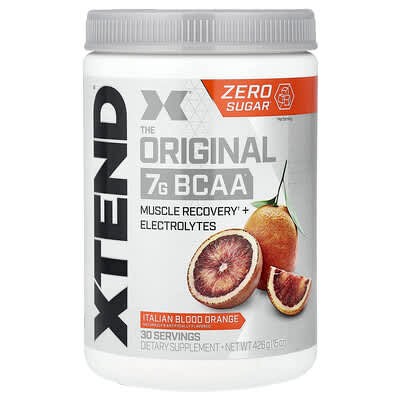
Quantity:435 Gram(s) • (30 servings)
Goals:
Energy
Heart Health
Immunity

Score 76

A full 2:1:1 BCAA serving and moderate glutamine make it practical for workout amino-acid support. Limited electrolyte detail and a small citrulline amount narrow its usefulness beyond that role.
How scoring works

Also available as

1 option
$27.99($0.93 per serving)
iHerb
$ 27.99
Amazon
$ 27.99
iHerb
$ 27.99
Report prices

Analysis

The main strength is a clearly disclosed 2:1:1 BCAA blend with 3.5 g of leucine and 1.75 g each of isoleucine and valine. Those amounts fit intra-workout amino-acid use, particularly when training takes place away from a protein-containing meal.

A 2.5 g glutamine serving adds moderate recovery-focused support, while 220 mg sodium and 180 mg potassium contribute to hydration. The sodium amount may be too light for heavy sweat losses, and the mineral forms plus the contents of the 1.14 g electrolyte blend are not identified.

The 1 g citrulline malate serving is modest for a performance ingredient, and the formula contains no stimulant for alertness. Serving value is reasonable for a flavored amino-acid and electrolyte powder. It fits amino-acid intake during training better than broad energy, immunity, or heart-health goals.

Who is it for
  • People who want a flavored BCAA drink during training
  • Athletes seeking disclosed leucine, isoleucine, and valine amounts
  • Users who prefer a non-stimulant workout formula
Best for
  • Intra-workout amino-acid intake
  • Training sessions away from a protein-containing meal
  • Light hydration support during exercise

Pros

  • Provides a full 2:1:1 BCAA blend with clearly listed amounts
  • Supplies 3.5 g leucine per serving
  • Includes 2.5 g glutamine alongside the BCAAs
  • Powder format is convenient for workout drinks

Cons

  • Citrulline malate is limited to 1 g
  • Electrolyte blend ingredients and individual amounts are not disclosed
  • Sodium and potassium chemical forms are unspecified
  • Provides little direct support for immunity or heart-health goals

Warnings

  • People following a clinician-directed sodium limit should count the 220 mg supplied per serving.
  • The potassium source is undisclosed; people following a clinician-directed potassium limit should review the full label before regular use.
  • The electrolyte blend lacks ingredient-level amounts, so combining it with other electrolyte products can make total mineral intake harder to track.

Nutrient quality

83 Highest impact

The disclosed amounts avoid an obvious excessive-dose concern. Unspecified mineral forms limit confidence in electrolyte quality.
Ingredient transparency

60 Moderate impact

Many actives have amounts, but the electrolyte blend overlaps with separately listed minerals. Flavoring, sweetener, and other inactive ingredients are not fully supplied.

Customer satisfaction

89 Highest impact

The very large review count makes the aggregate rating highly reliable. The aggregate customer rating is strong.

Value for money

75 High impact

The opaque electrolyte blend adds uncertain value beside the core amino acids. The serving cost is high for an unchanged formula with modest electrolytes.

Report analysis

Goals

Energy
Impact
High effect
B- Goal FitB Strength of SupportC CoverageA- Formula Quality
Potassium · 180 mg

Branched-chain amino acids, glutamine, electrolytes, and citrulline support workout nutrition and hydration more than cellular energy production. The amino-acid amounts are clearly disclosed and substantial for a sports drink.

No caffeine, meaningful B-vitamin system, creatine, or adaptogen directly addresses alertness or sustained vitality. It fits exercise recovery and training hydration better than a broad energy goal.
Heart Health
Impact
Moderate effect
C- Goal FitD+ Strength of SupportD- CoverageB Formula Quality
Vitamin B6 · 640 mcg

Citrulline malate may support nitric-oxide production and exercise blood flow, while potassium adds a small electrolyte contribution. The citrulline amount is far below common performance and vascular doses.

The formula is designed for workout hydration and amino-acid support rather than sustained cardiovascular health. Exact active amounts make the limitation clear, and no omega-3, CoQ10, magnesium, or homocysteine pathway is present.

Study evidence
Potassium Supportive 182 studies
Immunity
Impact
Moderate effect
F Goal FitD+ Strength of SupportD- CoverageB+ Formula Quality

Glutamine may support intestinal barrier needs during heavy training, and the amino acids and electrolytes fit a workout-recovery product. Ingredient amounts are clearly disclosed for the main amino acids.

The formula contains no vitamin C, vitamin D, zinc, selenium, vitamin A, or targeted immune botanical. Its immunity connection is indirect and depends on exercise or gut-stress context rather than broad daily defense support.

Study evidence
Glutamine Supportive 36 studies

Ingredients

IngredientAmount per serving
Calories
0 Calorie(s)
Total Carbohydrates
0 Gram(s)
Vitamin B6 (Pyridoxine Hydrochloride)
640 mcg
Sodium
220 mg
Potassium
180 mg
L-Leucine
3500 mg
L-Glutamine
2500 mg
L-Isoleucine
1750 mg
L-Valine
1750 mg
Electrolyte Blend
1140 mg
Citrulline Malate
1000 mg
Adults 18–50 Sugar Free Women
Report overview
Leucine · 3500 mg OverallScore79
C Active Ingredient Quality & BioavailabilityA+ Dose, Safety & Label TransparencyB+ Value

L-Leucine is clearly identified, but no fermented, vegan, or branded source is disclosed; the powder has no disclosed processing to improve solubility. The serving reaches the recognized trigger range for muscle protein synthesis; the amount is clearly disclosed, and the scoop is larger than the standard range. Cost per gram of active leucine compares favorably with the collection median.

Valine · 1750 mg OverallScore78
B- Active Ingredient Quality & BioavailabilityA+ Dose, Safety & Label TransparencyD- Value

A 1750 mg dose of free-form L-valine matches the benchmark for athletic use. The standard powder and individually disclosed amount are practical, but sport certification is not provided. Its cost per gram sits in the fair value range.

Isoleucine · 1750 mg OverallScore74
B+ Active Ingredient Quality & BioavailabilityB+ Dose, Safety & Label TransparencyD+ Value

A fully disclosed serving supplies 1,750 mg of isolated L-isoleucine, matching the collection benchmark. The scoopable powder should be practical for mixing, although no micronization, source method, or independent testing is stated. The serving cost provides only moderate value for the disclosed dose.

Loading alternative details
Report alternatives

Sources

Published studies used for the product analysis and the top-ranked studies for each ingredient and goal.

  1. Potassium intake, stroke, and cardiovascular disease a meta-analysis of prospective studies.
    D'Elia L; Barba G; Cappuccio FP; Strazzullo P · Journal of the American College of Cardiology · 2011
    Meta-analysis247,510 participants11 studies pooledHeart Health forPotassium
  2. Oral potassium supplementation for management of essential hypertension: A meta-analysis of randomized controlled trials.
    Poorolajal J; Zeraati F; Soltanian AR; Sheikh V; Hooshmand E; Maleki A · PloS one · 2017
    Meta-analysis1,213 participants23 studies pooledHeart Health forPotassium
  3. Joint association of urinary sodium and potassium excretion with cardiovascular events and mortality: prospective cohort study.
    O'Donnell M; Mente A; Rangarajan S; McQueen MJ; O'Leary N; Yin L; Liu X; Swaminathan S; Khatib R; Rosengren A; Ferguson J; Smyth A; Lopez-Jaramillo P; Diaz R; Avezum A; Lanas F; Ismail N; Yusoff K; Dans A; Iqbal R; Szuba A; Mohammadifard N; Oguz A; Yusufali AH; Alhabib KF; Kruger IM; Yusuf R; Chifamba J; Yeates K; Dagenais G; Wielgosz A; Lear SA; Teo K; Yusuf S; PURE Investigators · BMJ (Clinical research ed.) · 2019
    Cohort study103,570 participantsHeart Health forPotassium
  4. Effect of Potassium Supplementation on Endothelial Function: A Systematic Review and Meta-Analysis of Intervention Studies.
    D'Elia L; Cappuccio FP; Masulli M; La Fata E; Rendina D; Galletti F · Nutrients · 2023
    Meta-analysis332 participants5 studies pooledHeart Health forPotassium
  5. Effects of potassium supplementation on office, home, and 24-h blood pressure in patients with essential hypertension.
    Kawano Y; Minami J; Takishita S; Omae T · American journal of hypertension · 1999
    Randomized trial55 participantsHeart Health forPotassium
  6. Meta-analysis of Glutamine on Immune Function and Post-Operative Complications of Patients With Colorectal Cancer.
    Yang T; Yan X; Cao Y; Bao T; Li G; Gu S; Xiong K; Xiao T · Frontiers in nutrition · 2021
    Meta-analysis2,201 participants31 studies pooledImmunity forGlutamine
  7. Efficacy of Glutamine in Treating Severe Acute Pancreatitis: A Systematic Review and Meta-Analysis.
    Dong S; Zhao Z; Li X; Chen Z; Jiang W; Zhou W · Frontiers in nutrition · 2023
    Meta-analysis1,201 participants30 studies pooledImmunity forGlutamine
  8. Decreased mortality and infectious morbidity in adult burn patients given enteral glutamine supplements: a prospective, controlled, randomized clinical trial.
    Garrel D; Patenaude J; Nedelec B; Samson L; Dorais J; Champoux J; D'Elia M; Bernier J · Critical care medicine · 2003
    Randomized trial45 participantsImmunity forGlutamine
  9. Effect of perioperative glutamine-enriched nutritional support on patients with colorectal cancer: A systematic review and meta-analysis.
    Huang Y; Yang XZ; Qin SH; Zhang T; Xie M; Wang JW · World journal of gastrointestinal surgery · 2026
    Meta-analysis1,643 participants27 studies pooledImmunity forGlutamine
  10. Glutamine administration reduces Gram-negative bacteremia in severely burned patients: a prospective, randomized, double-blind trial versus isonitrogenous control.
    Wischmeyer PE; Lynch J; Liedel J; Wolfson R; Riehm J; Gottlieb L; Kahana M · Critical care medicine · 2001
    Randomized trial26 participantsImmunity forGlutamine