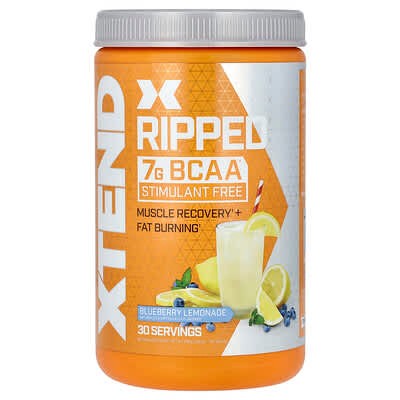
Product Image

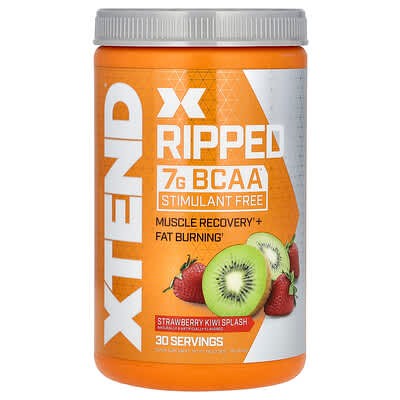
Ripped Strawberry Kiwi Splash

XTEND
4.4
★ ★ ★ ★ ★
(3440 ratings)
Sodium 230 mg
Valine 1750 mg
Isoleucine 1750 mg
Leucine 3500 mg
Glutamine 2500 mg
L-Carnitine 500 mg
Potassium 210 mg
Product Image
Score64
The well-disclosed BCAA profile is the main draw, with moderate glutamine and light electrolyte support alongside it. Secondary ingredients add variety but not enough depth for targeted performance or metabolic use.
How scoring works
Quantity:495 Gram(s) • (30 servings)
Goals:
Energy
Cardiovascular Support

Score 64

The well-disclosed BCAA profile is the main draw, with moderate glutamine and light electrolyte support alongside it. Secondary ingredients add variety but not enough depth for targeted performance or metabolic use.
How scoring works
$37.99($1.26 per serving)
iHerb
$ 37.99
Amazon
$ 0.00
Report prices

Analysis

The disclosed BCAA amounts are the main benefit, led by 3.5 g of leucine and supported by 1.75 g each of isoleucine and valine. A 2.5 g glutamine serving broadens the amino-acid support without turning the blend into a high-dose glutamine product.

Sodium and potassium can help replace some minerals during ordinary workouts, though the amounts are not aimed at heavy electrolyte losses. The listed citrulline malate, carnitine, CLA, and cayenne create a wider performance and weight-management theme, but their modest quantities make them supporting ingredients.

Clear amounts for most active ingredients help users understand what each scoop provides. Missing inactive-ingredient details and limited source or processing information make it harder to judge flavoring, sweeteners, mixability, and the quality of several components.

Who is it for
  • People looking for a BCAA drink around exercise
  • Active adults who need modest sodium and potassium
  • Users comfortable with a multi-ingredient flavored powder
Best for
  • Supporting amino-acid intake around workouts
  • Routine sessions with light mineral replacement
  • Users who value disclosed BCAA amounts

Pros

  • Supplies a balanced and clearly stated BCAA serving
  • Leucine is present at a useful per-serving level
  • Includes moderate glutamine for broader workout support
  • Provides slightly more potassium than the blueberry flavor

Cons

  • Citrulline is below the amount expected from a dedicated product
  • Carnitine and CLA contribute limited practical value at these amounts
  • Electrolytes may be insufficient for long or very sweaty sessions
  • The supplied data does not show inactive ingredients or detailed sourcing

Warnings

  • Capsimax cayenne extract can feel irritating to users with a sensitive stomach
  • The CLA source and protection from oxidation are not disclosed
  • Anyone restricting sodium should include the 230 mg serving amount in their daily total

Nutrient quality

70 High impact

The branched-chain amino acids reach useful workout amounts and glutamine is moderate. Several secondary actives are lightly dosed or incompletely characterized, and the formula poorly matches some listed goals.

.
Ingredient transparency

64 Moderate impact

Most amino-acid amounts are individually disclosed and easy to compare. Blank ingredient names, an aggregate electrolyte blend, missing CLA detail, and absent non-active ingredients leave notable gaps.

.

Customer satisfaction

67 High impact

Aggregate satisfaction data are moderately favorable and supported by substantial volume. Specific firsthand comments were not supplied, leaving repeated complaints and purpose fit uncertain.

.

Value for money

54 Moderate impact

Useful amino-acid amounts provide some practical value. Light secondary dosing and only moderate serving economics keep the formula from standing out.

.

Report analysis

Goals

Energy
Impact
High effect
C- Goal FitC+ Strength of SupportC CoverageB- Formula Quality
Potassium · 210 mg

Branched-chain amino acids, glutamine, and electrolytes support workout nutrition and hydration more than cellular energy. Citrulline malate is well below common performance amounts, and the formula contains no caffeine, creatine, or meaningful B-vitamin support.

Added carnitine, conjugated linoleic acid, and capsicum broaden the metabolic theme but remain modest for functional energy. The product may fit training recovery, but it is not a strong match for alertness or fatigue support.

Cardiovascular Support
Impact
Moderate effect
D+ Goal FitD Strength of SupportD+ CoverageC+ Formula Quality
Potassium · 210 mgL-Carnitine · 500 mgVitamin B6 · 640 mcg

Citrulline malate, carnitine, and potassium provide some relevance to blood flow, cardiac energy, and electrolyte balance. The sports-recovery formula is designed around amino acids rather than cardiovascular support.

Citrulline and carnitine are both below fuller targeted amounts, and the potassium contribution is modest. Most of the serving consists of branched-chain amino acids that do not deepen the cardiovascular pathways.

Study evidence
L-Carnitine Supportive 73 studies
Potassium Supportive 117 studies

Ingredients

IngredientAmount per serving
Calories
15 Calorie(s)
Calories from Fat
10 Calorie(s)
Total Fat
1 Gram(s)
Total Carbohydrates
1 Gram(s)
Sugar
0 Gram(s)
Vitamin B6
640 mcg
Sodium
230 mg
Potassium
210 mg
L-Leucine
3500 mg
L-Glutamine
2500 mg
L-Isoleucine
1750 mg
L-Valine
1750 mg
Electrolyte Blend
1140 mg
Sodium Citrate
0 NP
Potassium Chloride
0 NP
Sodium Chloride
0 NP
Citrulline Malate
1000 mg
Conjugated Linoleic Acid
850 mg
L-Carnitine
500 mg
Capsimax Cayenne (Capsicum annuum) fruit extract
50 mg
Adults 18–50 Women
Report overview
Sodium · 230 mg OverallScore80
B Active Ingredient Quality & BioavailabilityA- Dose, Safety & Label TransparencyB+ Value

Standard sodium salts provide functional electrolyte support without a premium natural source. The sodium dose can support lighter or more individualized hydration needs. Well-chosen supporting electrolytes strengthen the mineral profile, while the serving cost remains reasonable for the broader formula.

Valine · 1750 mg OverallScore78
B- Active Ingredient Quality & BioavailabilityA+ Dose, Safety & Label TransparencyD- Value

Free-form L-valine supplies the full 1750 mg benchmark in a practical workout powder. The label states the individual dose, though it does not mention micronization or external sport testing. The flavored multi-ingredient formula has fair cost efficiency per gram of valine.

Isoleucine · 1750 mg OverallScore74
B+ Active Ingredient Quality & BioavailabilityB+ Dose, Safety & Label TransparencyD+ Value

A fully disclosed serving supplies 1,750 mg of isolated L-isoleucine, matching the collection benchmark. The scoopable powder should be practical for mixing, although no micronization, source method, or independent testing is stated. The serving cost provides only moderate value for the disclosed dose.

Loading alternative details
Report alternatives

Sources

Published studies used for the product analysis and the top-ranked studies for each ingredient and goal.

  1. Potassium intake, stroke, and cardiovascular disease a meta-analysis of prospective studies.
    D'Elia L; Barba G; Cappuccio FP; Strazzullo P · Journal of the American College of Cardiology · 2011
    Meta-analysis247,510 participants11 studies pooledHeart Health Cardiovascular Support forPotassium
  2. Serum potassium levels provide prognostic information in symptomatic heart failure beyond traditional clinical variables.
    Toledo CC; Vellosa Schwartzmann P; Miguel Silva L; da Silva Ferreira G; Bianchini Cardoso F; Citelli Ribeiro V; Paim LR; Antunes-Correa LM; Carvalho Sposito A; Matos Souza JR; Modolo R; Nadruz W; Fernandes de Carvalho LS; Coelho-Filho OR · ESC heart failure · 2021
    Cohort study178 participantsHeart Health forPotassium
  3. Potassium-rich diet and risk of stroke: updated meta-analysis.
    D'Elia L; Iannotta C; Sabino P; Ippolito R · Nutrition, metabolism, and cardiovascular diseases : NMCD · 2015
    Meta-analysis333,250 participants14 studies pooledCardiovascular Support forPotassium
  4. The Relation of Serum Potassium Concentration with Cardiovascular Events and Mortality in Community-Living Individuals.
    Hughes-Austin JM; Rifkin DE; Beben T; Katz R; Sarnak MJ; Deo R; Hoofnagle AN; Homma S; Siscovick DS; Sotoodehnia N; Psaty BM; de Boer IH; Kestenbaum B; Shlipak MG; Ix JH · Clinical journal of the American Society of Nephrology : CJASN · 2017
    Cohort study9,651 participantsCardiovascular Support forPotassium
  5. Effects of L-carnitine administration on left ventricular remodeling after acute anterior myocardial infarction: the L-Carnitine Ecocardiografia Digitalizzata Infarto Miocardico (CEDIM) Trial.
    Iliceto S; Scrutinio D; Bruzzi P; D'Ambrosio G; Boni L; Di Biase M; Biasco G; Hugenholtz PG; Rizzon P · Journal of the American College of Cardiology · 1995
    Randomized trial472 participantsHeart Health forL-Carnitine
  6. Effective dosing of L-carnitine in the secondary prevention of cardiovascular disease: a systematic review and meta-analysis.
    Shang R; Sun Z; Li H · BMC cardiovascular disorders · 2015
    Meta-analysis3,108 participants5 studies pooledCardiovascular Support Heart Health forL-Carnitine
  7. Trimethylamine N-Oxide and Related Gut Microbe-Derived Metabolites and Incident Heart Failure Development in Community-Based Populations.
    Tang WHW; Lemaitre RN; Jensen PN; Wang M; Wang Z; Li XS; Nemet I; Lee Y; Lai HTM; de Oliveira Otto MC; Fretts AM; Sotoodehnia N; DiDonato JA; Bäckhed F; Psaty BM; Siscovick DS; Budoff MJ; Mozaffarian D; Hazen SL · Circulation. Heart failure · 2024
    Cohort study11,768 participantsHeart Health forL-Carnitine
  8. The Effects of L-Carnitine Supplementation on Weight Loss, Glycemic Control, and Cardiovascular Risk Factors in Patients With Type 2 Diabetes: A Systematic Review and Dose-response Meta-Analysis of Randomized Controlled Trials.
    Mirrafiei A; Jayedi A; Shab-Bidar S · Clinical therapeutics · 2024
    Meta-analysis2,041 participants21 studies pooledCardiovascular Support forL-Carnitine
  9. Intestinal microbiota metabolism of L-carnitine, a nutrient in red meat, promotes atherosclerosis.
    Koeth RA; Wang Z; Levison BS; Buffa JA; Org E; Sheehy BT; Britt EB; Fu X; Wu Y; Li L; Smith JD; DiDonato JA; Chen J; Li H; Wu GD; Lewis JD; Warrier M; Brown JM; Krauss RM; Tang WH; Bushman FD; Lusis AJ; Hazen SL · Nature medicine · 2013
    Other2,595 participantsCardiovascular Support forL-Carnitine
  10. Immunological and metabolic effects of cis-9, trans-11-conjugated linoleic acid in subjects with birch pollen allergy.
    Turpeinen AM; Ylönen N; von Willebrand E; Basu S; Aro A · The British journal of nutrition · 2009
    Randomized trial40 participantsImmunity forConjugated Linoleic Acid
  11. The effects of conjugated linoleic acid supplementation on immune function in healthy volunteers.
    Nugent AP; Roche HM; Noone EJ; Long A; Kelleher DK; Gibney MJ · European journal of clinical nutrition · 2005
    Randomized trial55 participantsImmunity forConjugated Linoleic Acid
  12. Effect of CLA supplementation on immune function in young healthy volunteers.
    Song HJ; Grant I; Rotondo D; Mohede I; Sattar N; Heys SD; Wahle KW · European journal of clinical nutrition · 2005
    Randomized trial28 participantsImmunity forConjugated Linoleic Acid
  13. L-Carnitine supplementation reduces oxidized LDL cholesterol in patients with diabetes.
    Malaguarnera M; Vacante M; Avitabile T; Malaguarnera M; Cammalleri L; Motta M · The American journal of clinical nutrition · 2009
    Randomized trial81 participantsCardiovascular Support forL-Carnitine
  14. L-Carnitine's Effect on the Biomarkers of Metabolic Syndrome: A Systematic Review and Meta-Analysis of Randomized Controlled Trials.
    Choi M; Park S; Lee M · Nutrients · 2021
    Meta-analysis9 studies pooledCardiovascular Support forL-Carnitine
  15. The Effects of L-Carnitine on Echocardiographic Changes in Patients With β-Thalassemia Major and Intermedia.
    Shahidi M; Hashemi SR; Fattahi N; Roshani D; Vahedi S; Sharifi P; Moradveisi B · Journal of pediatric hematology/oncology · 2020
    Randomized trial60 participantsCardiovascular Support forL-Carnitine
  16. Efficacy and tolerability of combined treatment with L-carnitine and simvastatin in lowering lipoprotein(a) serum levels in patients with type 2 diabetes mellitus.
    Solfrizzi V; Capurso C; Colacicco AM; D'Introno A; Fontana C; Capurso SA; Torres F; Gadaleta AM; Koverech A; Capurso A; Panza F · Atherosclerosis · 2007
    Randomized trial52 participantsCardiovascular Support forL-Carnitine
  17. Sex-specific associations between sodium and potassium intake and overall and cause-specific mortality: a large prospective U.S. cohort study, systematic review, and updated meta-analysis of cohort studies.
    Gan L; Zhao B; Inoue-Choi M; Liao LM; Graubard BI; Weinstein SJ; Albanes D; Huang J · BMC medicine · 2024
    Meta-analysis416,104 participantsCardiovascular Support forPotassium
  18. Blood pressure response to changes in sodium and potassium intake: a metaregression analysis of randomised trials.
    Geleijnse JM; Kok FJ; Grobbee DE · Journal of human hypertension · 2003
    Meta-analysis27 studies pooledCardiovascular Support forPotassium
  19. Twenty-Four-Hour Urinary Sodium and Potassium Excretion and Their Associations With Blood Pressure Among Adults in China: Baseline Survey of Action on Salt China.
    Li Y; Zhang P; Wu J; Ma J; Xu J; Zhang X; Luo R; Liu M; Sun Y; Li X; Tan M; He FJ; MacGregor GA; Li X · Hypertension (Dallas, Tex. : 1979) · 2021
    Cross-sectional study5,353 participantsCardiovascular Support forPotassium
  20. Dietary Sodium and Potassium Intake and Risk of Non-Fatal Cardiovascular Diseases: The Million Veteran Program.
    Wang DD; Li Y; Nguyen XT; Song RJ; Ho YL; Hu FB; Willett WC; Wilson PWF; Cho K; Gaziano JM; Djoussé L; On Behalf Of The Va Million Veteran Program · Nutrients · 2022
    Cohort study180,156 participantsCardiovascular Support forPotassium