



Magnesium Supportive

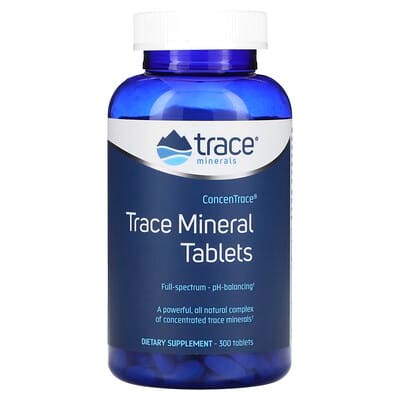
ConcenTrace Trace Mineral Tablets
Goals
$22.99 $0.76 per serving
Product analysis
Trace Minerals Research ConcenTrace Trace Mineral Tablets mainly help fill magnesium and other mineral intake gaps for bone and everyday health. Three tablets provide 295 mg of magnesium and 90 mg of calcium, but the magnesium includes oxide, a less readily absorbed form, and the proportions of its sources are not stated.
AI assessment of the formula, label and price. How scoring works
Nutrient Quality36
The mineral forms are mixed in quality, with boron citrate identified but magnesium oxide and an unspecified mineral source providing the main magnesium dose. Unstated proportions make the absorption potential of several blends difficult to judge.
Ingredient Transparency69
The listed amounts are clear, but several forms and the composition of mixed ingredients remain undisclosed. The quantities of individual minerals within the trace-mineral mixture cannot be established from its total weight.
Value For Money40
Value is strongest for chloride and boron, with less favorable comparisons for calcium, iron and the magnesium mixture. It is less attractive as a dedicated magnesium supplement than its substantial labeled amount might suggest.
Customer Satisfaction70
Customers generally rate it positively, at 4.37 out of 5. The 463 ratings give that feedback a reasonably substantial base.
Product Focus34
The strongest fit is mineral supplementation for bone and everyday health, with less direct support for some of the other goals. The broad mixture has at least 11 distinct ingredients, and not all trace components can be counted.
- Format
Tablet - Container
- 90 Tablet(s)
- Per serving
- $0.76
- Also available
 ConcenTrace Trace Mineral Tablets$52.99
- Customer rating
- 4.4 · 463 ratings
Goals
Impact
High effect
Magnesium · 295 mgBoron · 2.5 mg
ConcenTrace Trace Mineral Tablets is primarily a magnesium supplement for everyday mineral and energy-metabolism needs. The useful amounts are based on three tablets, not the catalogue's one-tablet serving. That selected serving supplies 295 mg of magnesium for normal energy and mineral metabolism. Calcium at 90 mg makes a smaller contribution to bone mineral needs, and the trace-mineral declarations do not establish equal support from every named mineral.
Boron Supportive


Impact
Moderate effect
Magnesium · 295 mg
ConcenTrace Trace Mineral Tablets offers conditional magnesium-based support for stress in a selected three-tablet label serving, rather than the one-tablet catalogue serving. Its 295 mg magnesium supports normal nerve function and a calming role, with more relevant evidence in low-magnesium or selected clinical settings. The declared magnesium oxide and ConcenTrace sources identify the mineral forms without establishing extra stress benefit.
Magnesium Supportive

Impact
High effect
Potassium · 75 mgMagnesium · 295 mg
ConcenTrace Trace Mineral Tablets offers modest mineral-based support for vascular function. The assessed serving is three tablets, which differs from the catalogue's one-tablet serving. Magnesium at 295 mg leads the formula's support for vascular tone, although its effects on blood pressure and arterial stiffness are inconsistent. Potassium at 75 mg adds a smaller contribution to sodium balance and blood-pressure regulation.
Magnesium Supportive
Potassium Supportive

Impact
High effect
Magnesium · 295 mgBoron · 2.5 mg
ConcenTrace Trace Mineral Tablets has a limited direct fit for testosterone support, and its listed amounts apply to three tablets rather than the catalogue’s one-tablet serving. That selected serving supplies 295 mg magnesium and 2.5 mg boron. Their hormone-related findings are limited and context-dependent, so these amounts mainly describe mineral intake rather than a predictable endocrine effect.
Magnesium Disputed
Boron Disputed

Impact
High effect
Magnesium · 295 mgCalcium · 90 mgBoron · 2.5 mg
ConcenTrace Trace Mineral Tablets mainly support bone health through magnesium nutrition. The declared 295 mg magnesium supports normal bone metabolism, and the assessed amounts apply to three tablets despite the catalogue listing one tablet. Its 90 mg calcium adds a small amount of bone mineral. Silicon is declared only in trace amounts, so its practical contribution cannot be quantified.
Calcium Supportive
Magnesium Supportive
Potassium Supportive
Silicon Supportive
Boron Supportive

Impact
High effect
Magnesium · 295 mg
ConcenTrace Trace Mineral Tablets has a limited heart-health fit led by magnesium, and its serving needs to be read as three tablets. That serving supplies 295 mg of elemental magnesium for electrolyte and vascular-tone balance, with 75 mg of potassium adding a smaller contribution. Selenium is named in the stored label text but its presence and amount are unresolved, so it should not influence the choice as a confirmed ingredient.
Potassium Supportive
Magnesium Supportive
Ingredients
| Ingredient | Amount per serving | Score |
|---|---|---|
Total Carbohydrates | 1 Gram(s) | |
Calcium (Calcium Carbonate) | 90 mg | |
Iron (Iron Glycinate) | 3 mg | |
Magnesium (ConcenTrace, Mag. Oxide) | 295 mg | |
Chloride (ConcenTrace, Potassium Chloride) | 625 mg | |
Sodium (Sodium Citrate) | 40 mg | |
Potassium (Potassium Chloride) | 75 mg | |
Low-Sodium ConcenTrace | 1.8 Gram(s) | |
Alfalfa leaf extract | 160 mg | |
Kelp | 150 mg | |
Boron (Boron Citrate) | 2.5 mg |
Chloride (ConcenTrace, Potassium Chloride) · 625 mg OverallScore69
Trace Minerals Research ConcenTrace Trace Mineral Tablets provides 625 mg chloride per serving, with good value at $0.098 per 80 mg chloride. The sources include potassium chloride, but the other source and their proportions are unknown. The full formula costs $0.77 per serving.
Iron (Iron Glycinate) · 3 mg OverallScore61
Trace Minerals Research ConcenTrace Trace Mineral Tablets provides 3 mg iron per serving and is expensive at $1.28 per 5 mg of iron. The iron is iron glycinate. The price is $0.77 per serving for the full formula.
Boron (Boron Citrate) · 2.5 mg OverallScore72
Trace Minerals Research ConcenTrace Trace Mineral Tablets provides a stated amount of boron: 2.5 mg per serving. The amount is lower than amounts commonly used for bone health. Boron Citrate is the named form. At $0.92 per 3 mg of boron, the price is good value; the full formula costs $0.77 per serving.
Alternative products
Report alternatives
Sources
Published studies used for the product analysis and the top-ranked studies for each ingredient and goal.
- [Comparative study of the urinary excretion of boron, calcium, magnesium and phosphorus in postmenopausal women with and without osteoporosis].
- Effect of dietary boron on mineral, estrogen, and testosterone metabolism in postmenopausal women.
- The relationship between boron and magnesium status and bone mineral density in the human: a review.
- Effects of boron supplementation on bone mineral density and dietary, blood, and urinary calcium, phosphorus, magnesium, and boron in female athletes.
- Metabolic responses of postmenopausal women to supplemental dietary boron and aluminum during usual and low magnesium intake: boron, calcium, and magnesium absorption and retention and blood mineral concentrations
- What is the impact of daily oral supplementation of vitamin D3 (cholecalciferol) plus calcium on the incidence of hip fracture in older people? A systematic review and meta-analysis.
- Calcium supplementation prevents seasonal bone loss and changes in biochemical markers of bone turnover in elderly New England women: a randomized placebo-controlled trial.
- The effects of calcium supplementation (milk powder or tablets) and exercise on bone density in postmenopausal women.
- The efficacy of calcium supplementation alone in elderly Thai women over a 2-year period: a randomized controlled trial.
- Calcium-enriched foods and bone mass growth in prepubertal girls: a randomized, double-blind, placebo-controlled trial.
- Association between Serum Magnesium and Fractures: A Systematic Review and Meta-Analysis of Observational Studies.
- Bioabsorbable Magnesium-Based Materials Potential and Safety in Bone Surgery: A Systematic Review.
- Vascularized bone grafting fixed by biodegradable magnesium screw for treating osteonecrosis of the femoral head.
- An update on magnesium and bone health.
- Sex-specific differences in the association of magnesium intake with femoral neck bone mineral density among older adults.
- Effect of potassium citrate on bone density, microarchitecture, and fracture risk in healthy older adults without osteoporosis: a randomized controlled trial.
- Long-term persistence of the urine calcium-lowering effect of potassium bicarbonate in postmenopausal women.
- Partial neutralization of the acidogenic Western diet with potassium citrate increases bone mass in postmenopausal women with osteopenia.
- Potassium citrate supplementation results in sustained improvement in calcium balance in older men and women.
- Effects of potassium chloride and potassium bicarbonate on endothelial function, cardiovascular risk factors, and bone turnover in mild hypertensives.